Domestic Android ecosystem calls for a new evaluation benchmark
Over the next two years, only those who can sell high-end flagships at a premium while safeguarding profits and cash flow will qualify to compete in the next round of competition.
Domestic Android brands are facing their coldest moment ever.
According to data from three major research institutes, Omdia, Counterpoint and IDC, global smartphone shipments in the third quarter of 2026 fell by 20% to 22% year-on-year, marking the largest single-quarter decline on record.
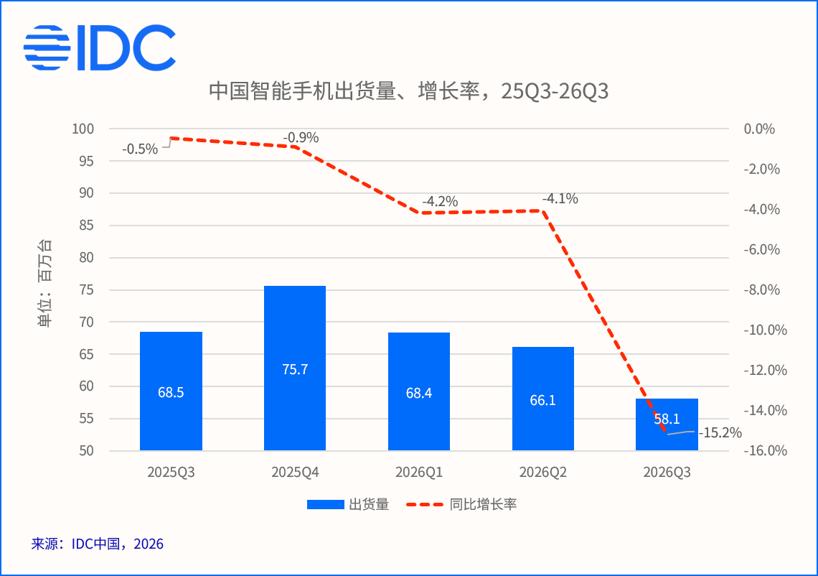
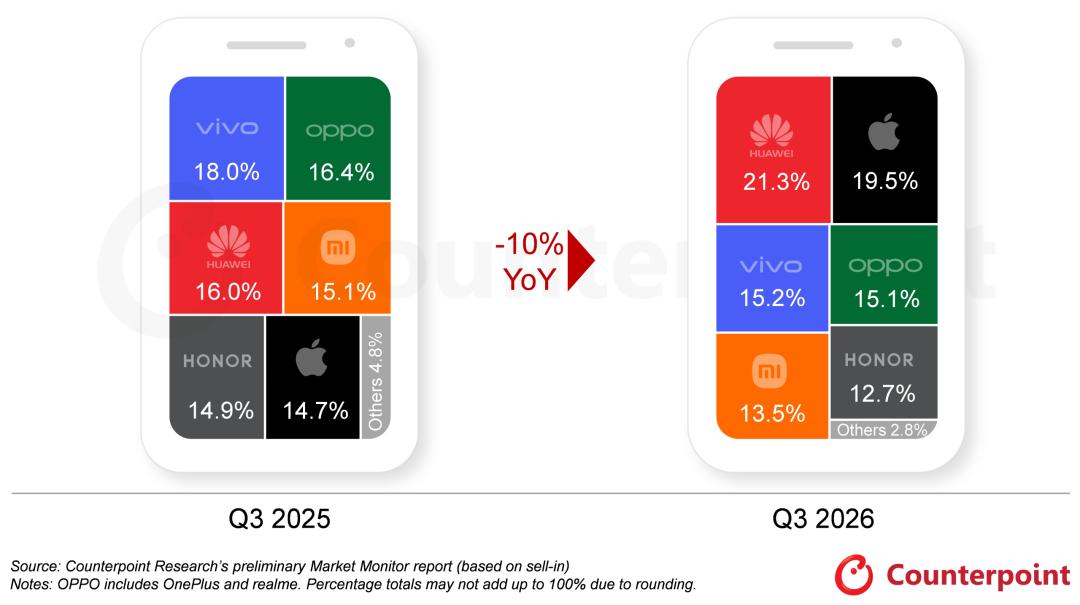
The decline in the Chinese market has also expanded significantly. IDC reports that smartphone shipments in China in the quarter stood at about 58.06 million units, down 15.2% year-on-year; Omdia's statistics put the figure at about 59.3 million units, down 12% year-on-year, the lowest level for the same period since 2013; Counterpoint's data shows a 10% year-on-year drop, the lowest for the same period since 2012. The figures from the three institutions vary slightly, but all agree that this is the coldest season in more than a decade.
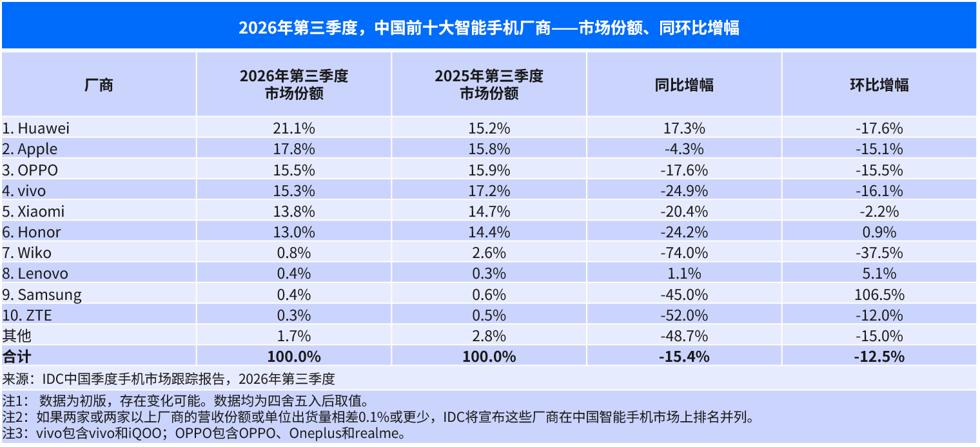
Vendor market share has also changed. Apple's global share hit 22% in the third quarter, breaking 20% for the first time ever in a third quarter. Its shipments in China fell slightly by 4.3% year-on-year, while its market share rose to 17.8%. Huawei, the only top-tier vendor that achieved double-digit growth, saw its shipments in China increase by 17.3% year-on-year, with its market share reaching 21.1%. For domestic Android brands including OPPO, vivo, Xiaomi and Honor, the decline rate is generally around 20%.
The good news is that the average selling price (ASP) and the market share of the high-end segment have both increased. IDC data shows that the market share of the price segment above $600 in the third quarter rose by 7.1 percentage points year-on-year, and the share of the $400—$600 price segment increased by 4.6 percentage points year-on-year. Among them, vivo not only ranks first in the domestic $400 to $600 price segment, but also takes the top spot among Android brands in the high-end market above $600. Under the pattern of falling volume and rising price, it is impossible to truly judge the actual operating performance of a manufacturer only by the ranking of shipments.
Some observers believe that although domestic Android brands are generally facing a decline, the situation of each brand varies greatly: some are passively shrinking due to weak demand, some are actively cutting unprofitable product lines, and others are the most impacted by rising costs due to their excessively high proportion of low-end product lines. All kinds of complex situations are mixed in the same shipment figure, making the ranking increasingly distorted.
"The smartphone market is increasingly facing a trade-off between 'volume' and 'price'," said Shilpi Jain, Senior Analyst at Counterpoint Research. For OEMs, the greater challenge in the future is not only to maintain shipment volume, but also to figure out how to keep product prices affordable while ensuring profits.
This means that what domestic Android brands need to answer right now is not who sold 500,000 more units this quarter, but who is reserving cards for the next replacement cycle. When the profits of low-cost devices are continuously eroded by storage costs, the high-end market has become the biggest trump card: it enjoys brand premium and gross profit buffer, and is also the culmination of imaging, foldable form, AI and system capabilities.
1
In the wave of price hikes,
Who is barely sustaining, and who is actively shrinking
This round of price hikes does not originate from within the mobile phone industry. The continuous demand for high-performance storage driven by AI infrastructure has made upstream vendors such as Samsung, SK Hynix and Micron more willing to allocate production capacity to CSPs with greater bargaining power, which has tightened the supply of storage chips for mobile phones and PCs. Due to the shortage of supply, the price of consumer storage chips remains persistently high.
According to senior storage industry insiders interviewed by *21st Century Business Herald*, the quotation of specific specification particles from storage manufacturers for first-tier mobile phone brands has risen to as high as about four times the original price. Facing high prices, mobile phone manufacturers are unwilling to stock up in large quantities, and mostly purchase according to end-market demand, adopting a "hold on as long as possible" strategy. The era of large-scale concentrated stockpiling is over, as the risk is too high and the amount of funds involved is too large.
In addition to storage, SoC prices are also rising. Cristiano Amon, President and CEO of Qualcomm, admitted at the earnings meeting that the company is implementing double-digit price increases covering different end markets. Storage and SoC are the two core components with the most obvious cost increases for mobile phones at present. Industry insiders break down that based on the configuration of "Qualcomm 8-series flagship SoC + 12GB DRAM + 256GB NAND", the core configuration cost is about 500 US dollars, and with the addition of materials such as screens, the BOM cost of the whole device will go even higher.
There is additional pressure in the domestic market. IDC mentions that the driving effect of various subsidy policies that previously boosted mobile phone consumption is weakening. Under the combined impact of rising storage prices and fading subsidies, overall domestic smartphone sales during the 618 promotion fell by nearly 15% year-on-year. Adjustments from channels and manufacturers have further amplified shipment fluctuations: some manufacturers shipped out products in advance before the price hike, but after the price of new products was raised, end-market sales fell short of expectations, forcing channels to readjust inventory and production plans, cut orders and control inventory, all of which are reflected in the shipment data.
However, the impact of price hikes is not equal across different price segments. For an entry-level phone priced at $80 and a flagship phone priced at $1,200, facing the same increase in storage cost, the former faces a survival problem, while the latter only sees a slight reduction in profits. As a result, global shipments of mobile phones under $100 shrank sharply year-on-year in the third quarter, and Samsung significantly increased its share in the $200—$299 price segment by taking advantage of the price hike. In the face of the same price increase, brands with strong brand premium have maintained their basic market, while those that rely on cost-effectiveness to drive sales have lost their positions.
Apple and Huawei are bucking the trend, while OPPO, vivo, Xiaomi and Honor are under pressure. It cannot be simply attributed to "domestic users collectively switching to Apple". The more direct reason is who has a thicker buffer in the face of cost shocks. Apple locked in long-term supply in advance with its supply chain bargaining power, maintaining a stable storage procurement scale, and part of the cost shock is digested internally. Huawei, relying on self-developed chips and the depth of the domestic supply chain, also blocked part of the cost pressure outside the system. Most domestic Android brands neither have the procurement volume of Apple nor the self-development depth of Huawei, so the cost pressure can only be passed down the industrial chain, leading to higher end-user prices and shrinking demand.
However, the decline in shipments is not entirely passive. Counterpoint pointed out in its third quarter report that Xiaomi's shipments fell by more than 30% because it "actively reduced investment in low-cost models and tightened shipment plans to avoid selling products with thin or even no profits". OPPO is also integrating product lines and sub-brands, compressing low-profit products, and shifting supply to markets with higher returns. Its shipment decline "includes a certain degree of active trade-offs". Some deteriorating figures are the result of manufacturers actively choosing between profits and market share, not a sign of being unable to hold on.
Huawei's counter-trend growth in the third quarter is, to a certain extent, attributed to its restrained pricing rhythm, raising prices as little as possible, as late as possible, and in batches, exchanging time windows for shipment space. Honor's strategy appears similar on the surface, but the underlying constraints of the two are different: Huawei was previously limited by chip production capacity supply, while Honor is in a fully competitive general supply chain system, and only chose a similar operating rhythm. Against the background of rising storage costs and widespread price hikes for all brands' flagships, the starting price of the Magic9 series is set at 4499 yuan. The two are in different situations but share the same logic: they do not pass the cost increase on to users all at once at the highest cost point, exchanging rhythm for scale, and restraint for market windows.
2
Beyond rankings, profits and cash flow are more honest than market share
The competitive logic of domestic mobile phones over the past decade is essentially ranking-driven. Shipment volume, online sales volume, and first-sale battle reports: a high ranking means that channels are willing to stock goods, the supply chain is willing to provide credit terms, and there are materials available for marketing. This logic is self-consistent in an incremental market: as the market grows, a higher ranking means a larger share of the increment, and scale reduces costs, which in turn brings profits.
In the stock cycle, the same logic operates in reverse. The market stops growing, so rising rankings can only be achieved by seizing market share; the most direct way to seize market share is price cuts, subsidies, and forcing channels to stock up. The short-term data looks good, but the cost is thinner profits, tighter cash flow, and squeezed R&D investment.
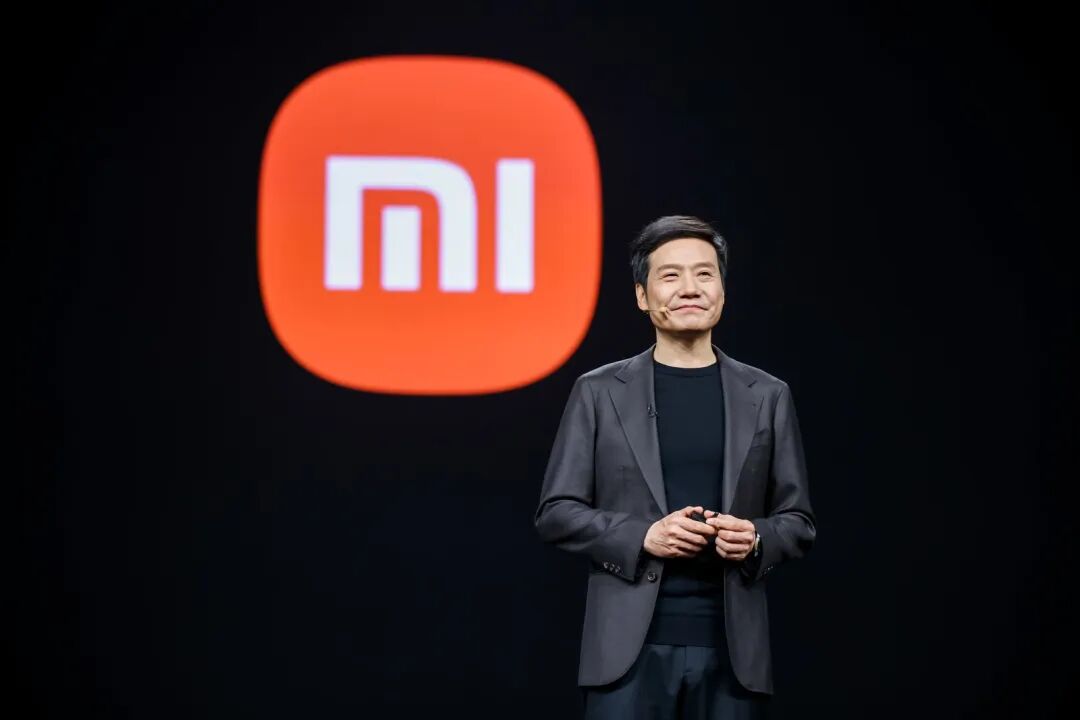
The wave of price hikes has brought these costs to the forefront. Xiaomi's average mobile phone price in the second quarter rose by 25.9% year-on-year, hitting a record high, but its mobile phone gross margin dropped from 11.5% to 8.5%, and the gross profit per mobile phone fell from about 123 yuan to 115 yuan — even though it is selling more expensively, it earns less money per unit. The situation of thousand-yuan phones is more straightforward: a thousand-yuan phone originally has a gross margin of only 6% to 10%, and a rise of two to three hundred yuan in storage costs will make profits zero or even negative.
Transsion is another case: its net profit in the first three quarters was 2.63 billion yuan, but its operating cash flow saw a net outflow of 9.873 billion yuan, and its inventory increased by 8.4 billion yuan compared with the beginning of the year. The profit statement still shows profits, but the cash flow statement has already felt the pressure. Some manufacturers are seeking syndicated loans to cope with the cycle. The market share on the books and the capital costs outside the books are completely different things.
The entire industry is generally shifting from volume to value. Counterpoint data shows that driven by the rising revenue contribution of high-end models and end-user price adjustments brought about by rising storage costs, the global average selling price (ASP) of smartphones rose by 27% year-on-year to reach 442 US dollars, hitting a new quarterly high.
The operating logic of domestic Android brands will also change accordingly. In this cycle, three indicators are more worth watching than share rankings: profit, cash flow, and operating rhythm. Profit determines whether manufacturers can continue to invest in R&D. Without funds to invest in chips, imaging and systems, their product competitiveness will fall behind in the next round. Cash flow determines whether they can withstand fluctuations: once credit terms tighten and inventory turnover slows down, they can only clear inventory at low prices and cut orders. Operating rhythm determines the judgment of timing: when to raise prices, by how much, and which product line to prioritize, which can better reflect a manufacturer's judgment of its own situation than single-quarter rankings.
These three indicators point to the same thing: whether manufacturers are willing to bear short-term pain for the next replacement cycle. Those who blindly cut long-term R&D investment will have no cards to play when demand picks up; those who grit their teeth to maintain long-term capacity building will have the opportunity to capture the restarted replacement demand. One of Huawei's core experiences during the difficult period of previous sanctions is that it continuously directed resources to the construction of underlying capabilities with longer return cycles.
Now, although domestic Android brands are not facing sanctions, the logic is similar. When external conditions are no longer favorable, they can only shift resources to internal capabilities. Different manufacturers give different answers, but the direction is the same: taking high-end flagships as the most important breakthrough track, using flagships to set benchmarks, and using mid-range products to capture market dividends. Low-end phones are the most sensitive to storage cost increases and have the smallest room for price hikes; high-end flagships have brand premium and gross profit buffers, and are also the culmination of imaging, foldable form, AI and system capabilities, which can turn technical investment into user-perceivable experience and brand recognition.
OPPO is betting on product structure. It integrates product lines and sub-brands, compresses low-profit product lines, shifts supply to markets with higher returns, and at the same time pushes towards higher unit prices and thicker gross profits with its Find series and AI capabilities. The unattractive shipment figures are exchanged for the reduction of organizational costs and channel costs.
vivo is betting on a layered matrix across different price segments. In the past four years, vivo has ranked first in domestic mobile phone shipments. This year, its shipments are under short-term pressure, but the pressure mostly comes from the time difference where low-end models are shrinking faster than the high-end segment is expanding.

In the high-end market, vivo has already secured a solid position. IDC reports show that vivo (including iQOO) ranks first among Android brands in the high-end market above $600, the S60 series helps it take the industry's first place in the $400—$600 price segment, and its foldable market share has steadily risen in the first three quarters, firmly ranking in the first echelon of domestic Android foldable brands. The high-end segment provides brand recognition and gross profit, the mid-range segment provides scale and channel turnover, and the foldable segment provides form differentiation and brand narrative. Actively giving up part of low-end sales in exchange for continuous upward movement of product structure: whether this deal is cost-effective depends on the product competitiveness of the next-generation X series and the channel inventory digestion rhythm.
Honor is betting on restrained pricing, maintaining its high-volume market with restrained price hikes, waiting for the return of scale effects. Xiaomi is betting on profit discipline: it would rather give up shipment volume than struggle to sustain operations at loss-making price points.
The common point of these brands is not that their short-term market share looks better, but that they are using different methods to reserve cards for the next cycle. Some reserve profits, some reserve cash flow, and some reserve high-end brand recognition. High-end flagship is the most concentrated of these "cards", which carries gross profit, technological iteration and brand recognition at the same time, and is the deep water area that domestic Android brands cannot avoid.
The extended replacement cycle does not mean that consumers stop replacing their phones, but that purchasing decisions