In the competitive AI era: Tencent revolves its business layout around WorkBuddy, while Qwen and Doubao move forward in step with Alibaba and ByteDance respectively?
Recently, Tencent has been extremely active in exploring AI applications and commercialization.
First, the short drama series launched on WeChat called "Green Bubble" once sparked widespread public attention to the "Tencent Era" and "ByteDance Era".
Later, at the recently held 2026 Tencent Global Digital Ecosystem Conference, Dowson Tong, Senior Executive Vice President of Tencent Group and CEO of Cloud and Smart Industries Group, launched a series of combined initiatives in the AI office sector.
Two of these moves are particularly noteworthy:
The first is the launch of the Buddy One office suite, a cross-application AI collaboration system with WorkBuddy as the central workspace, which integrates and connects Tencent Docs, Tencent Meeting, Tencent Cloud Drive and other office product tools — with unified accounts, a unified points pool and a unified data pool. The large language model can call different tools to generate multimodal content according to different demands, which can then be jointly modified and reviewed by the team.
What is the significance of this?
You can simply understand it this way: in the past, each office application was like an independent drawer, with files and records stored separately. To work with AI, you had to open each drawer one by one and manually move materials around;
But now WorkBuddy acts as a unified central platform, allowing you to pull all the drawers you need to the front with a single sentence, shifting the core workflow from "people moving around to follow files" to "AI working around tasks, people only focusing on reviewing and verifying final outputs"...
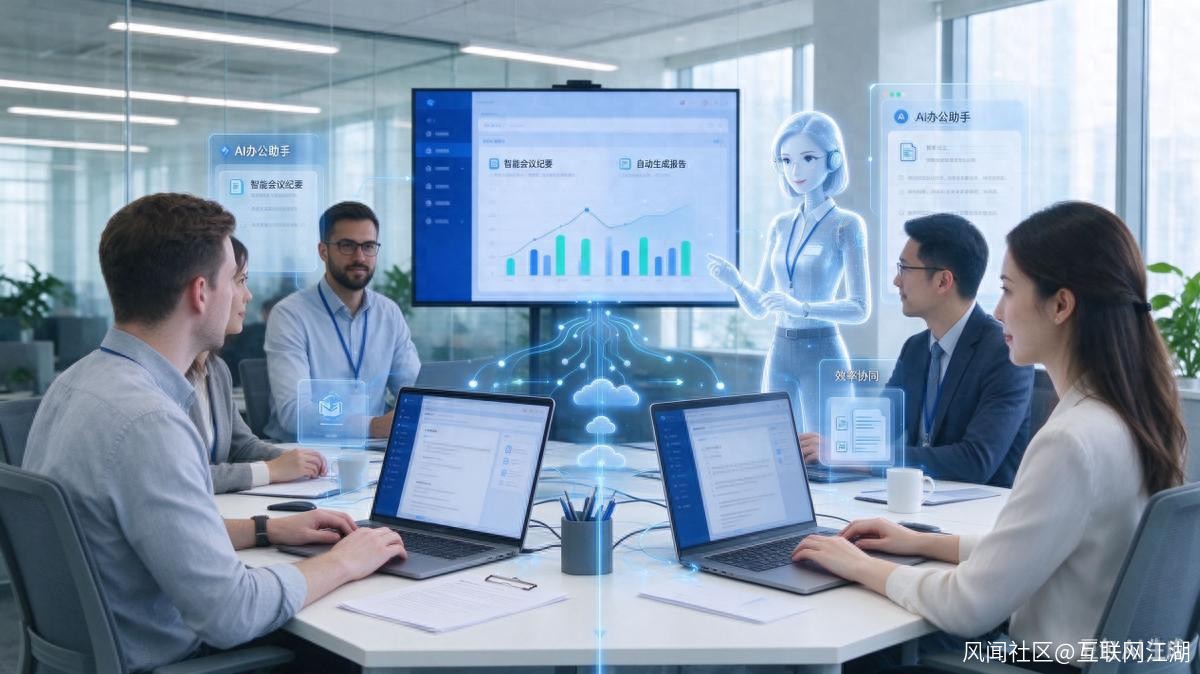
The other new offering is Tencent Cloud Drive. Yes, Tencent has rolled out its cloud drive service, which is positioned as "the organizational memory space in the Agent era".
Traditional cloud drives only store files and backups, while Tencent Cloud Drive stores records of what the AI has done, how it completed tasks, and the rules refined through collaborative work — the context and generated outputs accumulated by Agents during work are securely stored and accessible on demand, and will eventually be precipitated into corporate organizational assets.
Combining the two, the core logic forms a closed loop: Buddy One enables Agents to "get work done", and Tencent Cloud Drive ensures that the work completed by Agents does not go to waste. The whole package essentially provides users with a ready-to-use AI office demo space, allowing AI to operate in real workflows first, and then users can add personalized capabilities as needed...
Essentially, all these moves are market preparation for WorkBuddy, or AI office services in general.
In that case, we may as well follow up and see what impact Tencent's latest moves will have on the entire AI office track.
Against the background of internal integration and interconnection, how can the relationship between WorkBuddy and products like Tencent Meeting be properly balanced?
Tencent has set a good start for the AI office story
The biggest problem in the current AI office industry is not that the model is not powerful enough, but that there are too many breakpoints in the workflow:
For individual users, many previous AI office products including WorkBuddy had problems such as repeated authorization requirements and the need to manually copy context when used across different applications, leading to a very fragmented AI experience;
For enterprises, the problem is even more straightforward: if AI needs to conduct analysis and write plans, it needs to access business data from all links of the enterprise. Missing any link may lead to large deviations in the final results...
So how can products like WorkBuddy make AI productivity work properly, and how can they make enterprises willing to connect their Agents to their contextual data?
One idea Tencent put forward this time is to first integrate and interconnect Tencent's full suite of office products (including Tencent Docs, Tencent Meeting and Tencent Cloud Drive) to build a simplified version of the AI office demo space — Buddy One, then lower the access threshold and improve user experience.
The core logic is somewhat similar to the previous capability of Tongyi Qianwen to complete tasks with one sentence by integrating Alibaba's products including Fliggy and Amap.
However, it needs to be made clear that although Buddy One supports multi-person collaboration, it is essentially targeted at individual users, mainly solving the experience upgrade problem of AI office from "usable" to "user-friendly".
The WorkBuddy Enterprise Edition is built on the basis of Buddy One, with further open platform capabilities and improved enterprise-level security solutions, responding to enterprises' demands for AI office from "dare not use" to "dare to use" and "useful"...
Why is there such a big difference in the promotion pace between individual users and enterprise users?
This is affected by the different implementation difficulties of the two scenarios, and it is also a deliberate strategy of Tencent to develop the underlying infrastructure through the C-end market first, and then feed back to the B-end market.
After all, first, from the perspective of business trial and error, compared with enterprise scenarios, the decision-making chain in individual office scenarios is relatively shorter, with higher fault tolerance rate and faster feedback. If the model of feeding meeting context to Agents can be validated in the individual market, this AI collaboration capability can most likely be reused in the enterprise version.
Just like after WorkBuddy accumulated a set of Agent technical frameworks, other Tencent teams later developed CodeBuddy for code writing, DataBuddy for data analysis, and LBSwork that provides map development capabilities — all of which use the Harness framework that is homologous to WorkBuddy.
This reuse model of AI capabilities is a new development trend for Tencent in the Agent era.
Second, in terms of external competition, this approach of prioritizing individual users before enterprise users can also, to a certain extent, push enterprises to make choices — when most employees are already accustomed to using WorkBuddy in their personal scenarios, what will enterprises do in the end? Who will they choose? The answer is self-evident.
Third, in terms of commercialization, compared with enterprise office scenarios, the payment logic in the current individual AI office market is clearer. Once validated, it can rely on cash flow and commercial scale to win more penetration time for enterprise office scenarios, thus forming a promotion rhythm of "letting some get rich first, and driving others to get rich later".
Therefore, the Buddy One VIP individual membership package this time offers more value at the same price, with a monthly continuous subscription price of 700 yuan — which is not only the same as the previous continuous monthly subscription price of WorkBuddy Individual Flagship Edition, but also provides rights and interests such as Tencent Meeting Professional Edition and Tencent Docs Super Member Plus, including 50,000 general AI points and 1TB shared storage space per month...
Thus, the stage for WorkBuddy has been fully set up, and now it only depends on the market response.
However, we still have two questions here:
The first is, from the perspective of competition, can other players replicate the "demo space" logic of Tencent's WorkBuddy?
For example, Alibaba: according to Tianyancha APP, it not only has integrated AI office resources such as Quark Search, Alibaba Cloud Drive and DingTalk Meeting, but Tongyi Qianwen also has experience in internal group integration in the chatbot field;
Another example is Baidu, which also has accumulated capabilities from Baidu Wenku, search, cloud drive, maps and intelligent cloud services;
There is also ByteDance. With Feishu as the core, it does not seem difficult for ByteDance to build its own Buddy One...
From this point of view, the exploration of WorkBuddy does not seem to have brought much competitive barrier for Tencent?
In response to this point, Liu Yi, Vice President of Tencent Cloud and Head of Tencent CodeBuddy & WorkBuddy, said in communication that Tencent has never considered the so-called problem of "maintaining leading position".
"We all serve production enterprises, but we are still in a very early stage. 90% of enterprises in the market have not applied Agents and Agent productivity on a large scale. In the future, the competition will focus on who can provide better services, who has better Harness model collaboration, and who has better FDE team implementation."
In other words, the AI office industry is still in the stage of expanding the overall market size, and the future direction of the market is still uncertain...
Let's look at the second question: after WorkBuddy interconnects Tencent's office products, is it possible that it will affect the independent existence value of products like Tencent Meeting and Tencent Docs?
This is not unnecessary worry. During the conference, Dowson Tong responded that if in the future users gradually stop using the independent version of Tencent Meeting and get used to completing meeting-related work in WorkBuddy, Tencent may reconsider whether it is necessary to maintain the independent client.
Of course, this is only an assumption. Dowson Tong also emphasized that the usage habits that users have formed in a short period of time are difficult to change, and Tencent will not deliberately force users to switch to another product.
This statement is tactful, but judging from most people's usage habits, if a super app can meet all user demands, who would be willing to keep a bunch of vertical apps?
So next, how should WorkBuddy balance the relationship between the two and achieve perfect collaboration?
This issue is also worthy of attention.
To develop AI, do Tencent, Alibaba and other companies need to integrate the internet first?
In fact, from Tencent's recent series of moves, we can easily find one thing:
In addition to opening up to the outside world and connecting everything, Tencent has been continuously trying internal interconnection and integration.
For example, the integration of Tencent Docs, Tencent Meeting and other products by Buddy One;
For example, the deep integration and connection between WorkBuddy and WeCom;
For example, the integration of short drama resources on WeChat Mini Programs by Green Bubble, most of which are AI short dramas, so it can also be regarded as a layout in the AI short video track...
Moreover, it is not only Tencent. Horizontally, Alibaba's Tongyi Qianwen AI has previously integrated Fliggy, Taobao Flash Purchase, Amap and other products, and Tongyi Qianwen Office is deeply associated with DingTalk.
ByteDance connects Doubao with Feishu, and supports AI video with content distribution and creation tools...
Although this kind of integration existed before, it has become more frequent and intense since entering the AI era.
Why is that?
The core logic is as follows, divided into two steps:
First, the AI office and AI video tracks that Tencent, Alibaba and other companies are targeting now basically belong to the fields that combine internet and AI, with marginal returns and main competition battlefield both on the internet side.
Looking closely, AI office is not a pure model competition, but a workflow competition where model capabilities are embedded in meetings, documents, IM, emails, schedules, permissions and approval processes;
AI video is not a pure generation competition, but an industrial chain competition where models are embedded in content supply, creator ecosystem, copyright materials, distribution and recommendation, social fission and payment monetization.
In this context, with major large language models continuously catching up and open-sourced, their core capabilities have basically converged. Therefore, the competition has further shifted to the internet side, including scenario closed loops, distribution entrances and workflow embedding.
Second, if AI and Agents want to complete continuous tasks across meetings, documents, search, content, transactions and performance, they need to integrate internet-side assets into context and tools that can be called by AI.
However, since AI integration has a potential competitive relationship of siphoning other traffic entrances, Tencent, Alibaba and other companies can only achieve internal interconnection first, run through closed loops under certain conditions, and then expand the scale of the AI ecosystem...
In the past, the one-sentence task completion capability of Tongyi Qianwen AI, and now the integration of Tencent's full office product suite by Buddy One, are essentially the same.
However, to add a few more points, for the development of the AI industry, scenario integration is only one of the paths.
For example, in the AI programming field, for AI-native companies including Zhipu AI and Moonshot AI, their focus on AI programming is centered on models, entering the market through API/developer ecosystem, to match the "capability-oriented market" of programming rather than the "integration-oriented market".
In this case, model capabilities can determine everything.
Of course, back to the topic, the integration moves of Alibaba, ByteDance and Tencent also have their own additional considerations:
For example, the inheritance and integration from Alibaba's "Tongyi Qianwen" AI to "Tongyi Qianwen Office", and the deep connection between ByteDance's "Doubao" AI and "Doubao Work" — both of them focus on promoting the Tongyi Qianwen and Doubao brands rather than DingTalk and Feishu, which shows that their integration also has the intention of cultivating their own AI entrance.
Alibaba cultivates its entrance with "transaction + performance + e-commerce", while ByteDance cultivates its entrance with "traffic + distribution + collaboration".
This is a unique advantage that Yuanbao AI and WorkBuddy do not have.
Another example is the integration of short drama resources on WeChat Mini Programs by Green Bubble — if previous Keling proved that AI video model capability is very important, then the recent Hongguo further answers that:
Short drama distribution and consumption beyond the model also have large-scale commercial potential.
Therefore, Green Bubble is essentially Tencent's commercial market positioning for AI video built on its internet basic assets. It is not competing for the AI entrance, but the consumption entrance.
In a word, the current integration moves of Tencent, Alibaba and ByteDance are not simply centralizing power, but pre-organizational actions for the "AI transformation of internet assets".
In the future, whoever can embed the model into real workflows, content chains and consumption closed loops first can make the technology evolve from "usable" to "trustworthy".
The real dividends of AI office and AI video have just begun...
This article is from the WeChat official account "Internet Jianghu", written by Evin, edited by Liu Zhicheng, and authorized for release by 36Kr.