Have the Chinese people developed that "lithography machine for manufacturing AI"?
Just in the past couple of days, ForgeKernel, an unattended Agent, has made DeepSeek's latest core operator run 9.8% faster in full public view, without any reference to DeepSeek's original implementation at all!
FlashMLA is the attention core operator library open-sourced by DeepSeek. DeepInfer, the inference framework that was just open-sourced on October 20, has also integrated it; it is developed by the team widely recognized as the strongest in the Infra field, which can be said to represent the peak of human hand-written operators.
In the competition between China and the United States for the title of the world's top AI innovation origin, this achievement has scored an extremely important point in the RSI field. Especially since it is not programming, not running evaluations, not developing games, but writing the lowest-level operators, its significance is particularly highlighted — the light of RSI has already shone on the underlying R&D capabilities of China's AI innovation.
From September to October, top AI experts from all walks of life have been continuously fueling the development of RSI (Recursive Self-Improvement). Some are driven by anxiety about the ultimate relationship between humans and AI, while others may just be trying to maintain public voice for the commercial organizations behind them.
The people talking about this can be roughly divided into two categories. The first type are trendsetters, who focus on the industry's heat and the intensity of competition, with the underlying core being the ability to create trends, a typical example being Elon Musk. The other type have systematic practical experience as support, but lack support at the overall methodology level, such as Clark mentioned below.
On October 12, Jack Clark, co-founder of Anthropic, updated his statement in Issue 476 of Import AI: the arrival time of full RSI — the complete closed loop of recursive self-improvement — was moved forward from 2028 to 2027.
He is an evidence-based advocate, and the evidence is all around him. Anthropic's daily code merge volume has risen from 2,500 times in May to more than 30,000 times in September. Git can no longer support this volume, so they replaced it with a self-developed version management system called Scion. Musk only replied with one word on social media: Obv — obviously.
All leading enterprises are pushing hard in this direction. RSI seems to be the most certain cutting-edge direction today; but at the same time, it is also the direction with the most ambiguous standards, with no public evaluation framework, and the same term covers work of completely different values.
I noticed Mianbi Intelligence because it has gone a step further than the two types of people mentioned above, and has produced verifiable results. Starting from an empty directory, the AI wrote a training framework in about two days, which outperformed the baseline polished by human engineers for many years; Mianbi's own models have been trained on such a framework since May this year; a live broadcast plus its sweeping of the Huawei ranking has pushed this company to an extremely special and prominent position in the industry.
What really shocked me is the size of this company. A company with a scale of around 100 people is at the forefront of the AI R&D paradigm. This is not a story of a once-in-a-generation genius, it reflects the current trend of cutting-edge AI competition.
Two years ago, Mianbi said it would build a "lithography machine" for large models. Whether this machine has been completed, and at what stage it is now, is what this article will answer.
01
It won at the layer that relies most on human craftsmanship
A 22.5-hour live broadcast that most people would find extremely boring went viral.
It is exactly what we mentioned at the beginning: ForgeKernel, an unattended Agent, wrote 9.8% faster DeepSeek's latest core operator in full public view, without referring to DeepSeek's original implementation at all!
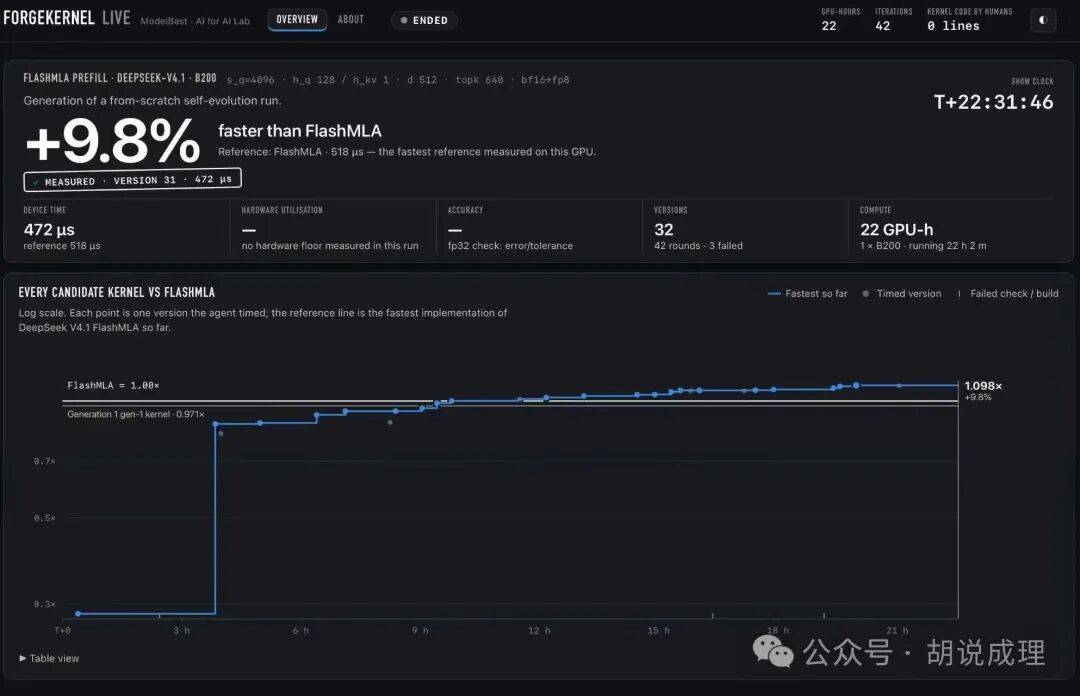
The live broadcast started on October 30 and ran until more than 9 a.m. the next day, lasting 22.5 hours in total. No one was typing code on the screen, only an agent, an NVIDIA B200, and one goal: to write a Prefill operator faster than DeepSeek's FlashMLA.
It only had the mathematical definition of the operator and the constraints of the target hardware, no source code, no papers to copy. The first version passed the correctness check, taking 1834 microseconds; in less than 4 hours, it was compressed to 593 microseconds.
Around the 7th hour, a breakthrough in the core structure made it first surpass its own previous generation version, and then outperform FlashMLA for the first time.
At the end of the live broadcast, the final version took 472 microseconds, while FlashMLA took 518 microseconds. The whole process went through 42 iterations, leaving 32 versions, using only one B200 and 22 GPU hours.
Humans wrote zero lines of code for this operator.
There is a detail in the later part of the live broadcast. It discovered by itself that the burst loading of Q was competing with the data movement of KV for memory access resources, so it actively controlled the request rhythm of Q, and reduced the time consumption by another 2.4%. Such judgments could only be made by senior experts in the past.
Operators are basic computing modules that are called repeatedly when large models are running. Operations such as matrix multiplication and normalization all need to be completed on the chip through corresponding operators. How much performance a chip can exert largely depends on the optimization level of these operators. How data is moved, how calculations are parallelized, and whether chip resources can be fully utilized will all affect the final running speed of the model. For the same chip, with different operator optimization levels, the actual performance can vary greatly.
A single operator can rewrite an entire industry. FlashAttention in 2022 only rewrote the attention calculation step, making it several times faster, making long contexts affordable ever since, and today almost every large model is inseparable from it and its derivatives. DeepSeek's FlashMLA is a branch grown from this lineage.
This is also the layer that relies most on human craftsmanship. To write a top-level operator well, you need to fully understand the algorithm, the memory hierarchy of the chip, and instruction scheduling, and then repeatedly test and error on each piece of hardware; according to Mianbi, for operators like FlashAttention that require deep reconstruction, human experts often take several months or even half a year to complete one iteration.
This layer has always been the most difficult part for AI to write code. When Stanford released KernelBench in early 2025, less than 20% of the GPU operators written by the strongest inference models could match the PyTorch baseline. AI has long been adept at writing web pages and business code; when it comes to the operator layer, it is facing the ceiling of human craftsmanship.
A large part of NVIDIA's moat is built on this layer. The CUDA ecosystem has come to today relying on nearly 20 years of generations of experts handwritten and tuned operator libraries; for every new generation of domestic chips and every new model, these operators have to be re-adapted. Last August, Huawei announced that it would fully open source the Ascend CANN software stack, aiming at this wall.
However, the number of human experts cannot keep up with the iteration speed of chips and models. There is already a gap between China and the United States in high-end computing power. If this software barrier still has to be filled by manpower and years, the gap will only widen.
Therefore, on October 27, the official Ascend CANN account posted an article naming ForgeKernel, which carries a lot of weight: it topped the three hardware lists of CANNBench: 950DT, 950PR, and A3 at the same time.

950DT is a new generation chip launched by Huawei this year, and its supporting operator library is still in the early stage of construction, so manual adaptation is inherently slow.
ForgeKernel took the lead in completing the adaptation, and according to the list on October 27, its total score was 37.1% ahead of the second place.
A3 corresponds to the most widely used Ascend 910C at present. As early as in the previous version of CANNBench whose ranking was closed on October 15, it was already the first on this list.
On the NVIDIA side, ForgeKernel also ranks first on the most difficult FlashInfer-Bench track in the NVIDIA-launched SOL-ExecBench. This evaluation extracts 235 CUDA operator problems from 124 real models, measuring how far the performance is from the physical limit of the hardware; teams at home and abroad such as Databricks, Cursor, and Qwen are also on the same list.
The software and hardware on both sides are very different: NVIDIA uses CUDA, while Ascend has its own independent architecture and toolchain. ForgeKernel uses the same set of systems, only replacing the performance analysis tool from NCU to msprof when switching platforms, and the hardware knowledge required for the new chip is accumulated by the model while testing on the chip.
The results are on the official lists, the process is in full public view, and the code has also been released: after the live broadcast, the Mianbi Intelligence Evolution Laboratory jointly announced the open source of ForgeKernel with the OpenBMB community.
A few days later, the paper about ForgeKernel was officially posted online.

This incident changed Mianbi's position in the industry. It was originally known for its end-side models; now, the operators it writes rank at the top of both the Ascend and NVIDIA official lists. The operators generated by ForgeKernel have also been connected to the training framework, and have completed the long training test of MiniCPM5-1B on domestic chips and NVIDIA platforms.
There has always been an unpublicized rumor in the industry: when a certain domestic hardware is doing underlying software tuning and cannot solve the problem, you can go to Mianbi to try your luck, and you may get different results. Of course, this has only been circulating in a small circle in the industry for a long time.
But this time it is different. Chip manufacturers like Huawei have officially named it, which means that all model teams based on the Huawei ecosystem can use it directly. Mianbi, a model company that used to be good at end-side models, has now entered the forefront of China's computing power ecosystem, and no one will regard it as just a model company anymore.
In the context of Sino-US competition, this point is even more important. Between domestic chips and NVIDIA, the hardest thing to catch up with is never just the hardware indicators, but also the nearly 20 years of expert experience accumulated in CUDA, which is a wall built by manpower and years. Now, this wall can be caught up by hours, and the thinner the software stack of domestic chips, the more AI can make up for it.
If what Mianbi wants to build is a "lithography machine" for large models, what ForgeKernel engraves is the thinnest line. In this layer of AI underlying technology that is the most profound and relies most on human craftsmanship, the AI of a Chinese company has ranked first on the official lists of both the Chinese and American ecosystems at the same time, and has publicly outperformed the human-written benchmark; this is much more difficult than letting AI write web pages and business code, and it is also the closest step RSI has ever reached to "AI building AI".
To find out how this point was obtained, we have to start with the term RSI.
02
The most certain direction has the fewest standards
About half a year ago, I chatted with a core technical staff of a domestic AI-native company. When talking about cutting-edge directions, he repeatedly told me not to report their progress in "AI manufacturing AI" to the public.
His exact words were: It's so cutting-edge that people will think we are bragging if we say it out loud.
Just half a year later, this once highly confidential topic has become the hottest word in the industry, and domestic AI-native companies are competing to show their own progress.
In the few weeks from September to October, RSI appeared consecutively in the press conferences of various companies. Alibaba talked about its exploration in training, inference, and chip-model collaboration at Yunqi Conference; Zhipu let the Infra Agent design and optimize its own inference system; DeepSeek and MiniMax also put this term into their technical narratives.
The academic community is also very active. The review "The Last Generation of AI Made by Humans" participated by institutions such as Shanghai Jiao Tong University, Tsinghua University, ByteDance, and Shanghai AI Lab sorted out 491 studies. ModularRSI and Dream-RSI, which were posted around mid-September, put the improvement object on the external Harness layer of the model, while the base model remains unchanged.
Optimizing inference systems, evolving external scaffolding, improving training methods, and even participating in chip-related design, these technical objects are far apart, but they can all be put into the big basket of RSI. If spread out according to the position of the work, it is roughly a diagram like this:
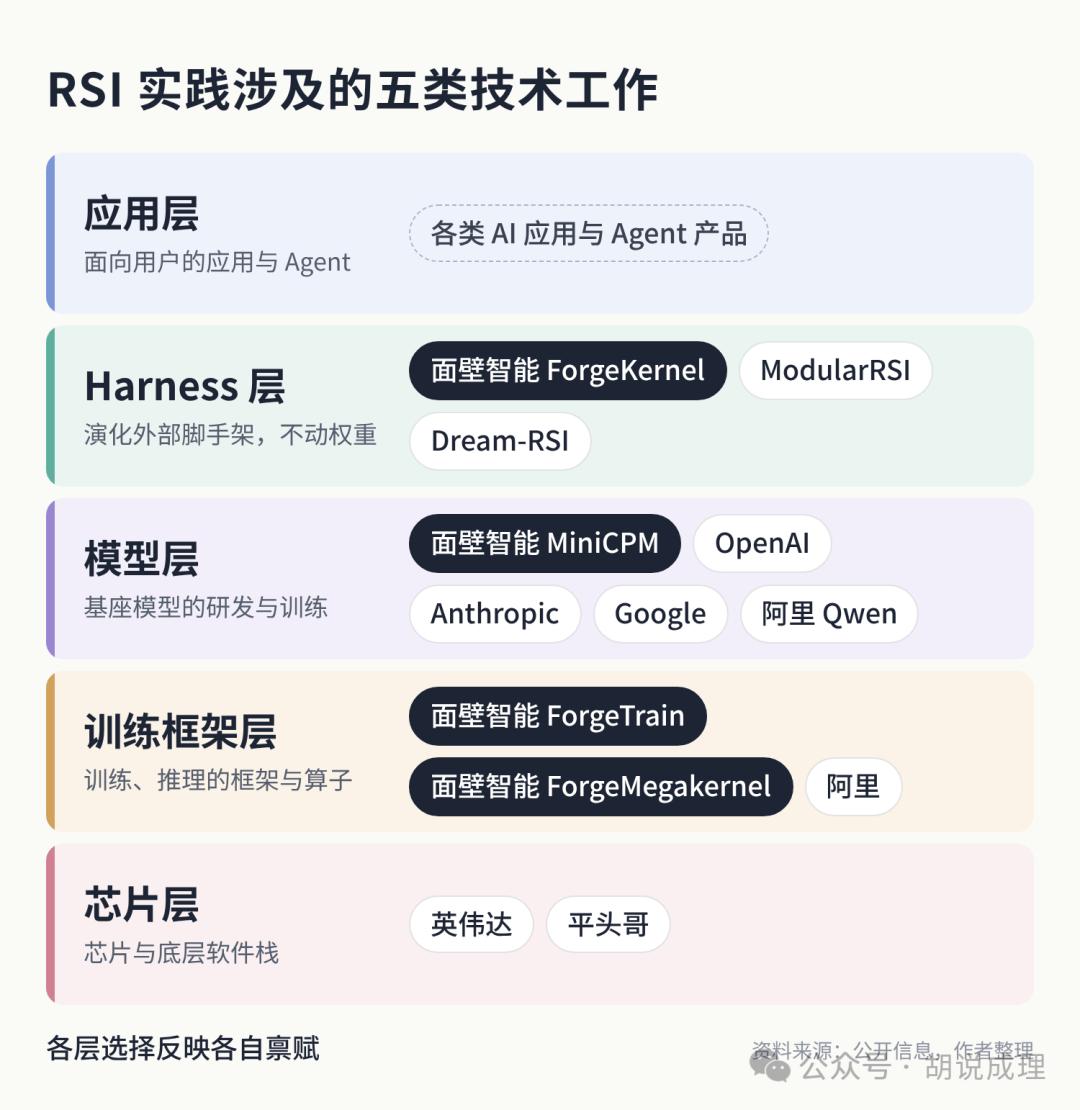
Figure note: The choices of each layer reflect their respective endowments.
All five layers have their own work, and no one is inherently superior to others. Mianbi appears in the Harness layer, training framework layer and model layer at the same time, which reflects that it has done specific work in these layers, not scoring for achievements. As for how deep it has gone and how much R&D work it has taken over, this diagram cannot answer that yet.
Li Yuxuan, Chief Scientist for Intelligent Evolution at Mianbi Intelligence, gave me a measurement scale: "The position of humans in the loop".
"The evolution of RSI is essentially a continuous process in which the behavior subject gradually transforms. Originally, humans were making models stronger, and later it is models that make themselves stronger. From the technical path perspective, none of the work done by humans can be omitted, only the executing subject is replaced."
According to this definition, writing code, adjusting parameters, generating data, doing evaluations, any work that is shifted a little from human hands to the model can be regarded as part of this transformation. It is not necessarily a bad thing that everyone is scrambling to jump into this basket; but if only the name RSI is reported, the technical differences between each other will be smoothed out.
Why is this worth competing for? AI has two abilities that humans do not have. The first is time compression: a human can write 500 lines of code a day, while a model can finish it in ten minutes. The second is that intelligence can be replicated: it may take thousands of years to train an Einstein, but once the model reaches that level, it can replicate tens of millions of copies.
Therefore, to judge the weight of an RSI work, we cannot stay on the name. Li Yuxuan only asks three things: which links of the R&D process the technology acts on, what proportion these links account for in the whole process, and how much the actual effect has improved.
Even if a single operator runs several times faster, we need to see how much time it takes in the complete task; when a section of process is handed over to AI, we also need to see how much work is still waiting for humans before