Half of the stocks are going to be burned.
The central bank cut the interest rate on borrowed funds to 1%, bringing a new repurchase method to the A-share market: buying back shares with borrowed money.
Companies borrow money from banks, then purchase their own shares on the secondary market; after the repurchase, part of the shares are cancelled, and the remaining part is reserved for employees. Enterprises have their own accounting books, banks have their own accounting books, and when viewed over an extended period, it forms another set of accounts.
There is a ready-made example this morning:
Changxin Technology announced that its chairman Zhu Yiming proposed to raise the repurchase amount range from 1 billion to 2 billion yuan to 2.5 billion to 5 billion yuan, and the plan was just approved by the board of directors on October 30.
I went through the original announcement: the amount is easy to remember, but the intended use is more noteworthy. For the repurchased shares, up to half will be reserved for employees, and the other half must be cancelled.
A company splits the use of repurchased shares into two parts, and clearly writes this rule into the official announcement in black and white.
In the past, most repurchases were to reserve shares for employees, the repurchased shares were held in place, and the total share capital remained completely unchanged; now it is different, at least half of the shares must be cancelled, and the repurchased shares will disappear directly from the market.
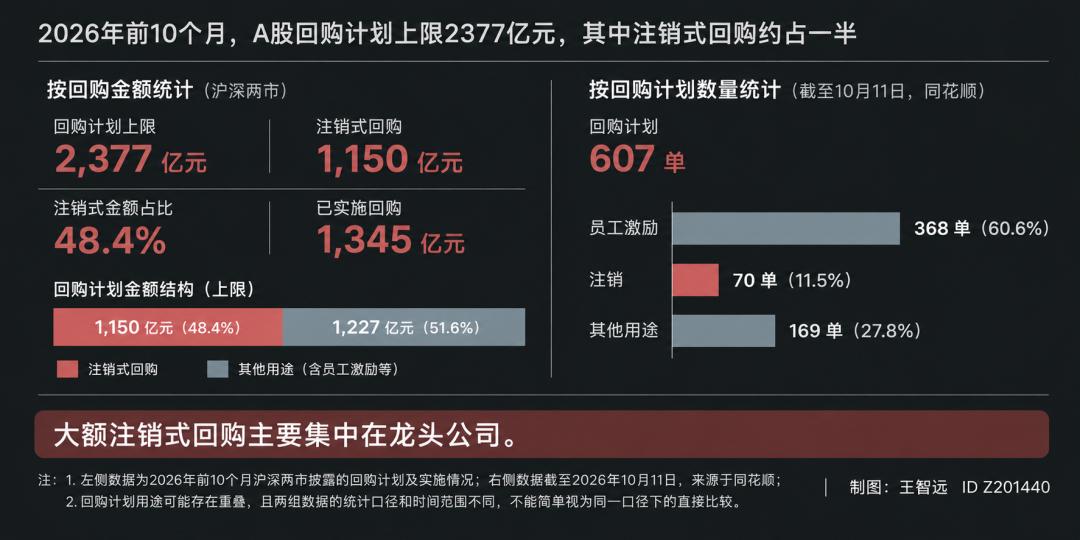
Data from the China Securities Regulatory Commission also matches this trend. In the first 10 months of this year, 645 companies on the Shanghai and Shenzhen stock exchanges disclosed 700 repurchase plans with a total upper limit of 237.7 billion yuan, of which cancellation-type repurchases reached 115 billion yuan, accounting for nearly half of the total. 747 companies actually spent real money to buy back 134.5 billion yuan worth of shares.
At the same time, the China Securities Regulatory Commission also relaxed the conditions for market-stabilizing repurchases. Companies can conduct repurchases even when their share price is below the issue price, the 6-month listing requirement is cancelled, and declarations can be submitted during the opening and closing call auction sessions. This rule may have a more direct impact on repurchase volume than interest rate cuts.
However, from another statistical caliber, the situation is completely different.
As of October 11, according to statistics from Tonghuashun, among 607 repurchase plans, 368 are for employee incentives, accounting for more than 60%, while only 70 plans are for share cancellation, accounting for just over 10%.
In the same market and the same year, calculated by amount, cancellation accounts for half of the total repurchase value; calculated by the number of plans, it only accounts for 10%. Where does this gap come from? The main reason is the size of the companies.
Cancellation-type repurchases are concentrated among large companies. CATL alone has a repurchase plan ranging from 20 billion to 40 billion yuan, and the repurchase plans of Midea, BOE, and Innolight are getting larger and larger. Small companies cannot afford such a large amount of money, and their repurchases of tens of millions of yuan are usually reserved for employee incentives.
Therefore, cancellation-type repurchase is currently a game for leading companies.
......
Then the question arises: now that the central bank has lowered the cost of borrowing, who can actually get this loan?
From the loans that have been issued, the median single loan amount is 100 million yuan, with an average of 226 million yuan. The vast majority of companies borrow tens of millions to 100-200 million yuan, which is enough to fulfill a moderate repurchase commitment.
To achieve a larger scale, the common structure in the industry is 10% own funds plus 90% loans; according to media statistics, both Innolight and Haier adopt this model.
From the perspective of borrowers, private enterprises are more numerous than central SOEs and local SOEs, with the amount roughly split 60/40, and most of the funds of small companies come from their own pockets.
More than 30% of the funds are not borrowed by the companies themselves, but by major shareholders, who use the money to increase their shareholding ratio. The new controlling shareholder of Feilu Co., Ltd. completed the equity transfer in July, and borrowed money to increase its shareholding in August, with the announcement stating that the move is to further consolidate control.
Take another look at Changxin Technology. It has no shortage of money, with revenue of 269 billion yuan and net profit of 132 billion yuan in the first three quarters, while it was still in loss in the same period last year. This 5 billion yuan repurchase uses its own funds without any loans.
Here comes an unavoidable mismatch:
Companies that want to borrow money may not be approved by banks; companies that banks are willing to lend to often have no shortage of cash on their books.
Whether the money can be borrowed is one thing, and how much buying power repurchases can bring to the market depends on another set of accounts.
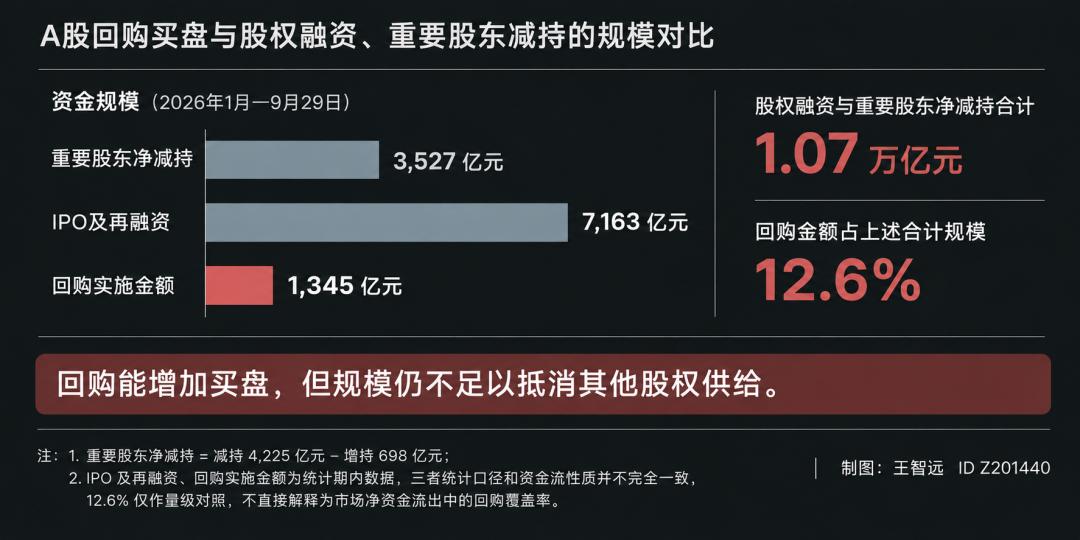
If we zoom out, the numbers change completely. From January to September 29 this year, important shareholders of A-shares reduced their holdings by 422.5 billion yuan, and increased their holdings by 69.8 billion yuan; the amount of selling is 6 times the amount of buying, with a net reduction of 352.7 billion yuan.
The semiconductor sector has the most aggressive selling. Among the top 20 companies with the largest net share reduction, 11 belong to the electronics sector. Advanced Micro-Fabrication Equipment Inc. alone reduced its holdings by 13.4 billion yuan, and even the National Integrated Circuit Industry Investment Fund Phase I reduced its holdings by 16.8 billion yuan.
The total market value of shares lifted from the ban this year is 3.62 trillion yuan, with two peaks in July and December.
During the same period, IPOs and refinancing raised 7.163 trillion yuan, of which IPOs alone reached 223.8 billion yuan, a 195% increase over the same period last year.
Adding up net share reduction and equity financing, the total capital outflow exceeds 1 trillion yuan.
On the repurchase side, the total amount is 134.5 billion yuan. Dividing the two numbers, the ratio is about 12.6%. The statistical calibers do not fully match, one side is equity financing plus net reduction by important shareholders, the other side is the actual repurchase amount, but the huge gap in magnitude does not affect the judgment.
One point needs to be made clear:
134.5 billion yuan of buying power, facing a capital outflow of over 1 trillion yuan, can hardly support the share price. What it can do is more about buying some time for the market.
To reverse the supply and demand situation, the total repurchase amount needs to reach 1 trillion yuan, which is 8 times the current level. No one is mentioning this figure right now.
The chairman of the China Securities Regulatory Commission mentioned a number at the Financial Street Forum: the total amount of dividends and repurchases within the year will reach 2.1 trillion yuan, which is 2.7 times the total IPO and refinancing amount in the same period.
This number is not small, but we need to break it down: repurchases only account for a tiny fraction of the 2.1 trillion yuan, and the rest is mainly dividends.
......
At this point, there is another account that has not been calculated. Part of the repurchase funds is borrowed, so where does the borrowed money come from? We need to look at the books of banks.
First, look at capital.
This type of loan is classified as general corporate risk exposure under regulatory standards, with a 100% risk weight, the same as ordinary corporate loans.
What does 100% mean?
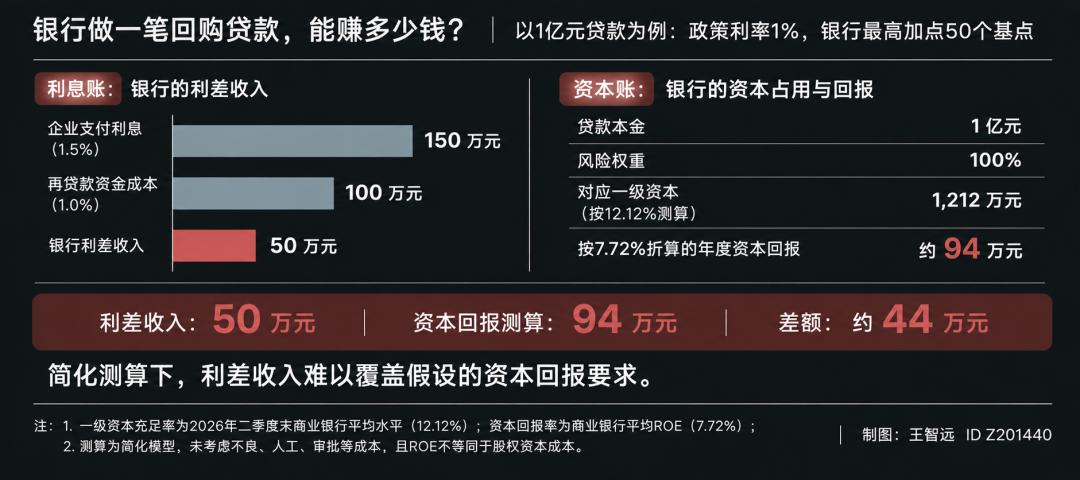
Issuing 100 million yuan of this loan will add 100 million yuan of risk-weighted assets on the books. Calculated based on the 12.12% tier 1 capital adequacy ratio of commercial banks at the end of the second quarter of this year, this 100 million yuan corresponds to 12.12 million yuan of capital.
Capital also has costs, and shareholders demand returns. Converted at a 7.72% return on capital, the annual cost is about 940,000 yuan.
Then look at the interest.
The policy reserves room for interest rate markup, with a maximum of 50 basis points. That means, for a 100 million yuan loan, the enterprise pays a maximum of 1.5% annual interest, which is 1.5 million yuan; after deducting the 1 million yuan paid to the central bank, the remaining net income is 500,000 yuan.
The required capital return is 940,000 yuan, while the net interest income is only 500,000 yuan, leaving a gap of 440,000 yuan. This does not even include the costs of non-performing assets, labor, and approval. Even calculated at the maximum markup allowed by the policy, banks still suffer losses.
In October 2024, the Agricultural Bank of China offered a 1.75% interest rate to Hengyi Petrochemical. Tian Lihui pointed out at that time that this is a zero spread, banks are not that generous, and the situation is mainly caused by fierce competition.
At the symposium on November 2 this year, the regulator specifically mentioned: banks should price according to market-oriented principles, avoid excessive involution competition, and maintain commercial sustainability.
This statement sounds polite, but in plain language it means: stop cutting prices any further, or no one will be willing to do this business.
Then who is doing this business?
It is still banks. The Industrial and Commercial Bank of China alone has issued a cumulative total of 49.095 billion yuan, accounting for 31.68% of the entire industry. This is the caliber as of July this year, when the total market-wide cumulative amount reached 154.995 billion yuan, covering 697 loans from 26 banks.
The total credit line is also rising, from 9.5 billion yuan in the fourth quarter of last year to 14.1 billion yuan in the first quarter of this year, and 26.4 billion yuan in the second quarter, expanding for three consecutive quarters.
What do people in the banking industry say? I read interviews by CLS with several banking business personnel, and their statements are roughly the same: This is a low-risk, policy-supported high-quality credit project, and banks still have strong willingness to issue such loans.
The term "low risk" depends on what you compare it with.
Compared with share pledge loans, it is indeed low risk: the funds go into a special account and operate in a closed loop, can only be used to buy the company's own shares, and cannot be diverted for other uses; but compared with government bonds, the risk is much higher. If the company cannot repay the loan, the bank still has to make impairment provisions.
Then what do banks get in return?
Behind a repurchase loan is a listed company. If a bank issues 50 million yuan of repurchase loan today, the company's subsequent settlement, bond issuance, M&A, and employee stock ownership plan business may all be placed with the same bank.
They earn less from interest, but can make up for it through other business lines.
Banks will not write this logic into their annual reports, but it can be seen from the issuance scale that large state-owned banks are indeed willing to carry out this business.
The coverage is also expanding. In the adjustment on November 4, in addition to 21 national banks, the support list added 5 systemically important city commercial banks: Ningbo Bank, Jiangsu Bank, Bank of Shanghai, Nanjing Bank, and Bank of Beijing.
However, city commercial banks usually have tighter capital than large state-owned banks, so they need to calculate the accounts more carefully for this type of capital-consuming business.
Moreover, the central bank does not provide a backstop. Banks make independent decisions and bear their own risks. After the loan is issued, the central bank provides re-lending at 100% of the principal. If the enterprise fails to repay, the loss will still be recorded on the bank's books.
The demand side is also changing. A business person from a joint-stock bank said that over the past year, share prices in some sectors have rebounded, the willingness of listed companies to conduct repurchases has decreased, the repurchase cost has also risen, and their willingness to finance has declined accordingly; some companies simply invest the money back into their main business, putting market value management aside for the time being.
As you can see, on one side banks want to issue loans, on the other side enterprises do not want to borrow.
The central bank cut the interest rate to 1% to make room for banks, but when banks pass this room to customers, customers start to hesitate.
......
After going around the whole circle, the central bank, banks, and enterprises still need to calculate one more account: how long can this money be used? The announcement on November 4 clearly states that the re-lending period is 1 year, and can be extended according to the needs of banks.
For enterprises, the situation is different.
The maximum loan term provided by banks is 3 years, which was extended from 1 year to 3 years only in December 2024. When the loan matures, the principal must be repaid. If the enterprise cannot repay, it can either apply for extension, seek re-financing, or default as a last resort.
Whether the bank is willing to renew the loan depends on the operating and solvency of the company at that time. The re-lending from the central bank can be extended, but the corporate loan cannot.
When was the first batch of funds issued?
October 2024. Sinopec obtained a 1.6 billion yuan credit line from Bank of China, which was one of the earliest batches. If calculated based on the 3-year term after actual withdrawal, the first batch of maturing loans may arrive in the fourth quarter of 2027.
There is no complete public data on the exact amount of maturing loans so far.
From October 2024 to October 2025, A-shares applied for 747 repurchase loans with a total upper limit of 151.6 billion yuan. However, credit line does not equal actual disbursement, and the entire 151.6 billion yuan cannot be counted as maturing in 2027.
The 3-year loans issued successively in 2025 and 2026 may also mature in 2028 and 2029.
What will be used to repay the loans when they mature?
First, operating cash flow. If the company operates well and has enough cash on its books, it