Cooking robots that "take over" the back kitchens also have their own limitations beyond their capacity.
There is a touching scene at the end of Disney's blockbuster *Ratatouille*: a gourmet tastes a delicious meal and cannot help but want to pay tribute to the chef. If this scene is transplanted to today's China, the gourmet may be surprised to find that the person standing in front of the stove is a robot.
A huge transformation is taking place in the back kitchens of restaurants.
Cooking robots are taking over restaurant kitchens on a large scale, and the dishes they cook are so indistinguishable that ordinary consumers cannot detect any "abnormality". For example, stir-fried pork with chili, a representative Hunan stir-fry dish, has become one of the most skilled signature dishes of cooking robots.
"Stability comes first," Tao Liurang, founder of Wang Jiaojiao Shanghai Noodle House which has widely adopted cooking robots, told BrandPrism.
Human beings are undoubtedly the most complex variable in the business world. Suppose a chef quarrels with someone early in the morning and is in a bad mood, all the dishes he cooks that whole day may carry a hint of resentment, with the taste score dropping sharply from 95 points to 85 points. Cooking robots, however, can always maintain a score of 90 — a point that is critical for chain catering brands.
In addition, cooking robots can also greatly improve efficiency. According to calculations, the "one person operating multiple machines" model increases the overall kitchen efficiency by 30% to 50%.
Therefore, as you can see, leading chain catering brands such as Laoxiangji, Xiaocaiyuan, and Nanchengxiang are all applying cooking robots on a large scale, and JD 7Fresh Mini Kitchen even takes "robot cooking" as one of its selling points.
Then here comes the question: Should cooking robots become the masters of restaurant back kitchens?
Complementing Rather Than Replacing Human Chefs
The advantages of cooking robots are self-evident: high efficiency and consistent dish output.
Since 2024, the application of cooking robots has seen explosive growth. 2025 is regarded by the industry as the "first year of cooking robots". In August this year, Guojin Securities mentioned in a special research report that all more than 1,000 stores of Bawan Gaimafan across the country have used self-developed cooking robots; Xiaocaiyuan once planned to invest 100 million yuan in 2025 to purchase 2,000 cooking robots; cooking robot and intelligent kitchen equipment suppliers such as Xianglu Technology and Buting Technology have each raised hundreds of millions of yuan in cumulative financing since 2024.
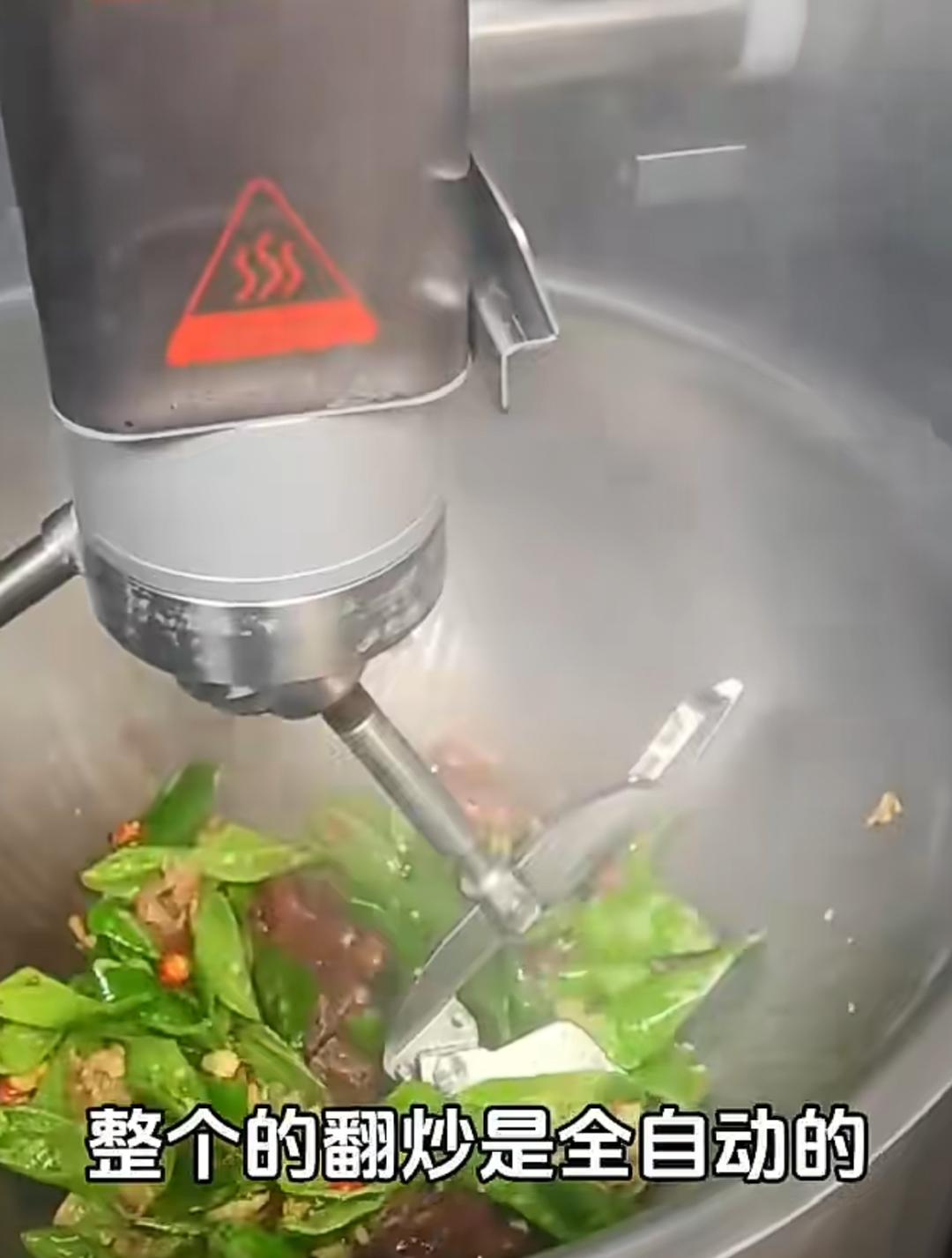
A cooking robot is at work. (Source: Screenshot from Meishanshi WeChat Channel)
However, the popularity of cooking robots has not been accompanied by much protest from chefs. This is a thought-provoking scene, and this kind of "silence" is rare in other labor-intensive industries — when Apollo Go driverless vehicles were piloted in Wuhan, local taxi drivers immediately staged protests.
This may mean that cooking robots are not taking away chefs' jobs, but more of a "complementary role".
On the one hand, in the past few years, leading chain catering brands have been firmly committed to "scaling up". In the process of expanding their territory, the speed of training chefs has been difficult to keep up with the expansion speed of stores, which has given cooking robots a chance to show their capabilities.
Calculated based on public data, there are approximately 8 million to 10 million chefs in China. But it is worth noting that in the labor market, there are many qualified candidates for ordinary back kitchen positions, but the number of people who can actually take charge of cooking is still limited, and the training of professional chefs cannot be accomplished overnight.
On the other hand, more and more young people are unwilling to take up the chef profession.
At the end of 2025, the remarks of Deng Xiaoqing, a professor at Sichuan Tourism University, once sparked widespread discussion in the industry. He said: "Sichuan cuisine is facing inheritance problems. The average age of Sichuan cuisine chefs is now 43, and post-90s account for only about 10%."
Even Sichuan cuisine, which can represent Chinese flavors, is facing a talent gap.
Statistics show that the current talent gap for chefs in the catering industry is about 3 million. In addition, chef is a position with high mobility. Even if enterprises are willing to train chefs, it is still uncertain whether they can retain talents for a long time. In this case, the "complementary role" of cooking robots becomes very natural.
However, the deployment of cooking robots does not mean that chefs will be laid off.
BrandPrism has communicated with a number of catering practitioners and learned that the current mainstream model is "human-robot collaboration".
What is human-robot collaboration? The newly emerged position of "cooking technology application specialist" in the labor market in recent years may give part of the explanation. This long job title actually refers to the person who sets parameters for cooking robots and debugs equipment.
"Humans" and "cooking robots" thus form a division of labor and collaboration: executive chefs focus on new product R&D and AI recipe training; ordinary operators are responsible for ingredient preparation, equipment monitoring and basic maintenance; as for standardized execution actions such as automatic feeding, dish cooking, precise temperature control, and automatic cleaning, they are handed over to cooking robots.
Win by Stability, and Also Limited by Stability
Then where is the upper limit of cooking robots? Since robots perform stably and never get emotional, can we assign more back kitchen work to cooking robots?
The answer is not that simple. Stability is the lifeline of catering, but not the whole story. For restaurants to retain customers in the long run, on the basis of stability, they also need to keep improving and continuously raise the upper limit of dish taste.
In the past two years, cooking talent shows have become popular, which fully shows that there is no ceiling for cooking skills itself. Today, when robots are employed in large numbers in back kitchens, there are still many top chefs committed to making dishes better and more creative, which itself meets market demand.
This does not mean that the implementation of cooking robots has encountered obstacles. The menus of many chain restaurants usually consist of dozens of fixed dishes, most of which are home-style dishes. Even for signature dishes, there are relatively fixed ingredient processing methods and cooking techniques. For chain restaurants, compared with making customers occasionally amazed by a certain dish, it is more important to ensure that the "presentation" result of the same dish is stable in different stores.
"Chain catering pursues management stability. Top chefs are only a few after all. If ordinary chefs cook, the output of different people will be uneven, so it is better to hand over the work to cooking robots," Tao Liurang said.
But the problem with cooking robots is precisely that they win by stability, and are also limited by stability. They will not underperform, but they will not actively raise the upper limit either.
In addition, complex flavor profiles are also beyond the capability of cooking robots.
For example, Sichuan cuisine has 24 basic flavor profiles. Just for spiciness, there are many flavors such as numbing spicy, red oil, pepper numbing, sour spicy, pickled pepper spicy, and burnt spicy. Some dishes are even a fusion of multiple flavor profiles. The common configuration of the main and auxiliary ingredient slots of cooking robots is only four, which cannot support the operation of complex dishes at least at the current stage.
Furthermore, cooking robots are products of scale effect. They are more suitable for dishes with highly standardized cooking processes. Developing a dedicated cooking robot for dishes with complex flavors alone does not conform to economies of scale.
In other words, at the current stage, cooking robots can only fill the gap in standardized scenarios, and cannot replace the chefs in charge of complex dishes yet.
An Irresistible Trend, Oriented Towards Human Beings
Despite their limited capabilities, the popularity momentum of cooking robots has not slowed down. According to calculations by NCBD Food Dictionary, the market size of cooking robots reached 3.81 billion yuan in 2025, with a year-on-year growth rate of over 20%, and it is expected to exceed 10 billion yuan by 2030.
The driving forces behind this trend include leading enterprises as well as young entrepreneurs.
In 2025, JD launched 7Fresh Mini Kitchen, a quality catering platform under the joint operation model, focusing on "freshly cooked food + transparent kitchen". In 2026, under the upgraded model, JD provides standardized pre-processed ingredient supply chains and intelligent kitchen equipment, and completes cooking through robots; partners provide venues and undertake localized operations.
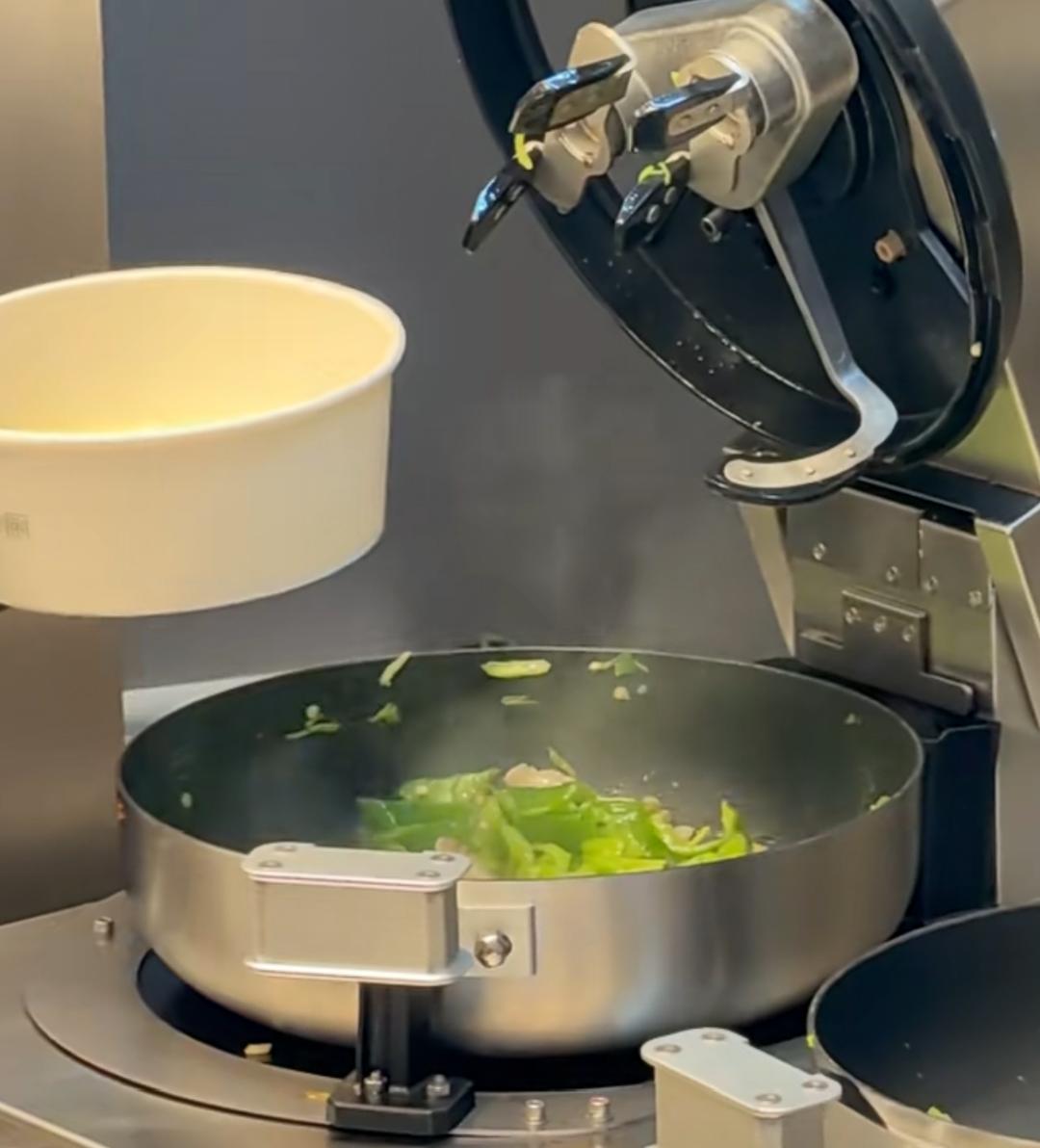
Cooking robots at 7Fresh Mini Kitchen. (Source: Screenshot from CNR Finance WeChat Channel)
JD dares to bring cooking robots to the forefront, and its confidence comes from its investment in Xianglu Technology, a leading domestic cooking robot company, which has launched the cooking robot named "Meishanshi". In December 2023, Xianglu Technology announced that it had obtained tens of millions of yuan in Series A financing from JD; in July 2024, Xianglu Technology announced that it had obtained nearly 200 million yuan in strategic investment from JD again, and reached a comprehensive strategic cooperation.
Nanchengxiang also invested in cooking robot enterprise Zhenshanmei. In 2025, Nanchengxiang transformed its existing 2.0 stores, focusing on stir-fried dishes; on the other hand, it launched a new 3.0 fresh-cooked community canteen store format. Both the new 2.0 stores and the 3.0 upgrade have applied intelligent cooking machines.
In the second half of 2025, when Wang Jiaojiao only had 27 stores, Tao Liurang decided to introduce cooking robots. As a middle-generation catering entrepreneur who pays attention to AI, he believes that cooking robots represent the future of chain catering, and young people in the catering industry are more likely to accept them.
At present, cooking robots are mostly used in affordable chain catering, and the dishes are mostly home-style dishes. But Tao Liurang firmly believes that with the progress of products, cooking robots will be able to handle more dishes in the future. More importantly, the current cooking robots do not have high usage thresholds, are easy to operate, and the later maintenance is not complicated.
With the demand side exploding and the supply side maturing, cooking robots and catering enterprises have thus achieved mutual recognition and win-win cooperation. According to a report by CCTV Finance Channel in October 2026, Jin Yong, Vice President of China Hotel Association, revealed that the penetration rate of cooking robots in Chinese fast food chains and mass casual dining sectors has reached 30%.
In the view of some practitioners, today's cooking robots are not the final form of intelligent kitchens, but only an important step forward.
Zheng Haotian, founder of Heiboluo Smart Kitchen, said in a recent public speech that cooking robots are only one link in the intelligent kitchen. If a complete intelligent kitchen can be built, it may become a new growth engine for catering enterprises.
The new tea beverage industry can be used as a reference. Due to the mature digital and standardized construction of the back end of the new tea beverage industry, even after the epic takeaway war in 2025, tea and coffee chain stores can basically cope with the situation. In contrast, the digitalization progress of restaurant back kitchens is still slow. Under the wave of large-scale application of cooking robots, catering enterprises should take advantage of the trend to accelerate the digital layout of the entire back kitchen.
What we need to be alert to is that with the increase of the chain rate of the catering industry, the widespread use of cooking robots in restaurants in the future may bring another kind of homogenized competition.
"If the menus of affordable catering are all similar in the future and the robots are all the same, how can we create differentiation to attract customers?" Tao Liurang said. While embracing cooking robots, he also attaches great importance to the role of human beings. "Cooking robots solve the problems of standardization and efficiency, but the direction still lies in human beings. A cooking robot is like an exoskeleton for a person, but don't expect it to become a prosthetic limb."
This article is from the WeChat Official Account "BrandPrism", written by Fang Yu, edited by Tian Tian, and published with authorization from 36Kr.