Are liberal arts graduates unwanted in the AI era? I sorted out what AI positions at ByteDance, Tencent and Alibaba are recruiting liberal arts graduates.
A few days ago, I wrote an article titled ByteDance's AI Strategy and Tactics Reflected in Recruitment.
After the article was published, I went through the highlights marked by readers.
To my surprise, many parts I was proud of received far less attention than I expected.
The section with the most highlights was the second last one: "What kind of talents does ByteDance want?"
That section only presented a few statistics:
ByteDance hardly sets strict academic thresholds in job descriptions. Only 1.3% of AI positions explicitly require a doctoral degree, and soft requirements like curiosity and passion appear more frequently in AI roles than in non-AI roles.
Then a reader sent me a message and asked: Wei Xi, I am a student of liberal arts, is there any way for me to get a job in an AI company?
I thought for a moment and realized this was a great topic worth further exploring.
Last time we sorted out ByteDance's AI recruitment, this time we will also look at the recruitment situation of Tencent and Alibaba together.
Let's see what AI positions are available that liberal arts students can also take on?
Without further ado, let's get straight to the point —
I
First, let's talk about where the data comes from?
On the afternoon of November 2, I asked Claude to crawl all publicly displayed positions on the official recruitment websites of ByteDance, Alibaba and Tencent in the way of loading positions through official web pages.
(How did my Claude account not get banned? Well, it actually did get banned once. I placed a Mac Mini at my classmate's home in Winnipeg, Canada to make it work.)
No login was required throughout the process, and all the data we read is visible to any visitor.
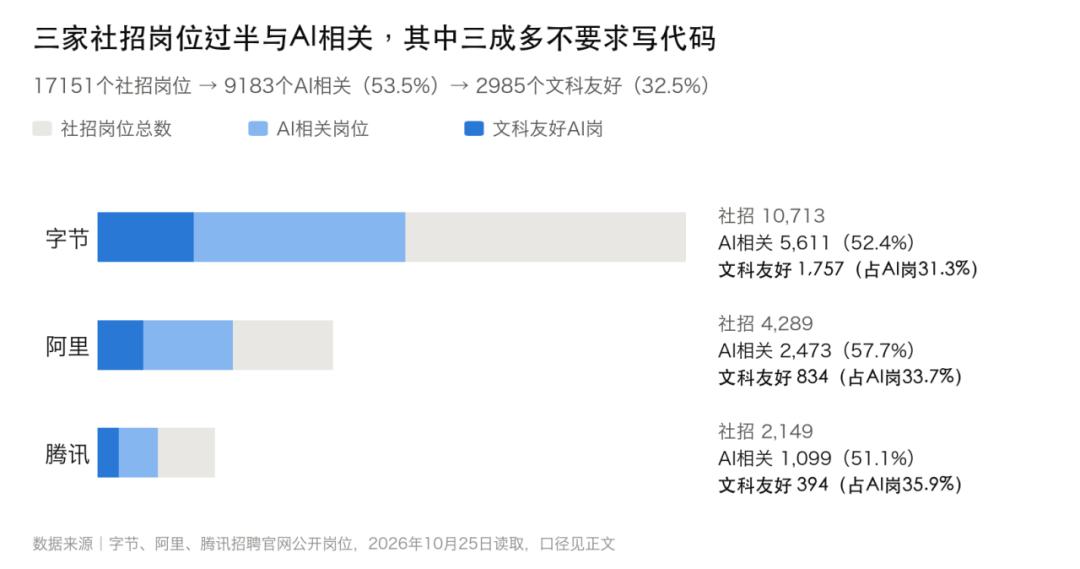
For social recruitment: 10713 positions at ByteDance, 2149 at Tencent, 4289 on Alibaba's main site, totaling 17151 positions, excluding campus recruitment and internship positions.
According to this standard, AI-related positions account for 53.5% of the 17151 social recruitment positions, and all three companies have more than half of their roles related to AI.
Next comes the figure we really care about —
What do we mean by "positions accessible to liberal arts students"?
I set a relatively conservative standard:
Positions are not in the R&D sequence, and the title does not include words like engineer, algorithm, development, architecture.
Hard thresholds such as Python, Java, C++, programming, coding ability, deep learning, and "computer-related major" do not appear in the job requirements.
Also, positions with requirements like "computer or related majors are preferred" are all excluded.
Therefore, the following number will only be smaller than the actual value, not larger.
The result is:
Among the 9183 AI positions, 2985 meet this standard, accounting for 32.5%.
1757 at ByteDance, 834 at Alibaba, and 394 at Tencent.
One in every three AI positions currently posted by the three major tech giants does not require you to write a single line of code.
II
Which departments are these 2985 positions distributed in?
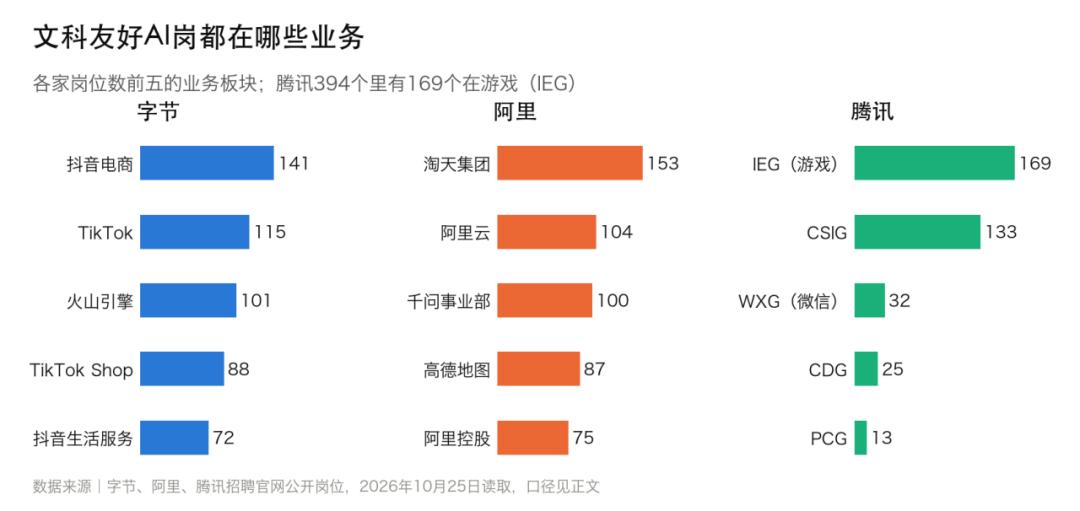
First let's look at the business sectors.
The top three at ByteDance are Douyin E-commerce (141 positions), TikTok (115 positions), and Volcano Engine (101 positions).
There is an interesting contrast here.
As I mentioned in the previous article, e-commerce is one of the sectors with the lowest AI penetration rate at ByteDance, only 26.4%, but the largest number of liberal arts-friendly AI positions are exactly in Douyin E-commerce.
It makes sense after a little thought: AI in e-commerce is currently mainly used in customer service and creator support.
All these jobs are people-facing.
The top three at Alibaba are Taobao & Tmall (153 positions), Alibaba Cloud (104 positions), and Qwen Business Unit (100 positions).
Tencent has the most concentrated distribution: among the 394 positions, 169 are in IEG, the game division, accounting for more than 40%.
In the gaming industry, narrative, art, and planning have long been tracks with a large proportion of liberal arts practitioners.
At present, it seems that the arrival of AI has not had that big of an impact on them.
Then let's look at job types: product, operation, and content take the top three spots, followed by marketing, brand public relations, and sales.
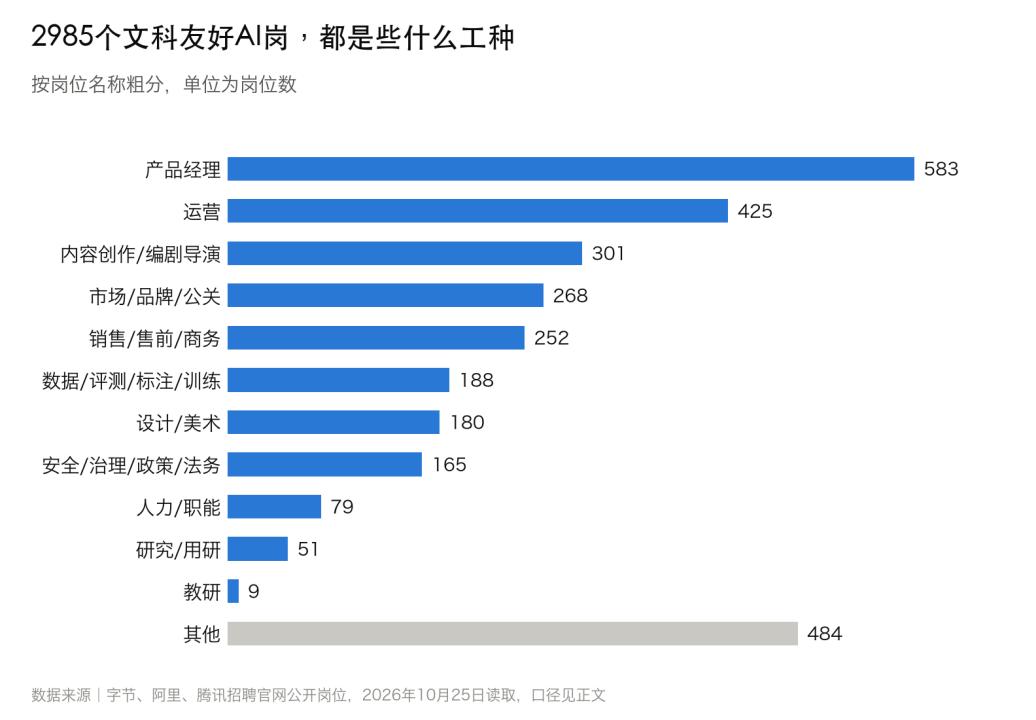
We won't expand on the broad categories. The interesting parts are in the specific job descriptions, let's move on —
III
First let's talk about an internship position for Doubao: "AI Product Intern (Writing Evaluation Direction)".
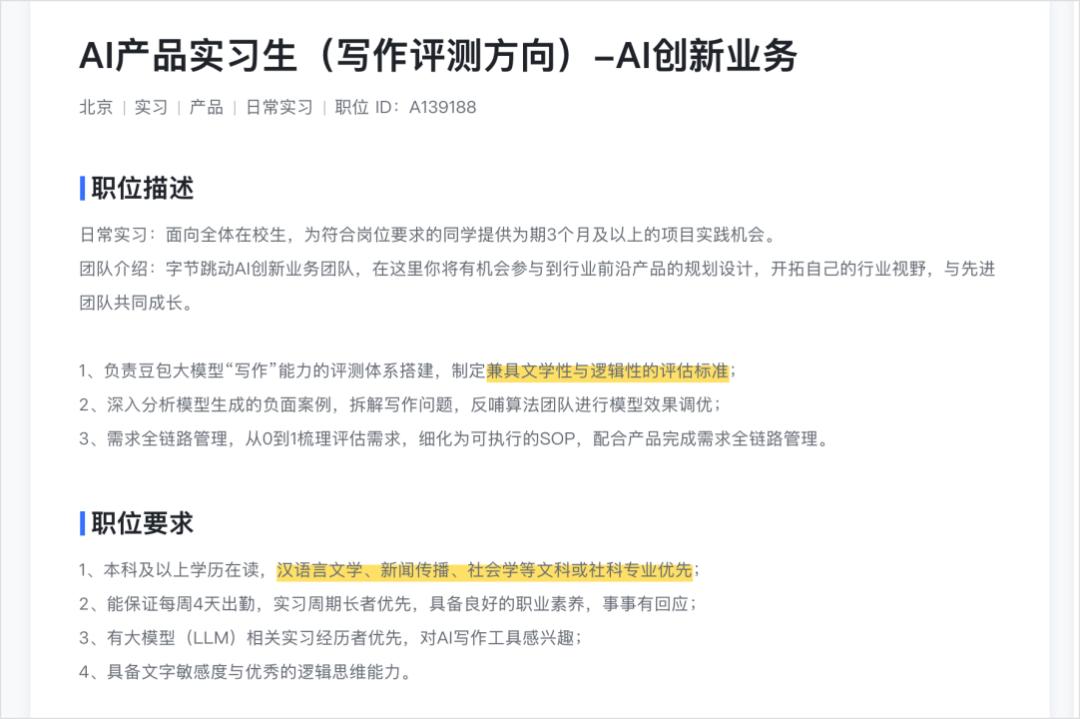
This role is responsible for building an evaluation system for Doubao's writing capabilities, and formulating "evaluation standards that combine literariness and logicality".
The major column says: "Liberal arts or social science majors such as Chinese Language and Literature, Journalism and Communication, and Sociology are preferred."
I once wrote a long article discussing the writing ability of Deepseek.
Obviously, the ability to write well can only be perceived by people who are highly sensitive to literary aesthetics, which is where Chinese language and literature majors have an advantage.
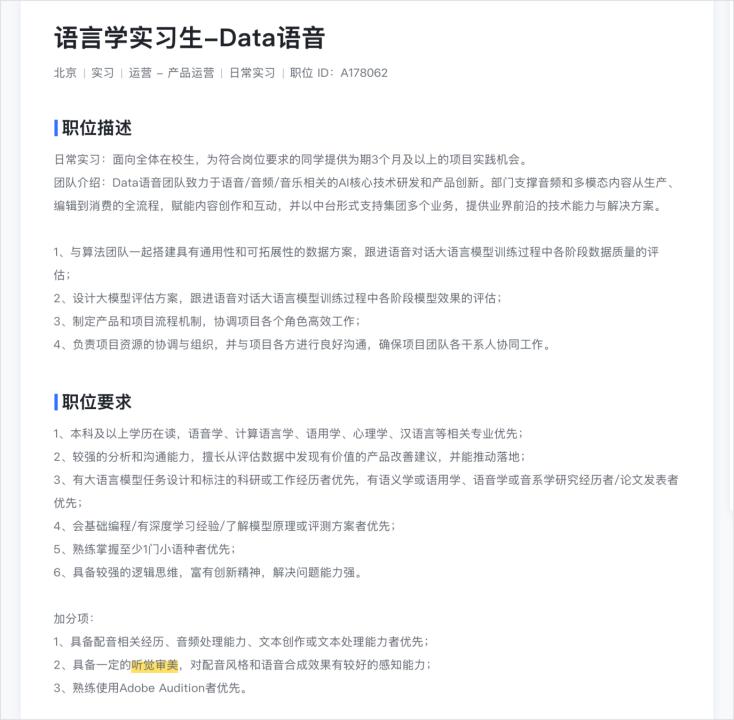
Moving on, the Linguistics Intern position at ByteDance's Data Speech team recruits for multiple directions at once.
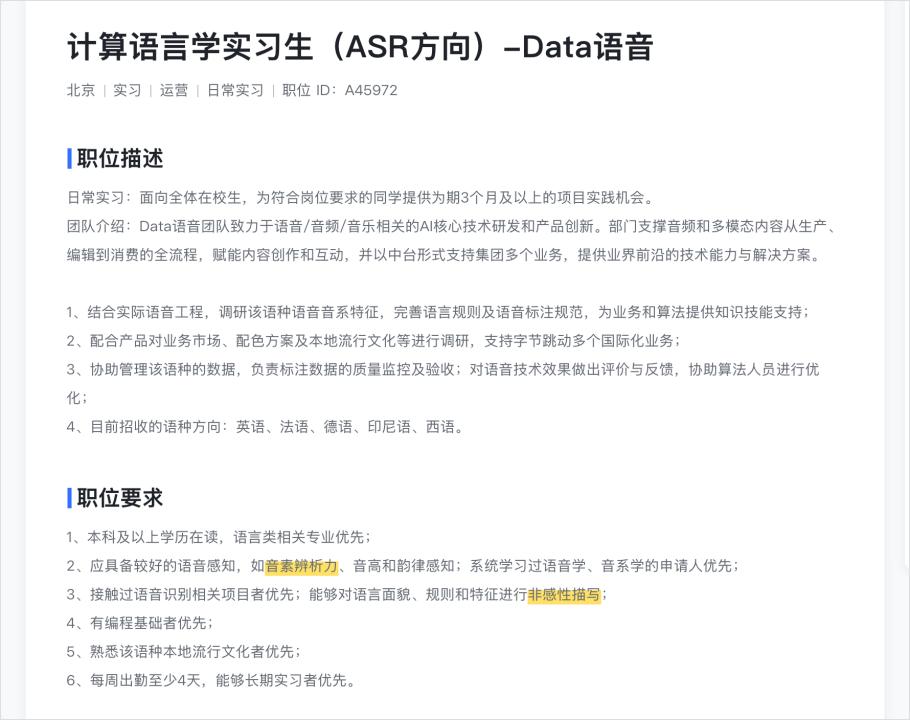
The ASR direction requires you to have phoneme discrimination and prosody perception, preferably with systematic learning of phonetics and phonology.
One of the requirements is: being able to make "non-perceptual descriptions" of language forms, rules and features.
One of the bonus points for another "Linguistics Intern" position is: having a certain level of "aural aesthetics".
Then let's look at the "Large Model Product Evaluation Strategy Expert" position at Alibaba's Qwen Business Unit, with no restrictions on majors.
One of the responsibilities is: organizing industry experts to participate in evaluations, "promoting the continuous reduction of expert inconsistency ranking rate".
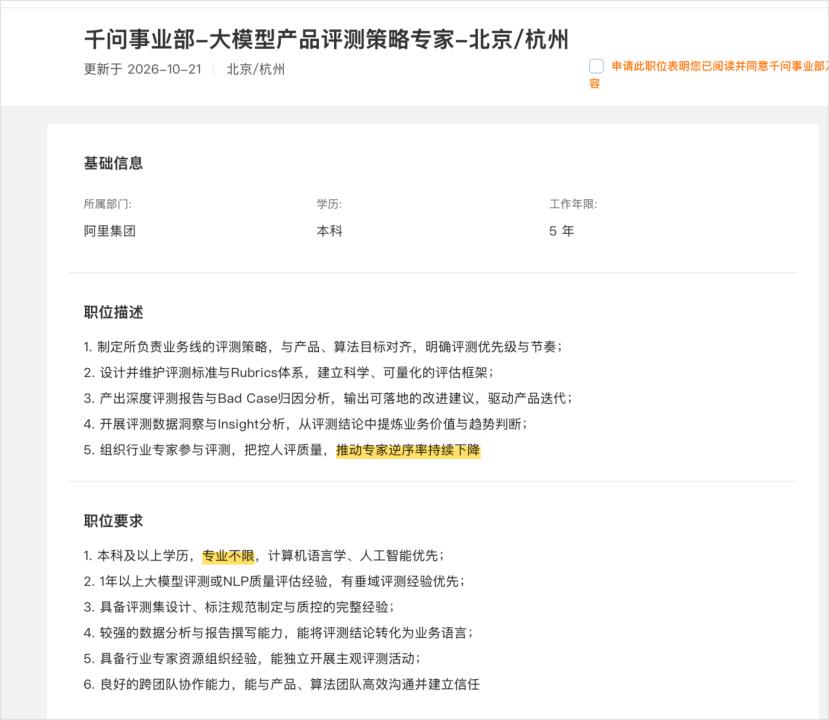
The inconsistency ranking rate roughly refers to the degree of conflict between the rankings of multiple model responses made by a group of experts.
Making experts disagree less is a pretty interesting job.
Moving on, there is the "AI Script Content Evaluation Expert (Short Drama)" position at TikTok.
This job description is very well written, and the first responsibility is:
Define "what makes a good script", extract judgment criteria for viral potential by genre (sweet romance, revenge, counterattack, suspense, time travel), and precipitate them into scoring cards with scoring rules and anchor samples, "so that the quality of scripts can be judged consistently by different people".
Now you know why Red Short Drama is so successful, right?
ByteDance is really looking for professionals to dig deep and fully master this field.
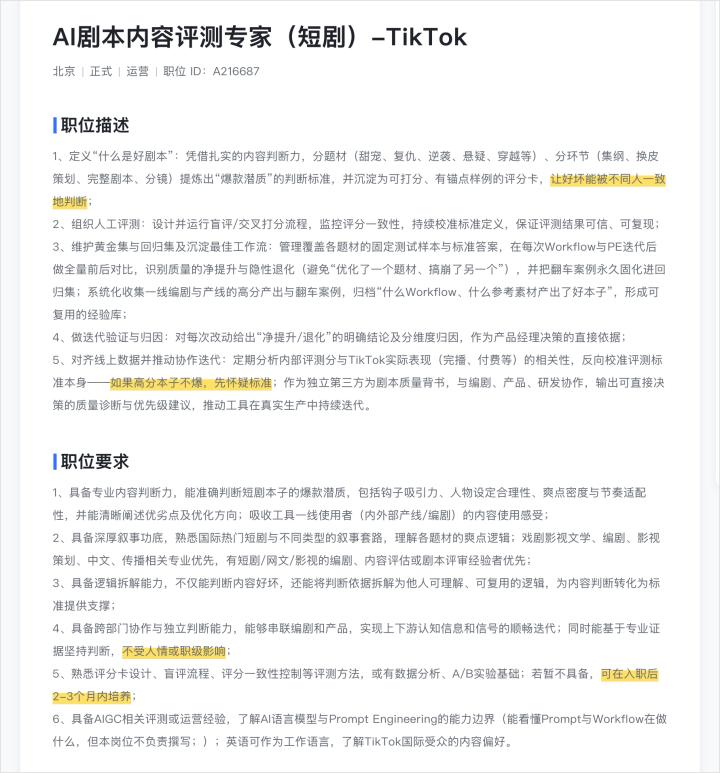
There are two more sentences later:
One is: "If high-scoring scripts do not go viral, question the standards first."
The other is: "Be able to stick to judgments based on professional evidence, unaffected by personal relationships or job levels."
At the end of the job requirements it says:
Evaluation methods such as scoring card design and blind review processes "can be trained within 2-3 months after joining if you do not currently have relevant experience".
Well, we can teach you the methods, but you have to have the judgment yourself.
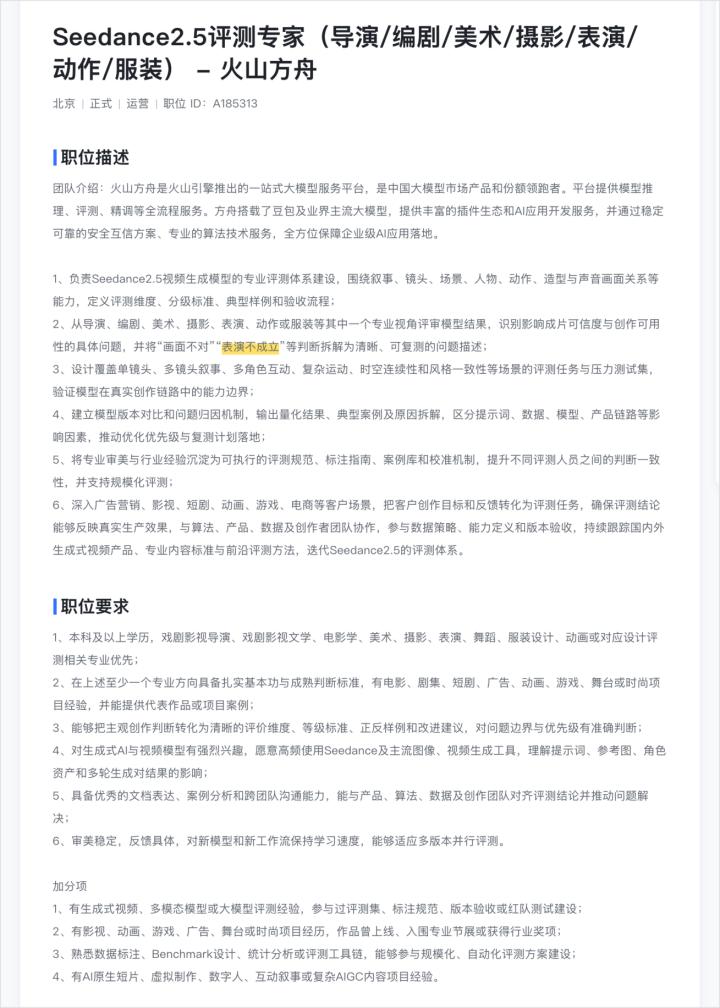
Moving on, the "Seedance 2.5 Evaluation Expert" position at Volcano Ark lists seven job types in parentheses at once:
Director, screenwriter, artist, cinematographer, performer, action director, costume designer.
The second responsibility is:
Review model outputs from one of the professional perspectives above, and break down judgments like "the picture is wrong" and "the performance is not convincing" into clear, reproducible problem descriptions.
In the previous article I guessed that one of the reasons Seedance works so well is the feedback from experienced industry insiders, which is now confirmed in the job description.
Tencent has a more straightforward description.
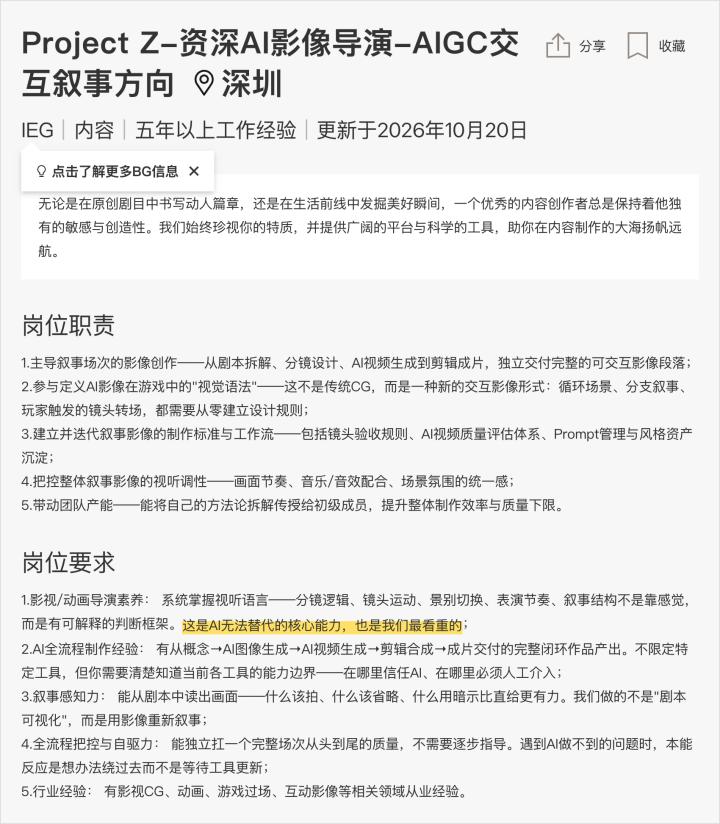
The Project Z team in IEG is recruiting a "Senior AI Cinematography Director", the first requirement is:
Film and animation director literacy — storyboard logic, camera movement, performance rhythm, narrative structure.
Right after that it says:
"This is the core capability that AI cannot replace, and it is what we value most."
Liberal arts students can take a screenshot of this line from the job description and save it.
Alibaba's style is different.
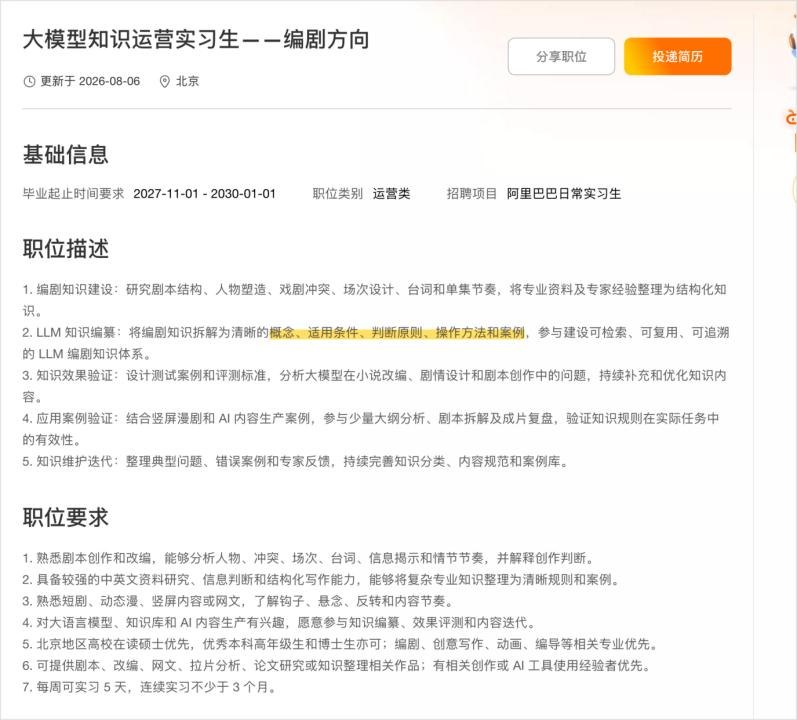
It recruits "Large Model Knowledge Operation Intern" for two directions: screenwriting and directing.
The screenwriting direction requires researching script structure, character building, dramatic conflicts, lines and episode rhythm, and building a complete screenwriting knowledge system for large models.
The craft of screenwriting used to be passed down from master to apprentice through oral teaching, now big tech companies are paying people to teach it to AI models.
Tencent Games has two more positions, let's talk about them together.
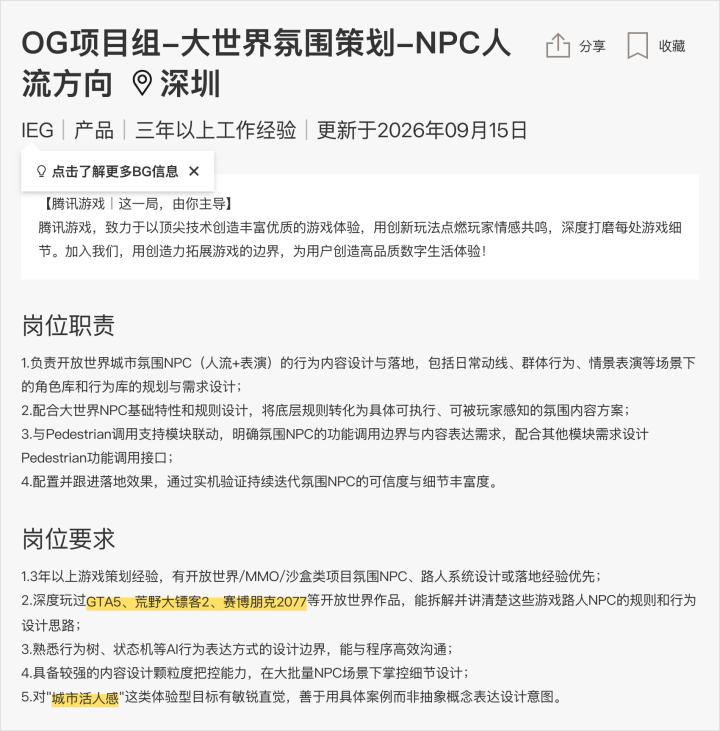
One is the City Atmosphere Planner for an open world project, responsible for the daily routes and group behaviors of passers-by NPCs.
Candidates are required to have played in depth games like GTA5, Red Dead Redemption 2, and Cyberpunk 2077, and have a keen intuition for experiential goals like "the lively feeling of a living city".
The other is "Senior Game Narrative Planner (AI-assisted Tool Direction)":
Need to build a personality library, dynamic memory and multi-turn dialogue strategies for NPCs based on large models, "strike a balance between predictability and emergent sense", and also write Skills by yourself.
In my understanding, designing personalities for NPCs used to be the job of novelists.