AI memory is worth a sky-high price.
The base cost of AI memory has dropped so low that it is hardly associated with "sky-high prices". For the standard version of Alibaba Cloud PolarDB Agent Memory in mainland China, the cost of computing and storage resources for every 10,000 memory entries per hour is 0.015 yuan. If the number of entries remains 10,000 all the time, the cost for 30 days is 10.8 yuan, and model calls are billed separately.
However, more and more companies are competing for this business. OpenAI's ChatGPT, Anthropic's Claude and Grok have all provided personalized capabilities across conversations; database vendors and independent service providers hope to deliver memory capabilities to more applications. Mem0 announced a total of $24 million in financing for its seed round and Series A round in October 2025, and the API call volume disclosed in the same period increased from 35 million times in the first quarter of that year to 186 million times in the third quarter.
What all parties are striving for is the assets that users and enterprises have accumulated: repeatedly explained requirements, handled exceptions, rejected plans, and half-completed work. Storing a few sentences can be very cheap, but making these accumulations continue to work in the next task will affect which service users are willing to entrust their work to, and whether they are willing to switch to another service provider.
The value of memory will eventually be realized in continuous work scenarios.
Chat records are not equivalent to work experience
AI applications can store a large number of conversations, and long-context models can also read a huge amount of text at one time. However, the complete history contains both final decisions and abandoned plans; both long-term preferences and one-off requirements. When the next task starts, the model still needs to judge which content is relevant and which version is valid. Saving the materials only completes one step of the whole process.
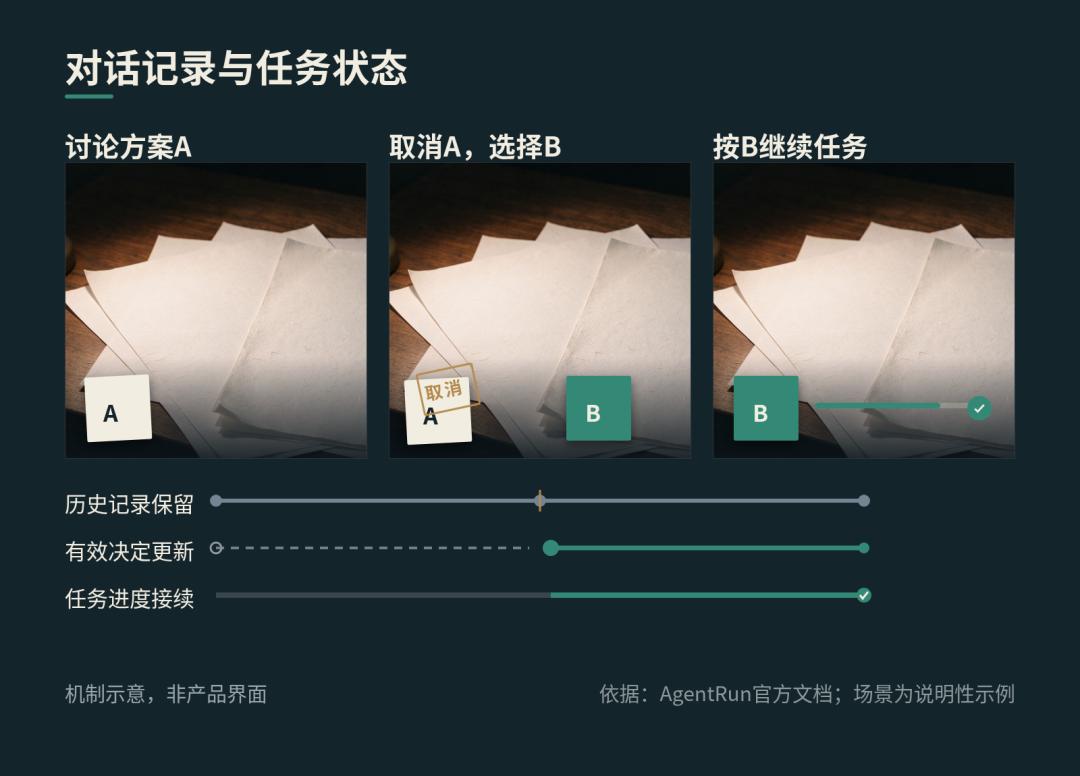
Alibaba Cloud AgentRun manages long-term memory, session history and session status separately. Long-term memory stores cross-session preferences and information, session history retains complete messages, and session status stores variables and progress of the current task. When the user says "please continue", the system needs to know both his consistent requirements and the progress of the current task, instead of applying the completion status of the last task to the current one.
This difference is particularly obvious when there is a project change. After a certain plan is discussed and rejected, there will still be a large number of reasons supporting it in the history. If retrieval is performed only by text similarity, the old plan may be easier to find than a short cancellation decision. Even if the system accurately retrieves the original statement, it may continue to do something that should no longer be done. Memory must retain the sequence and scope of application between decisions, so as to have the conditions to become usable experience.
The LongMemEval benchmark is designed with 500 questions to examine information extraction, cross-session reasoning, temporal relationship, knowledge update, and restraint when the answer cannot be provided. Its small-scale version has about 40 sessions and 115,000 Tokens in a single test history. Finding a name is a different requirement from identifying that this person has later changed their responsibilities. Continuously used AI needs to face the latter kind of change.
Read fewer materials, and lose fewer conditions at the same time
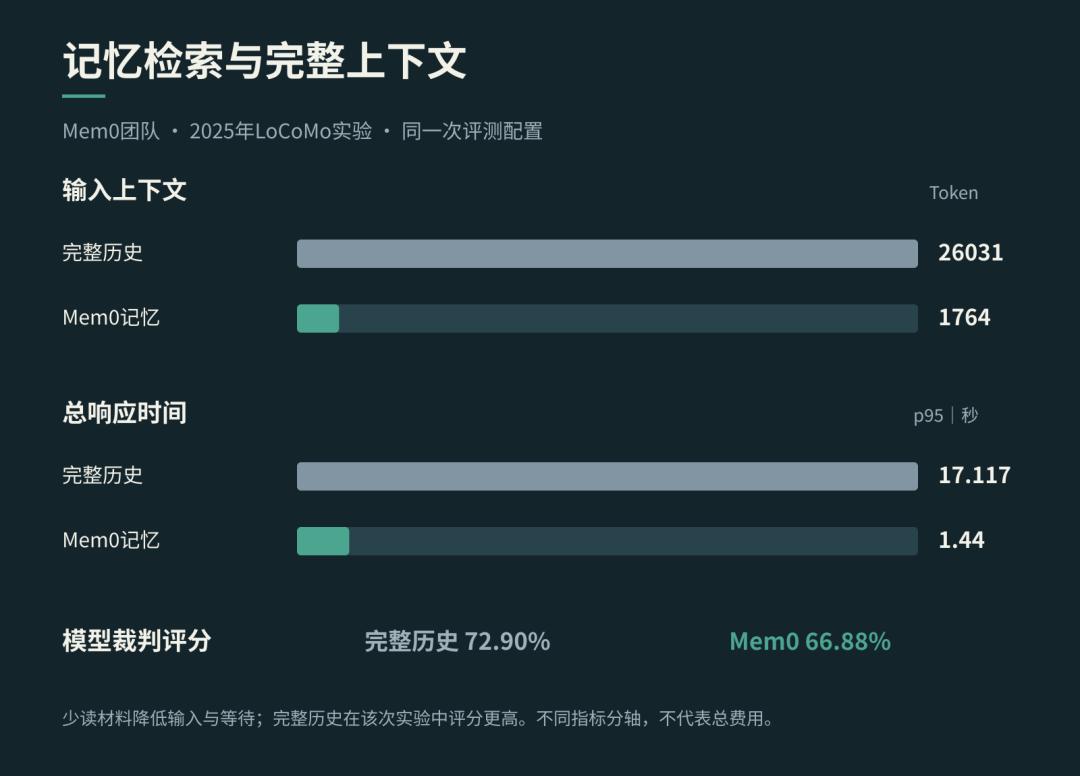
When repeatedly feeding historical data to the model, the first problem encountered is the cost of input and waiting. In the 2025 LoCoMo experiment of the Mem0 team, the full-context solution used about 26031 Tokens per query, while the Mem0 memory scheme used 1764 Tokens; the 95th percentile of the total response time was 17.117 seconds and 1.440 seconds respectively, which means about 95% of the requests are completed within the corresponding time.
However, the model judge score of the full-context scheme is 72.90%, while that of Mem0 is 66.88%. This set of results shows a clear trade-off: memory retrieval greatly reduces input volume and waiting time, while the complete history still has a higher score in this experiment. Reading fewer materials brings benefits, but also has the risk of missing conditions.
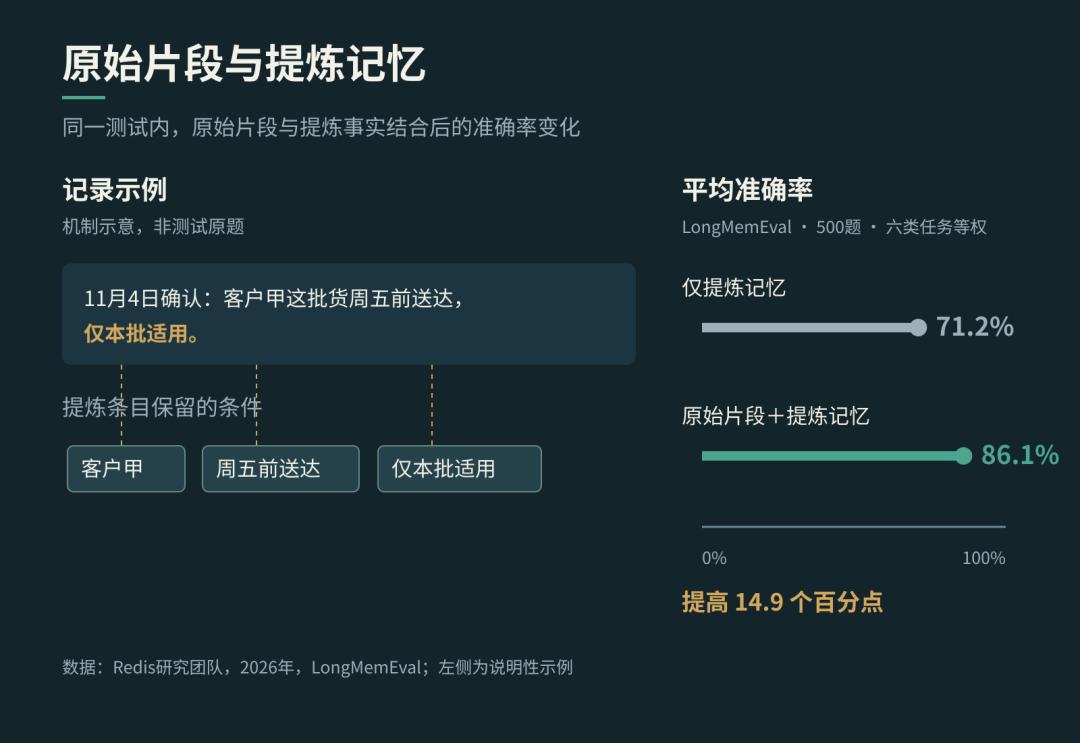
How to balance efficiency and details is the part worthy of more investment. In the LongMemEval test released by the Redis research team in 2026, when only refined memory was used, the average accuracy of six types of tasks was 71.2%; when both original fragments and refined facts were retrieved, the accuracy reached 86.1%. This test included 500 questions and adopted the model judge scoring mechanism, with a gap of 14.9 percentage points between the two configurations.
Refined facts are suitable for merging cross-session information and sorting out changes, while original fragments retain names, dates and specific wordings that are easily omitted in summaries. An exception that may seem insignificant at the time may exactly determine whether the task can be executed next time. Retaining original content leaves the opportunity for subsequent judgment to trace back to the materials. The two studies use different tests and configurations, which respectively answer the cost of reading fewer materials and how to reduce information loss, and cannot be combined to form a ranking of different products.
What enterprises finally need to calculate also includes maintenance and rework. When the same requirement is called multiple times by subsequent tasks, the preliminary sorting work can be reused repeatedly; the more frequently the document is modified, the more investment will be required for extraction, indexing and updating. Caching can reduce the cost of repeated input, but retrieval itself also needs to be measured, and the bill will not only include the storage fee.
Greater losses may occur after the answer is generated. Missing a delivery condition will lead to follow-up supplementary inquiries, rework and manual correction, and the saved Tokens will be consumed by rework. What purchasers really care about is how much time and cost a task takes from being handed over to AI to being completed. Only when memory services improve this overall account can the low unit storage price make commercial sense.
Three AI providers are accumulating understanding of users
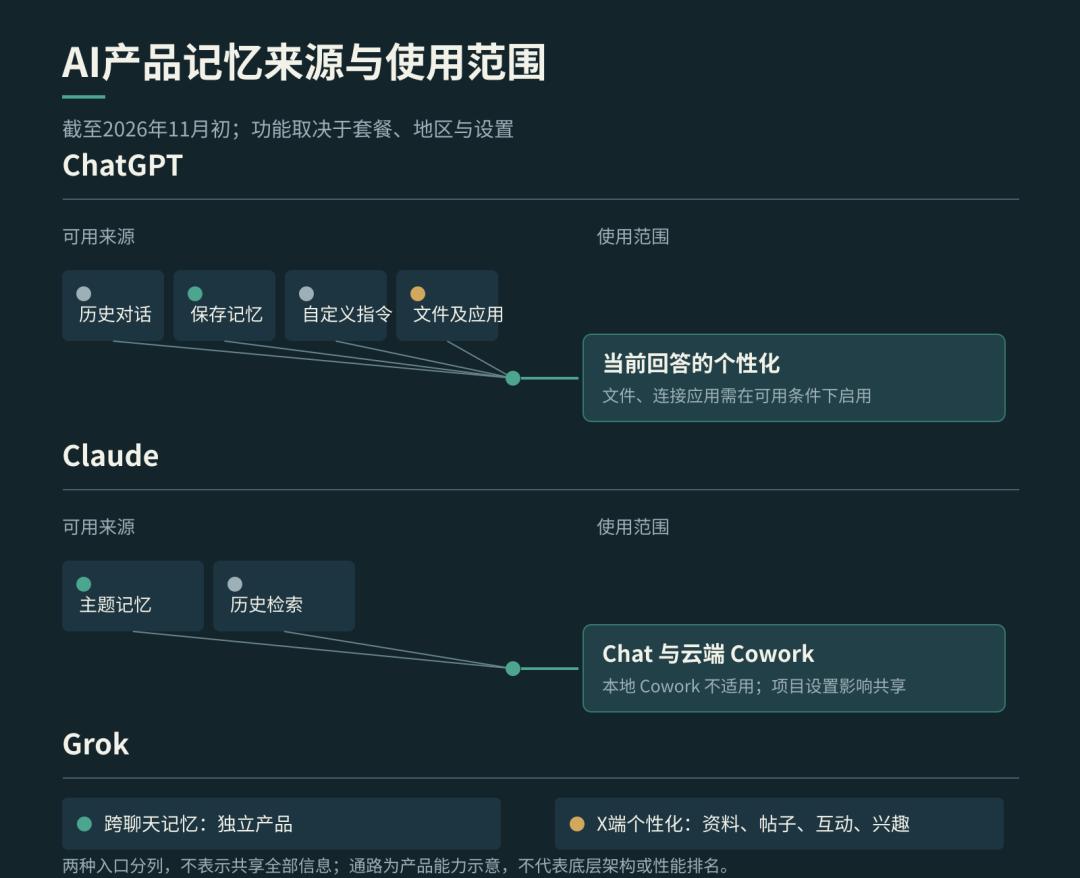
These technical choices have already been integrated into daily products. OpenAI's ChatGPT can use historical conversations, saved memories and custom instructions; under supported plans, regions and settings, it can also use the content of saved files and connected applications. It provides memory summaries, and can display the sources involved in personalization below the answer, so that users can review or correct them, but neither the summary nor the source list is a complete inventory.
As a result, the materials for understanding users no longer only come from the chat window. Project changes in emails and saved work files can all help AI continue the task. With more sources, error correction also becomes more complex: after modifying a summary, old information may still remain in a certain email or document. Users need to be able to find where the error comes from, and service providers need to handle the relationship between different sources.
Anthropic's Claude separately provides theme-based stored memory and historical conversation retrieval. The current version can save memory during the chat process, and can also search old conversations, with retrieval displayed as a tool call. Chat and cloud-based Cowork can share memory, while locally run Cowork does not support this function for the time being; whether project memory and account memory can interoperate depends on the corresponding settings.
This arrangement connects "remembering requirements" and "retrieving original statements", and allows accumulated experience to flow along with work. When users shift from discussion to task execution, the previously explained writing style and project background can continue to be used. It is consistent with the previous research direction, but the fact that the product has these entry points does not mean that information can be extracted and called correctly every time, and the actual effect still needs to be tested in continuous tasks.
Grok's official website also lists cross-chat memory, which can remember preferences and past conversations. The X platform also has a set of personalization mechanisms: with corresponding authorization, information such as public materials, posts, interactions and interests can be used for personalization, with independent control items provided. This has different use cases from the ability to search web pages and public posts in real time. Search complements external ongoing events, while personal memory helps the system understand users' previous requirements and decisions.
The three providers have different information sources and control methods, but their common goal is to reduce users' labor of repeatedly explaining requirements. What is discussed here is how products store and use context, not that the model permanently writes each piece of personal information into its weights. The continuity experienced by users comes from the work completed jointly by the model and peripheral systems.
This also increases competitive pressure on independent memory service providers. If the demand is only to remember occupation, writing style and commonly used tools, the built-in functions of the platform may already be sufficient. The reason why third-party providers continue to charge is that they need to enter more complex work scenarios: whether multiple models can use the same set of experience, whether different members can call it according to permissions, and whether it can be corrected in time after business changes. After preference preservation becomes a basic capability, reliably reusing accumulated work experience is more difficult to be replaced.
What enterprises need is modifiable experience
Database vendors have their own position in this field. The information that enterprises need AI to remember is often already connected to actual business, and updates also occur in business systems.
Oracle's Agent Memory product description cites a logistics scenario: a factory needs specific materials every week, transportation personnel need corresponding qualifications, and delivery must be completed before a specified time. These requirements need to be retained in multiple scheduling processes and updated along with business changes. After remembering a sentence, the system must know which factory and which batch of goods it corresponds to, and when it is valid.
If the memory service stores a separate copy of the requirements, this copy of memory must also change when the business system is modified. Otherwise, AI may skillfully arrange a process that has expired. Oracle lists update, expiration and cascade deletion as product capabilities; Tencent Cloud Agent Memory distinguishes personal memory, agent memory and team memory, team sharing requires explicit authorization and is private by default.
Whether a piece of experience can be reused cannot only depend on whether the content is correct. If the special requirement of a certain customer loses its attribution, it may be applied to other customers; if a temporary exception is saved as a general team rule, subsequent agents may follow it all the time. Memory makes correct practices easy to continue, but also gives errors a longer spread time.
This makes permissions, versions and sources part of the service. When users find problems, they need to distinguish whether the original information is wrong, whether the refinement misses conditions, whether the retrieval selects the wrong version, or the model has a deviation in understanding. Different links require different correction methods. Switching to a larger model cannot guarantee that the previous problems in storage and retrieval will disappear together.
Only memory services that can handle these relationships can become infrastructure for long-term use by enterprises. What customers pay for is not just how many pieces of information are retained, but also that old rules can exit in time after updates, errors can be traced, and information will no longer spread after authorization is withdrawn. The deeper the work is entrusted, the more difficult it is to measure the value of these management capabilities by the unit storage price.
How much memory can users take away
Long-term accumulation will affect the competition between platforms, but it does not necessarily have to stay in the original platform.
Claude has already provided memory import and export. Users can paste the memory text sorted out by other AIs into it, and Claude will extract and save it as entries; users can also export their own Claude memory. Import is still an experimental function, which may not fully absorb all content, but part of preferences and experience already have a migration path along with users.
This changes the way service providers retain users. A writing style preference can be copied, and introductions of several commonly used projects can also be re-entered; relying only on storing these entries, it is difficult to establish a solid long-term relationship. What is really difficult to migrate may be the entire set of arrangements that support the experience to take effect.
Text can clearly state that a certain customer has special requirements, but it does not automatically come with original emails, records of subsequent requirement withdrawal, team authorization and ongoing task status. After migrating to another system, which records should be retrieved, which version takes priority, and who can see what, all need to be re-established. The completion of export does not mean that the same work can continue in the original way.
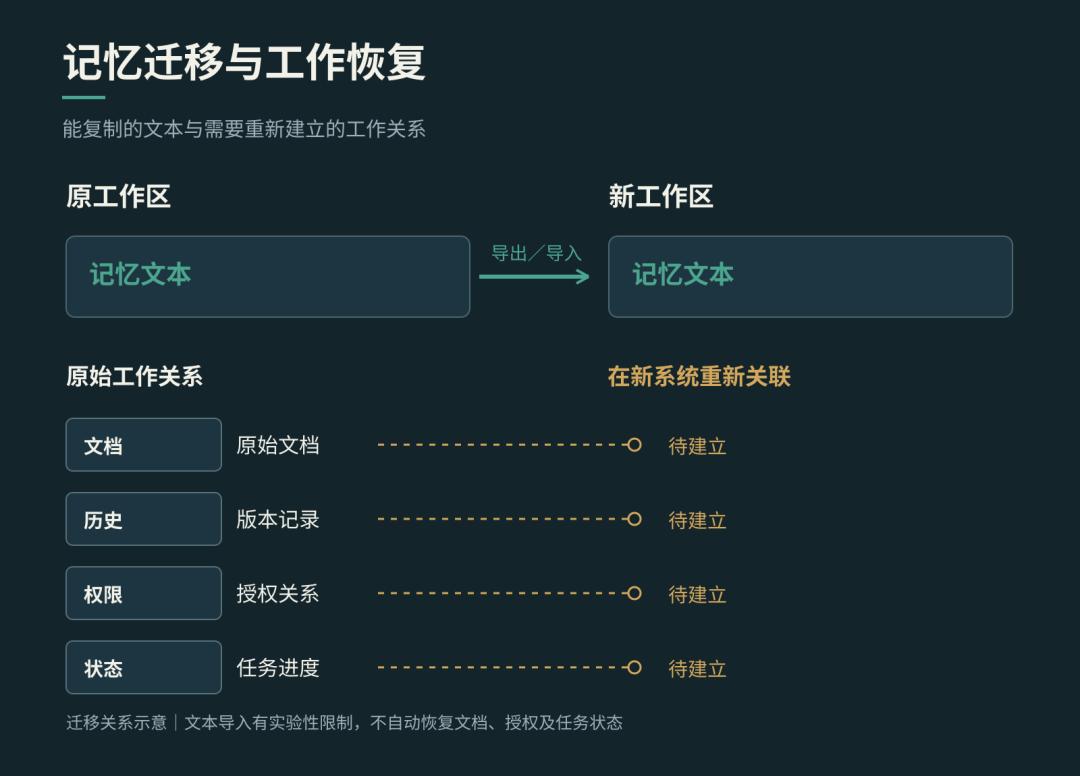
This is also the space that independent service providers can strive for. Platforms hope to retain users through continuous experience, while cross-model memory services need to prove that the accumulation can still be used reliably after replacing the model or application. Enterprises can accordingly keep their experience in systems under their own control, and then select suitable models to complete tasks. The focus of competition between the two sides has shifted from storing information to how to organize and deliver this accumulation.
The high value of AI memory ultimately falls on these specific results: one correction can reduce subsequent rework, one effective handling can help similar tasks, and one expired requirement can exit the decision-making process in time. Storing them may only require a very low base cost, but turning them into reliable, updatable and migrable work capabilities requires long-term service. What users are willing to pay continuously for is the work efficiency that has been changed by these accumulations.
This article is from the WeChat official account "Feng Wei Feng Dabai", author: Feng Dabai, published with authorization from 36Kr.