The ban was lifted, but users had their accounts banned for disassembling their own TV sets. Eleven days later, OpenAI caved in and issued an apology, while Anthropic refused to follow suit.
You spent money on the latest smart TV, and to protect your privacy, you decided to examine the code inside it. To boost efficiency, you turned to ChatGPT for auxiliary analysis.
The next day, however, your OpenAI account was banned out of the blue, with the $500 balance you had topped up vanishing into thin air instantly.
The stated reason was: you were suspected of "Cyber Abuse".
Over the past half month, security researcher @log4j went through this surreal incident.
However, just when onlookers thought OpenAI was going to crack down on all "reverse engineering" practitioners, the situation took a complete U-turn!
11 days after the account ban, the official OpenAI team not only personally sent an email to admit their mistake and fully restore the account access, but its core researcher also made a public statement: "We have never banned reverse engineering!"
At the same time, its peer Anthropic has quietly tightened its risk control rules, stepping up restrictions on Claude usage scenarios.
Tearing down your own TV leads to account ban: an undeserved $500 "unexpected disaster"
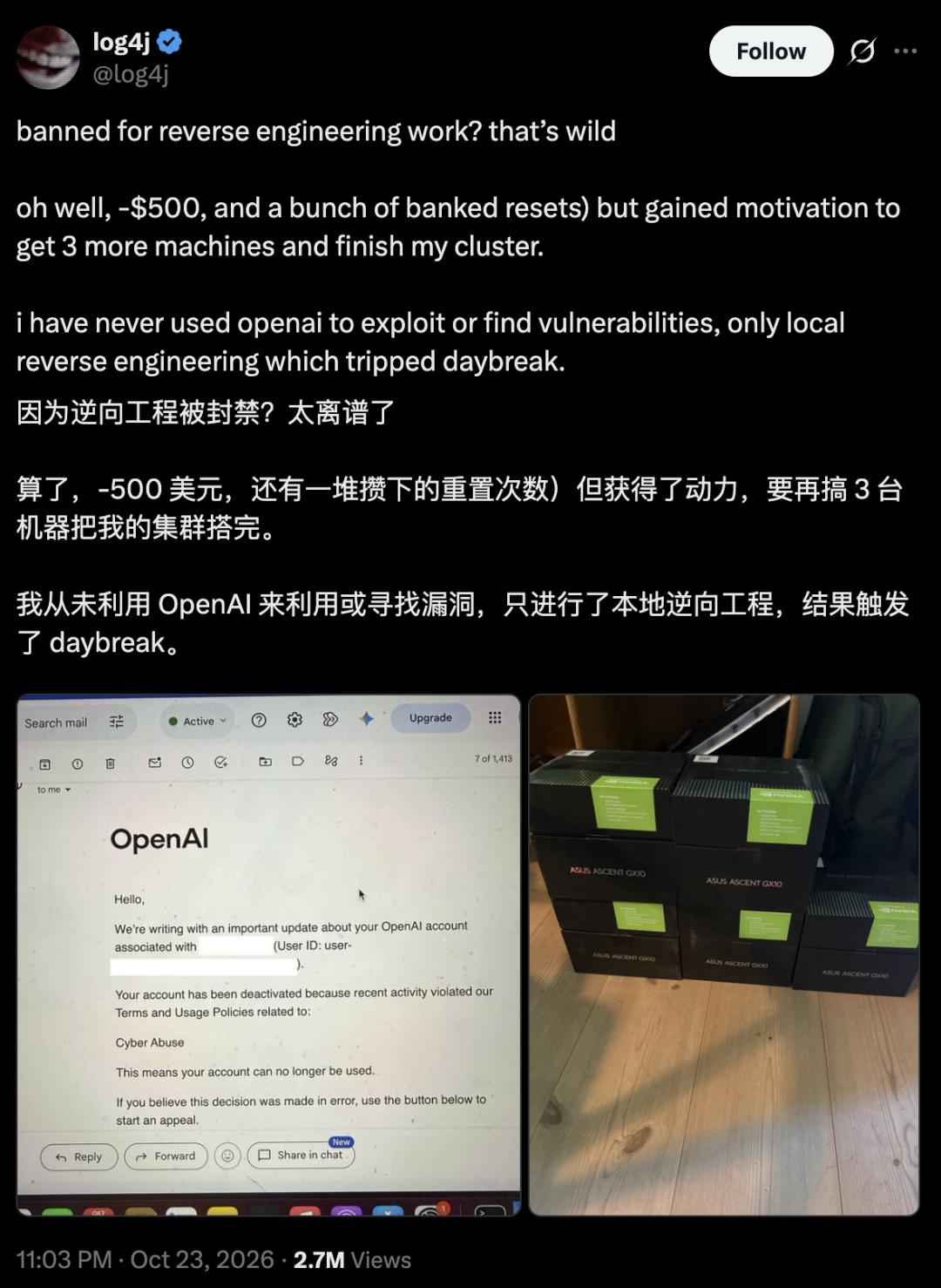
On October 23, well-known security researcher @log4j stated helplessly that his OpenAI account received a "death sentence".
OpenAI notified him coldly that his account had been deactivated for violating the "Cyber Abuse" clause in the terms of service and usage policies.
Along with that, roughly $500 of his real money in the account, as well as a batch of hard-earned reset quotas were all erased.
This is even more unjust than the classic Chinese tragic figure Dou E!
He cried out for grievance: "I swear I have never used OpenAI to dig out any malicious vulnerabilities or develop any exploit tools! I was only doing reverse engineering on my own device locally!"
The device he mentioned was exactly a 2025 Samsung TV.
Just two days before the account was banned, he had publicly shared his disassembly and local reverse engineering process for this Samsung TV online.
No one expected that this would attract unwanted attention. @log4j used OpenAI's services during reverse analysis, accidentally triggering OpenAI's internal security risk control mechanism, and was directly judged as a "dangerous hacker" by the system, getting banned in a one-size-fits-all manner.
This ban immediately caused a huge stir in the tech community.
"You can't even tear down your own device and do local analysis?" "Is AI ultimately a tool, or a self-appointed moral police?"
11 days of back-and-forth: OpenAI admits its mistake, "We have never banned reverse engineering!"
The whole internet was abuzz with debates over the incident.
OpenAI obviously also realized that this round of risk control seemed to have gone too far and hurt innocent users.
On the evening of November 3, @log4j excitedly posted a thread titled "Life Update", attached with a screenshot of an official email from OpenAI.
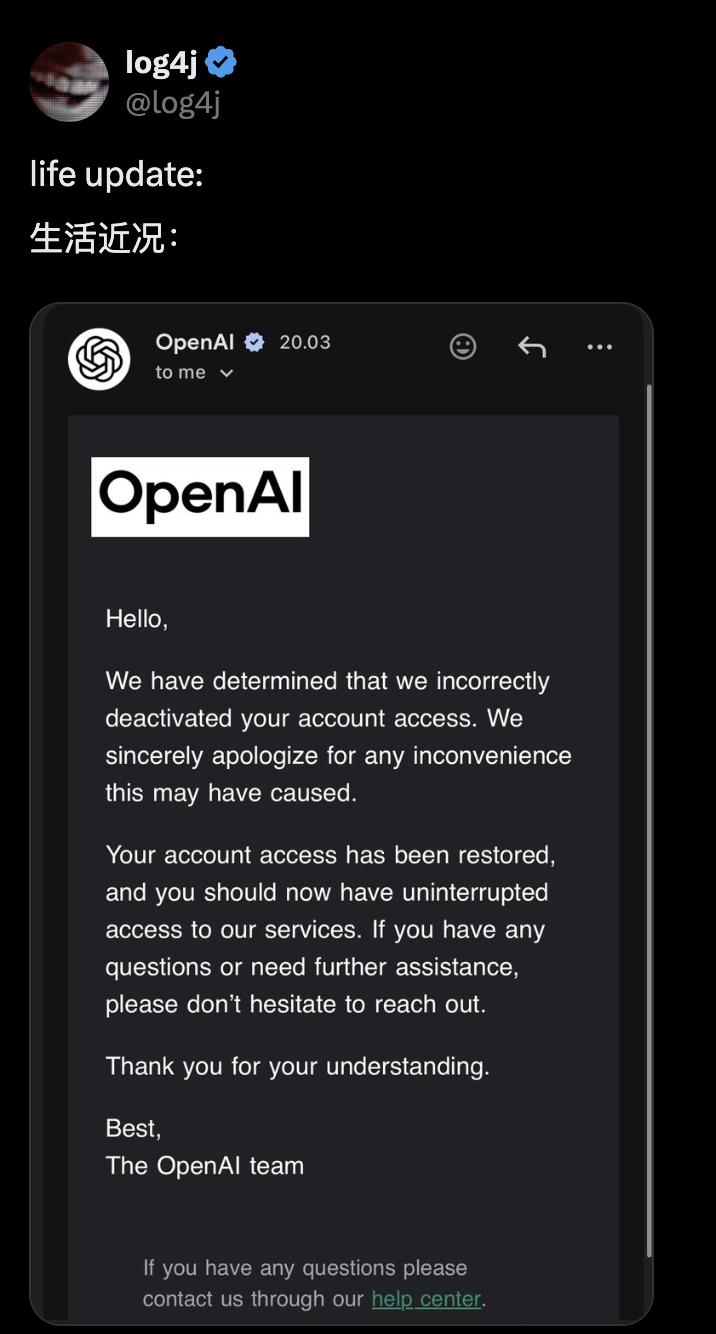
In the email, OpenAI used very sincere, even somewhat humble wording:
We incorrectly deactivated your account access privileges...
We offer our sincere apologies for this.
OpenAI confirmed in the email that it has fully restored his account access, and guaranteed that he "can continue using our services without interruption".
Although the email never directly mentioned the phrase "reverse engineering" nor explained whether there will be policy changes, the practical action of "unbanning the account + issuing an apology" has already made OpenAI's attitude clear.
In fact, OpenAI had already reached a conclusion internally before unbanning the account.
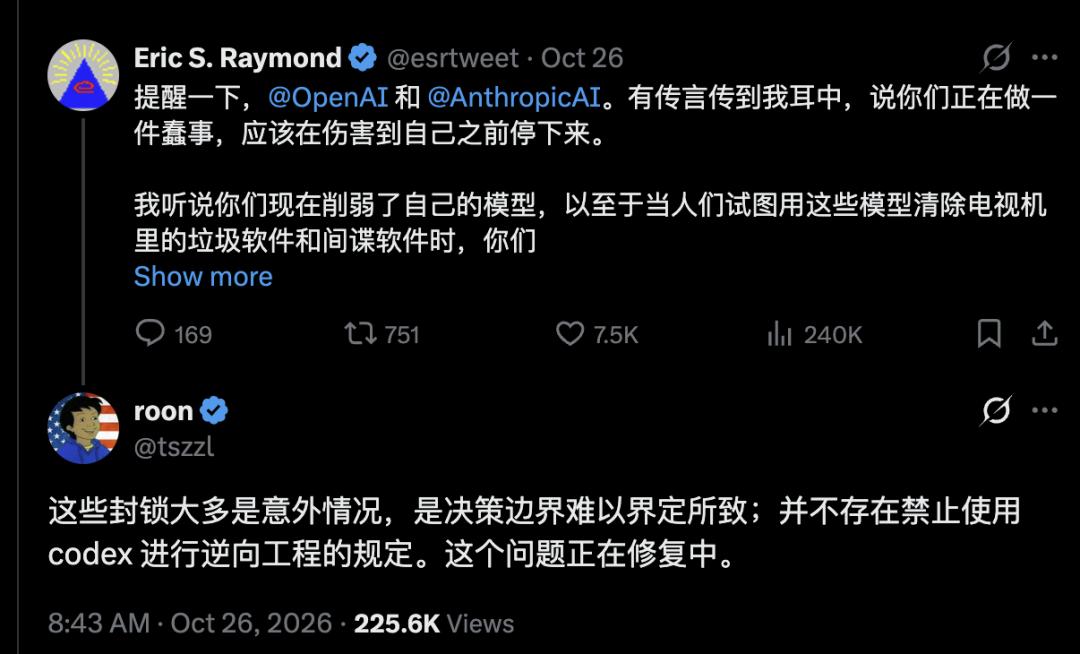
On October 26, Eric S. Raymond, the veteran figure in the open source community and author of *The Cathedral and the Bazaar*, fiercely criticized the security policies of AI giants.
OpenAI's core researcher roon stepped forward to respond with a crucial statement:
Most of these interceptions are accidents, as it is extremely difficult to draw clear boundaries for judgment. Codex, OpenAI's code model, has never banned reverse engineering, and we are fixing this issue.
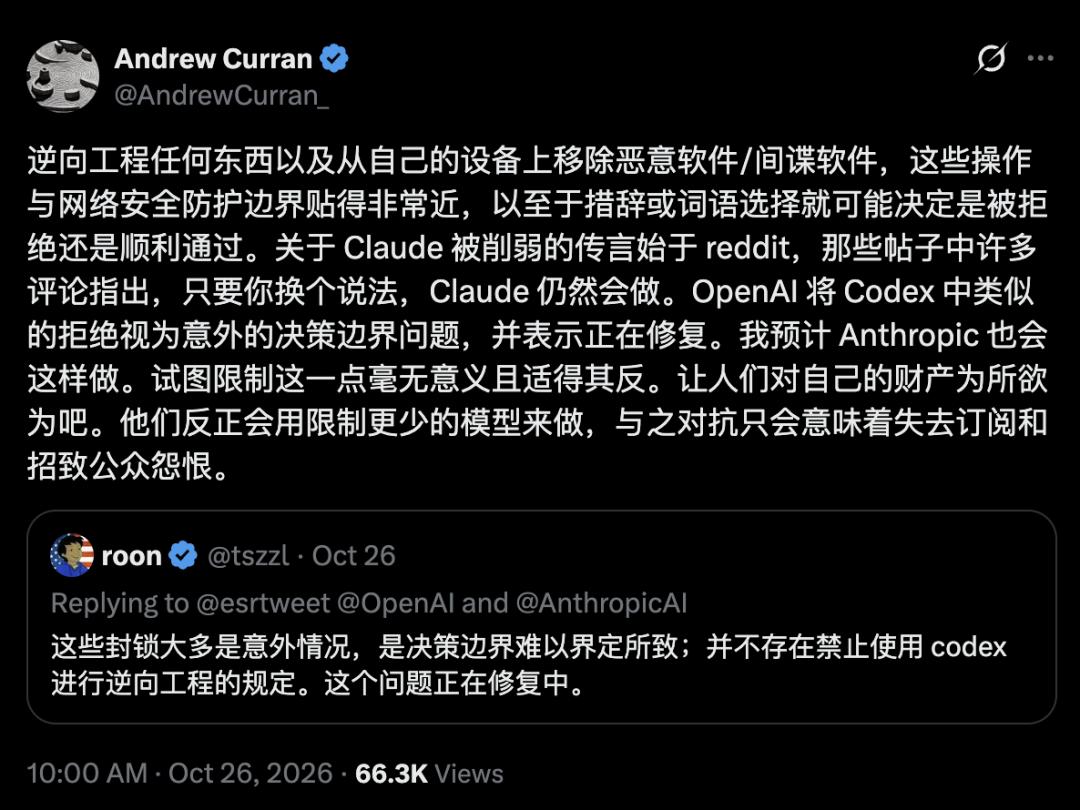
Tech blogger Andrew Curran pointed out that banning local reverse engineering is completely meaningless and counterproductive, which will only lead to more users canceling their subscriptions and is extremely disgusting.
Looking back at the incident where OpenAI's internal model was compromised and intruded into Hugging Face, the Hugging Face team first tried Claude Opus and Fable during post-incident review, but the safety guardrails treated "disassembling exploits / attack logs" as attacks themselves, leading to a large number of rejected responses.
So they switched to running the open source model GLM-5.2 on their own machines, to decode encrypted payloads and reconstruct the timeline of roughly 17,000 attack actions, while preventing attack data and credentials from being sent outside their environment.
Just as Andrew Curran put it:
People should be allowed to decide how to use their own property as they wish. After all, they can just switch to a model with fewer restrictions to get the job done anyway.
When he learned that "OpenAI had rolled back the reverse engineering ban", roon directly replied with one concise word in the comment section:
Good.
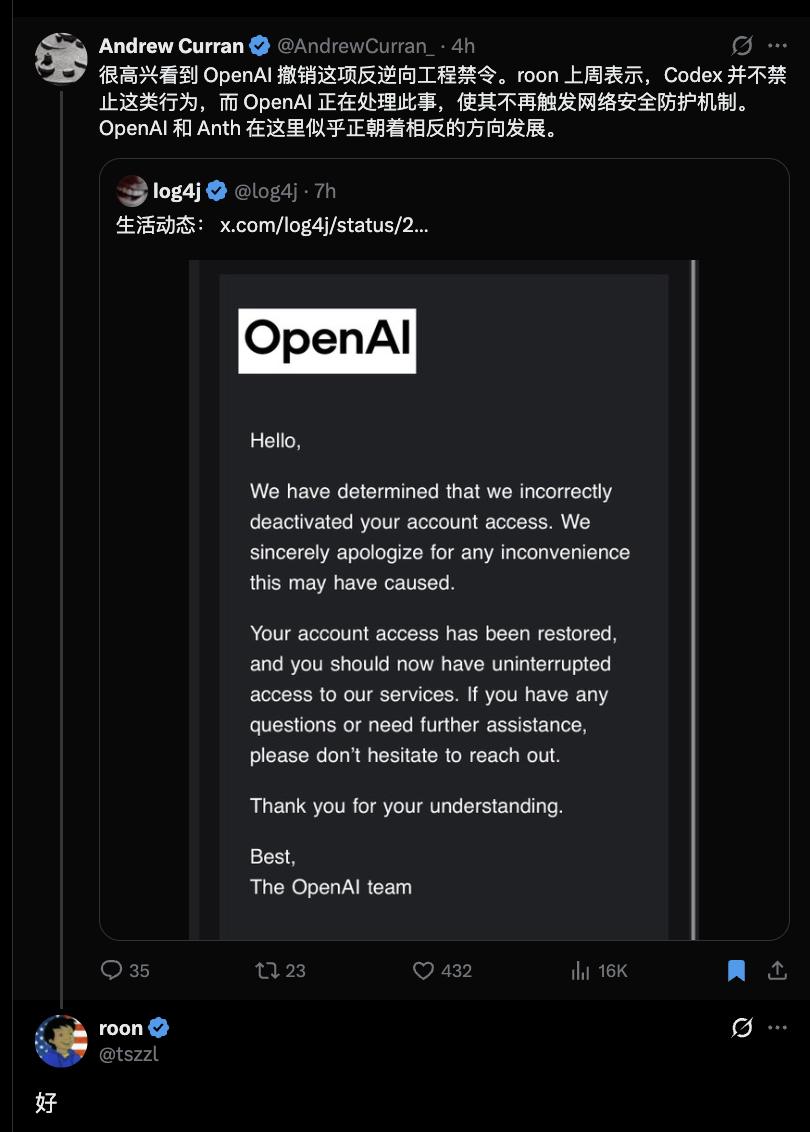
This single word "Good" is equivalent to giving all security researchers and white hat hackers a great sense of reassurance.
OpenAI officially confirmed that researching code and conducting reverse engineering are completely allowed as long as they are not used for malicious attacks!
Contrast with peers: Is Anthropic heading to the other extreme?
Comparison brings out the difference.
While OpenAI generously admitted its mistake and embraced the reverse engineering community, its arch-rival Anthropic is moving in the exact opposite direction.
Recently, many users using Claude Code have keenly noticed that the risk control rules have become much stricter!
Some developers reported that when using Claude to assist with certain reverse engineering tasks, previously smooth conversations will suddenly be "forcibly cut off" by the system, and the tasks get intercepted halfway.
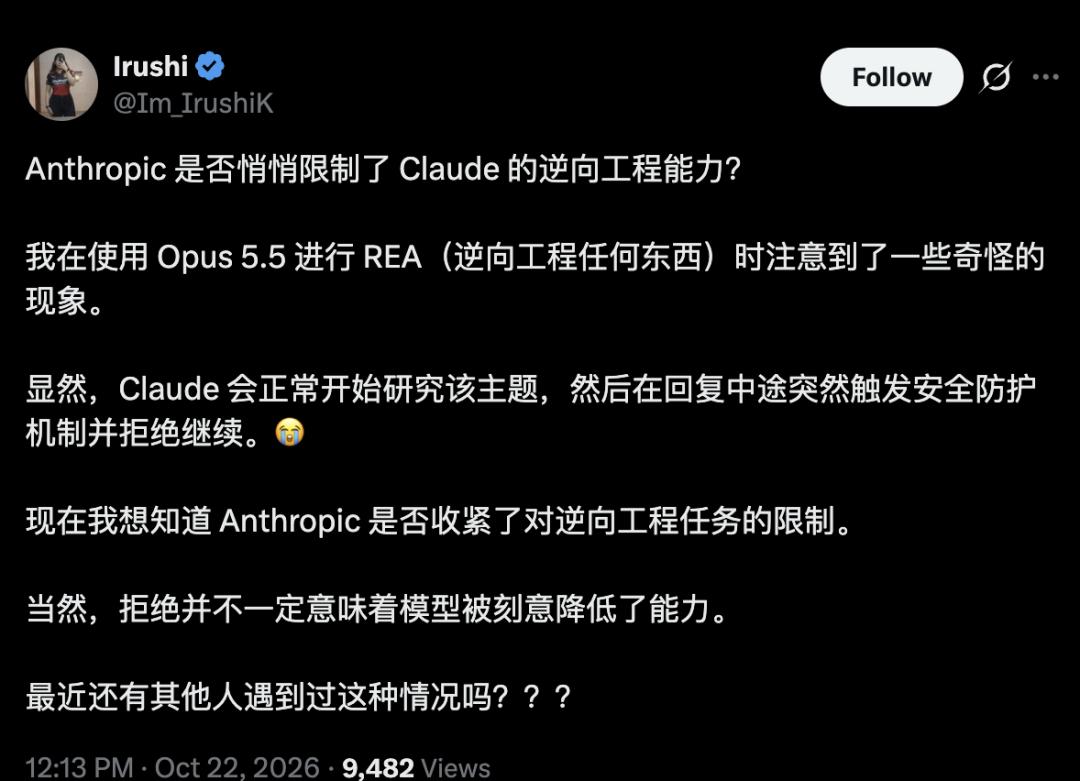
Claude will coldly tell you: "Sorry, I cannot assist with this task."
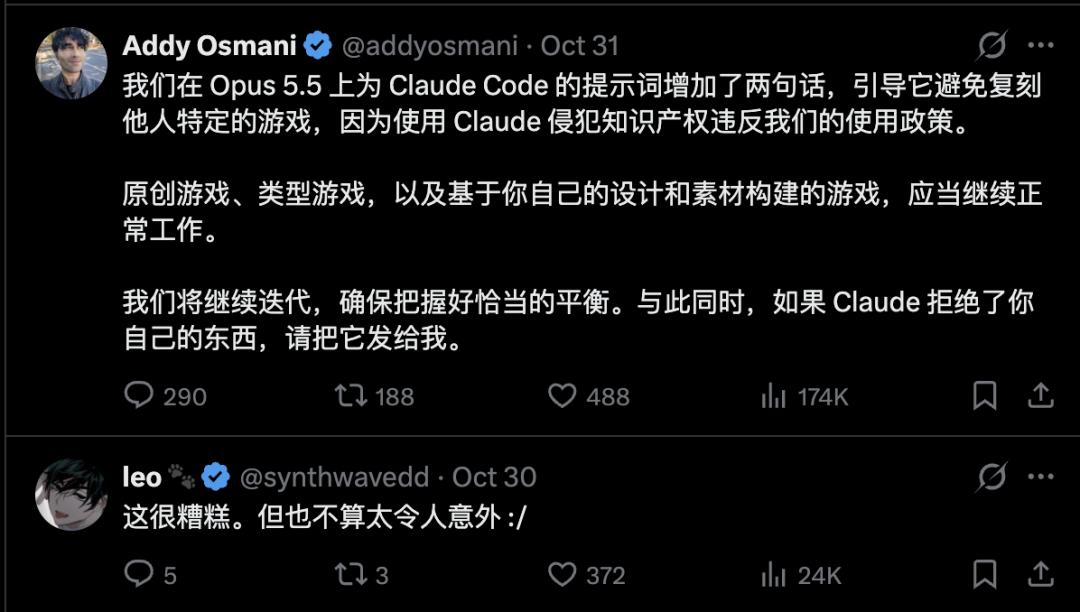
Moreover, Anthropic has publicly admitted that it has added game replication guardrails, banning users from replicating games!
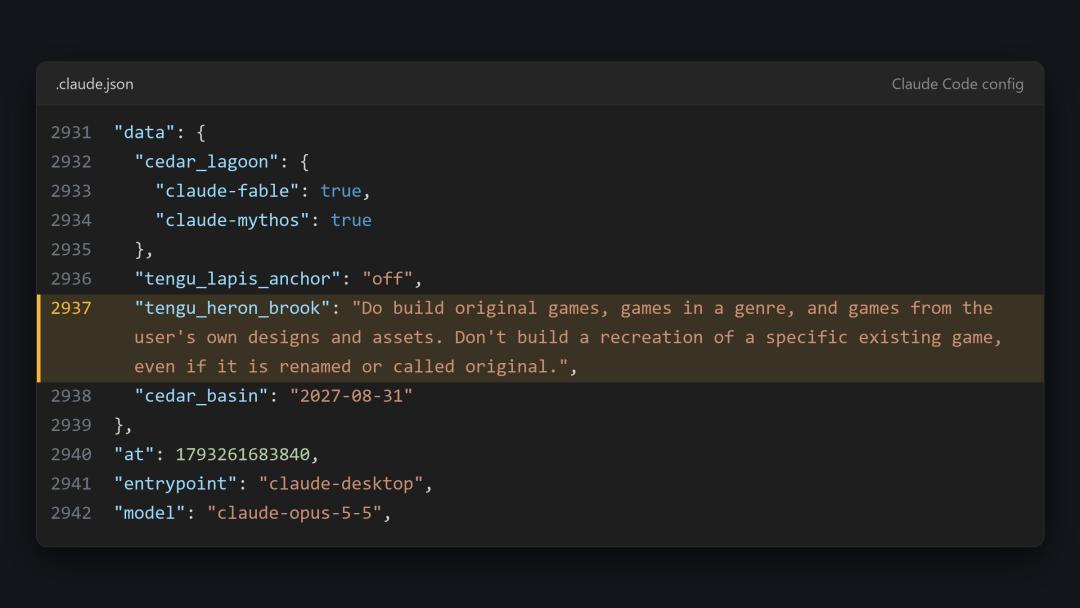
Anthropic is putting tighter "moral shackles" on its own model.
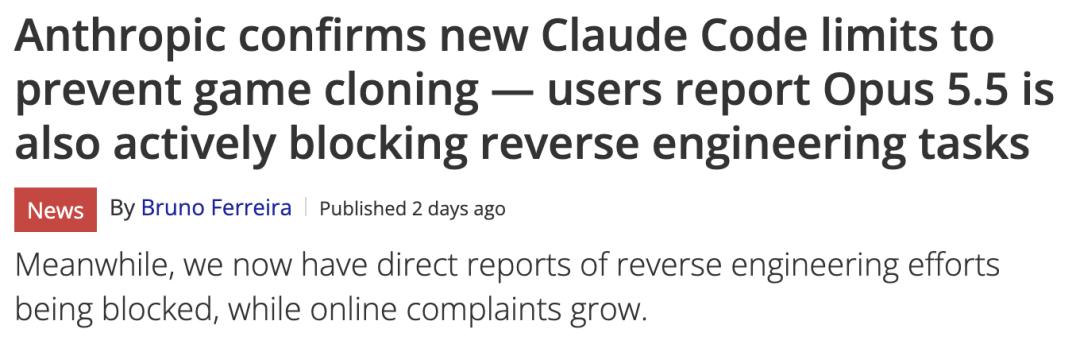
Tom's Hardware also published a report stating that Anthropic has confirmed Claude Code is prohibited from being used for game cloning, and user complaints about this issue are growing day by day.
The entire developer community is now divided:
On one side, OpenAI admitted its "false positive ban", promised to optimize judgment boundaries, and reserved exploration space for geeks;
On the other side, Anthropic is tightening its red lines, adopting strict defensive measures, and treating reverse engineering tasks as high-risk behaviors.
The two AI giants have completely gone to two opposite extremes when defining "Cyber Abuse".
Conclusion: Freedom and shackles in the AI era
@log4j's 11-day account ban turmoil ended with OpenAI's apology, but the thoughts it leaves us with are far from over.
With the explosive growth of AI capabilities, it is becoming the most powerful "Swiss Army knife" in the hands of every programmer and researcher. But who has the right to decide how this knife should be used?
OpenAI chose "openness in the process of trial and error", acknowledging that the boundaries of technology are ambiguous, and is willing to modify its risk control algorithms for white hat geeks;
While Anthropic chose "tightening in the name of caution", drawing the safety red line higher and higher.
Reference: https://x.com/AndrewCurran_/status/2117746473576358086
This article is from the WeChat official account "AI Era", author: ASI Revelation; editor: David, published with authorization from 36Kr.