Unitree's quadruped robot won the championship on Mount Tai, but the humanoid robot was carried down the mountain on a stretcher.
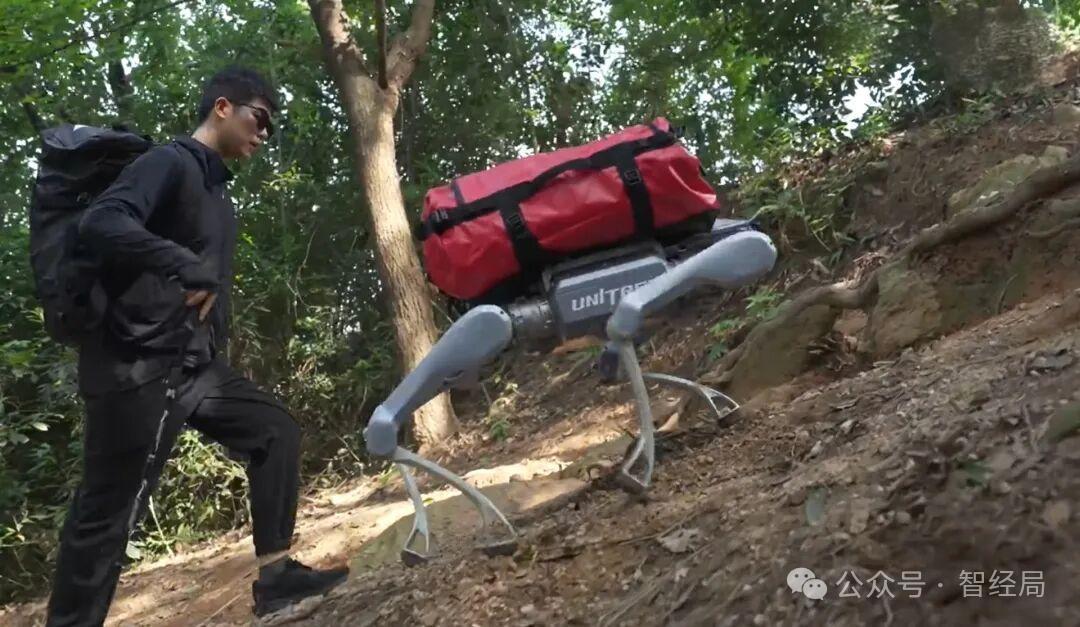
At the Taishan Robot Competition, the quadruped robotic dog won the championship, while the humanoid robot withdrew from the race due to overheating.
A highly contrasting scene unfolded on Mount Tai on November 2.
On one side, the team of Beijing Lingyi Technology under Unitree Technology, with its A2 robotic dog, claimed the championship of the legged robot racing event with an actual time of 41 minutes and 41 seconds (final time 43 minutes and 41 seconds, with a 2-minute penalty). The full course of 3.9 kilometers has over 3,100 steps, and the A2 operated in fully autonomous mode throughout the whole journey, conducting real-time perception and real-time decision-making, achieving stable and fast movement on irregular stone steps.
On the other side, the Unitree G1 humanoid robot, the same model that appeared in the Spring Festival Gala, was placed on a stretcher and carried down the mountain by the staff midway through the competition. The operator explained that they chose to withdraw from the race midway for safety concerns, fearing overheating of the robot. This unit was sent by Yongda Zhicheng based on the Unitree G1 developer version, and it was not an official participating product of Unitree.
Two types of robots, two completely different results. This is not a show, but a test question.
01 The robotic dog passed the test, while the humanoid robot was carried down the mountain
The first CMG World Robot Mount Tai Climbing Competition is hosted by China Media Group, jointly organized by China Software Testing Center, relevant departments of Shandong Province and the Tai'an Municipal People's Government. The track takes the hiking trail from Hongmen to Zhongtianmen as the start and end points, with a total length of about 3.9 kilometers and more than 3,100 steps. It takes continuous stone steps, steep slopes and curves as the core challenges, testing the robots' movement and autonomous decision-making capabilities in complex mountain environments. The qualifying round was held on October 26 earlier, and the main competition concluded on November 2.
Unitree's competition record includes 1 gold medal and 2 silver medals. The A2 of the Lingyi Technology team won the championship of the racing event; the Shanghai Gaoyi Technology team used the Unitree A2 to win the runner-up in the racing event, and used the Unitree B2 to win the runner-up in the load-bearing event. The B2 effectively carried 66 kilograms of load in the section from Wanxianlou to Doumu Palace, with an actual total load of 74 kilograms including the bracket, and climbed the steps steadily under full load.
It is worth noting that Unitree officially only sent two quadruped robots, A2 and B2, to participate in the competition, on the grounds of limited time and energy; there were also many independent teams on site that participated spontaneously after secondary development based on Unitree's products. The G1 that was carried down the mountain was the participating entry of Yongda Zhicheng, the Unitree G1 developer version, which is the same model as the one in the Spring Festival Gala. In other words, both the one that reached the summit and the one that withdrew from the race are based on Unitree's technical foundation, but with different forms.
02 Quadruped robots can climb up while humanoid robots cannot, the bottleneck lies in heat dissipation
Withdrawing from the race due to overheating is no accident. From the perspective of structural principle, humanoid robots have a high center of gravity and narrow gait, and each step requires the joint motor to continuously output high torque to counteract gravity. It may perform well running a hundred meters in the laboratory, but in an environment with continuous climbing and poor heat dissipation conditions like Mount Tai, local air cooling cannot suppress the accumulation of heat.
This is a common problem in the industry, not a problem exclusive to Unitree. A mechanical industry research report from Sealand Securities breaks down the sources of heat generation: When the robot is running, about 90% of the energy is directly converted into heat instead of doing work. The winding of the joint motor generates a large amount of copper loss when outputting high torque, the reducer generates frictional heat due to gear friction and viscous resistance of lubricating oil during high-speed or frequent forward and reverse rotation, and the power devices in the driver also continuously lose energy under high-frequency operation; the carried GPU and NPU chips are also major heat generators when performing visual processing. If the heat cannot be dissipated, the joints will overheat and reduce the operating frequency, and the dexterous hands will lose accuracy.
Quadruped robots have natural advantages in structure: low center of gravity, dispersed force on four limbs, and the load pressure on a single joint is less than the high torque working condition of the lower limbs of humanoid robots. Even so, the process of winning the championship was far from easy. On-site reports mentioned that some steep slope sections still required rope traction, some continuous operation required spray cooling, and some needed to replace accessories due to joint wear and foot end loss.
In this test question set by Mount Tai, the quadruped robot barely passed, while the humanoid robot directly suffered from overheating. The most unglamorous engineering problems such as heat dissipation, battery life and reliability are exactly the watershed that determines whether robots can move from the laboratory to the real world.
03 Unitree's account book: Quadruped robots are making profits, while humanoid robots are catching up on basic capabilities
Another highlight of this competition is the product line strategy of Unitree, the first humanoid robot stock on the A-share market.
On August 19, 2026, Unitree Technology was listed on the Sci-Tech Innovation Board. From a valuation of 13.33 million yuan in the seed round in 2016 to a market value of nearly 61 billion yuan, its valuation has increased by more than 4,500 times in ten years. As of July 2026, Unitree's biped humanoid robots have been cumulatively produced and rolled off the production line for about 18,000 units; the total shipment in 2025 exceeded 5,500 units (calculated based on pure humanoid robots, excluding wheeled dual-arm robots), ranking first in the world; the target shipment for 2026 is 10,000 to 20,000 units.
From the perspective of revenue structure, from January to September 2025, the revenue of Unitree's humanoid robots exceeded that of quadruped robots for the first time, reaching 595 million yuan and 488 million yuan respectively.
But the leading position of humanoid robots is not stable. An on-site visit by CLSA in June this year showed that Unitree focused on displaying and selling C-end products such as the basic version of G1 humanoid robot (85,000 yuan), the basic version of R1 humanoid robot (29,999 yuan) and Go2 robotic dog in its experience hall. The commercial consumption revenue of quadruped robots has surpassed the scientific research and education sector for the first time, while 70% of humanoid robots are still sold to universities and scientific research institutes.
Fiercer competition lies in the shipment end. According to data from Counterpoint Research, in the global humanoid robot shipment pattern in the first half of 2026, Zhiyuan ranked first with about 9,700 units, accounting for more than 43% of the market share, and Unitree ranked second with more than 7,000 units, accounting for about 31%; from the perspective of shipment flow, cultural and entertainment commercial performances, scientific education and data collection still account for more than 60%, and humanoid robots are still far from the front line of production.
The basic market of Unitree's quadruped robots is not weak: from 2023 to 2025, the total sales of Unitree's quadruped robots have exceeded 30,000 units, ranking first in the world for many consecutive years; the first three-quarter report after listing shows that the revenue in the first three quarters of 2026 was 1.817 billion yuan, a year-on-year increase of 55.71%, but the non-recurring profit and loss deducted net profit was 349 million yuan, a year-on-year decrease of 18.78%. The main reason for the profit decline is that the company concentrated its funds on the research and development of embodied large models and computing power, that is, to make up for the shortcomings of humanoid robots.
Putting the account book and Mount Tai together, Unitree's strategy is very clear: the quadruped robot has been able to climb over 3,100 steps in a fully autonomous manner, and is accelerating into real scenarios such as mountain patrol and material transportation, which is a business that can generate revenue immediately; the humanoid robot is still making up for basic engineering problems such as overheating, and needs to first increase production capacity and shipment volume, and then solve the problems of being able to climb and not overheating.
Quadruped robots are making money, while humanoid robots are catching up on basic capabilities. The A2 that reached the summit of Mount Tai is already on sale, and the G1 that was carried down the mountain on a stretcher is still waiting for liquid cooling. Which one the market will pay for, the answer is not in the competition, but in the next financial report.
This article is from the WeChat official account "Caineng Circle", and is authorized for release by 36Kr.