Lei Jun's latest announcement: Xiaomi robots manufacture Xiaomi cars
Your Xiaomi car is being manufactured by Xiaomi robots:
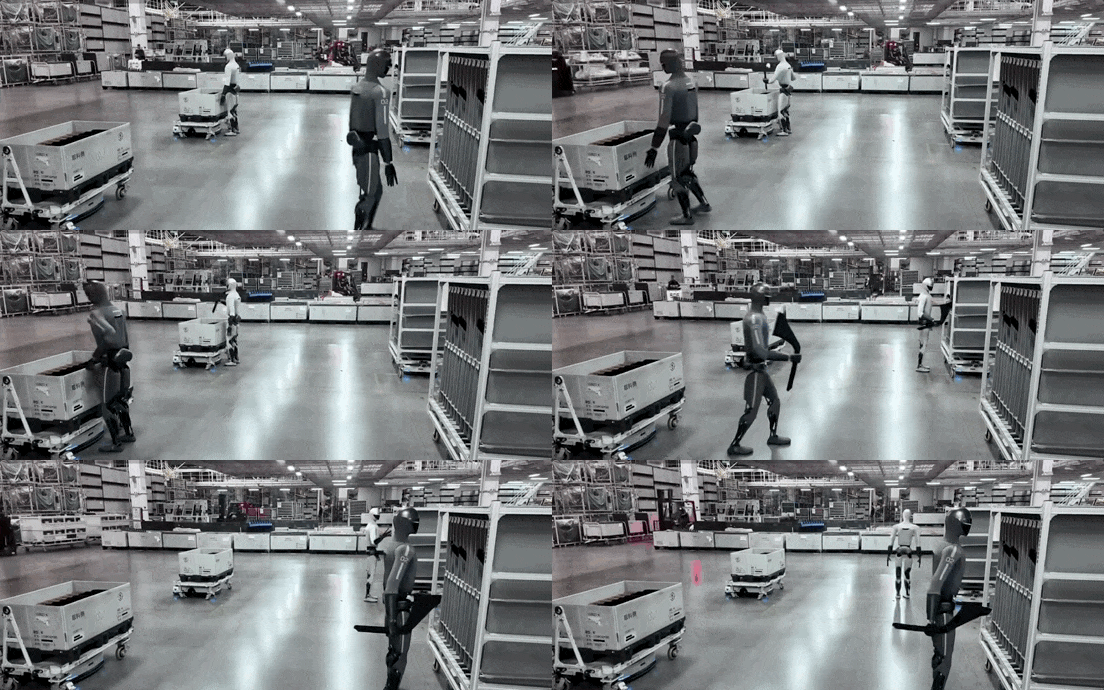
Just now, Lei Jun, founder of Xiaomi, personally released the latest progress:
Xiaomi's humanoid robot has successfully completed stable 8-hour operation in the automobile factory for the first time, fully meeting the all-day production demand.
For Xiaomi, this is a highlight moment that marks its first breakthrough past the critical threshold for embodied intelligence.
On the other hand, it is rather ironic: among all major tech companies, the first one that has implemented the "8-hour working system" is unexpectedly a robot

Xiaomi Robot, the "8-hour Working System"
It is no exaggeration to say that real-world scenarios are indeed the best baseline.
In the video of Xiaomi robots working in the factory in July, you could still see obvious "flaws", such as jitter and operation stuck.
But in the latest footage, CyberOne 02 has been able to continuously complete tasks in the automobile assembly workshop for 8 hours:
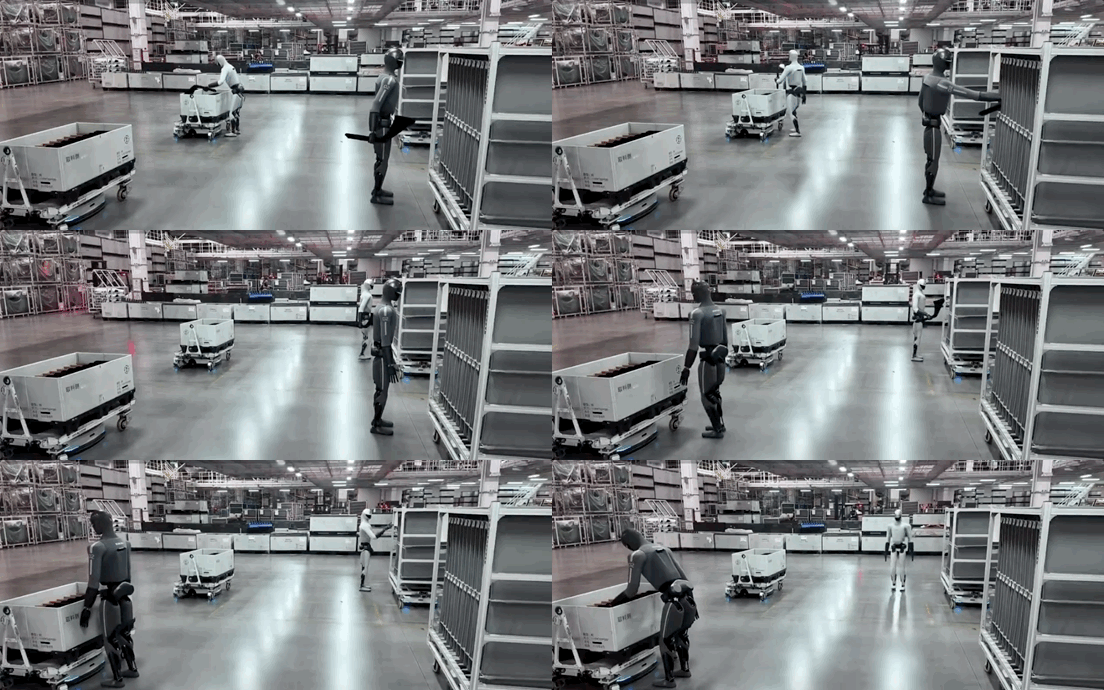
The workstation is responsible for sorting the center console side covers in the automobile final assembly logistics area. These covers are flexible workpieces with large size, irregular shape, and random placement posture, which impose higher requirements on visual positioning and grasping force control than standard structural parts.
CyberOne 02 operates continuously following the production line rhythm within 8 hours, and will automatically adjust its material picking route and stride to cooperate with the incoming material AMR:
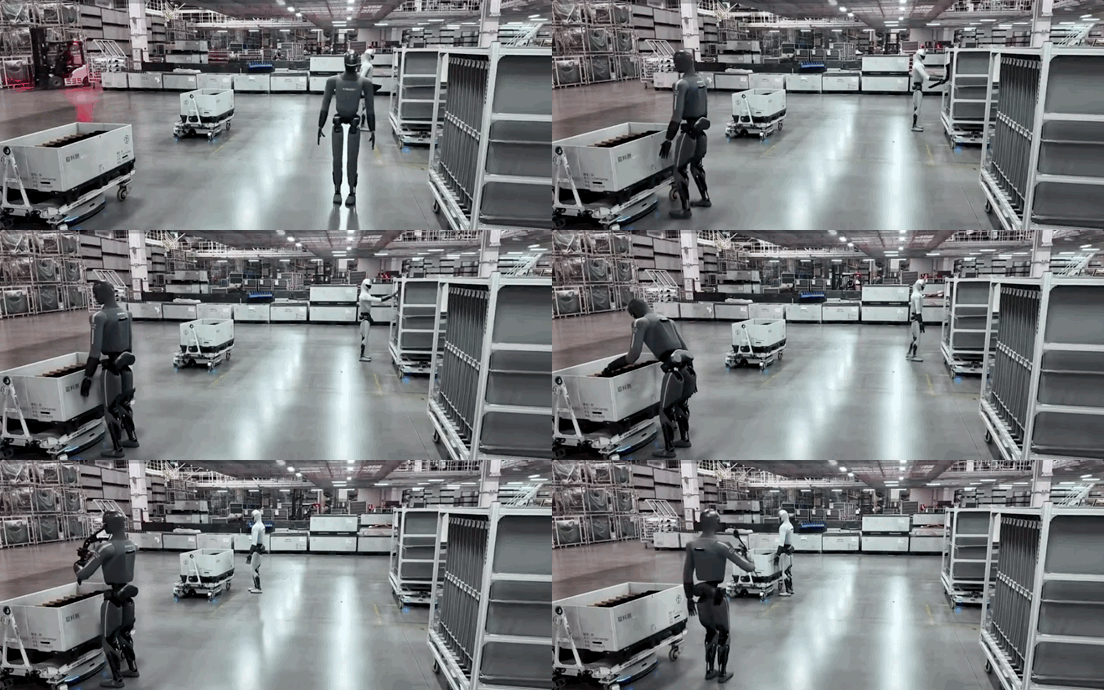
When the AMR changes its post, CyberOne 02 will wait patiently, and can adjust on its own when encountering incoming material deviation or placement failure:
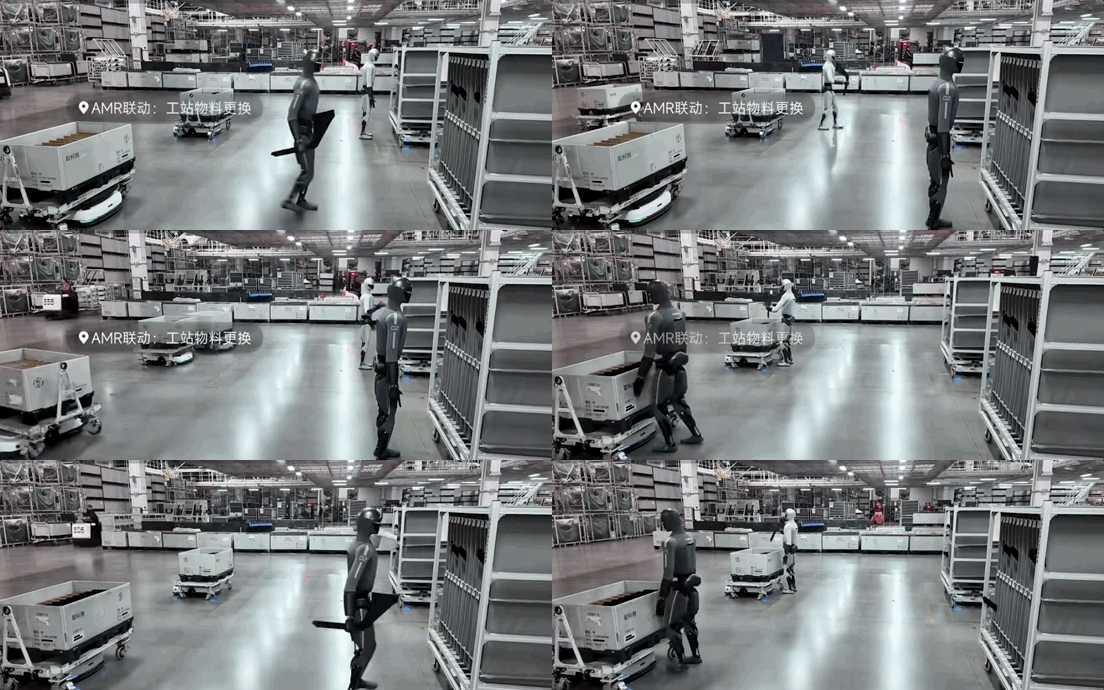
Lei Jun is very modest, defining this stage as the robot's "internship" and the preliminary verification of production-line-level operation capabilities.
In addition to factory scenarios, he also mentioned another scenario:
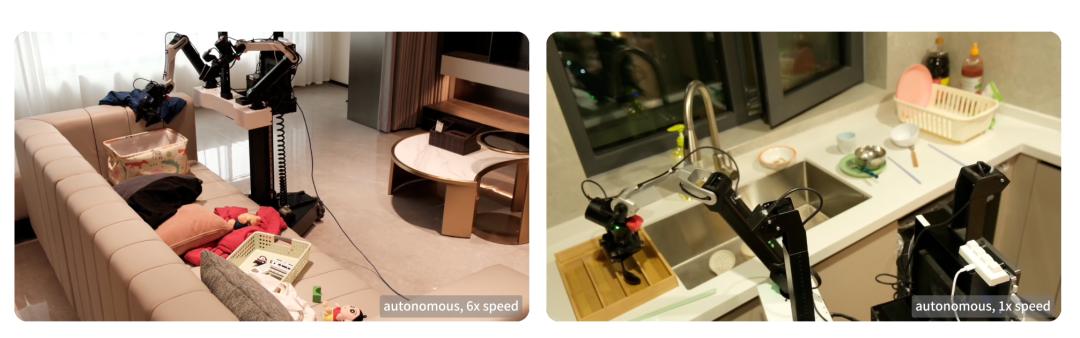
Xiaomi Youth Apartment has completed the verification of long-horizon tasks that last for more than 30 consecutive minutes, cover 3 rooms, and include more than 50 tasks.
It can independently plan and execute complete tasks covering links including tool preparation, sofa and desktop tidying, garbage cleaning, item sorting and placement, room inspection, full-house recheck and departure.
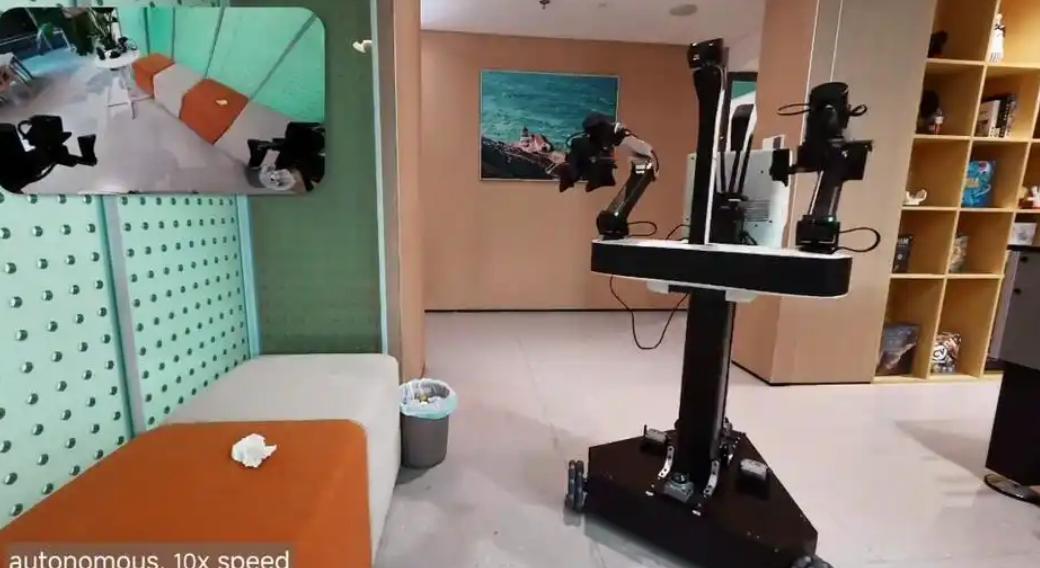
Making progress in both B-end and C-end scenarios, Xiaomi's embodied intelligence presents a completely new look compared to the previous Iron Egg robot.
And Lei Jun also emphasized that no matter which scenario it is, the same set of underlying embodied intelligence model is applied behind.
What is the current progress of Xiaomi's embodied intelligence technology?
The CyberOne 02 robot that "works" in the Xiaomi automobile factory is officially confirmed to be powered by Xiaomi's latest embodied base model, Xiaomi-Robotics-1.
And this is a typical research approach that "finds solutions based on actual problems".
Embodied intelligence has long faced a practical problem: it is very difficult for robots to obtain enough training data as easily as large language models. To learn a specific action or task, a real robot needs to perform it repeatedly in the physical environment, and then collect data through methods such as teleoperation:
However, for robots to repeatedly perform specific tasks in the physical environment, the robots need to be able to perform these tasks first... To this day, there is no universally recognized and efficient kickstart path for the data closed loop of embodied intelligence.
You may say that human operation is the best data source. To be honest, autonomous driving has already stepped into this pit before, and the embodied intelligence field has learned the lesson and will not make the same mistake.

Not to mention the cost issue, even if there is a data collection product that everyone needs and wears every day, how can we guarantee the proportion of key and efficient data that solves corner cases in the collected data?
If we hire people specifically to collect targeted data, we will fall back into the cost dilemma. Therefore, human-generated data can be used for reinforcement and assistance for key cases, but it can hardly be used as the main data source for the iterative improvement of the base model.
What Xiaomi XR-1 tries to solve is exactly the problem of how embodied intelligence can obtain large-scale pre-training data. In other words, it tries to replicate the Scaling Law that has been proven in the large model field.
Specifically, in terms of model architecture, XR-1 adopts an end-to-end VLA (Vision-Language-Action) architecture, and introduces the Mixture-of-Transformers (MoT) design.
To put it simply, VLA needs to connect three links: the robot obtains environmental information through vision, understands the task goal combined with language instructions, and finally generates executable actions.
XR-1 splits this entire process into two mutually coupled core components: the vision-language backbone and the action generation head.
The vision-language backbone adopts the pre-trained Qwen3-VL, which is mainly responsible for understanding the current scene seen by the robot and the language instructions given by users. It provides information at the visual and semantic levels to help the model judge the current environmental state and task requirements.
The action generation part adopts Diffusion Transformer (DiT). It takes the state of the robot body and the KV cache provided by the vision-language model as conditions, and generates the action sequence for a period of time in the future through Flow Matching, that is, Action Chunk.
The architecture has a clear division of labor: Qwen3-VL is responsible for understanding the environment and tasks, DiT is responsible for converting the understanding results into continuous actions, and the two work collaboratively through the MoT architecture to form an end-to-end VLA model.
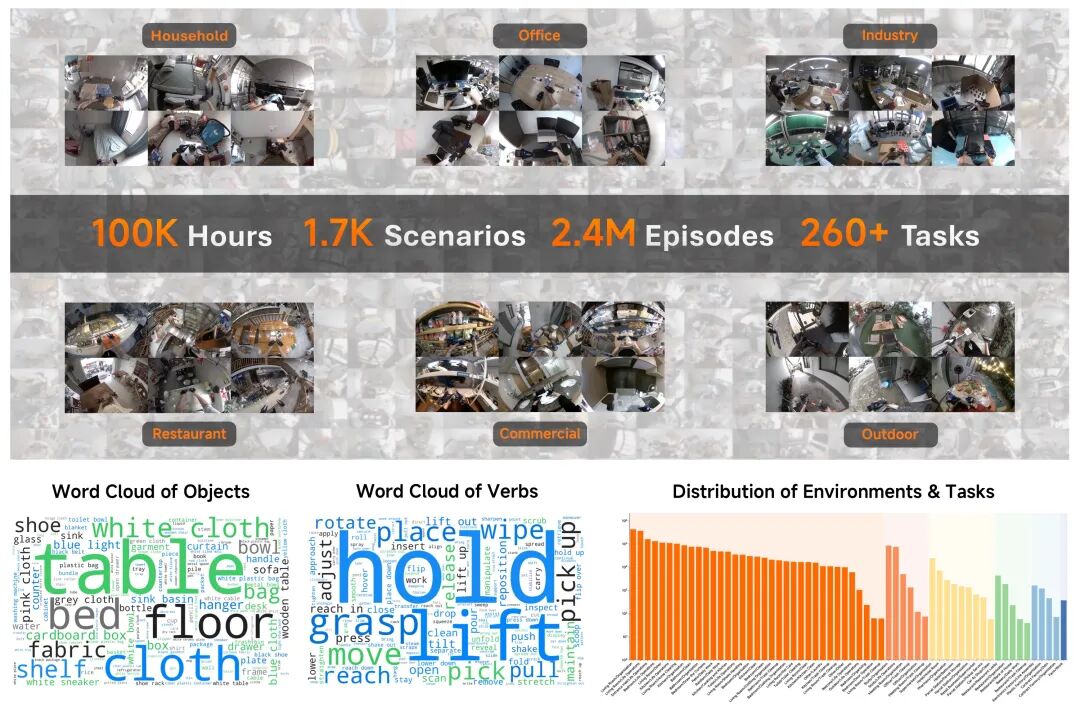
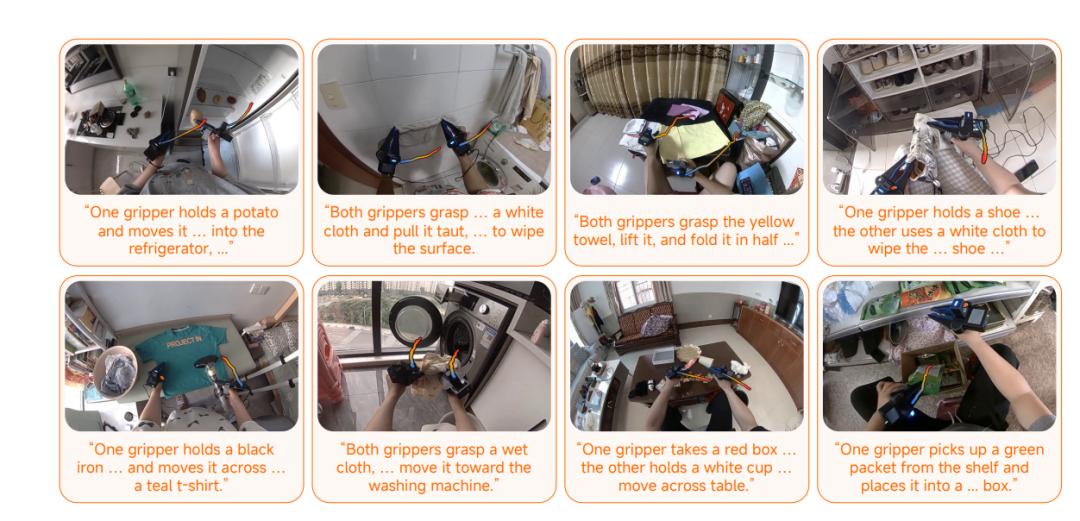
With the model ready, XR-1 adopts a two-stage paradigm in the training phase. The first stage is Embodiment-free Pre-training. Xiaomi uses UMI devices to collect more than 100,000 hours of real human operation trajectories.
UMI can be understood as a low-cost handheld operation data collection device, composed of components such as a gripper and a wrist camera. The Xiaomi team uses this device to complete operations such as grasping, moving, and placing in real environments, and the system records visual information and operation trajectories synchronously — the collected data does not need to be bound to a specific robot, and the core is to record the relationship between different elements of task execution.
After completing pre-training, XR-1 enters the second stage: Cross-embodiment Post-training: Through these data, the model gradually adapts to the body structure, motion capability and control method of specific robots, and learns task instructions that are more commonly used by humans at the same time.
This is the real core point of Xiaomi XR-1 — adaptation, which provides a shared physical interface for all robots for these embodiment-free action intentions.
XR-1 chooses to unify the action labels as delta EE pose (relative incremental end-effector pose), which means it only describes how much the end effector translates along a certain direction and how much it rotates around a certain axis.
The same type of operation intention corresponds to different joint trajectories on different robots, but their delta EE poses are similar.
The model learns on this shared representation, so post-training does not need to maintain a separate action vocabulary for each robot.
However, delta EE pose only unifies the writing format of actions, and cannot solve the kinematic feasibility problem. Post-training can use real robot data to expose these infeasible mappings, allowing the model to learn to avoid them.
This is the second layer of embodiment alignment: the shared representation provides a unified coordinate framework, and real machine data constrains the instructions in this framework to the subspace that the specific robot can indeed reach.
The adaptation at the network level adopts layered fine-tuning.
The post-training data is about 10,000 hours, of which Xiaomi's self-collected real machine data exceeds 7,200 hours. This volume is naturally not enough to support training from scratch, but its role is calibration: the last few layers of the visual encoder are fine-tuned adaptively, so that the features shift from semantic category orientation to physical interaction orientation, paying more attention to graspable parts and spatial relationships;
At the same time, the action generation head DiT adjusts the output distribution on cross-embodiment data, so that the generated delta EE pose sequence is closer to the reachable range of the target body.
As for the main body knowledge of the Qwen3-VL backbone, it is retained, and only interface-level adjustments are made.
Therefore, the actual meaning of "gradual adaptation" is: establish a cross-embodiment action writing layer with delta EE pose, constrain this layer to the reachable space of each robot with real machine data, retain pre-training knowledge while correcting interface-level distribution offset through layered fine-tuning, and then switch the trigger mechanism to human language with imperative instructions.
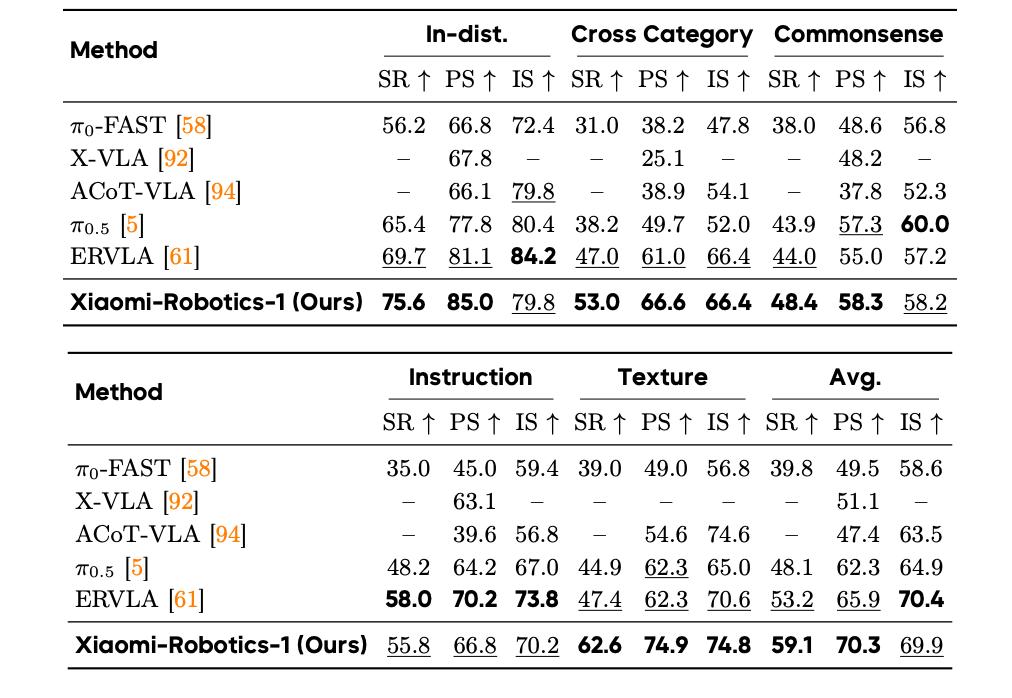
From the experimental results disclosed in the paper, XR-1 has demonstrated certain generalization capabilities.
In simulation tests, XR-1 achieved a success rate of 57.4%—57.6% on RoboCasa365, which is higher than the previous best result of 46.6%; on RoboDojo, the average score reached 20.07, which is also a significant improvement compared with the previous result of 13.07.
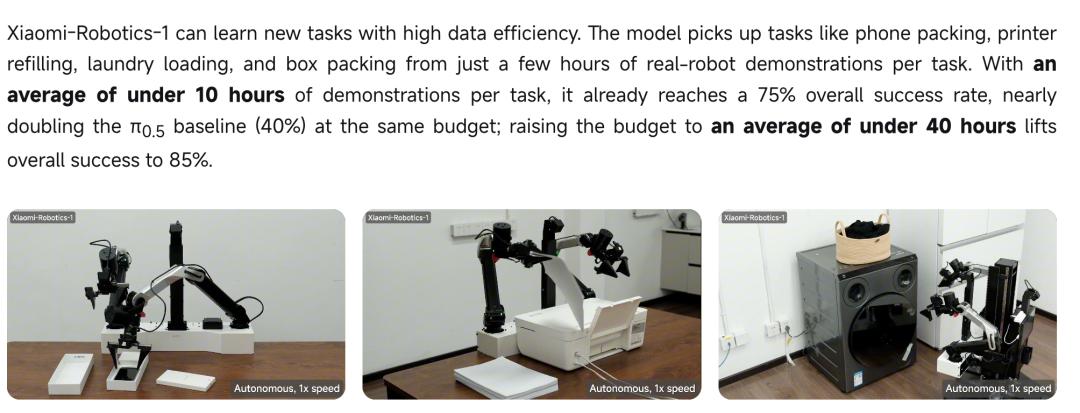
In the few-shot fine-tuning test, XR-1 uses an average of less than 10 hours of demonstration data for each task, and the average success rate of four complex tasks reaches 75%, while the comparison baseline π0.5 given in the paper is 40%.
In addition, the paper also demonstrates room-level long-horizon operation tasks lasting more than 10 minutes, such as independently completing suitcase packing. Such tasks involve multiple consecutive operation links, which impose higher requirements on the model's task understanding, action planning and execution coherence —
Doesn't this echo the verification deployment in Xiaomi Youth Apartment mentioned by Mr. Lei?
Finally, to sum up, the most valuable exploration of Xiaomi's embodied intelligence is reflected in:
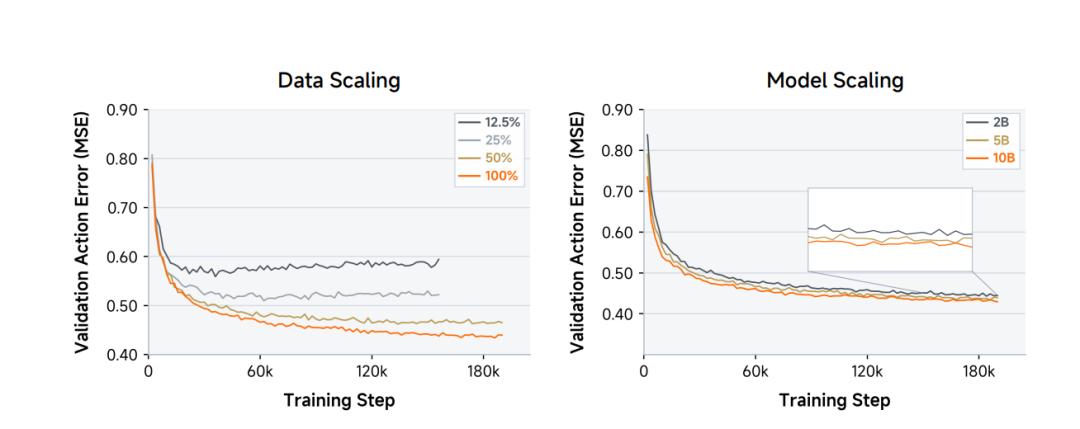
The pragmatic choice on the data paradigm, and the verification of the transferability of Scaling behavior.
If this trend continues to hold on a larger scale, it means that the robotics field can also follow the engineering paradigm of "pre-trained base model → downstream adaptation".
Xiaomi Has Initially Crossed the "Critical Threshold" of Embodied Intelligence
Of course, objectively speaking, Xiaomi's XR-1 is far from a mature, one-size-fits-all commercial solution. Technically, it is more focused on engineering path exploration rather than underlying paradigm innovation.
For example, the 100,000-hour UMI data still has a gap with actual deployment.
The data collected by the gripper is used for training, and now the transferability has only been initially verified.