2 trillion Tokens were sold in Li Jiaqi's live streaming room within half an hour. Are consumers buying efficiency or AI anxiety?
"3, 2, 1, go live with the link!"
This familiar slogan has finally been applied to AI.

Left: Li Jiaqi Right: Chen Yusen
On the evening of November 2, a special product appeared in Li Jiaqi's live stream.
It is not a lipstick, not a face cream, nor a newly launched smart home appliance, but Token.
A monthly basic membership card of Qianwen Office is priced at only 0.01 yuan for the live stream promotion. In just half an hour, nearly 100,000 membership entitlements were snapped up, which is equivalent to about 2 trillion Tokens converted by the quota of the package.
For most consumers, Token may still be a strange technical term. But this does not prevent it from becoming a new member in the Double 11 shopping cart.
In the past, what we snapped up in live streams were products that make people more beautiful and make life more convenient. Now, AI capabilities that can help people write plans, make spreadsheets and organize materials have also been put on the shelves.
When AI also begins to be promoted for a limited time and snapped up, are we buying efficiency, or a sense of security that we are afraid of being left behind by the times?
From lipstick to Token, Li Jiaqi starts selling "productivity"
If we turn back the clock a few years, it is hard to imagine that someone will snap up Tokens in a live stream.
After all, this term first appeared mainly in the work scenarios of large model developers. To put it simply, Token is one of the basic measurement units used by AI models when processing information such as text. The model will consume Tokens when reading questions and generating answers.
Chen Yusen, CEO of Qianwen Office, described Token this way: "Just like we need to refuel when driving, and our daily electrical appliances need electricity, the fuel for AI to work is Token."
Ordinary consumers may not care about how the underlying model operates, but care more about how many tasks these quotas can allow AI to help them complete.
What Li Jiaqi sold in this live stream is the monthly basic membership card of Qianwen Office, which costs 0.01 yuan per card. The membership package includes the corresponding Token usage quota. Nearly 100,000 membership entitlements sold in half an hour are converted to about 2 trillion Tokens.
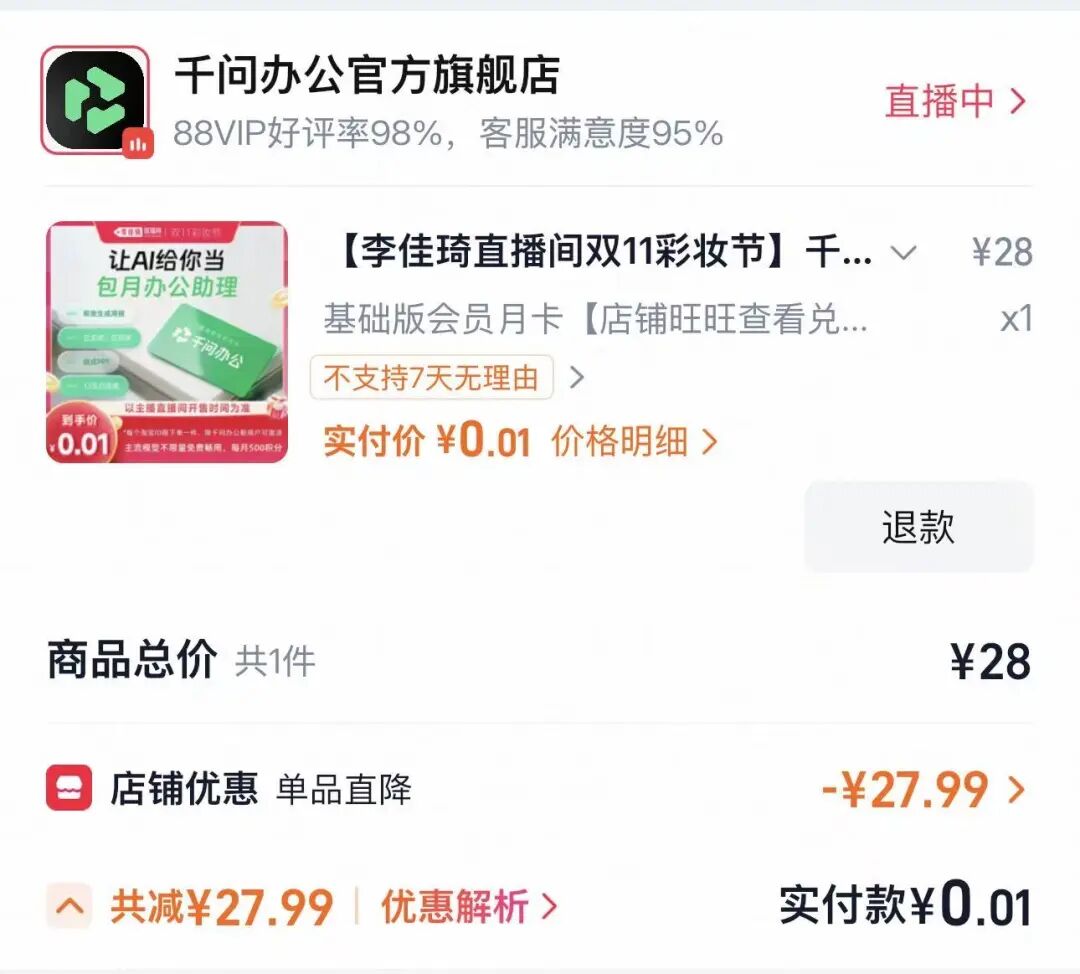
In the past, AI computing power and model calls were mainly purchased through channels such as development platforms and enterprise services. Now ordinary consumers can also obtain AI usage rights on e-commerce platforms just like buying video memberships.
More importantly, what the live stream shows is no longer how advanced the model parameters are, but what it can do.
Writing a work summary, sorting out meeting content, analyzing data, and assisting in making presentation materials, these tasks that originally took a lot of time are becoming the most intuitive selling points of AI products.
Li Jiaqi has sold countless kinds of products: lipsticks make people more beautiful, skin care products make people more refined, and home appliances make life more convenient.
This time, the live stream began to sell an invisible and intangible product that may change the way of working — productivity.
In the past, we spent money buying things, now we spend money buying time
Why can AI become a product in the live stream?
Because what people are willing to spend money on is changing.
Buying a dishwasher is to spend less time washing dishes; buying a sweeping robot is to save the time of cleaning; subscribing to a video membership is to get a more convenient entertainment experience.
Behind these consumptions, there is actually a common logic: spend money to get a better experience, or save your own time.
AI brings this kind of exchange to knowledge work.
In the past, a professional who wanted to make a decent presentation might need to consult materials, sort out data, build a framework, make PPT, and then revise it repeatedly.
Now, the information that originally required repeated searches can be sorted out by AI first; in the face of a complex data table, AI can be used to assist in finding patterns; when preparing a speech, AI can also help organize ideas first.
AI does not guarantee that every task can be accelerated, let alone omit fact-checking and professional judgment. But for suitable tasks, it does reduce the time cost of completing work.
The biggest difference between AI membership and video membership is that buying video membership is usually for consuming content; buying AI membership may be for producing content, processing information, and even completing part of the work.
We no longer only pay for "what we get", but also start to pay for "what we can do".
When this capability is packaged as a monthly card and incorporated into the Double 11 promotion system, AI has changed from a slightly abstract technical concept to a service that ordinary consumers can understand, compare and purchase.
But do we really need so many Tokens?
Do people who snap up Tokens really need that many Tokens?
What can you buy with one cent?
In today's consumer market, you may not even be able to buy a plastic bag, but in Li Jiaqi's live stream, it can buy an AI monthly membership card.
Such a low price almost eliminates the economic threshold for consumers to try a new product. Even if they don't know what it can do for the time being, it seems that they won't suffer a loss if they grab one first.
This kind of psychology is not unfamiliar. When we buy a gym card, we imagine ourselves insisting on exercising in the future; when we buy online courses, we expect ourselves to be more capable after finishing learning; when we stock up on a pile of e-books, what we buy seems to be not just reading materials, but also the possibility of becoming a better self.
AI membership may also carry similar expectations.
Buying it means that in the future, you may be able to finish reports faster, process data more easily, and face work more calmly.
But there is always a distance between expectation and actual use. There is a frequently mentioned concept in psychology called "FOMO, namely Fear Of Missing Out": When people think that a certain opportunity is scarce, or see people around them participating one after another, they may have the psychology of worrying about missing it.
AI just has such a background of the times. In the past few years, discussions about AI have emerged continuously. Some people use AI to write code, some use AI to make videos, and some use AI to complete work that was difficult to complete independently in the past.
On the one hand, these cases demonstrate the possibilities of the technology, and on the other hand, they constantly remind people that the way of working is changing.
As a result, buying AI tools may contain several motivations at the same time.
Some people do have high-frequency usage needs; some just want to try new things at low cost; others hope to have an AI tool first and learn to use it when they really need it.
But a month later, how many people who grabbed the membership today will actively open AI?
Because low price can drive the first purchase, but may not create long-term usage habits.
Whether a technology can truly enter daily life ultimately depends on whether it solves real problems.
Just like buying a gym card does not mean having a healthy body, buying an AI membership does not mean you already have AI productivity.
When everyone can buy AI, what is truly scarce?
An important change brought by AI is that it makes some tasks that previously required professional skills to complete easier to get started.
People who can't write code can try to build simple tools with the help of AI; people who are not good at design can use AI to make visual drafts; people who are facing unfamiliar fields can also get a basic information framework through AI first.
This does not mean that professional competence is no longer important. On the contrary, when the access threshold of tools keeps decreasing, people's professional judgment may become more important.
AI can help organize information, but it does not naturally know which problem is most worth solving. That's why having the same tools does not mean being able to create the same value.
In knowledge work, AI may help people narrow the ability gap in some basic tasks, and may also allow people with professional knowledge to explore complex problems faster.
But in either case, the efficiency improvement brought by tools needs to be combined with people's experience, judgment and work process.
When productivity tools are easier and easier to buy, what really determines the level of productivity may be those abilities that cannot be purchased directly.
The bustle in Li Jiaqi's live stream may just be a beginning.
When AI moves from the technology circle to the mass market, in the future we may naturally buy AI services just like buying cloud storage and video memberships.
At that time, AI will no longer be a new tool worth showing off, but will gradually become an ordinary basic capability in work and life.
The next time the live stream shouts "3, 2, 1, go live with the Tokens", you may first ask yourself:
Do I really need AI to help me do something, or am I just worried that others are already running ahead?
This article is from the WeChat Official Account "Liepin" (ID: liepinwang), written by Matcha Guobaorou, published with authorization from 36Kr.