Why have the once money-burning and defunct unmanned convenience stores made a comeback?
The once wildly popular unmanned convenience stores almost collapsed collectively overnight.
In 2017, Taocafe, BingoBox and Xingbianli flooded into the market, with 138 unmanned retail enterprises securing 4.847 billion yuan in financing. However, the boom lasted no more than a year, and store closures, layoffs and bankruptcies came one after another, leaving nothing but a mess.
No one expected that after nine years of silence, unmanned convenience stores would warm up again.
Data from the Ministry of Commerce shows that from January to May 2026, the retail sales of unattended stores included in official statistics rose by more than 20% year-on-year, far exceeding the 6.8% growth rate of ordinary convenience stores.
Why have the unmanned convenience stores that collapsed back then come back to life?
01
The first generation of unmanned convenience stores failed because of "unmanned" operation
Doing business is a competition of efficiency and cost.
Convenience stores are no exception. As long as there are staff on site, the cost cannot be reduced.
The idea of unmanned stores is to remove on-site staff and cut down costs.
Amazon was the first to act.
At the end of 2016, Amazon launched the Amazon Go unmanned convenience store in Seattle, putting forward the slogan "Just Walk Out". Customers scan the code to enter the store, leave directly after selecting products, and the system automatically completes the settlement.
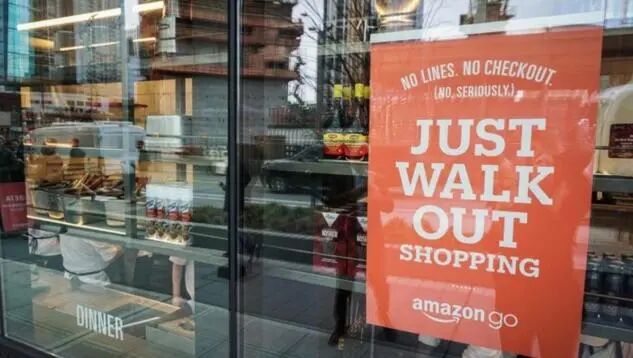
Amazon launched the "Just Walk Out" slogan. Source: ifanr
With its advanced concept, Amazon Go quickly became a hit and set off a craze for check-in visits.
When this wave spread to China, capital went completely crazy.
Alibaba's Taocafe debuted, followed by JD.com and Suning.
More than 200 unmanned convenience stores popped up across the country overnight, and 25,000 unmanned shelves were spread all over office buildings.
In 2017 alone, there were 93 financing events in the track, and a total of 4 billion yuan of hot money poured in from 2017 to 2018.
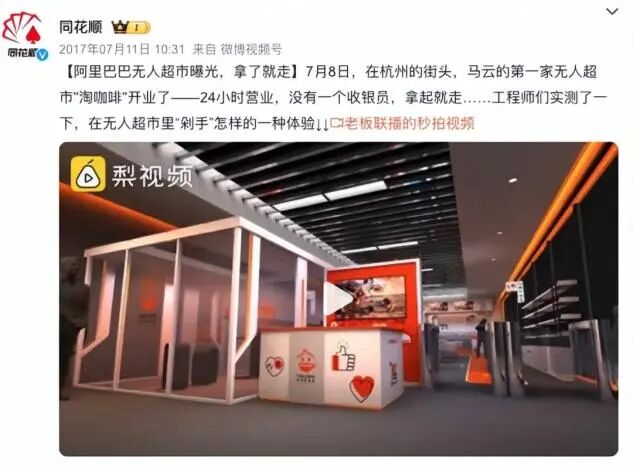
Alibaba's unmanned convenience store became a hot search topic
Large manufacturers and capital collectively believed that after mobile payment matured, the "Just Walk Out" unmanned model would be the future of retail.
The blueprint looked beautiful, but the implementation was full of troubles.
The biggest pitfall of unmanned convenience stores was precisely the lack of on-site management.
The first BingoBox store in Shanghai back then was a typical example.
In the middle of summer, no one noticed that the air conditioner broke down, the temperature in the store rose to 40℃, and all the chocolates and desserts on the shelves melted and went bad.
What was more tricky was the anti-theft loophole: some customers wrapped products in tin foil to shield RFID radio frequency signals, or directly tore off the tags, so that the system could not identify the products and they could take the items away directly.
Theft and bill evasion occurred frequently, and goods loss remained high.
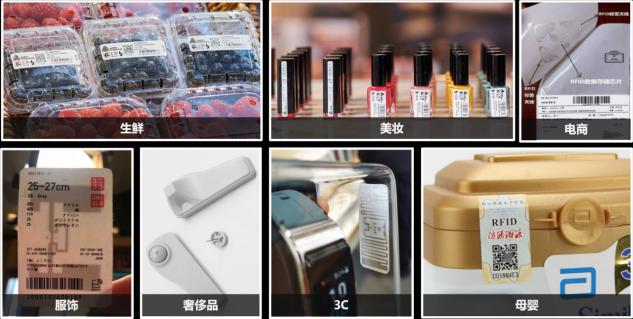
RFID tags on various products
In addition, the operating cost of unmanned convenience stores is far less cost-effective than advertised.
Traditional retail stores require 4 people to run one store, while under the unmanned model, 4 people can maintain 40 stores. The huge efficiency gap made capital very excited.
But after seeing through the appearance, it turned out that unmanned supermarkets only saved the cost of cashiers, and all other hidden costs skyrocketed.
The first is the huge investment in hardware and back-end systems.
Chen Zilin, founder of BingoBox, once mentioned that a small store of only 15.6 ㎡ needed to install 5 cameras to achieve no-dead-angle monitoring, and there were loss-prevention specialists in the background staring at the screen.
Jian 24 adopted a more costly computer vision solution. Its founder Lin Jie revealed that the first store invested about 500,000 yuan, of which cameras and GPU local servers alone cost 200,000 yuan.
Excluding the coffee machine in the store, the expected investment in one store is about 150,000 yuan higher than that of a traditional convenience store.
Hardware is only the one-time major expense, and software R&D is a bottomless pit that keeps burning money.
Software cannot be done once and for all. Image recognition algorithms, model training, and cloud computing power scheduling must be continuously iterated, otherwise recognition errors, missed orders and misjudgments are very likely to occur.
This means that annual server costs, version updates, and bug fixes are long-term rigid expenses.
Secondly, hidden labor costs still exist.
Many people mistakenly think that unmanned stores do not need people at all. In fact, they only remove the front desk cashiers, and restocking, shelf arrangement, cleaning, and equipment maintenance all require field staff to come to handle.

The unattended shelves are covered with a layer of dust
Xingbianli's earliest estimate was that a salesman could visit 10 to 12 shelf points a day under ideal conditions.
But in actual implementation, it was found that two salesmen working all day could only visit a maximum of 5 points to restock and check goods, and there was a big gap between ideal and reality.
Ironically, the "black technology" of unmanned stores has instead created many unpleasant experiences for customers.
As soon as you enter the store, cameras all over the wall track you the whole time. Many netizens complain that it feels like there is a pair of God's eyes staring at them from above, buying a bottle of water is like being treated as a potential thief, and you feel uncomfortable all over as soon as you enter the door.
In addition to psychological discomfort, the recognition system responsible for settlement and anti-theft itself has constant failures.
At the EAT BOX unmanned convenience store in Beijing, a customer clearly paid the bill, but the exit access control judged the transaction as abnormal, leaving the customer stuck between two doors. There was no clerk on site, so the customer could only call the customer service remotely to unlock the door. (The store adopts four-layer access control anti-theft with two doors at the entrance and exit, and gravity sensors are installed on the floor between the doors to judge whether someone has torn off the RFID tag and smuggled goods by the weight difference between entry and exit.)
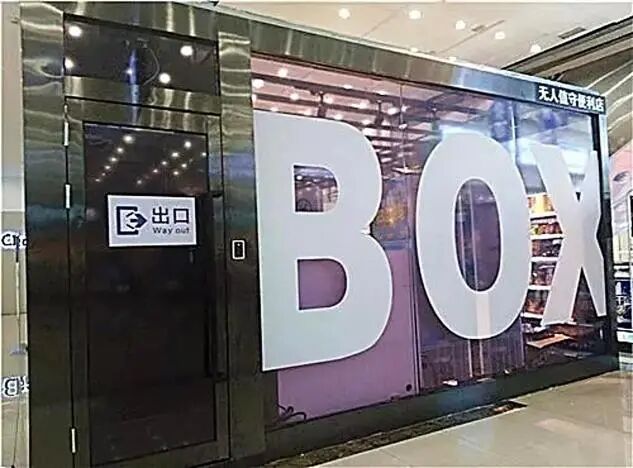
EAT BOX unmanned convenience store located at Beijing Century Golden Resources Shopping Mall
Technology was supposed to reduce transaction troubles, but the first generation of unmanned convenience stores put the cart before the horse, creating new problems with complex technology.
Therefore, only one year after the boom started, the bubble burst.
The once highly anticipated Linjia Convenience Store lost 5 million yuan every month, continued to bleed without seeing profitability, and finally closed down.
Then the domino effect of continuous collapse began, and star projects such as Guoxiaomei, Xingbianli, GOGO Mini Supermarket, and Qizhi Kaoala were successively exposed with news of losses, layoffs and bankruptcies.
Even Amazon, the pioneer of this trend, after nearly a decade of trials, reluctantly announced the closure of all Amazon Go physical stores.
The once hot unmanned retail track cooled down to freezing point overnight.
02
The collapsed track is quietly reborn
The first generation of unmanned retail put technology ahead of business logic, and its failure was expected.
When the business logic caught up, this track really began to recover.
Data from the National Bureau of Statistics shows that from January to May this year, the year-on-year growth rate of retail sales of above-quota unattended stores exceeded 20%.
Industry monitoring shows that the domestic unmanned store market size exceeded 30 billion yuan in 2025, and technical service providers such as Weidian 24, Bangke Cloud Attendance, and Hantang Cloud have empowered more than 100,000 supermarkets, convenience stores and mom-and-pop stores in total.
The first main line of industry recovery is the intelligent transformation of stock traditional convenience stores.
Different from the radical scheme of pursuing full unmanned operation in the early years, the current mainstream mode is "on-site staff during the day + cloud unattended at night".
According to reports from CNR, such stores already account for 61.6% of 24-hour convenience stores.
Hongqi Chain is a sample of large-scale implementation of this transformation.
This solution is not completely unmanned, but switches according to time periods.
From 8 a.m. to 10 p.m., staff are on site to handle cash transactions and face-to-face services.
From 22:00 to 8:00 the next day, cloud unattended mode is enabled. There are no staff on site in the store, and remote customer service in the background monitors the store online relying on cameras and self-checkout equipment.
Customers scan the code to shop by themselves; when encountering problems such as failures and refunds, remote customer service will intervene in time to handle them.
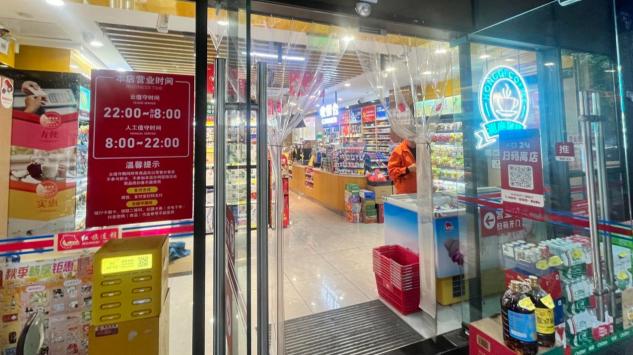
Hongqi Chain located on North Shuwa 2nd Street in Chengdu posts the cloud unattended time and on-site staff attendance time at the store entrance
In August 2025, Hongqi Chain reached a cooperation with the service provider Weidian 24 to upgrade its stores relying on intelligent hardware, AI algorithms and real-person remote attendance.
At present, there are more than 1,000 cloud unattended stores, and the full rollout is planned for 2027.
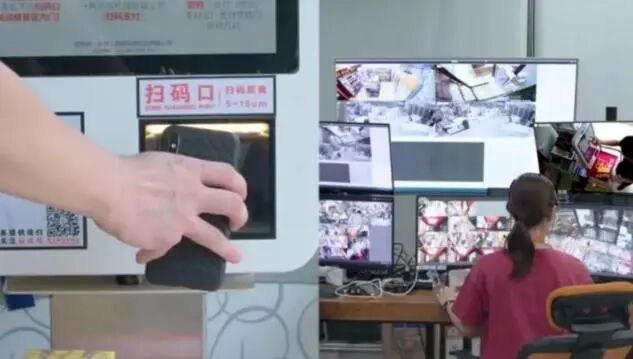
Back-end cloud customer service monitors stores in real time through multiple screens
Not only Hongqi Chain, but also chain brands such as Meiyijia and Tianfu are following up on the implementation.
At present, more than 60% of the top 100 convenience stores in China have connected to cloud unattended and self-checkout systems, and a large number of community convenience stores in Guangzhou, Shenzhen, Taiyuan and many other cities have completed intelligent upgrades.
The second main line is the expansion of unmanned retail scenarios.
Today's consumers are no strangers to vending machines. They can be placed anywhere in subway stations, industrial parks, universities, scenic spots, office buildings... A single cabinet can be put into operation, which is more flexible and portable than physical stores.
Well-known traditional vending machine operators such as Ubox and Nongfu Spring are mostly located in public areas such as subways and shopping malls, selling drinks and snacks relying on floating passenger flow.
The leading operator Feng E Zu Shi (parent company Fengyi Technology) has chosen a differentiated path.
In 2025, its GMV reached 2.34 billion yuan, with 184,000 retail cabinet points covering 72 cities. It is the largest intelligent retail cabinet operator in China, but you may not have seen it, or you may not remember it even if you have seen it.
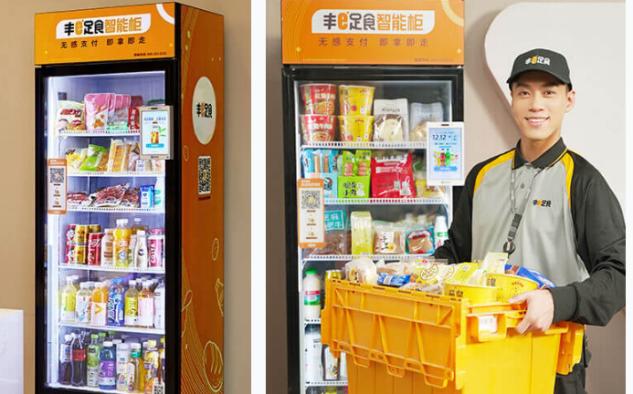
Feng E Zu Shi intelligent retail cabinet
The reason is that it places the cabinets in closed and semi-closed scenarios such as factories and warehousing parks, targeting fixed crowds, adopting the mode of scanning code to open the door and automatic settlement after closing the door.
The hardware cost of its self-developed retail cabinet is only 30% of that of traditional vending machines, which is convenient to be placed in the venues of small and medium-sized enterprises.
However, this type of capillary scenario has its own shortcomings: small and medium-sized enterprises have weak anti-risk capabilities, with an average operating cycle of only two to three years. Once they relocate or close down, the cabinets have to be removed and transported.
In response to the instability of scenarios, Fengyi Technology has built a dynamic point elimination mechanism.
In 2025, the company added 130,867 new points and closed 84,765 points at the same time; points with monthly GMV less than the 300-yuan break-even line will be actively removed, and such removed points account for 61.3% of the total closed points.
This means that it does not lay a static network that never changes, but continuously screens and replaces points.
In 2025, Fengyi Technology's sales and marketing expenses were 961 million yuan, accounting for 47.8% of total revenue, covering point development, operation and maintenance, and network expansion.
Retail cabinets look light, but their actual operation highly depends on the digital point screening capability.
A complete system of people, goods, warehouses and distribution is also needed for support, so that unmanned retail can penetrate into