By leveraging AI to cut massive costs, Duolingo recorded a 29% surge in daily active users, and it will prioritize revenue generation next year.
On November 3 US time, Duolingo (Duolingo, Inc. Nasdaq: DUOL) released its financial report for the third quarter of 2026. Its bookings, revenue and profitability all exceeded market expectations.
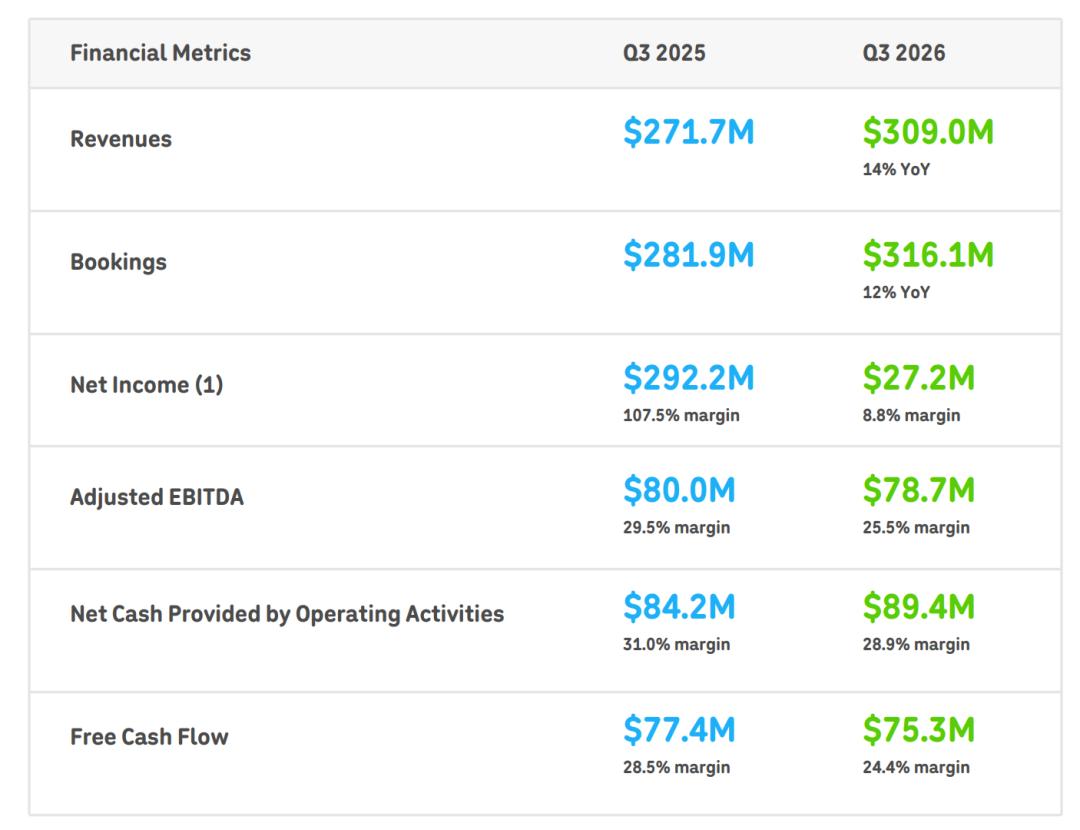
According to the financial report, Duolingo's revenue in the third quarter of 2026 reached 309 million US dollars, a year-on-year increase of 14%; Bookings hit 316.1 million US dollars, up 12% year on year.
Affected by factors such as the high base effect, net profit stood at 27.2 million US dollars, compared with 292.2 million US dollars in the same period last year, down by about 90.69% year on year. Adjusted EBITDA was 78.7 million US dollars, compared with 80 million US dollars in the same period last year, representing a marginal year-on-year decline of only 1.6%. This indicates that the profitability of Duolingo's core business remains robust.
Daily Active Users (DAU) saw accelerated growth for the second consecutive quarter, rising 29% year on year, higher than the 23% growth recorded in the second quarter.
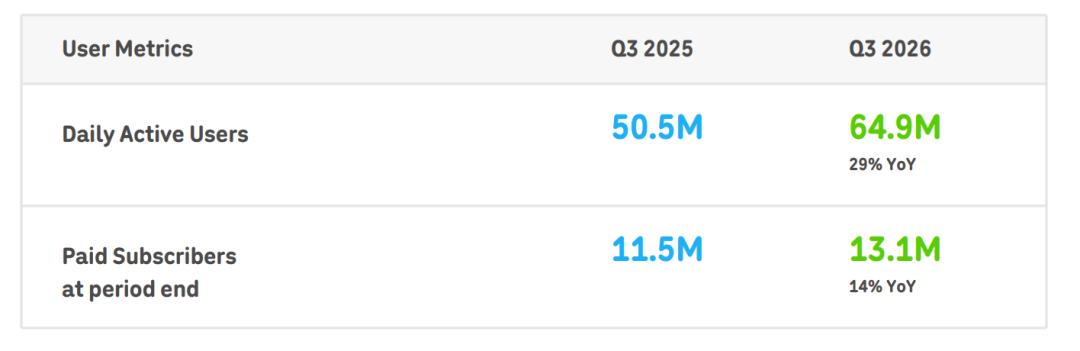
The momentum is expected to continue, with DAU year-on-year growth in the fourth quarter projected to be similar to that of the third quarter, and fourth-quarter bookings will be slightly higher than the previous full-year outlook guidance.
In the shareholder letter, CEO Luis von Ahn mentioned that Duolingo's "Green Machine" compounded many small product changes into meaningful improvements through experiments, and this process continued to drive strong user growth in the third quarter. Hundreds of experiments were run across all parts of the product (such as notifications and streak learning), aiming to improve user retention and DAU.
At the product level, one major change for Duolingo is that Duolingo Max has been migrated to Duolingo Super. Luis von Ahn explained that the sharp drop in AI costs has made the original "high-end premium tier" Max no longer necessary; merging it into Super and upgrading it to a family plan is the optimal solution that "does not hurt revenue, delights users, and is conducive to long-term growth".
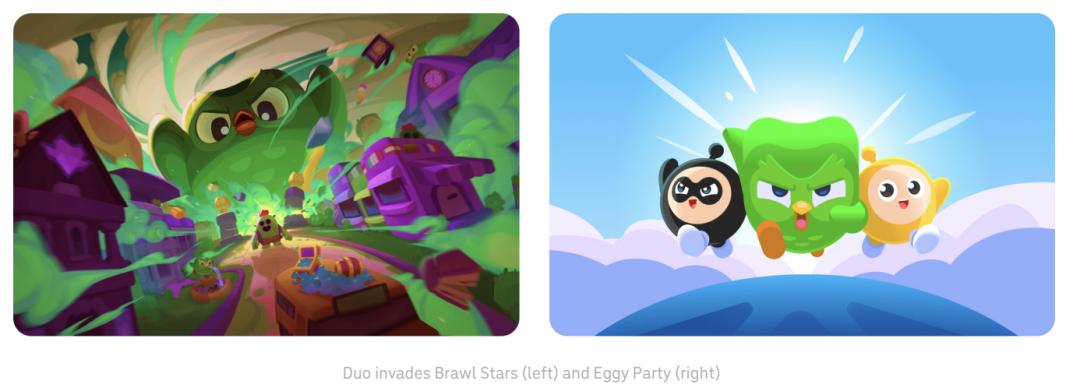
The company continued to expand brand marketing partnerships, collaborating with two games: the global multiplayer hit Brawl Stars, and Eggy Party, a wildly popular game in China. Duolingo's mascot Duo was prominently featured in both games, and players can earn rewards by learning on Duolingo. The two partnerships combined brought millions of new and returning users to Duolingo.
During the third quarter earnings call, the management elaborated on the transformative impact of AI on product iteration efficiency, and made it clear that next year the company will gradually increase monetization efforts without compromising the free user experience.
01
The proportion of speaking practice has doubled
In the shareholder letter, Luis von Ahn mentioned that speaking practice is one of Duolingo's top priorities this year, designed to get learners to practice speaking more. Speaking is an essential part of language learning, but it is also the hardest skill to practice regularly. Since the start of the year, the proportion of exercises where learners can respond verbally has doubled.
As Duolingo continues to reduce per-unit AI costs, the company has also made progress in expanding the coverage of Video Call, its AI conversation practice feature. Last quarter, Duolingo began offering unlimited Video Call access to new Super subscribers, and is on track to roll it out to all Super subscribers by the end of this year. This marks a major step forward towards Duolingo's goal of "teaching better".
02
More monetization efforts next year, with "strict guardrails"
In the shareholder letter, Luis von Ahn noted that every new learner expands the audience that Duolingo can monetize in the future. While improving teaching quality and user growth remain top priorities, Duolingo is gradually placing more focus on monetization while preserving the quality of the free experience.
Subscriptions remain the biggest monetization opportunity, and the company believes the most sustainable way to grow subscriptions is to teach better. Duolingo is particularly excited about the potential of Video Call to help language learners make real progress in speaking, and the company is focused on making it accessible to more people and better communicating its value.
Since unlimited Video Call will be part of Super, Duolingo has decided to discontinue its highest subscription tier, Duolingo Max. This month, Duolingo Max will stop selling new Max subscriptions, and migrate existing individual Max subscribers to the Super family plan at the same price, giving them the same feature set plus the extra benefit of sharing the subscription with family or friends.
The impact of this adjustment on bookings is expected to be minimal and is already reflected in the fourth quarter guidance. Duolingo is still evaluating options for legacy Max family plan users, but will address that in 2027.
At the same time, Duolingo is exploring new ways to both monetize and drive engagement. The Junior's Toy Hunt event in the third quarter is a great example. It was the first event built around the new Avatar Collections system, where learners collected puzzle pieces to unlock avatar outfits. This event was one of the biggest experimental wins for getting learners to complete more lessons, demonstrating that collection-based activities can be a promising opportunity for in-app purchases that grow over time. Duolingo plans to continue building collection events in this format on a regular cadence.
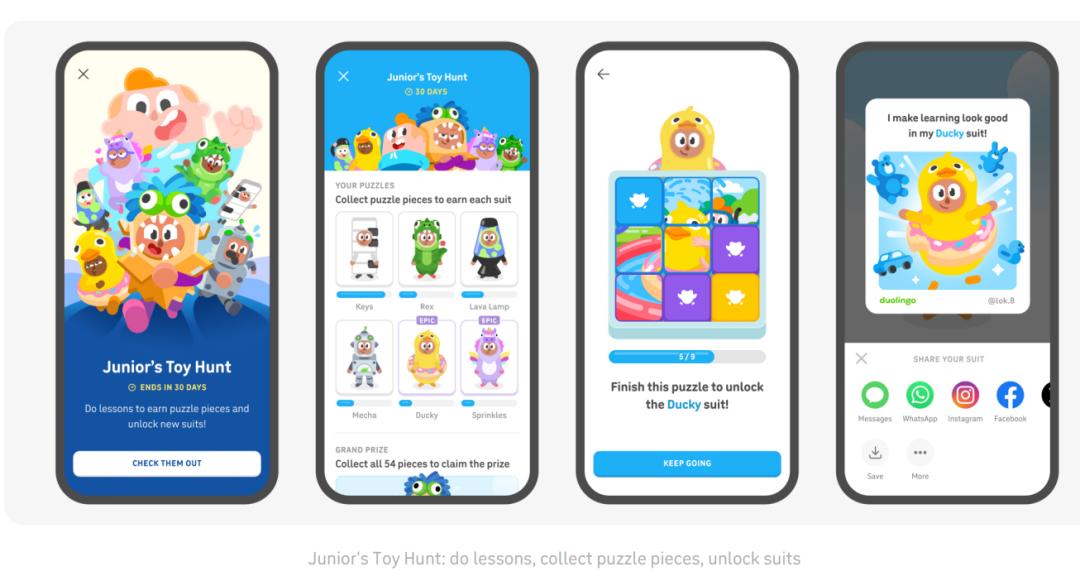
Junior's Toy Hunt was a limited-time collection event launched in September 2026. Players earned puzzle pieces by completing lessons, and unlocked limited Avatar Suits by collecting designated combinations. The event included 6 base outfits, with an additional reward outfit available once all base outfits were collected.
Avatar Collections is an underlying functional framework launched by Duolingo: users collect special outfits through limited-time events to customize their Duolingo avatars. Once obtained, these collections belong to users permanently and can be switched and displayed at any time.
Luis von Ahn explicitly listed collection-based activities as one of the new monetization methods found this year that do not conflict with DAU growth, stating that they can effectively drive lesson completion and in-app purchases.
During the third quarter earnings call, Luis von Ahn made it clear that this year is a special year, with the entire company focused on accelerating user growth and an all-employee bonus set up for that purpose; next year, while continuing to prioritize user growth, the company will significantly ramp up monetization experiments.
But he also drew a clear red line: "We have a strict internal guardrail of no longer degrading the free user experience. The good news is that we spent the whole year figuring out how to monetize without hurting the free experience, and I think we've just found a lot of effective levers."
According to the introduction, the identified monetization levers include longer free trials (currently only available to some users, to be expanded), in-app purchases such as Avatar Suits, and monetization of chess courses — chess just hit 10 million daily active users, and Luis von Ahn said it is "completely under-monetized, and we are only picking the low-hanging fruit right now".
Math courses are growing at roughly the same pace as language courses, but slower than chess. Luis von Ahn joked that "people prefer playing chess to learning math".
In terms of advertising business, Duolingo's overall performance in Q3 was flat but saw strong growth at the end of the quarter. Management mentioned that the company is shifting from low-quality ad networks to high-quality direct sales, has built a direct sales team, and is optimistic about the long-term outlook.
03
AI has led to a surge in experiment volume, allowing non-engineers to launch A/B tests
A major feature of Duolingo's product development process is that it runs a large number of A/B tests before launching new features or fine-tuning products, and AI has now accelerated this process. Management revealed that to drive monetization, A/B testing efforts will be scaled up even more next year.
During the third quarter earnings call, Luis von Ahn described AI as the core accelerator of the company's improvement engine. He disclosed that the number of A/B tests the company ran in the recent past month increased by about 90% year on year, while the headcount only grew by 10%. "A large part of that, not all, but a large part is due to AI. The promise of AI coding took a while to actually translate into speed gains, but we're seeing that now."
He further pointed out that AI has not only increased the number of experiments, but also significantly shortened the delay from idea to launch.
The more critical organizational change is that AI tools have enabled non-engineers to independently complete full product modifications. "A product manager or designer can now go all the way from idea to getting into the app, they can do it on their own now, no engineer help needed," Luis von Ahn stated, adding that the number of experiments next year will be an "integer multiple" of this year's volume.
On the cost side, the sharp drop in AI inference costs has made advanced features accessible to more users. The AI inference cost per Video Call session has dropped from around $0.30 initially to well below $0.01, mainly driven by the shift to open source/open weight models. This directly prompted the company to discontinue the premium Duolingo Max subscription tier, merge Video Call into the Super tier, and expand the addressable user base by about 10 times.
Luis von Ahn also outlined the long-term vision for AI teaching: Duolingo is currently "better than the classroom, but not yet as good as a one-on-one human tutor", but human tutors do not improve, while Duolingo gets better every year. "We believe we can reach the level of a one-on-one human tutor in the next few years. But it won't look like a one-on-one human tutor — it will still feel gamified in the end, because the most important failure mode is people quitting."
04
User growth: driven primarily by product improvements, supplemented by game partnerships
During the third quarter earnings call, Luis von Ahn emphasized that most of this year's user growth came from product improvements rather than external partnerships. "The vast majority of our active user growth comes from improved retention, because the product is getting better." The game partnerships with Brawl Stars and Eggy Party this quarter did bring in users with good retention performance, but "I really want to emphasize that we believe most of this comes from app improvements, which is why we think this will continue."
Growth was broad-based, with DAU growth accelerating in 8 out of the top 10 markets, and double-digit year-on-year growth in subscription bookings in most regions. Duolingo CFO Gillian Munson said: "We feel very good about the breadth of growth across both the DAU and monetization sides of our business."
05
Paid marketing becomes a "major win this year"
Duolingo has long been known for organic brand spread and viral social media operations, with paid user acquisition historically limited in scale and low in refinement. This situation has improved significantly this year: paid marketing now accounts for about 60% of the company's non-payroll marketing spend, corresponding to an amount slightly higher than 100 million US dollars, and it is overall profitable — meaning the lifetime value (LTV) of the users it brings in is higher than the customer acquisition cost (CAC).
CFO Gillian Munson said the company is profitable on this spend, and believes there is still room for improvement in the LTV to CAC ratio. CEO Luis von Ahn was straightforward: "We've actually gotten smart about performance marketing, and I'm very happy about that."
It is important to emphasize that this does not mean Duolingo is shifting from "free growth" to "paid user buying". Luis von Ahn made it clear that paid marketing "will never be the primary way we go to market", and organic growth remains the main engine; paid campaigns are a superimposed accelerator that has been tuned up this year, which can profitably amplify user growth and expand the future addressable audience pool for monetization.
06
Outlook
Q4 bookings are expected to grow 13% year on year, revenue to grow 14%, adjusted EBITDA margin to reach 26.1%, and adjusted EBITDA to be around 84 million US dollars (roughly flat year on year). Full-year bookings are projected to grow 12%, revenue to grow 18%, and adjusted EBITDA margin to hit 26.5%.
Q3 operating expenses include an 11 million US dollar bonus accrual to reward the team for re-accelerating user growth; the second tranche of the bonus is included in Q4 guidance and is expected to be paid in full in early 2027.
In the shareholder letter, Luis von Ahn said: "Our user growth across all regions globally and every subject we teach this year reinforces our belief that there are still huge opportunities ahead of us. Our goal is to eventually reach one billion learners and build a much larger business over time. The more people we can teach, the bigger this opportunity gets."
This article is from the WeChat official account "Duozhiwang" (ID: duozhiwang), written by Wang Shang, and published by 36Kr with authorization.