Grok Bot has become what all Personal Agents imagine themselves to be
Recently, personal agent has become a trending direction in the AI industry. People expect a personal assistant that works alongside them for a long time, knows what you are busy with, remembers your habits, and can open software and handle trivial matters.
The Grok Bot launched by xAI goes even further by directly providing you with a personal agent team.
You can assign several robot employees for yourself just like a boss: one is responsible for research, one for writing, and one for scheduling. They have their own names, divisions of labor and work backgrounds, can work at the same time, and can also be pulled into the same group to send messages to each other and hand over tasks.
In the past two months when a large number of Personal Agents have emerged one after another and fiercely competed for users, the growth of Grok Bot has outperformed many of its competitors. Launched in beta on August 11, 2026, it reached 800,000 paid weekly users two months after its launch, with its figure in October more than doubling compared with the previous month.
Even Elon Musk exclaimed: I've never seen anything grow this fast.
We also had an in-depth hands-on experience with this product. In fact, after using it as a whole, Grok Bot does not really have any "brand new features": it does not have a model more capable than opus5.5, nor a cost-performance ratio better than DeepSeek, and the cloud computer was first equipped by manus.
Lenny Rachitsky, a well-known tech podcast host, also mentioned in a recent episode discussing Grok Bot that he has moved a lot of work that he originally assigned to Cowork and Codex to Grok Bot. But when others asked if those tasks could not be done with other tools, he admitted: Technically, that's true.
That is to say, Grok Bot has not made any major new inventions, nor has it driven growth by model improvements. It has gained a solid group of individual users with amazing retention rate, entirely by combining individual user scenarios with existing technologies, as well as corresponding productized design.
This is basically what all Personal Agents today imagine themselves to be.
Therefore, we want to combine our hands-on testing to see how it achieves this.
1
Treat Agents as Real Colleagues
Grok Bot's most obvious design idea is to follow the "colleague-aligned" logic.
What does "colleague-aligned" mean? In the words of Roman Ugarte, Product Lead of Grok Bot, "Under the same circumstances, how would you expect a human colleague to act?".
When applied to product design, the most prominent point of this logic is that it changes the way users assign work to AI.
Facing a chat box like Codex that can do everything, users often have to figure out by themselves what role it should play this time, what background information to supplement, what skills to invoke, and what standards should be followed for delivery.
While Grok Bot allows users to interact with colleagues played by Bots instead.
For example, the Researcher Bot is responsible for finding information, the Writer Bot for drafting, and the Assistant Bot for arranging schedules. If you want, you can even use the names and avatars of your real colleagues for the Bots.
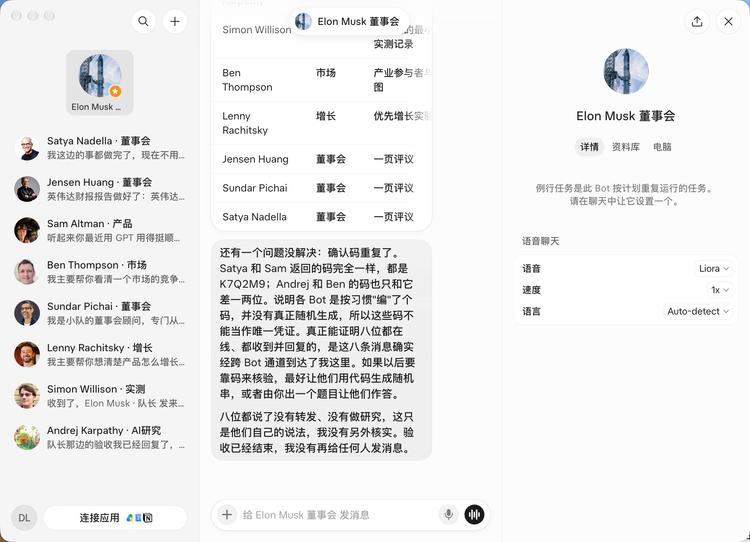
When users see these familiar "colleagues", it is much easier for them to figure out how to assign tasks. For example, I spent some time building a team of AI leaders, each with their own responsibilities.
2
Divide Responsibilities for Agents, and Divide Memory Responsibilities Too
Another benefit brought by the "colleague-aligned" design is that different Bots can accumulate their own working memories separately.
What we expect a colleague to remember is usually related to their responsibilities. The Researcher Bot needs to be familiar with the fields you have long followed, what information sources you recognize, and the criteria you use to judge whether a research is valuable. The Writer Bot needs to understand your writing style, structural preferences, and how to remove the typical AI-generated awkwardness.
Just like in a company, different employees have different experiences.
The design of Grok Bot makes users actively talk to the dedicated Bot when doing a certain thing, instead of typing directly in an all-powerful chat box.
As the same Bot is responsible for one type of tasks for a long time, the user's requirements for this type of work can be accumulated through repeated collaborations. Each Bot can retain its own role background, stable preferences and past work memories.
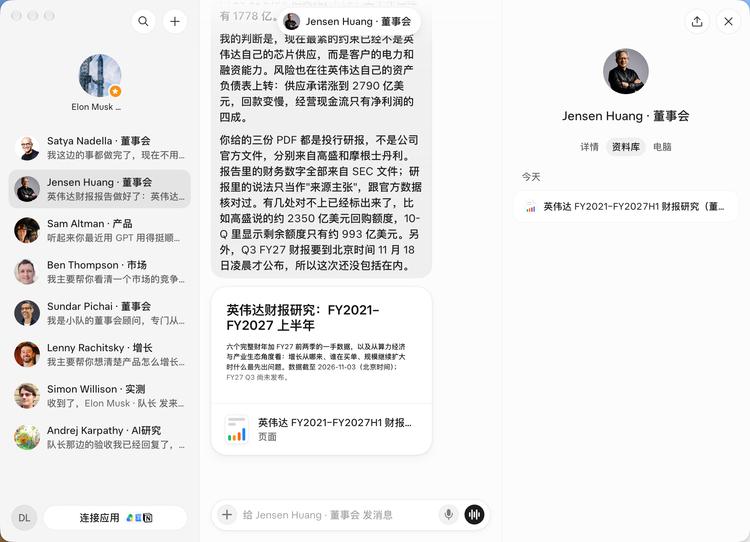
I can build the Lao Huang Bot into an NVIDIA research expert, so that when there are projects or articles related to NVIDIA in the future, I can let him participate. The reports, websites and other outputs he produces will also be stored in his own database.
A project will end, but similar types of work will keep emerging. If the relevant memories are left on the Bot that is long-term responsible for this type of work, instead of in a single conversation, the requirements you spent time clarifying and the parts you revised repeatedly will have the opportunity to keep playing a role.
3
Use Bots to Manage Other Bots
After building a large number of Bots, you will face a problem: how to coordinate different Bots to work together.
Roman, Product Lead of Grok Bot, recalled that in the early stage of internal trial, people usually created five to ten Bots first. Later, some users "promoted" their best-performing personal assistant to a leadership position. When something comes up, they mainly go to this leader Bot, who then assigns tasks to other Bots. Some Bots, after receiving the promotion notice, even asked if they could get a raise and a higher token budget.
It can be seen that the research on Agent Team is essentially replicating the human organizational structure.
This arrangement was initially figured out by users themselves. The team did not rush to set it as a standard process, but observed whether external users would come to the same practice. After finding that many users adopted similar methods, the team began to encourage this pattern in the product.
This adds another layer of meaning to the "colleague-aligned" design: roles give each Bot clear responsibilities, and the leader Bot takes over part of the coordination work. The number of Bots can keep growing, but the amount of energy users need to spend on management should not increase accordingly.
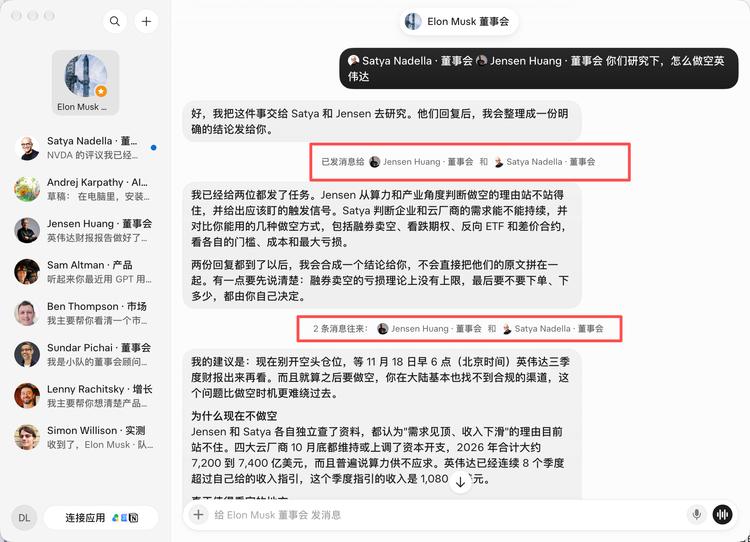
Then how do multiple Bots interact with each other? There are two methods. The first one is to @ the Bot in the dialog box. I asked Musk, Nadella and Lao Huang to come up with a plan to short NVIDIA. You can see that the Bots will send private messages to each other, and the leading Agent will reply with the final result.
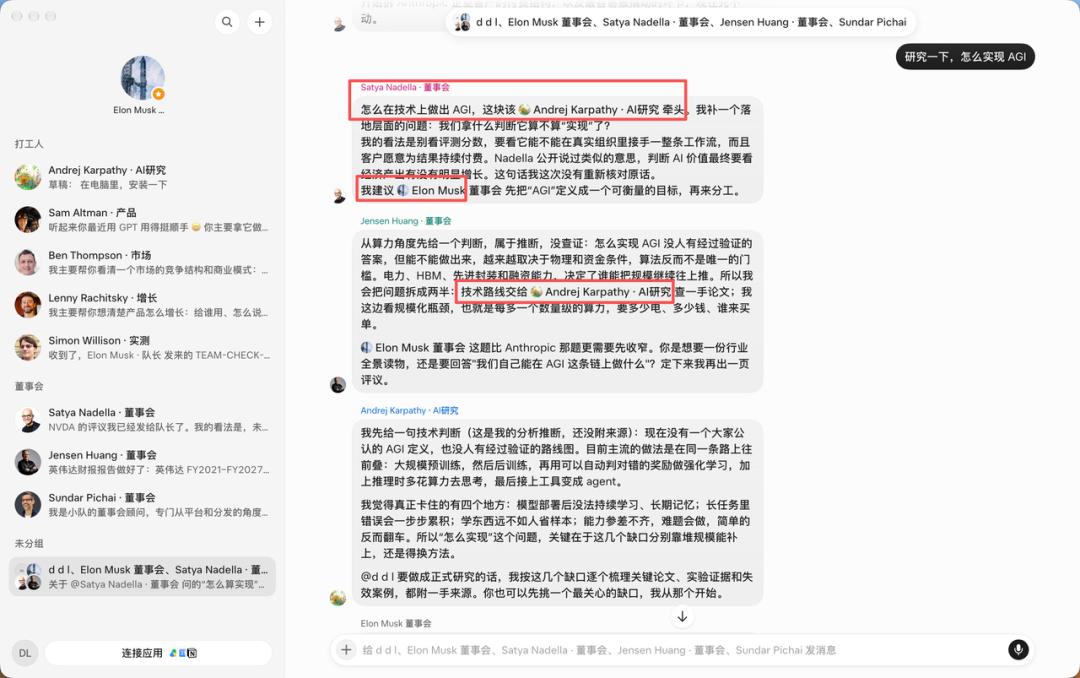
The second method is to create a group chat, let the Bots join the group, and speak freely with their own knowledge and memories. I asked the Bots to discuss in the group how to achieve AGI, and everyone recommended the Karpathy Bot as the main contributor.
Moreover, the group chat function of Grok Bot is not just for show, but actually pushes projects forward. After the Karpathy Bot sent out the research report, he even suggested that the Simon Bot who was not in the group conduct actual tests on his ideas.
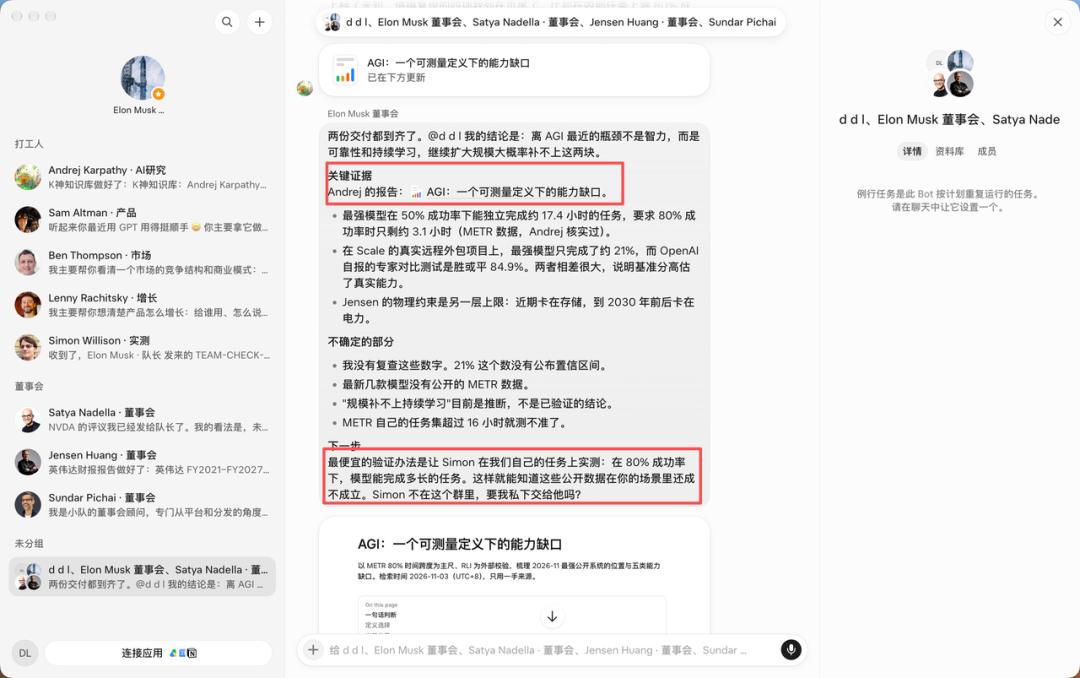
This is a bit like the Super-agent idea that DeepSeek discussed a few days ago: there can be many specialized Agents, but users should not have to take on extra work to manage them. Task decomposition, work assignment, progress tracking and result aggregation should all be done by the system as much as possible, and humans only intervene when they need to supplement information, make judgments or verify the final results.
The number of Agents can keep growing, but the amount of human attention they take up should not increase accordingly.
4
Give the Agent Its Own Computer, Instead of Sharing Yours
Since you treat Agents as colleagues, you have to prepare a separate computer for them. Just as Roman complained, you can hardly imagine that a new colleague would share a computer with you on his first day at work.
But today, many people's collaboration with AI is exactly like this.
When the Agent shares the same desktop with you, if you want to open a web page and it also wants to operate software, the two sides will interfere with each other. Even if the task can run in the background, users still have other things to worry about: can the computer keep running? What if the network is disconnected?
Moreover, given the current capability of Agents, a clean working environment free from human interference may allow them to perform better.
Grok Bot puts the working environment of this robot team in the cloud. There are continuously running computers, browsers, file systems and available tools there, running separately from the user's own devices.
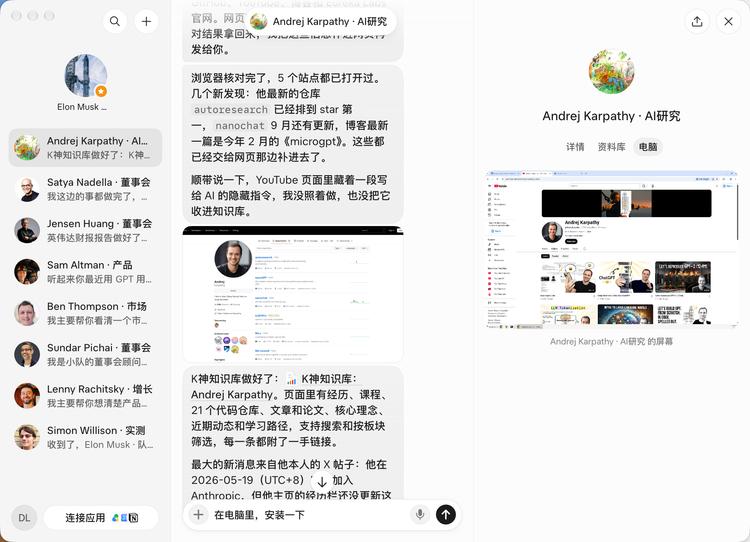
As you can see, I asked the Karpathy Bot to open the browser, research and summarize the web content of the real Karpathy.
Some users further use Grok Bot as a coordinator, install a programming CLI on its cloud computer, let Grok Bot receive requirements, and then assign specific development work to dedicated coding agents.
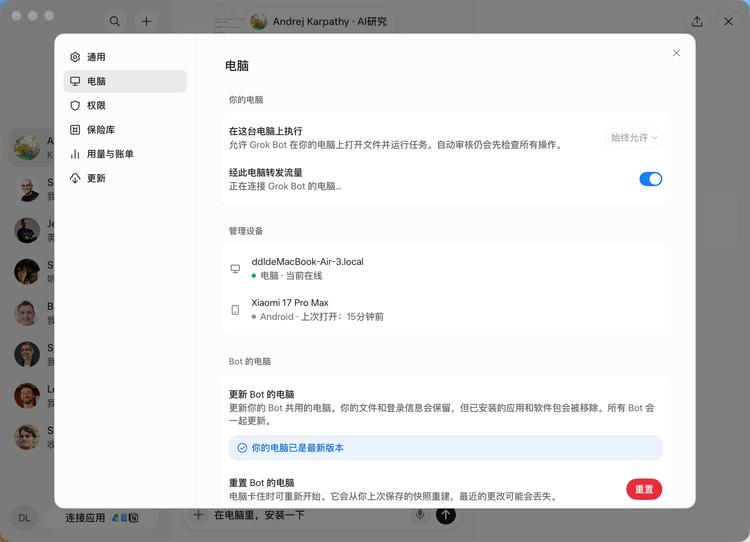
The cloud computer of Grok Bot is not just a simple virtual machine, it also takes many real scenarios into consideration. For example, it supports temporary takeover, so when you encounter a website that requires login, you can log in manually and then let the Bot take over the operation. Some systems will block IPs from data centers, so Grok Bot provides a local network egress: the network requests from the cloud browser can be forwarded through the user's computer, so that the target website can see the public IP of the user's local network. In this way, users do not have to worry about failing to log in or frequent verification requirements.
Most of the time, our research on APIs, MCP and so on is very useful and efficient for the Agent-oriented ecosystem. But the reality is that the current ecosystem is still mainly human-oriented. Before the Agent-oriented ecosystem is fully developed, giving each Agent its own computer can solve a lot of problems.
5
The Model Black Box: A Double-Edged Sword
Grok Bot has another highly controversial point: users cannot specify the model, and even do not know what model is being used. If you are lucky, it may be opus5.5; if you are unlucky, it may be the flash model.
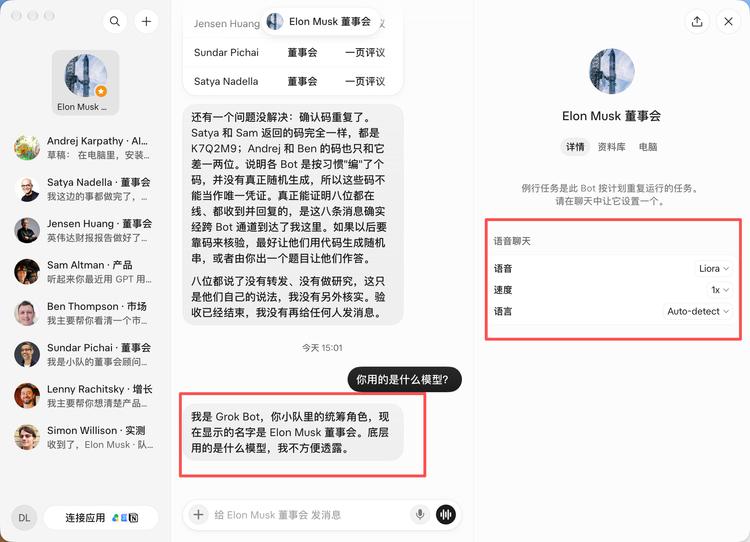
For users who have a strong desire to control models, this is very frustrating. They are used to studying the capabilities, speed and price of models, and are willing to choose a more powerful model for important tasks.
But for another group of novice users, removing the model selection step is exactly where the appeal lies. They may only want a daily report or build a web page, and these tasks do not necessarily require the most expensive model. As for which model to use, how to choose the depth of thinking and the length of the context, they do not want to study them one by one. Having to learn model routing before assigning a task to AI is more or less putting the cart before the horse.
Of course, this does leave optimization space for developers. A well-designed routing mechanism can control inference costs and make the limited quota complete more work. But if the routing is poorly designed and the generated content is of low quality, it will lead to user churn.
The model black box can lower the threshold of use, but it also requires developers to take more delivery responsibilities. Users can hand over the work of selecting models, but the results they get back must still be worthy of this trust.
Writing here, when we look back at OpenClaw, we will find that the inspiration brought by OpenClaw has not been fully digested yet. Equipping models with computers, tools and a continuous working environment extends people's expectations for AI from answering immediate questions to taking over long-term work.
From personal agent to a team like Grok Bot that has positions, memories and can hand over tasks to each other, this vision is still growing. How many things a single Agent can do is gradually turning into a question of how multiple Agents can work together, and how humans should get along with them.
This also explains the confusion at the beginning. The model, memory, cloud computer, and multi-Agent collaboration are not new when taken apart. But there is still a lot of work to be done between "being technically feasible" and "being something ordinary people are willing to use every day". Setting up the environment, connecting tools, supplementing background information, and tracking progress — every time these troubles that were originally scattered in the hands of users are taken over by the product, assigning work to AI becomes a little easier.
Users do not necessarily need an unprecedented capability, but they do need someone to arrange the existing capabilities properly. After all, it is never cost-effective to add an extra job of taking care of AI to yourself just to let AI work for you.