AMD: Unlike Intel, it is ramping up Helios to bolster its market position.
AMD (AMD.O) released its Q3 2026 earnings report (for the period ending September 2026) after US market hours on the morning of November 4, 2026 Beijing Time, key points are as follows:
1. Core Metrics:
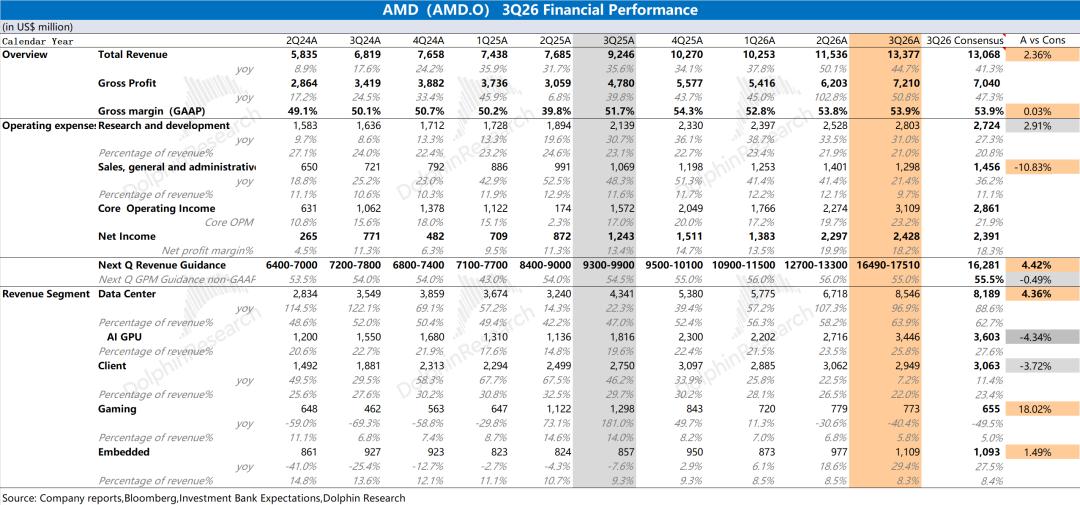
① Next quarter guidance: AMD expects revenue of 16.49–17.51 billion US dollars in Q4 2026 (beating market expectations of around 16.3 billion US dollars), representing a year-on-year increase of approximately 66%. The company expects non-GAAP gross margin to be around 55% (slightly below market expectations of 55.5%); non-GAAP operating expenses will be approximately 3.75 billion US dollars.
By segment breakdown: the company guides data center revenue to grow by about 5% quarter-on-quarter, corresponding to about 12.8 billion US dollars (a quarter-on-quarter increase of about 4.3 billion US dollars, compared to 1.8 billion US dollar quarter-on-quarter increase this quarter); Client and Gaming revenue will decline by more than 20% quarter-on-quarter, corresponding to less than 3 billion US dollars; Embedded revenue will deliver double-digit quarter-on-quarter growth, corresponding to more than 1.2 billion US dollars.
Management clarified that Q4 will be the first quarter when data center AI revenue exceeds server CPU revenue by a "significant margin", which means the next quarter's sequential growth will mainly come from the mass production ramp-up of MI450.
Previously, Dolphin Analyst worried that the PC downturn disclosed in Intel's earnings report would drag down AMD's 4Q guidance. The actual guidance decline for Client and Gaming (over 20%) is comparable to Intel's client guidance, but the data center's quarter-on-quarter increase of about 4.3 billion US dollars (MI450 incremental volume is expected to reach over 3 billion US dollars), the ramp-up of Helios more than offsets the drag from the PC segment.
② 2027 outlook is significantly revised upward: the company expects total 2027 revenue to grow by more than 80% (more than double the long-term financial model released at the Analyst Day last November); server CPU revenue will double (up from previous guidance of over 70% growth last quarter), data center AI revenue growth will "significantly exceed doubling", and data center revenue will account for more than 80% of total revenue.
Dolphin Analyst estimates that AMD's 2027 data center (server CPU + GPU) revenue is expected to reach 80 billion US dollars, significantly exceeding market expectations (around 70 billion US dollars), where both AI GPU and server CPU will achieve more than double growth.
2. Data Center: Server CPU revenue doubles, MI455X/Helios starts to contribute revenue. Revenue for this quarter reached 8.55 billion US dollars, up 96.9% year-on-year and 27.2% quarter-on-quarter, beating market expectations of 8.2 billion US dollars.
The growth of the data center business this quarter is jointly driven by server CPUs (both cloud and enterprise revenue more than doubled year-on-year) and the first batch of shipments of the MI450 series, and the segment operating margin rose to 33.7% (24.7% in the same period last year).
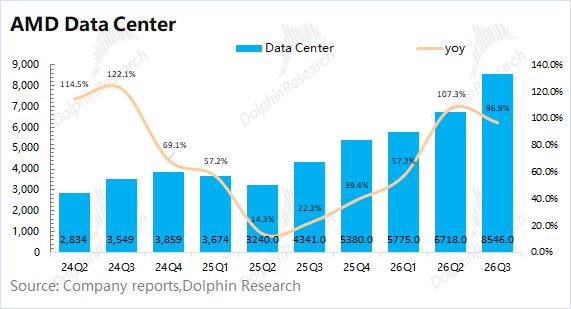
① Server AI GPU: Dolphin Analyst estimates AI GPU revenue this quarter is about 3.4 billion US dollars, up about 27% quarter-on-quarter (a sequential increase of about 700 million US dollars).
This quarter marks the first quarter that MI455X/Helios recognizes revenue, Anthropic, Meta, Microsoft, OpenAI and Oracle have already run models on the first batch of Helios racks, the CFO stated that MI450 ramp-up is "better than expectations heading into Q3". Significant volume ramp-up will come in Q4: calculated based on guidance, AI GPU revenue is expected to more than double quarter-on-quarter to reach around 7 billion US dollars.
② Server CPU: Driven by the increased demand for general-purpose computing power brought by Agentic AI, server CPU remains the company's main source of growth. Dolphin Analyst estimates the company's server CPU and related revenue reached about 5.1 billion US dollars this quarter, up about 100% year-on-year, significantly exceeding management's previous guidance of "over 80% year-on-year growth in the second half of the year".
Management stated that growth mainly comes from increased shipment volume and core count, with ASP contributing a small share; Venice has started revenue recognition, and OEM systems will be launched in Q4.
3. Client Business: Revenue this quarter reached 2.95 billion US dollars, up 7.2% year-on-year, below market expectations (3.1 billion US dollars).
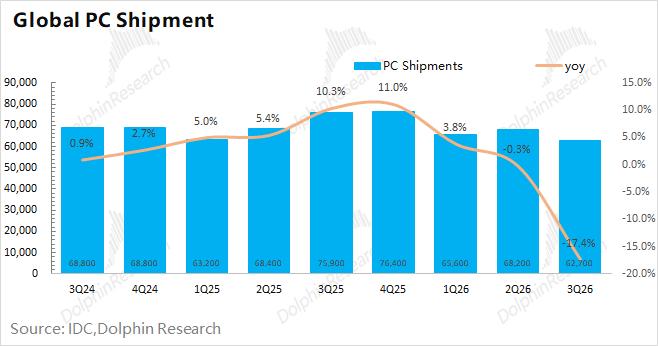
Intel released its earnings report first, which already set market expectations for PC performance, but AMD still achieved positive growth this quarter. The global PC market this quarter was dragged down by memory shortages, with shipments falling 17% year-on-year, while the company's client business still maintained year-on-year growth (Intel's client revenue fell 5% year-on-year in the same period).
This means the slowdown in AMD's client business growth is mainly affected by the industry-wide β impact, while the company's share in the PC market is still rising, but it can no longer fully offset the industry downturn.
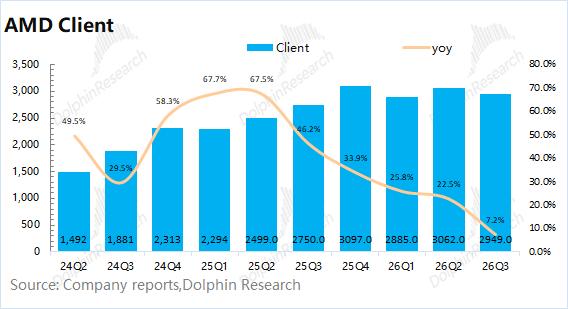
Intel's management attributed this downturn to industry-wide memory shortages that compressed total PC volume and tightened IT budgets. AMD's management gave a consistent explanation: PC channel circulation slowed down at the end of the quarter due to rising prices of memory and components, the company proactively controlled shipments in line with channel circulation to maintain healthy channel inventory, and is planning for double-digit decline in 2027 PC shipments.
4
AMD achieved revenue of 13.38 billion US dollars in Q3 2026, up 44.7% year-on-year, beating market expectations (13.1 billion US dollars). The company's revenue continued to grow this quarter, mainly driven by the data center business: on a quarter-on-quarter basis, data center revenue increased by 1.83 billion US dollars, Embedded revenue increased by 130 million US dollars, and Client and Gaming revenue decreased by 120 million US dollars.
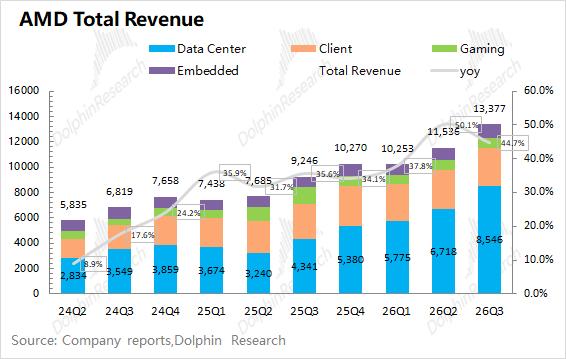
Expense and Profit Side: non-GAAP gross margin stood at 55.9%, largely flat quarter-on-quarter.
R&D expenses this quarter were 2.8 billion US dollars, up 31.0% year-on-year; sales and management expenses were 1.3 billion US dollars, up 21.4% year-on-year. The growth of the company's core operating expenses is lower than revenue growth (+45%), and the core operating expense ratio fell to around 30.7% (34.1% last quarter).
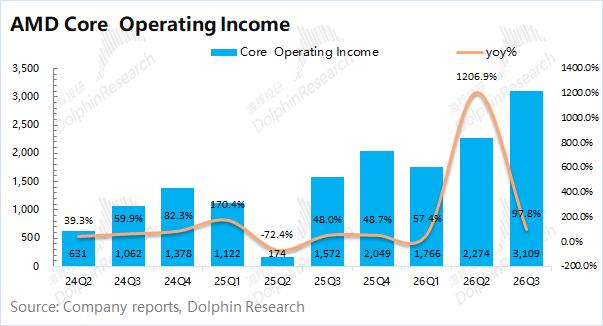
AMD achieved GAAP net profit of 2.43 billion US dollars this quarter, affected by non-recurring items such as fair value changes of customer warrants (1.097 billion US dollars non-cash loss). From an operating perspective, the company's core operating profit this quarter reached 3.11 billion US dollars, up 36.7% quarter-on-quarter, and the core operating margin rebounded to 23.2%.
"Core operating profit = gross profit - R&D expenses - sales and management expenses"
Dolphin Analyst's Overall View: Helios ramp-up exceeds expectations, 2027 guidance is raised further
The highlight of AMD's earnings report this quarter is the better-than-expected guidance, and its growth structure has completed the transition: The client segment is dragged down by the industry downturn and starts to underperform, this quarter's growth is underpinned by high server CPU growth, and starting from next quarter, the growth baton will be passed to Helios. The profit side also delivered positive surprises, the rising proportion of high-margin business keeps gross margin stable, expenses are better than guidance, and operating leverage starts to release.
In terms of guidance, the significant ramp-up of data center business next quarter is more than enough to offset the decline of Client and Gaming; next year's revenue growth rate (80%+) far exceeds the long-term model (35%) at Analyst Day, both server and data center AI growth rates are raised, management stated that power supply and data center facilities have been planned in advance with customers.
Dolphin Analyst believes that the medium-term logic of "CPU as the base, GPU taking over growth" remains unchanged. The market focus has shifted from "whether there are orders" to "whether Helios can be delivered on time and how much profit will be retained", and the post-market stock price surge is exactly the response to this.
Apart from this quarter's earnings report, the market's main concerns about AMD are as follows:
a) Big Tech capital expenditure: Cloud service providers are the largest chip purchasers
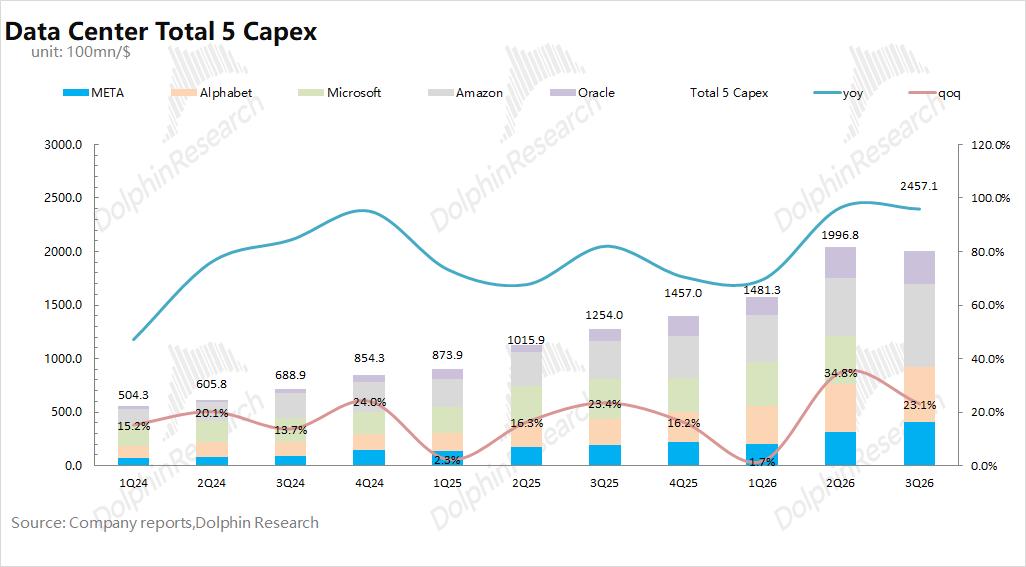
Four major CSP vendors have released their Q3 earnings reports, according to Dolphin Analyst's statistics, the total capital expenditure of the five core cloud vendors (Meta, Google, Microsoft, Amazon and Oracle) in Q3 still maintains a year-on-year growth rate of over 90%. AI Capex continues to be raised, but free cash flow turns negative, both Meta and Google posted negative free cash flow this quarter.
The main cause of this recent round of correction is not the sudden collapse of AI demand, but under the controversy over Anthropic's ARR growth, the market re-priced AI's payback period and financing capacity. The decline started roughly from the "most leveraged" players: first new cloud vendors such as CoreWeave and Oracle (5-year CDS spread jumped sharply), then big tech companies' cash flow, and finally the upstream semiconductor sector was hit.
b) CPU: The largest fundamental base at present
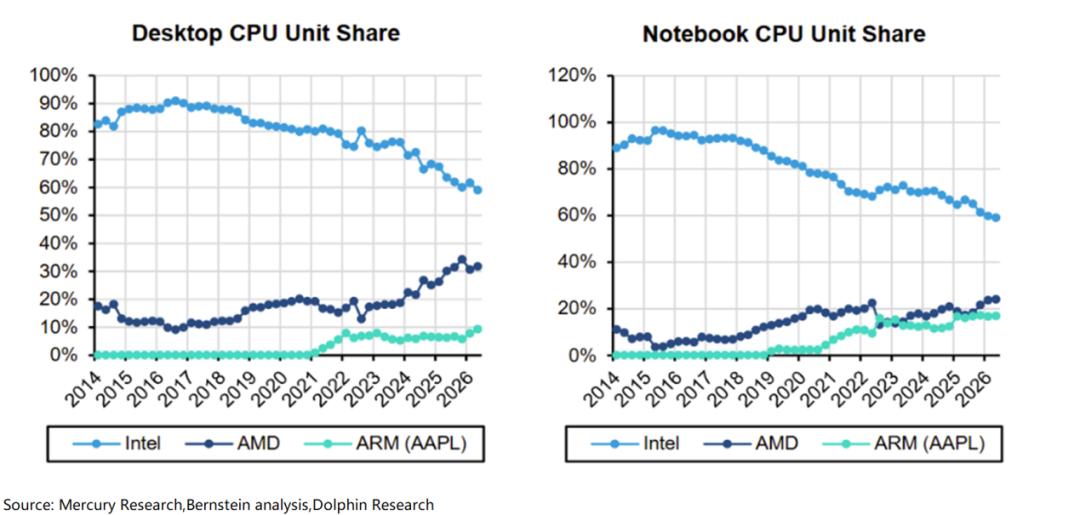
Under the circumstance that PC industry shipments fell 17% year-on-year this quarter, AMD's client business still achieved 7% growth, reflecting the continuous improvement of the company's competitiveness in the CPU field. However, it should also be noted that Intel, with a larger price increase in Q2, regained some revenue share in both desktop and notebook segments, AMD's advantage is more reflected in the continuous increase in shipment share.
Intel's Q3 earnings report released on October 29 delivered an "industry answer sheet" for AMD's CPU business in advance, with the conclusion of "PC market is weak, server market is strong":
① The PC side is an industry-wide negative factor that AMD cannot avoid.
This is an industry-wide issue: rising memory prices and shortages reduce OEM production volume, AMD's CPUs cannot be sold out either. Under the large β of double-digit industry decline, AMD's client business will shift from "grabbing share" to "declining less than peers".
② The server side is an industry-wide positive factor, which also leaves share room for AMD. Intel stated that substrate supply constraints will last until 1H27, dragging down AI CPU capacity release. But this is not obvious at AMD: the supply chain for PC and data center can be mutually allocated, the weak PC market can free up part of the production capacity for the more constrained server segment (the server CPU guidance revised from 70% year-on-year growth to 100% in 2027 is proof).
Management breaks down server demand into three segments: traditional cloud and enterprise, Agentic CPU, and head node CPU, the TAM will deliver a CAGR of about 50% in the next three to four years, reaching about 220 billion US dollars by 2030 (in line with mainstream market expectations of 200-220 billion US dollars), and stated that the company is gaining share in all three segments. The constraint remains on the supply side: demand still exceeds supply, in addition to wafers, supporting components such as substrates and DDR5 also need to be in place synchronously.
c) AI GPU Progress: MI455X/Helios starts shipping
Strong server CPU growth is already market consensus, and the ramp-up performance of MI455X is the key to whether the company's valuation can shift from "story" to "reality".
Strong server CPU performance is market consensus, and the ramp-up of MI455X is the key. After revenue recognition in Q3, shipments will start via server OEM/ODM in Q4, deployment will increase significantly, and ramp-up will continue throughout 2027.