Renting 30 apartments solely for training? The robots are yet to be sold, but the data-selling business has already taken off.
Who could have imagined that the first widespread public attention to embodied intelligence data collection came from a rental mishap?
A recent trending news story tells that someone rented 30 properties in one go, each for only about a week. Real estate agents initially mistook this for a new type of scam or illegal activity, but after investigation, they found out the tenant rented so many houses just to build scenarios to collect training data for humanoid robots.
Has the industry been rolled out to such an extent just for data collection? Lei Technology (ID: leitech) found that such stories are not isolated cases.
As the embodied intelligence track becomes increasingly hot, a number of companies specializing in providing data collection, data labeling and training services for robots have emerged.
Some people have built robot training grounds covering thousands of square meters, some distribute collection devices to ordinary people, allowing them to collect data for robots while doing housework at home, and others have expanded their business to dozens of cities across the country.
While robot manufacturers are still striving to find commercial application scenarios, the data collection work around robots' skill learning has already boomed in advance.
Before robots enter households, a group of people teaching them to work have already made a living from the industry
Data is everything. One of the important reasons why large language models have achieved rapid progress in the past few years is that there are massive texts, images and videos on the Internet.
Content from web pages, books, or social platforms can all become materials for model learning. Although these data also need to be screened, cleaned and labeled, at least the access channels are relatively abundant.
Robots are not that lucky.
Humans can learn knowledge through texts and videos, but if a robot wants to truly complete a physical task, it is not enough to just know how to do it. It must understand the position, shape and weight of objects, know where its arm should move, how much force is needed for grasping, and how to adjust when encountering unexpected situations.
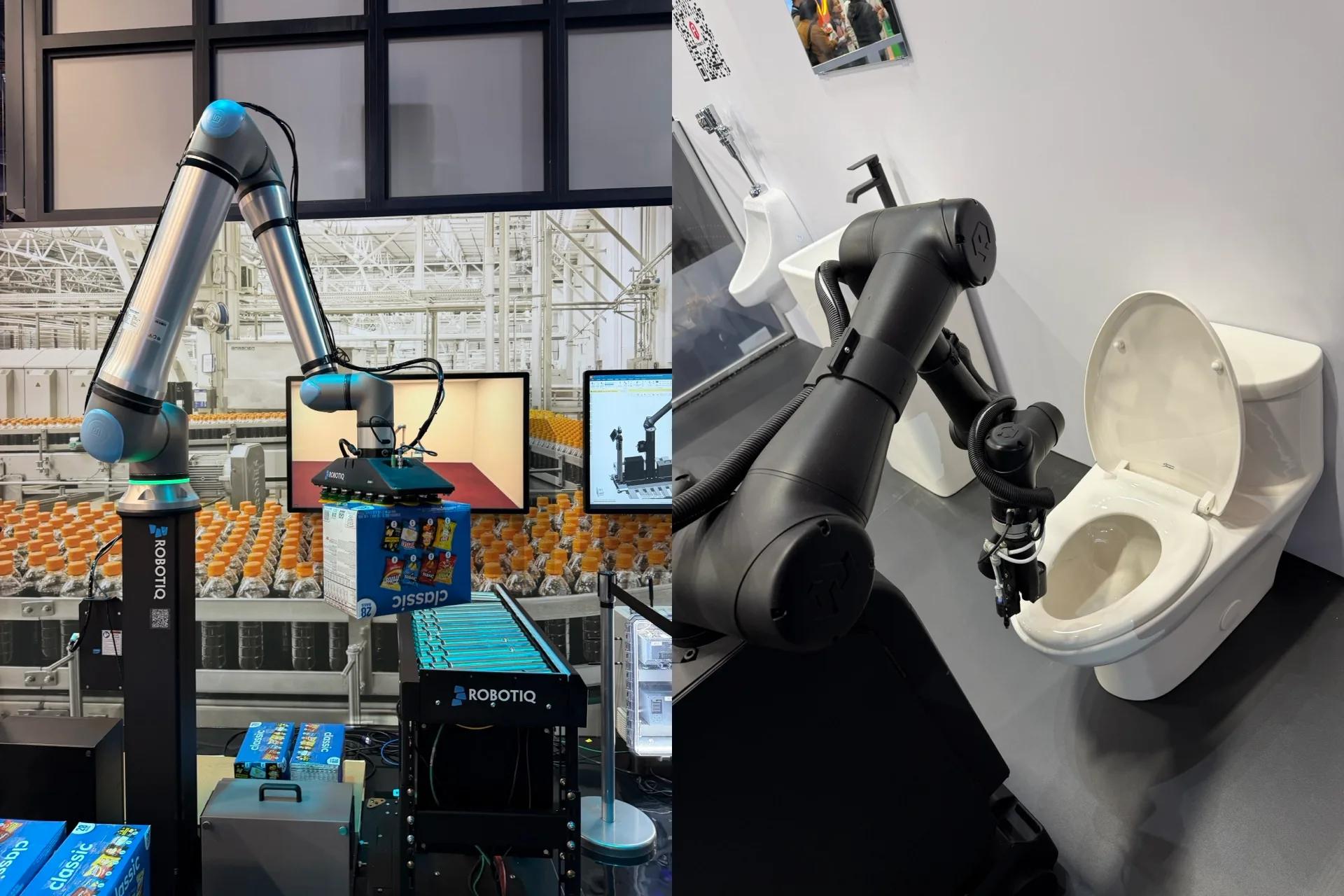
Filmed by Lei Technology at CES 2026 site
Take a simple example: let the robot pick up a water cup.
For humans, this hardly requires any thinking. But the robot needs to first identify the position and posture of the water cup, judge the shape of the cup, then plan the motion trajectory of the mechanical arm, and control the gripper to complete the grasping. If the cup is filled with water, the grasping force should not be too strong, otherwise the cup may be crushed; nor too weak, otherwise the cup will fall off.
Moreover, humans rarely perform only one independent action in real life. We may hold a mobile phone in one hand, pick up the water cup with the other, then turn around and put the cup on the table. The whole process involves two-hand coordination, spatial judgment, object recognition and continuous action planning.
This is also why robots cannot learn to work just by watching videos.
It needs a large amount of real-world interaction data, to know what actions people take in what environment, what kind of contact occurs between hands and objects, and what results are produced after the action is executed.
Such data can hardly be provided only by the Internet.
According to a report by China Securities Journal in October, the current data demand of many robot enterprises and large model enterprises has moved from the million-hour level to the ten-million-hour level. To make a single skill of a robot reach the deliverable level, 2000 to 5000 hours of training data may be required.
As a result, companies specializing in collecting robot training data have begun to appear.
In addition to collecting data in the fixed scenarios of 30 houses mentioned at the beginning, many companies have begun to explore ontology-free data collection to reduce costs.
The so-called ontology-free collection can be simply understood as that it is not necessary for a complete humanoid robot to perform all actions in person. Instead, humans wear devices such as head-mounted displays, gloves or hand-held grippers to simulate the process of robots performing tasks, and then convert human action trajectories, spatial positions and operation information into training data.
In this way, the collection cost can be greatly reduced. After all, the price of a complete robot is not low. If collecting each piece of data requires occupying one robot, the cost of large-scale application can be easily imagined.
From this perspective, the work of robot data collectors is a bit like the people who did data labeling for AI models in the past, except that this time they are not only telling AI what is in a picture, but also stepping into the real world to tell robots how to act.
Some rent houses, some launch crowdsourcing, the data collection market is gaining momentum
In fact, although data collection seems new, different operation models have already been developed.
Currently, the typical routes can be roughly divided into centralized collection, crowdsourced collection, and full-link services formed around data processing and training.
Centralized collection refers to building a dedicated robot training ground, moving scenarios such as families, factories, supermarkets, and catering into fixed venues, then deploying different types of robots and collection devices to make them perform specified tasks repeatedly.
For example, the Beijing Humanoid Robot Innovation Center has built a dedicated data and training base. The advantage of this model is that it is relatively easy to control data quality. The collection environment, equipment and operation process are relatively unified, and problems can be easily traced when they occur.
But it also has obvious limitations: the real world is too large, and it is impossible for a fixed training ground to simulate all scenarios.
Therefore, crowdsourced collection has become another alternative.
In September this year, Mifeng Technology, an affiliate of Agibot, officially launched the crowdsourcing mode of embodied intelligence data collection. Ordinary people can apply for collection devices, complete tasks such as organizing desktops, cooking, and folding clothes in daily life, collect corresponding data and get paid.
As of October, the crowdsourcing business of Mifeng Technology has been launched in 40 cities including Beijing, Guangzhou, Shenzhen and Shanghai.
Participants can earn 10 to 30 yuan per hour for data collection. For ordinary people, this is equivalent to turning part of their daily actions into a part-time job. For data service providers, it extends the collection network to more real families and life scenarios in a relatively low-cost way.

Source: Filmed by Lei Technology
This does not even require all participants to have knowledge about robots.
As long as they wear the equipment as required, complete the specified actions, and upload the collected data, they can have the opportunity to become providers of robot training data.
In addition to Mifeng Technology, JD is also promoting a similar large-scale data collection program. JD has mobilized more than 100,000 internal employees of different occupations and up to 500,000 external personnel from various industries to participate in the collection, with the goal of accumulating 5 million hours of real-scene human video data within one year and exceeding 10 million hours within two years.
In addition, a number of companies are not satisfied with simply selling raw data, but have begun to extend to links such as data processing, labeling, quality review, and model training.
For example, when a person folds clothes, it seems to be just a simple video, but what the robot really needs may be the hand movement trajectory, the position change of the object, the contact information during grasping, and the task state corresponding to each action.
If these pieces of information are not processed, the help of the data to the model will be greatly reduced.
Therefore, what data service providers need to complete is not only collection, but also data cleaning, action labeling, quality inspection, format conversion, and even customizing dedicated datasets according to the robot configuration and model requirements of customers.
Interestingly, the participants of these data collection activities are not only embodied intelligence enterprises, local innovation centers, AI data service providers, hardware equipment manufacturers, and even retail and service enterprises with a large number of offline scenarios can all become participants.
Robots have not been sold on a large scale yet, but the industrial division of labor around robots' learning capabilities has been established in advance. This is not difficult to understand: intelligent driving also follows a similar path, learning through a large amount of real data in the early stage, and then achieving explosive growth at a certain point in time.
Can selling data really make money? It depends on the degree of adaptation
After reading the above content, some people may think that ordinary people can participate in this industry just by wearing equipment and doing housework, and the demand seems strong. In this case, embodied intelligence data collection seems to be a good business.
Even so, it is not recommended that everyone enter the market blindly. The scale of data collection is indeed expanding, but it does not mean that all data can be sold, nor does it mean that a stable profit model has been formed.
From recruitment apps, we can also learn that the salary for embodied intelligence data collection is not high, most of which are in the range of 3000 to 4000 yuan. If you live in first-tier and second-tier cities, this salary is even lower than that of delivering takeout.
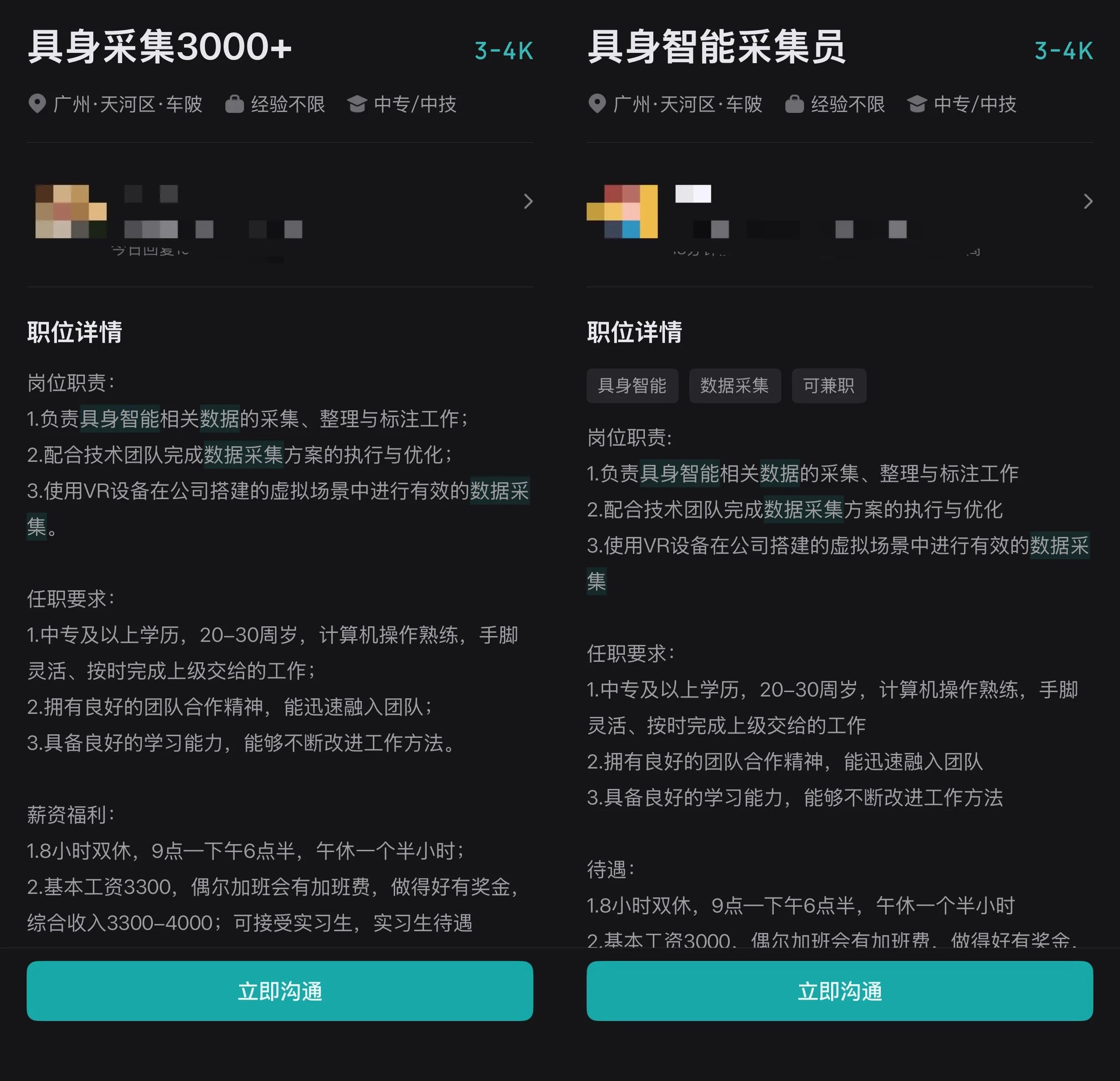
Source: Screenshot of a recruitment app
There are two reasons for this: first, the threshold of this job is not very high; second, the data is not universal data, which means the input-output ratio is not proportional, so it is impossible to pay too high a salary.
Let's elaborate on the second reason. At present, the embodied intelligence industry is still in the stage of rapid evolution of technical routes. Different manufacturers use different robot configurations, sensors, control systems and model architectures. Therefore, the data collected by one data service provider may not be directly used by another robot enterprise.
This leads to an awkward phenomenon in the data industry: on the one hand, everyone is complaining about the lack of data; on the other hand, each company is building its own data system according to its own technical route.
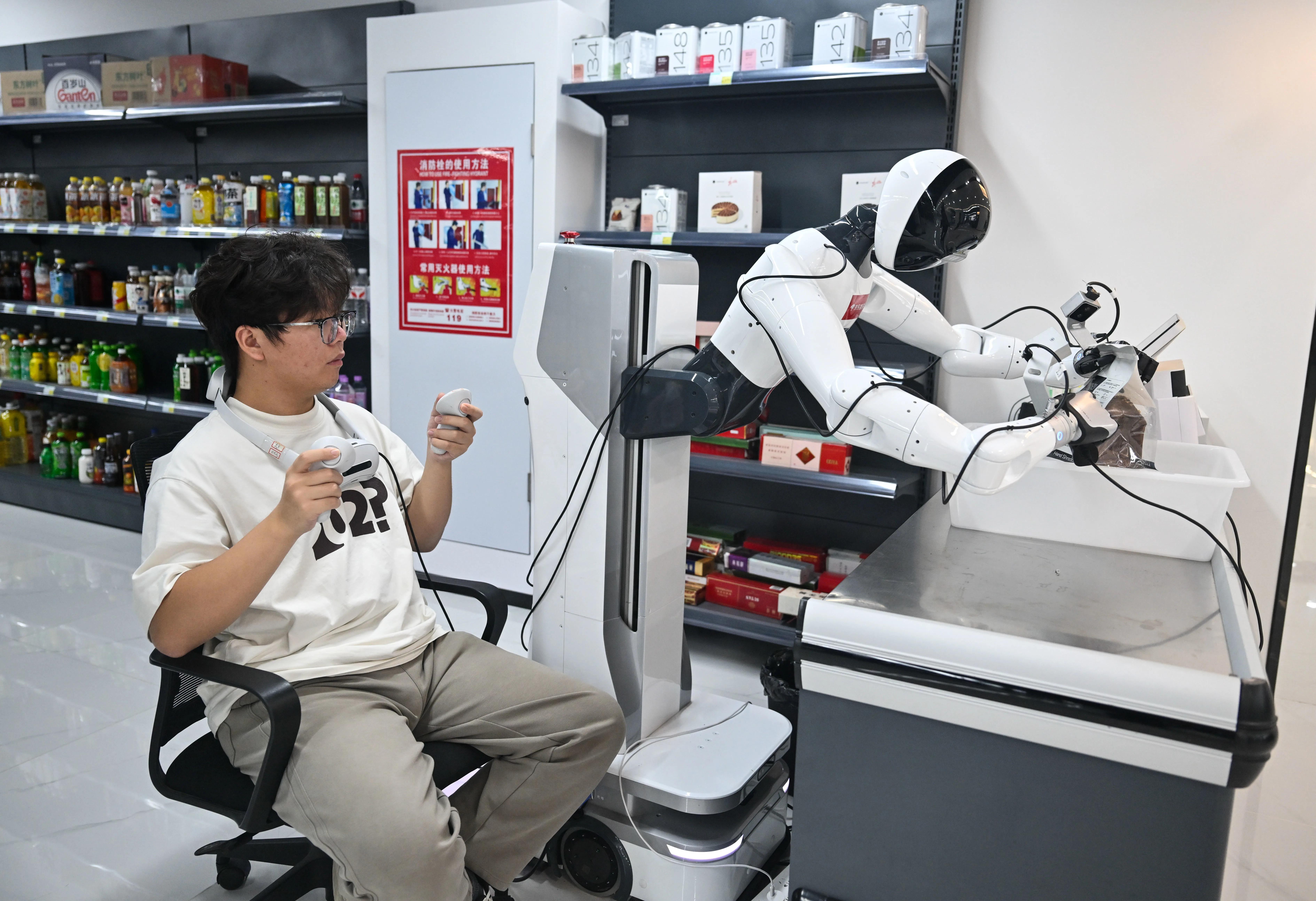
Source: Xinhua News Agency
The "Embodied Intelligence Development Report (2025)" released by the China Academy of Information and Communications Technology mentions that currently, the data collection and labeling methods of different training grounds and the configurations of robot bodies are not unified, so it is difficult to integrate and share data across different training grounds. At the same time, whether the training ground data can continuously match real business needs remains to be verified.
Data is not like ordinary commodities that can be produced and placed on shelves waiting for buyers. It usually needs to be adapted according to the customer's robot, model and specific tasks.
Moreover, robot enterprises themselves are also working on data collection. Agibot has its own data collection factory, and also explores crowdsourced collection through its subsidiary Mifeng Technology; the Beijing Humanoid Robot Innovation Center not only builds training bases, but also promotes data delivery; robot enterprises such as Galaxea and Ubtech are also building data collection and training capabilities around their own products and models.
Therefore, the more likely situation in the future is not that all robot enterprises outsource data collection, but that self-built data systems and third-party service providers coexist.
By the way, when it comes to data, there is inevitably a problem that cannot be ignored: privacy and security.
In scenarios such as families, supermarkets, and catering, the collection process may involve private content such as personal images and family environments. Small-scale collection is fine, but when the collection scale expands from dozens of people to dozens of cities, data security is no longer a small issue.
Therefore, what the embodied intelligence data industry needs to solve next is not only how to collect more data, but also how to desensitize these data and continuously generate value under the premise of compliance.
To some extent, this is more important than simply expanding the collection scale.
This article is from "Lei Technology", authorized for release by 36Kr.