Employees who are concerned about AI programming security were berated by the CEO as having a "loser mentality". All staff of Proton are required to "re-take the interview", and the CTO even stated bluntly that "programming is dead".
"It is recommended to spend a few more days on security testing before new code goes live." This was originally a perfectly normal engineering suggestion. After all, for a technology company that builds its reputation on privacy and security, whether the code can run safely is obviously more important than launching a few days earlier.
But the reaction of Proton CEO Andy Yen caught the employee who made the suggestion somewhat off guard:
"That's bullshit and loser thinking."
He not only opposed employees slowing down the development speed, but also asked everyone to stop "meticulously hand-writing code" and use AI more instead.
This debate is just a microcosm of the internal AI transformation turmoil at Proton. To embrace AI as soon as possible, this privacy-focused company not only began tracking employees' AI usage, but also planned to have almost all employees re-interviewed to prove they can keep up with the AI era.
Employees are worried about security and their jobs, but the CEO believes that those who cannot keep up with AI may be eliminated by the times.
After media exposure and user protests, Andy Yen finally canceled this "AI re-interview". But almost at the same time, Proton's CTO released an engineering manifesto, directly throwing out a controversial judgment: "Programming is dead, but engineering is not."
01
From banning AI usage to 90% of code written by AI
For a quick introduction, Proton is a Swiss-headquartered tech company with products including Proton Mail, Proton Drive, Proton Pass, Proton Meet and more. For a long time, privacy protection and security have been its most important brand labels.
However, under the AI wave, the way Proton works internally is undergoing drastic changes.
According to an investigative report by 404 Media, Proton once banned employees from using AI at work before, but later quickly shifted to fully embracing AI. By October this year, about 90% of the company's code had been written by AI, a large part of which was completed with the help of Anthropic's Claude. It is reported that Proton also installed software on employees' computers to track the amount of AI-generated code.
To drive the transformation, its CEO Andy Yen has repeatedly emphasized the importance of AI internally, and his vision for the future is quite radical. He once stated in an internal message that 2026 will be the last year the company recruits traditional software engineers; starting from next year, the company will recruit more product managers and build products with the help of AI.
He also left a rather oppressive sentence on Slack: "The train is coming. Get on or get crushed. Don't become a fax operator in the internet age." — which means: The train of the times is coming, either get on it or get crushed, don't end up as a fax machine operator in the internet era.
In Andy Yen's view, AI is no longer a tool that employees can choose to use or not, but the key to determining the company's future competitiveness. The problem is, when the management is fully focused on pursuing speed, where should the code quality and security issues that engineers care most about be placed?
02
Employee raises security suggestion, CEO directly hits back with "loser thinking"
This August, in the Slack channel of the company's security team, an employee suggested that they should at least spend a few days conducting penetration testing (Pentest) on the newly written code to confirm there are no security issues before deploying it online.
The original intention of this suggestion is not hard to understand: AI can generate code quickly, but fast generation does not mean the code is free of problems. Especially for companies like Proton, whose products cover emails, passwords and cloud storage, once a security vulnerability occurs, it may affect the privacy data of a large number of users.
However, Andy Yen did not start a discussion around the testing process, but responded directly on Slack: "This is absolute nonsense and loser thinking. Speed and security can absolutely be achieved at the same time." He added: "Don't always think about how to slow things down, think more about how to make things faster."
Not only that, there is the most harsh sentence: "Stop meticulously hand-writing code, use AI more."
Based on this phenomenon, 404 Media interviewed 8 current employees and 1 former employee of Proton, and reviewed internal Slack messages, meeting recordings and other materials. In fact, many employees are not opposed to AI, but just worry that the company's excessive pursuit of development speed will eventually drag down security and engineering quality. However, they have no way to express these concerns publicly:
Employees worry that they will be reprimanded by the CEO in front of everyone for raising questions, and even their jobs will be affected.
In response, an internal Proton employee gave a rather sharp comment: "Andy Yen has completely fallen into AI Psychosis."
03
All employees re-interviewed: if you can't use AI, you might lose your job?
If the debate over security testing only made employees see Proton management's obsession with speed, then the next arrangement directly made them feel the pressure on their positions.
According to 404 Media's report, Proton originally planned to have almost all employees re-interviewed, focusing on investigating how they use AI in their work — not simply asking "Have you used Claude", but requiring employees to present specific cases, to explain how they complete work with the help of AI, what results they have achieved, and how they changed their original work methods.
Company CTO Bart Butler also emphasized in a previous internal meeting that this evaluation is quite important. If employees have not tried AI and have not seriously thought about how to use AI to change their work methods, they should start taking action now. It is understood that Andy Yen has interviewed about 40 management personnel in the engineering and product fields, and some employees with good performance have been arranged to interview other colleagues.
In this regard, employees naturally have another layer of concern: if they cannot prove that they are actively using AI, will they be considered unfit for the company's future development? Is this interview actually to help employees adapt to AI, or a disguised layoff?
04
After public opinion ferments, CEO cancels re-interviews: but AI transformation will continue
On October 29, after 404 Media published the relevant report, backlash quickly emerged within Proton and its user community.
Many users are worried that the company's aggressive promotion of AI will affect the long-emphasized security commitments of its products. On social media, some people demanded Andy Yen's resignation, while others said they would cancel their paid subscriptions. Andy Yen later responded on Reddit, trying to explain the company's position to users, but the controversy did not subside, and his reply received more than 1800 downvotes.
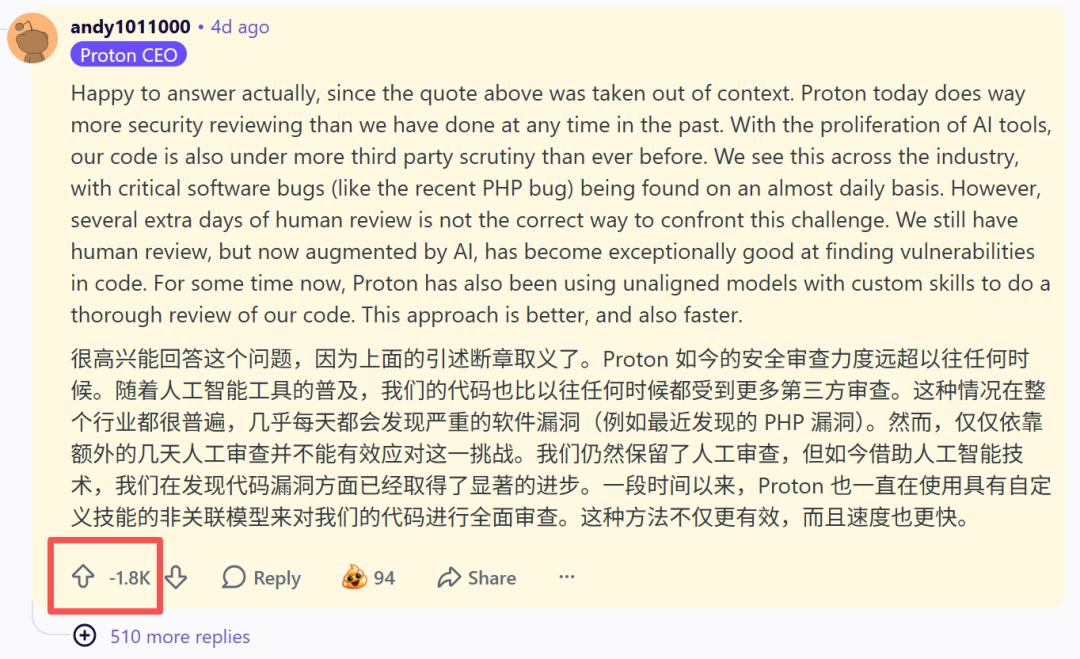
The next day, on October 30, Andy Yen announced at an all-hands meeting that the company had decided to cancel the originally planned AI re-interviews for employees. He admitted that he had made mistakes in communication, saying that some things could have been conveyed in a better way, and he needed to reflect and improve.
However, canceling the AI re-interviews does not mean that the AI transformation will hit the brakes. Andy Yen said he will continue to push AI forward, and explained that after discussions between the management and the board of directors, the re-interviews have achieved some of their goals — employees have begun to seriously discuss AI and learn how to use it at work.
Andy Yen also revealed that Proton will carry out organizational adjustments next month to redistribute talents across different teams, but emphasized that no employees will lose their jobs because of AI.
In addition, the company's CTO Bart Butler also tried to respond to employees' concerns about security issues. He said that pragmatically using AI does not mean the company will abandon security, good architectural design and software engineering principles. Regarding the previous handling, he said straightforwardly: "We messed up, we know we messed up."
Even so, employees' reactions are not uniform. Some think it's good to cancel the AI re-interviews, while others worry that AI usage will still be part of performance assessments, and the real problems have not been resolved. For them, the re-interviews are canceled, but the direction the management is pushing AI has not changed.
05
CTO releases engineering manifesto: Programming is dead
When the turmoil had not yet subsided, on November 1, Bart Butler published "Proton's Software Engineering AI Manifesto" on Proton's official website, whose core view is quite straightforward: AI has changed software development, and engineers' work must change accordingly.
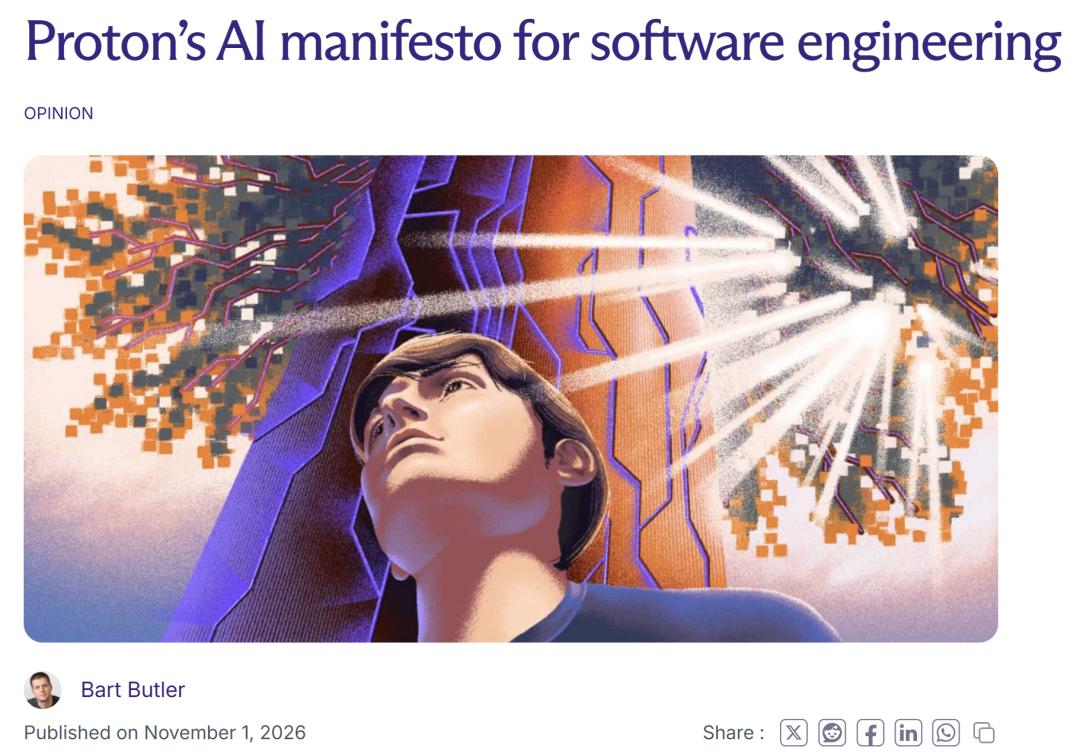
Bart Butler believes that in the future, the responsibility of engineers will no longer be to write every line of code personally, but to help AI complete development tasks faster and better. He also proposed a new working mode: every engineer should become the head of a small team, except that the team members are no longer all humans, but composed of multiple AI models and agents.
What engineers need to do is to prepare the code repository context, shared skills and prompts for AI, so that they can continuously complete tasks autonomously; when AI fails repeatedly on a certain problem, they must also find the cause and fix it, so that it will not make the same mistake next time.
However, Bart Butler does not think human engineers are worthless anymore. He emphasized that experience, judgment, system understanding ability, and the ability to take responsibility for the final result are still irreplaceable parts of humans. Security, architecture and software engineering principles will not become invalid just because of the emergence of AI.
In his view, Proton has only completed the first step of AI transformation so far: using AI to speed up existing work. The next step is to re-examine the entire software development process to identify new bottlenecks. For example, AI can already write code quickly, so do continuous integration, design approval, requirement specification formulation and code review also need to be redesigned? If you only let AI speed up code writing without adjusting other links, the efficiency improvement will eventually be limited.
At the end of this manifesto, Bart Butler even said straightforwardly: "Programming is dead, but engineering is not dead, and professional competence is not dead."
However, for Proton's employees, the most urgent question to answer right now may not be how to get AI to write more code, but whether the company's management has really thought clearly: In the AI era, when efficiency conflicts with security, which one is the bottom line that cannot be compromised?
After all, AI can help engineers save a few days of code writing time, but it may not be able to bear the cost of a single security incident for the company.
Reference link: https://www.404media.co/protons-ceo-cancels-ai-re-interviews/
This article is from the WeChat official account "CSDN", written by Zheng Liyuan, and published with authorization from 36Kr.