Shanghai brain-computer interface unicorn kicks off its IPO
Another domestic brain-computer interface enterprise is sprinting towards the capital market.
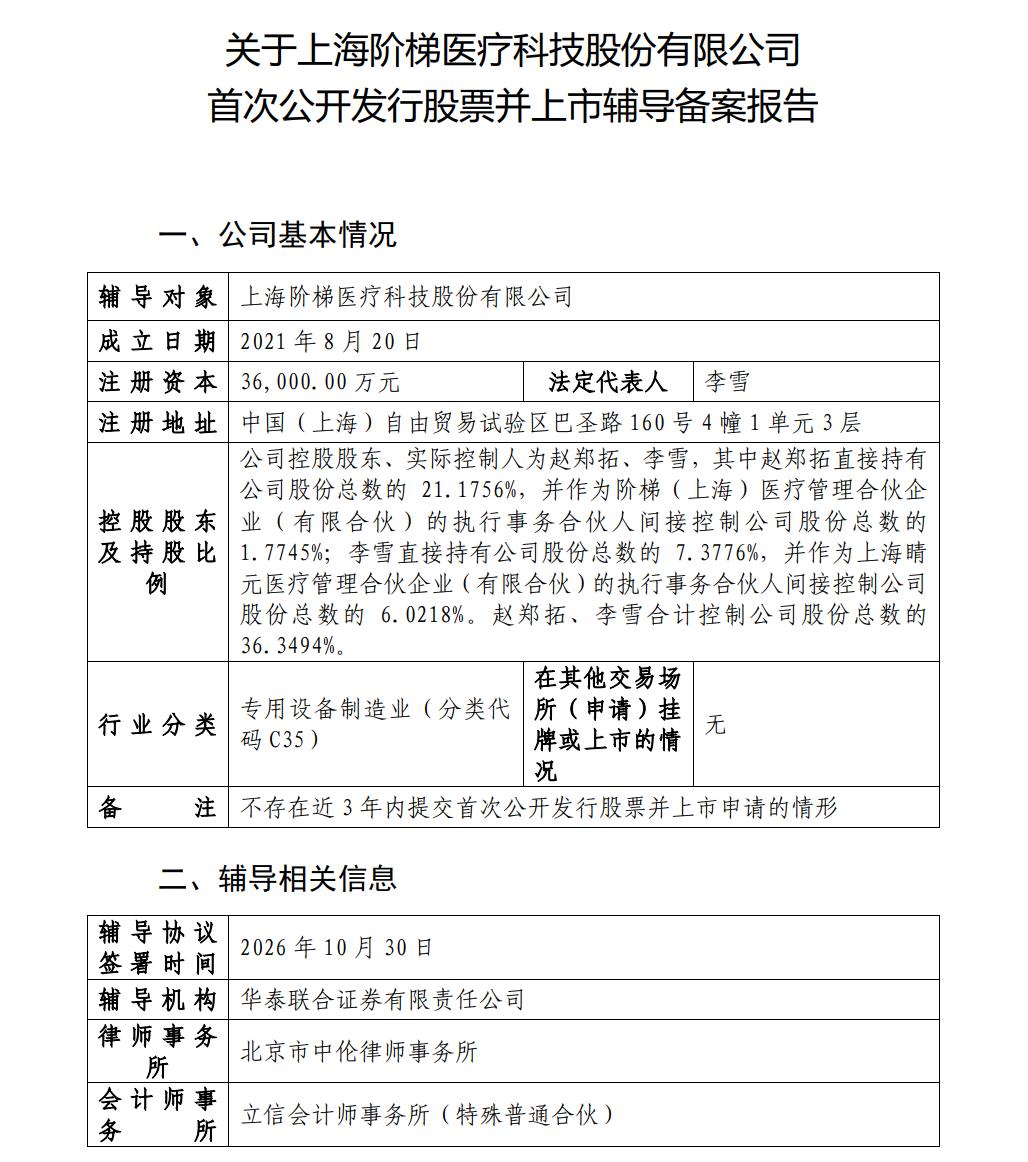
Recently, according to information disclosed on the website of the China Securities Regulatory Commission, Shanghai Step Medical Technology Co., Ltd. (hereinafter referred to as Step Medical) has launched its listing tutoring, with Huatai United Securities as the tutoring broker. The two parties signed a tutoring agreement on October 30, and the company is currently in the tutoring filing status.
Founded by a post-90s couple
Step Medical was founded in August 2021, headquartered in Pudong New Area, Shanghai, focusing on the R&D, clinical transformation and industrialization of minimally invasive implantable brain-computer interface (BMI) systems, with core directions including motor function replacement, neurological disease monitoring and regulation, and sensory perception restoration. Its products cover electrodes, implants, algorithms and surgical robots and other segments.
Public information shows that Step Medical was co-founded by Zhao Zhengtao and Li Xue, a couple born in the 1990s.
Among them, Zhao Zhengtao was born in 1991. He completed his undergraduate study in Energy and Power Systems and Automation at Xi'an Jiaotong University, and successively obtained a master's degree in Mechanical Engineering from the University of Michigan-Dearborn and a doctorate in Biomedical Engineering from the University of Texas at Austin.
From 2019 to 2020, Zhao Zhengtao conducted postdoctoral research at the University of Texas at Austin and Rice University; in November 2020, he joined the Center for Excellence in Brain Science and Intelligent Technology of the Chinese Academy of Sciences as a researcher and head of the Neural Interface Research Group. He participated in the founding of Step Medical in 2021 and currently serves as a director of the company.
Li Xue was also born in 1991, and her ancestral home is Henan Province. She graduated from Huazhong University of Science and Technology with bachelor's and master's degrees in Biomedical Engineering, and later obtained a doctorate in Electrical and Computer Engineering from Rice University in the United States. She returned to China in 2020 and joined the Center for Excellence in Brain Science and Intelligent Technology of the Chinese Academy of Sciences, and currently serves as the chairman of Step Medical.
According to the tutoring filing report, the controlling shareholders and actual controllers of Step Medical are Zhao Zhengtao and Li Xue. In terms of shareholdings, Zhao Zhengtao directly holds 21.1756% of the company's shares, and indirectly controls 1.7745% of the company's shares by acting as the executing partner of Step (Shanghai) Medical Management Partnership (Limited Partnership).
Li Xue directly holds 7.3776% of the company's shares, and indirectly controls 6.0218% of the company's shares by acting as the executing partner of Shanghai Jingyuan Medical Management Partnership (Limited Partnership). The two jointly control 36.3494% of the company's shares.
Core products have completed clinical subject enrollment
In terms of technical path, Step Medical focuses on the invasive route. Zhao Zhengtao previously publicly explained that the reason why the company chose the invasive route is that the ultimate engineering of invasive technology has stronger certainty. As long as sufficient resources are invested, the probability of future implementation will be higher. The strategy of Step Medical is to first focus on the problem of engineering certainty, while continuously paying attention to the development of different technical paths. At the appropriate time point, the downstream process pipeline built based on the invasive scheme will be connected to different front-end technical paths.
It is precisely for this reason that among the brain-computer interface startups established in recent years, Step Medical is regarded by the industry as the domestic company that is most similar to Neuralink.
The core technical foundation of Step Medical is the ultra-flexible neural electrode. The diameter of the electrode is about 1/100 to 1/300 of a hair strand, the diameter of the implant is about 26 mm, and the thickness is less than 6 mm. The implantation procedure only requires a 3-5 mm micropore in the skull, which reduces invasive damage while maintaining the signal acquisition capability at the neuron level. Around this technology, the company has simultaneously developed an implantable brain-computer interface platform system, neural signal decoding algorithm and semi-automatic flexible electrode implantation surgical robot.
At the current stage, the core product of Step Medical is the 256-channel minimally invasive implantable brain-computer interface system WRS 01 (currently the second-generation product), which is mainly oriented to motor function reconstruction for patients with high paraplegia. The system collects neural signals through electrodes implanted in the brain, and converts the patient's motor intention into control instructions through signal processing and decoding algorithms, so as to realize the control of computers and external peripherals.
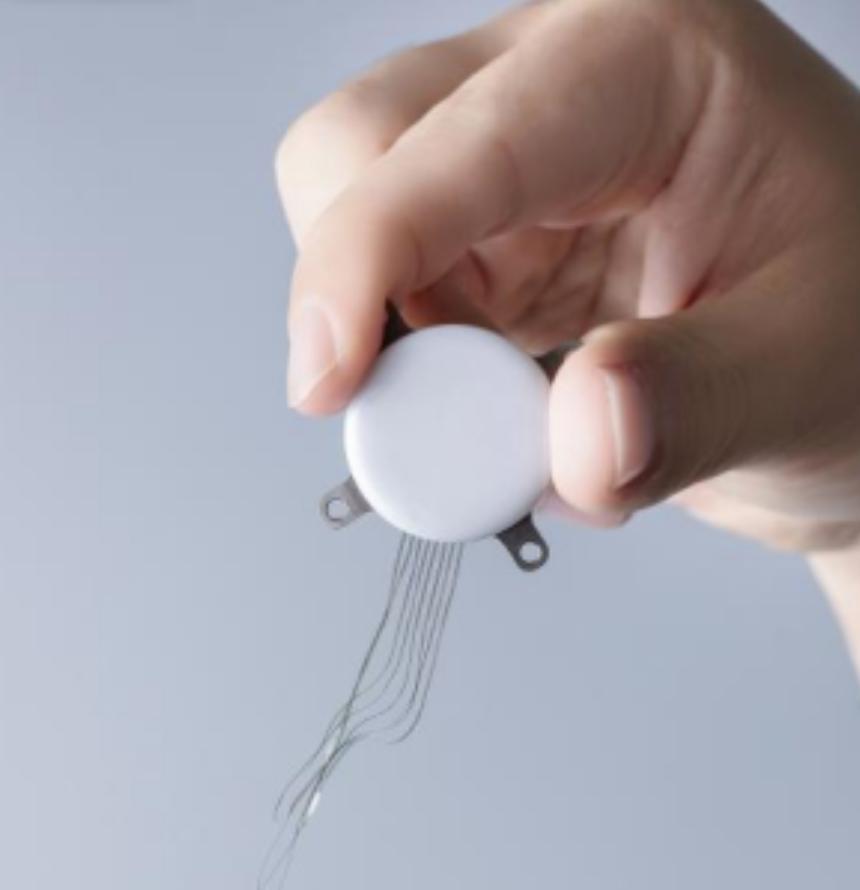
Figure | Physical object of WRS 01 implant Source: Official WeChat account of Step Medical
At present, WRS 01 is the first fully invasive brain-computer interface product to enter the special review procedure for innovative medical devices of the National Medical Products Administration, and has been recognized as a "globally new" medical device.
At present, WRS 01 has entered the registered clinical stage. In August 2026, the multi-center registered clinical trial of this product completed the enrollment of all subjects, becoming the world's first fully invasive brain-computer interface product that completed the enrollment of registered clinical trials.
According to the disclosure on Step Medical's official WeChat account, the company has completed a total of 42 cases of long-term implantation, with the cumulative in-vivo duration of subjects exceeding 5000 days and the cumulative duration of brain-controlled use exceeding 10000 hours.
At the same time, Step Medical has also developed a closed-loop ultra-low damage deep brain nerve stimulation system (deep brain stimulation system). 4 clinical research implantation operations have been completed, and the regulation function verification has been realized. The clinical trial is planned to be launched in 2027, with indications including Parkinson's disease and epilepsy.
The invasive brain-computer interface industry is still in the early stage. For long-term implantable medical devices, to be promoted to clinical application, R&D breakthroughs are only the foundation, and stable large-scale production capacity, continuous delivery capacity, as well as sufficient safety and reliability verification are equally critical.
In this regard, according to the public information disclosed by Step Medical, on the manufacturing side, the company has built a "Brain-Computer Innovation and Manufacturing Base", which integrates three modules: a medical-grade MEMS manufacturing center, a GMP production platform and an exclusive fully invasive brain-computer interface test platform. Among them, the MEMS manufacturing center is responsible for the precision processing of the core component ultra-flexible neural electrodes.
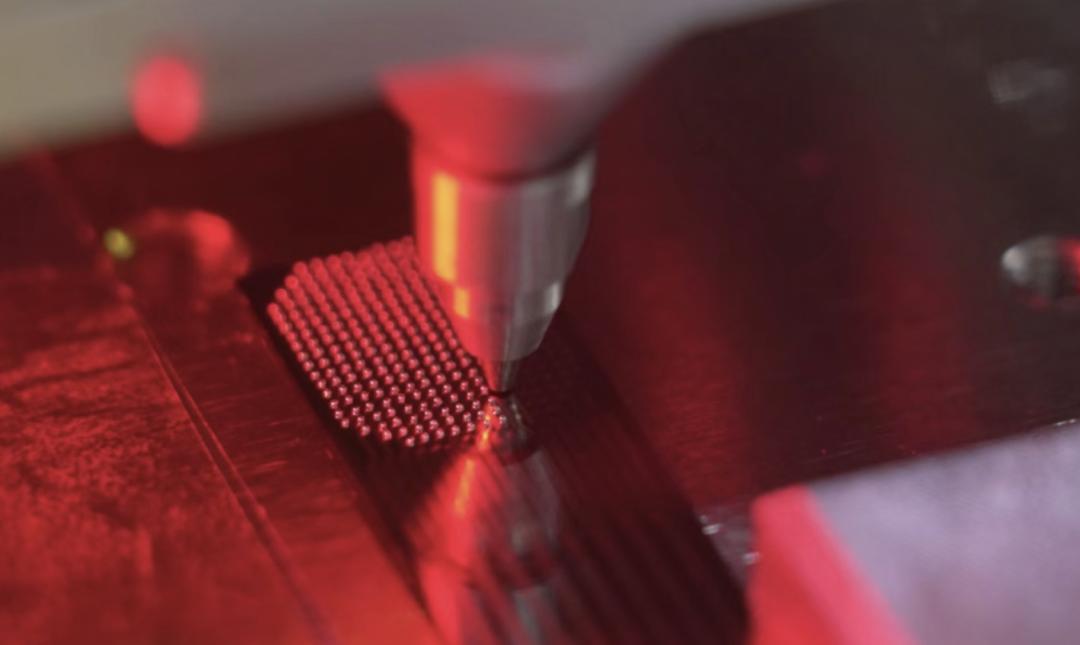
Figure | Equipment in MEMS manufacturing base: laser ball mounter Source: Official WeChat account of Step Medical
Step Medical said that the company is one of the earlier enterprises to introduce semiconductor technology into medical device production. Relying on more than 100 processes such as photolithography, it completes the preparation of fine electrode structures and conductive circuits at the sub-micron scale.
Cumulative financing has reached 2.6 billion yuan
Before launching the listing tutoring, Step Medical has completed multiple rounds of financing, with many well-known investment institutions supporting it, and it is the first enterprise deployed by Alibaba and Tencent in the brain-computer interface track.
In terms of financing, Step Medical has intensively completed multiple rounds of capital raising since 2022. In December 2022, the company successively completed the angel round and Round A financing. Among them, the angel round was participated by Yuanlai Capital, with a financing amount of tens of millions of yuan; the investors of Round A were Orbimed and Yuanhe Origin, with a financing scale of hundreds of millions of yuan.
In February 2025, Step Medical completed 350 million yuan of Round B financing, with Qiming Venture Partners, Orbimed, Lilly Asia Ventures and Yuanlai Capital participating. In December of the same year, Shanghai State-owned Investment participated in its B+ round of investment.
In March this year, Step Medical announced that it had completed 500 million yuan of strategic financing, led by Alibaba, followed by SDIC Chuanghe, and old shareholders Tencent, Yuanlai Capital, Orbimed, Yuanhe Origin, Qiming Venture Partners, Lilly Asia Ventures, Source Code Capital, and Shanghai State-owned Investment Pilot also continued to participate.
In just the past year, Step Medical's cumulative financing amount has exceeded 1.1 billion yuan. As of September, the cumulative financing amount has reached 2.6 billion yuan, higher than the 2.5 billion yuan of BrainCo, making it the invasive brain-computer interface enterprise with the highest cumulative financing amount in China at present.
It is worth noting that the current domestic brain-computer interface track is ushering in a concentrated period of capitalization, and many leading enterprises are sprinting towards the capital market at the same time.
In addition to Step Medical, the STAR Market IPO of BrainRoCo has been accepted and the first round of inquiry has been completed; Xuli Innovation, which focuses on non-invasive brain-computer interface, also launched the STAR Market IPO tutoring in September; BrainCo was previously exposed to have secretly submitted its Hong Kong IPO application.
Who will win the title of "the first brain-computer interface stock" is still uncertain. The review progress, product implementation and commercialization performance may all become important variables that determine the result of this race.
This article is from the WeChat official account "STAR Market Daily", author: Shi Shiyun, published with authorization from 36Kr.