Li Jiaqi, can you help Chen Yusen deliver significant results?
The viral highlight of this year's Double 11 arrived a bit later than expected.
On the evening of November 2, an invisible product was listed on Li Jiaqi's live stream.
The comment section of the live stream was flooded with the phrase "3, 2, 1, launch the Token".
The 0.01-yuan monthly personal membership card for QwenWork went on sale, selling 50,000 units within 10 minutes, and nearly 100,000 units in half an hour, with the total nominal AI computing power quota corresponding to approximately 2 trillion Tokens.
This marks the first time AI computing power products have been sold on a top-tier influencer's live stream.
The guest who came to promote the product is Chen Yusen, Vice President of Alibaba Group, CEO of QwenWork, and the youngest head of a business unit at Alibaba.
Born in 1992, he is the same age as Li Jiaqi.
The last time a high-profile Alibaba executive appeared on Li Jiaqi's live stream was during the 2018 Double 11 event. Jack Ma and Li Jiaqi competed in a live stream PK session to sell lipsticks, where Li Jiaqi sold 15,000 lipsticks, creating a legendary memorable moment.
Eight years have passed, lipsticks have been replaced by Tokens, and the person standing next to Li Jiaqi has changed from Jack Ma to Alibaba's youngest vice president.
The question is: can nearly 100,000 1-cent monthly cards turn into the significant outcome Chen Yusen needs?
01
Handing in the paper in five months: the mid-term exam for the top-priority project
Chen Yusen's schedule is extremely packed.
On June 11, Wu Zhao (Chen Hang), the founder of DingTalk, resigned amid controversy sparked by his long article "Inside DingTalk", and Chen Yusen took over as CEO of DingTalk to oversee Alibaba's AI office business.
This post-90s entrepreneur, who founded the cybersecurity company Chaitin Tech at the age of 22 and launched MuleRun as an internal startup after the company was acquired by Alibaba Cloud, has since become the most watched new rising star at Alibaba.
In July, Alibaba integrated three internal competing Agent products, QoderWork, Wukong and MuleRun, via "technical integration" to launch QwenWork. The public beta launched on August 3, the same day the flagship model Qwen3.8 was released. On September 4, QwenWork announced that the number of users had exceeded 30 million within 30 days of launch, with enterprise users accounting for more than half of the total. It updated 120 versions in 30 days, iterating an average of 4 times per day.
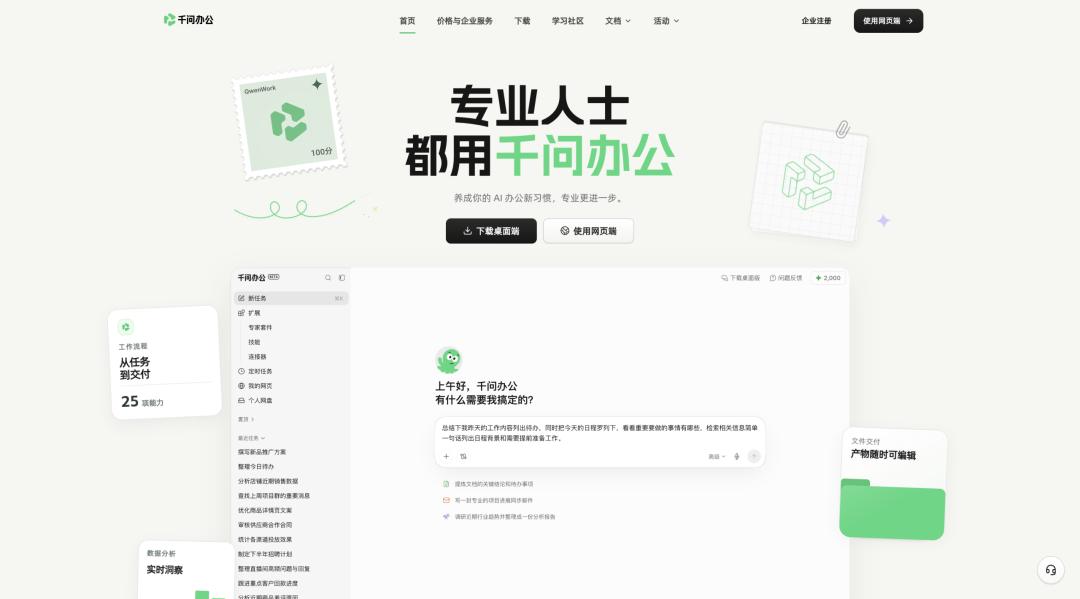
Screenshot of QwenWork official website
At the Yunqi Conference on September 22, QwenWork held a dedicated session, where Chen Yusen made his first public appearance about 100 days after taking office. His speech was themed "Context is All You Need", and he launched the "Enterprise Context" product for enterprises.
Behind this series of rapid moves, the situation is far from easy.
Statistics from Analysys on 17 mainstream desktop AI-native office agents show that in June 2026, Tencent's WorkBuddy recorded 20.97 million visits, ByteDance's domestic TRAE IDE version recorded 12.79 million visits; Alibaba's QoderWork and Wukong combined recorded 9.19 million visits, of which QoderWork accounted for 7.88 million visits.
Tencent's products recorded a total of 32.62 million visits, while Alibaba's total was only about 30% of that figure.
Martin Lau, President of Tencent, stated on the Q2 earnings call that WorkBuddy has very high user retention rate and willingness to pay.
On August 25, ByteDance split the "Work Task" function from its Doubao App and released an independent AI office product "Doubao Work", promising that basic functions will be permanently free. On September 15, ByteDance held a 3,000-person launch event in Beijing, with CEO Liang Rubo personally taking the stage to position Doubao as the group's "core AI business", while Feishu was concurrently adjusted to a business line under the AI product division.
All three major tech giants have entered the track, and the market pattern has not yet been finalized.
Data from QuestMobile shows that in September, the total number of active users in the AI office track reached 142 million, a year-on-year increase of 50.6%. WorkBuddy ranked first among office Agents with 32.353 million active users, more than three times that of the second-place product. Tang Daosheng, Senior Executive Vice President of Tencent Group and CEO of Cloud and Smart Industries Group, publicly stated that more than 50% of China's top 500 enterprises are already using WorkBuddy, and 60% of the top 100 enterprises have been covered by the product.
Clearly, Tencent has already achieved "significant results" in the AI office field, while QwenWork, which entered the market later to compete, has not delivered many outstanding performances.
The window of time left for Chen Yusen is visibly narrowing.
More importantly, the 30 million figure announced by QwenWork refers to the cumulative number of users in its first month of launch, and the official has not disclosed monthly active users, retention and payment data. This statistical caliber cannot prove whether the product has truly been integrated into users' daily work processes.
Pressure also comes from inside Alibaba.
In the exclusive report "Exclusive | QwenWork Becomes Alibaba's 'Top Priority Project', All Talents and Computing Power from Alibaba Cloud and DingTalk Will Be Integrated into the Product" previously published by Surge AI, QwenWork is a company-level strategic product for the second half of 2026, with senior group executives personally participating in its key meetings, and the flagship model Qwen3.8 was released and first accessed on the same day as QwenWork.
The flip side of resource tilting is that expectations are also rising simultaneously.
In addition, the two products with the same name, the To C Qwen App and the To B QwenWork, have blurred boundaries for target users. The media outlet Insight once reported that the two products "competing for users" is no secret.
Therefore, the Double 11 event has become a node that cannot be missed.
Tmall has listed Token as an independent promotional category for the first time this year, and launched the "AI Space Station" recharge center on September 3.
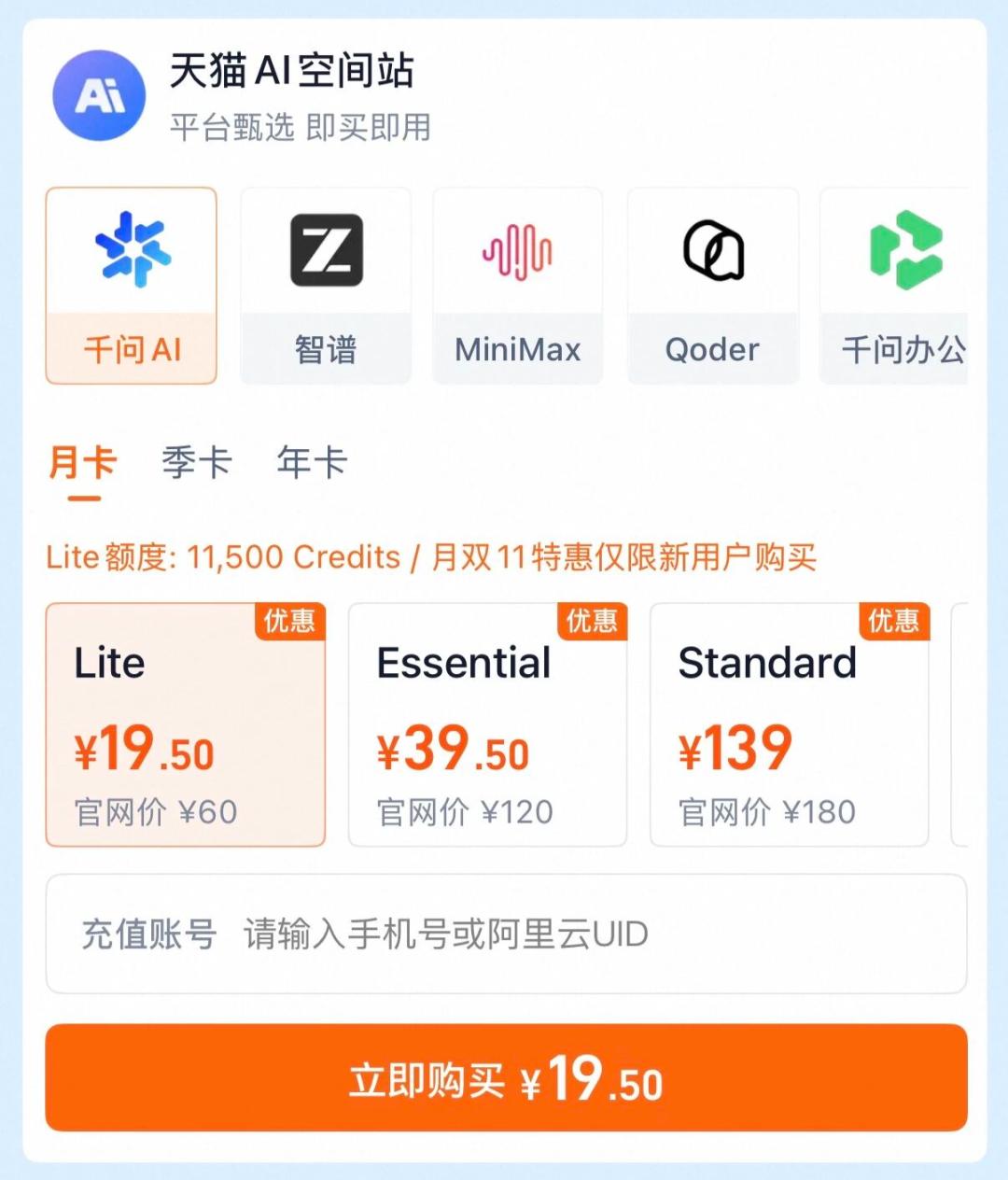
For QwenWork, this is a direct conversion field that can turn user volume into activity, and public attention into paid users, and it is also the first major exam for Chen Yusen after taking office.
02
All girls, and the 1-cent monthly card
Back to the live stream.
Li Jiaqi asked Chen Yusen: "Can you help me create an AI avatar that can chat with girls 24 hours a day?" Chen Yusen's answer became the most widely shared clip that night: "AI can never replace Li Jiaqi. I hope more to help fans use AI to deal with trivial matters, so that they can get off work on time, spend time with their pets, and take good care of their families."
This live stream did not start by introducing model parameters, but broke down the product into several specific practical scenarios.
Li Jiaqi used QwenWork to generate a global fishing map that supports multi-user access; QwenWork collected the public information of Li Jiaqi's assistant Wangwang on social media and generated a work report; parents can use it to sort out their children's homework and exam papers, and make targeted training mini-games.

Li Jiaqi's live stream
Along with the Tokens, three AI laptops pre-installed with QwenWork (Lenovo Lecoo Air, Machenike Light 16S Youth Edition, Lenovo Zhaoyang Yue Plus), AI audio recording cards and desktop robots were also listed, all part of the "Tmall QwenWork AI Laptop Program". 70 laptop hardware models equipped with QwenWork will be launched for the first time during this year's Double 11.
This live stream completed an effective translation of public demand.
Token, a technical term that originally mainly appeared in developer discussions and subscription pages, was translated into the public-friendly language of "use AI for 1 cent a month", and nearly 100,000 monthly cards were sold in half an hour.
The problem is hidden right in these nearly 100,000 monthly cards.
Li Jiaqi's traffic capability does not need any proof, he is still the undisputed top live stream influencer in the current market.
The public profile of his core audience base "All Girls" shows that the viewers of his live stream are mainly women aged 18 to 35, with students, ordinary white-collar workers and mothers accounting for a considerable proportion. Their consumption decisions are concentrated in categories such as beauty, snacks and daily necessities, and they are highly price-sensitive.
Therefore, when they come into contact with AI office and Tokens, they find it very novel. Many users in the live stream and on social media clips are marveling at the functions of AI office products.

Screenshot from Li Jiaqi's live stream
But the payment logic for AI office products is completely different. The standard version of QwenWork personal edition is priced at 98 yuan per month, the premium version at 198 yuan per month, and the enterprise version at 198 yuan per seat per month. For this type of product to be viable, it relies on users' real daily work processes: writing documents, making spreadsheets, running data analysis, and accessing the enterprise knowledge base.
The more frequently users use the product, the more Tokens they consume, and the more stable their renewal willingness will be.
The live stream performance report did not disclose the previous AI office usage habits of these new users, nor can it prove which work tasks they will continuously delegate to QwenWork.
There is no answer yet as to how many users will renew or upgrade to the regular-priced packages after the 1-cent monthly card expires.
This is the part that Li Jiaqi can help Chen Yusen solve: short-term download volume, registration volume, national-level brand exposure, plus the public mindset education that "even Li Jiaqi is selling Tokens".
The part he cannot solve is equally clear: monthly active users, retention rate, continuous Token consumption, and in-depth penetration into enterprise-level scenarios.
Using subsidies to expand scale is the most familiar tactic for the previous generation of internet companies.
QuestMobile's judgment on the AI office track is that "the shorter the path, the stronger the stickiness; the lower the decision-making cost, the higher the usage frequency".
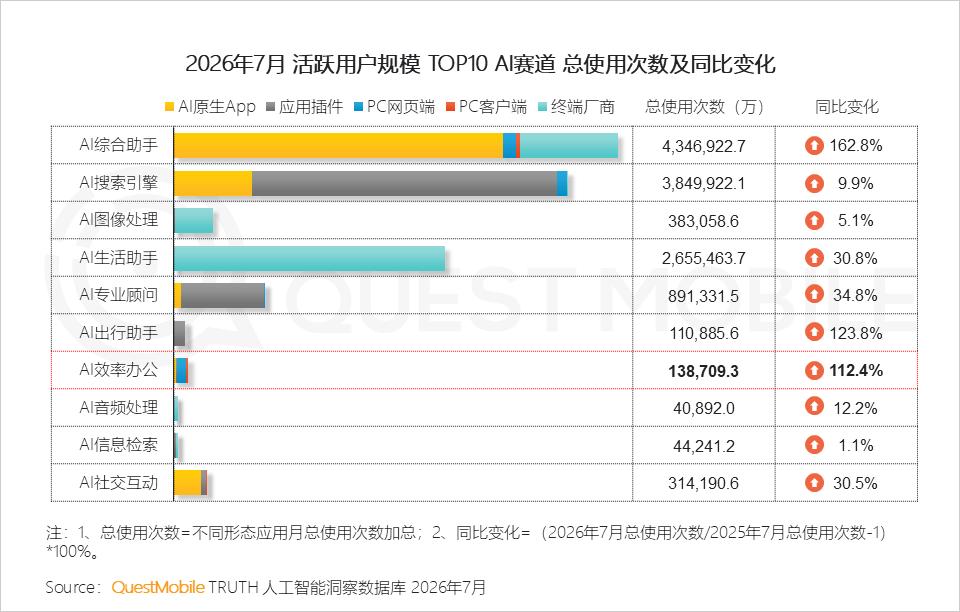
Source: QuestMobile
But the path from the live stream is exactly the shortest and shallowest one in the entire e-commerce ecosystem. Users click in from the live stream, spend 1 cent, and leave immediately after using the product.
For AI office products, continuous consumption is a better indicator of product value than one-time ownership. There is a huge gap between curiosity and forming a work habit, which Li Jiaqi cannot cross, and can only be crossed by the product itself.
03
Tokens on the shelves
Chen Yusen is not the only person who has put Tokens on e-commerce shelves.
On September 2, Zhipu took the lead in opening an official flagship store on Tmall, selling GLM Coding Plan subscription packages: Lite version at 118 yuan/month, Pro version at 538 yuan/month, Max version at 1078 yuan/month, and team version at 598 yuan/seat/month.
Subsequently, manufacturers including MiniMax, Alibaba Cloud Bailian, Moonshot AI, and StepFun have successively settled in Tmall's "AI Space Station", with Token packages displayed in categories of monthly cards, annual cards and recharge packs.
QwenWork in the live stream is just the most prominent position on this shelf.
The platform data looks very lively.
Within 48 hours after Zhipu settled in, its brand search volume increased 50 times month-on-month, driving the transaction volume of Tmall's AI Token subscription products to increase by more than 160% month-on-month; Tmall data shows that on the first day of Double 11 sales on October 20, the transaction volume of Taobao's Token category surged by 450% compared with the previous month. However, the platform has not announced the absolute transaction base of this round of growth.
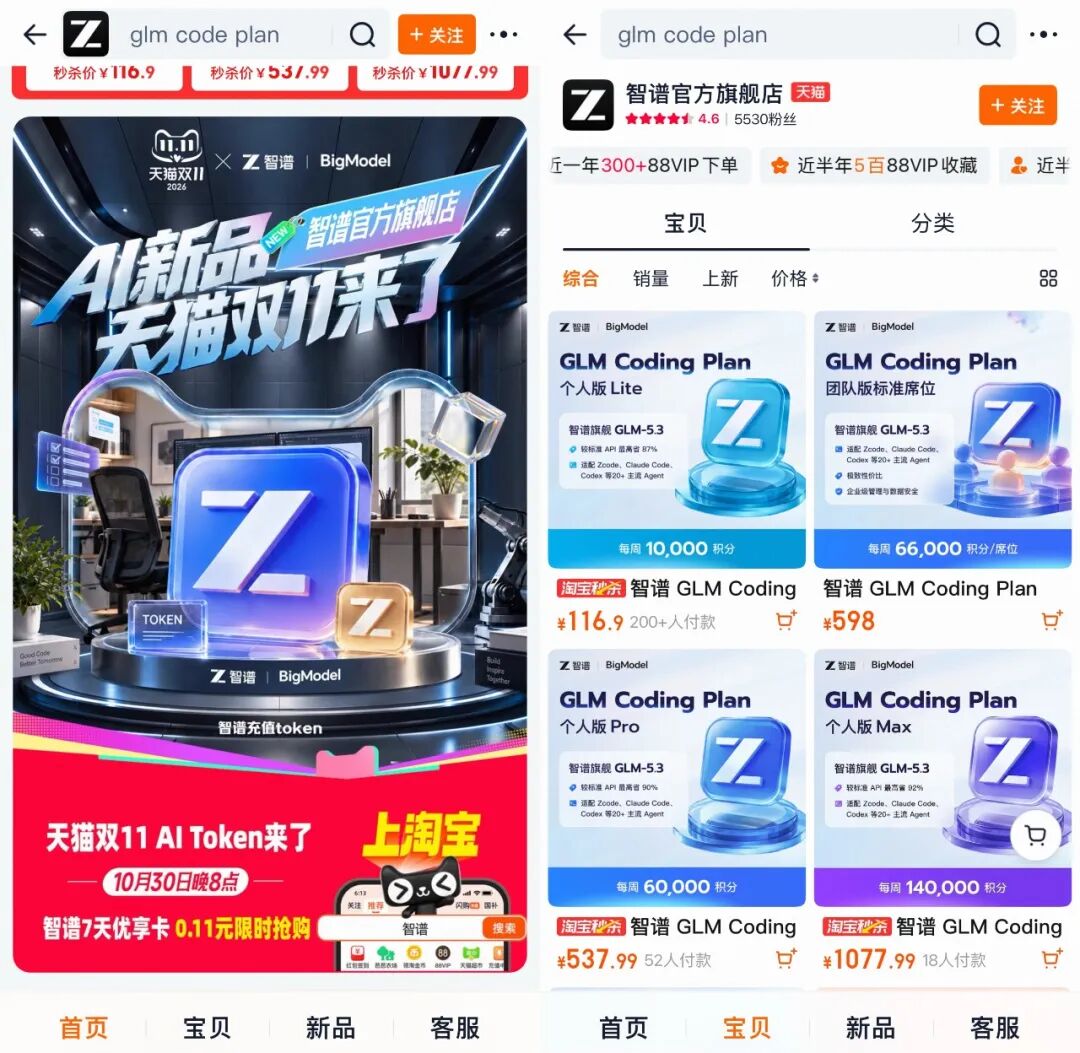
Another set of data is much more cold.
In the early days of Zhipu's flagship store opening, the sales volume was not displayed on the four product pages. According to a report by Baloong HK Stock, as of September 18, the three personal version packages had sold a total of more than 144 units. At least based on the store's performance at that time, the search popularity had not been converted into transaction scale synchronously.
The real value of official channels may lie elsewhere.
On