As AI gaming enters the "Red Fruit Moment", why are Tencent and miHoYo not panicking?
AI games have once again become the focus of the internet.
Not long ago, Anthropic released Claude Opus 5.5, which focuses on improving game programming capabilities, leading large language models to reshape the game development track.
In this way, AI games are no longer insignificant supporting roles.
Developers can not only quickly replicate classic games with the help of large models, but also stitch different games together, subverting the entire game industry's inherent perceptions.
Even so, AI games still have a long way to go.
The development threshold is no longer required
AI games are not the first time to go viral.
At the birth of large models, games were regarded as their natural landing scenario. Therefore, AI games sprouted very early, and related works also entered the vision of the industry.
The most typical one is the funny game "You Be the Dad", which uses AI to generate plots and corresponding pictures in real time, so as to endow the game with randomness and achieve an effect that varies from player to player.
At that time, AI games did not live up to their name, and AI played more of a polishing role in them.
Until 2025, large models entered the zero-threshold development stage, and ordinary people can develop an immersive and free game work with the help of AI without any prior foundation.
As a result, AI has become the protagonist of game development.
Public data shows that there are more and more games with AI tags on the Steam platform. The proportion was 1.2% in 2023, and as high as 30.8% by the middle of 2026.
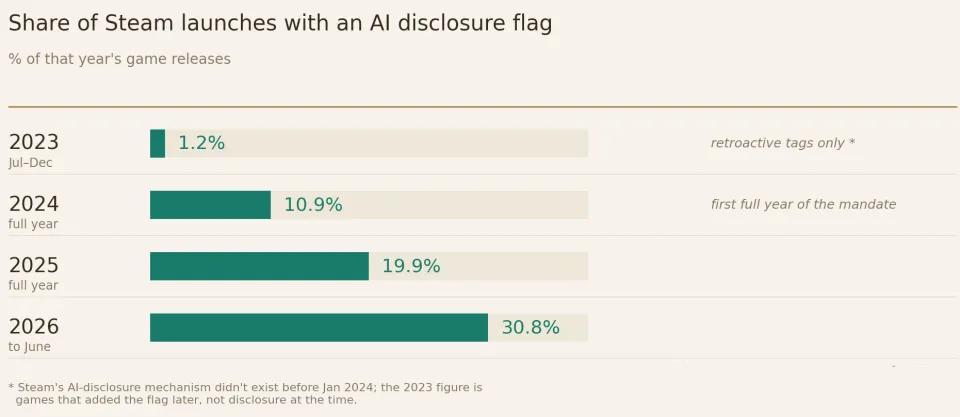
AI has become the protagonist of game development
It is worth mentioning that Elon Musk has also entered this field, established the XAI artificial intelligence game studio, and plans to release a native AI game built based on the Grok large model before the end of 2026.
Even so, for a fairly long period of time, AI games have not become the mainstream of industry development.
The reason for this is that the previous AI technology was not sufficient for the full-process development of games, resulting in insufficient quality of AI games, which were even inferior to mini-games with relatively low development thresholds.
No one expected that with the continuous evolution of AI Coding, AI games have not only achieved smooth development but also flourished.
At present, throwing a game video to a large model can generate a roughly similar game; throwing a 3A blockbuster to a large model can produce a web version that does not require high computer performance; throwing a low-pixel old game from decades ago to a large model can create a high-pixel version...
A game developer told Zinc Scale: "Current AI games have the same vibe as AI short dramas, the creation threshold is extremely low, and you can make it as long as you have an idea."
The aforementioned game developer further stated that in the past, most players dismissed AI games and resisted classic IPs embracing AI, but now they hold an open attitude. Some people even stitched the shooting game "Modern Warfare 2" and the skateboarding game "Skate 3" into a new AI game, which unexpectedly went viral.
Various signs indicate that AI games will enter a blowout stage, attracting more players' attention and changing the industry competition landscape.
"Rosky" said: "In the past, making mods and porting games had high technical thresholds; now this threshold is loosening. When players can modify games by themselves, competitors can also reproduce the core mechanism faster, and manufacturers have to reconsider the test cycle, release rhythm, and the value of platform exclusivity."
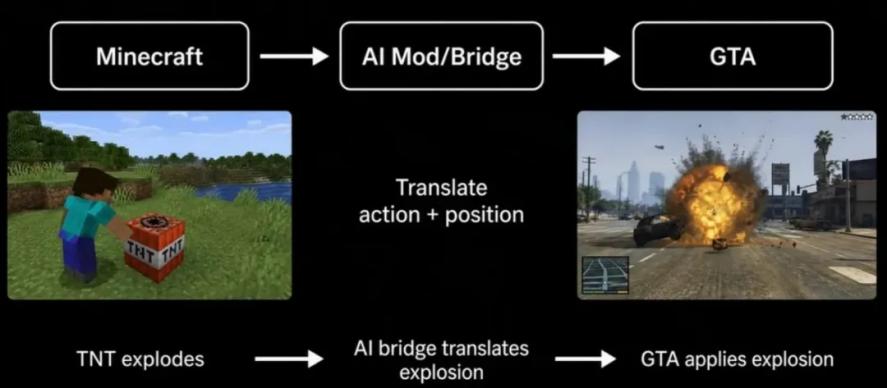
Source: Rosky
Bad money cannot drive out good money
Correspondingly, the industry's dissatisfaction with AI games is also growing stronger.
Looking back, large models can obtain the source code of the target game through decompilation, then replicate it according to the source code and generate a new game. This process is similar to the widely criticized game piracy.
It should be noted that decompilation was not easy in the past, but it is a piece of cake for the continuously evolving large models.
Luke Dicken, former head of the AI department of American game company TAKE TWO, said: "Today, any game enthusiast can decompile blockbusters and generate cloned games at a very low cost, entirely because cutting-edge labs such as Anthropic and OpenAI are using huge venture capital to 'subsidize computing power'."
More importantly, there is a second path for replication besides decompilation.
Specifically, large models do not need to copy the source code exactly. Instead, they can study relevant functions based on game videos or game demos, understand the underlying logic of the game, then rewrite the game code, superimpose AI-generated game assets and fine-tune the details of game gameplay to create a new game, so as to avoid copyright protection.
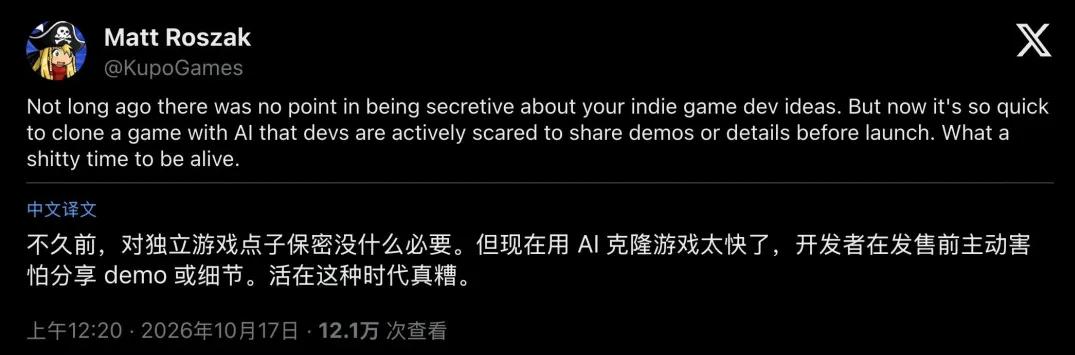
Source: Tech Edge
It is not difficult to see that there is a certain degree of ambiguous space for AI games.
In fact, after the large-scale implementation of AI, the outputs it generates such as images, music, and videos have always faced intellectual property disputes, and related lawsuits are constant.
The latest case is that music management company Reservoir accuses Anthropic of allegedly copying copyrighted lyrics without authorization for its Claude large model.
"Tencent Technology" said: "AI does shorten the time from 'I also want to make one' to 'I have already made it'. But legal judgment cannot be compressed into a simple sentence of 'using AI means infringement', nor can it be simply understood as 'gameplay is not protected, so it can be copied'. AI can reduce production costs, but it cannot turn systematic 'skin-changing' into legal innovation."
Against this background, mini-game platforms have taken the lead to safeguard the virtuous cycle of the ecosystem.
For example, WeChat Mini Games has launched a free "one-stop rights protection" function. The costs of clue monitoring, evidence collection and basic legal services are all borne by the platform. It has disposed of more than 50,000 non-compliant clues and removed more than 20,000 black and gray industry links, effectively protecting the legitimate rights and interests of original developers.
For another example, Douyin Mini Games has upgraded its rights protection mechanism. For unauthorized decompilation and replication of third-party works, the platform will implement step-by-step aggravated penalties: remove the infringing work and give a warning for the first infringement; ban the subject from submitting new games for 7 days for the second violation; ban for 30 days for the third time; if the fourth infringement occurs, the subject will face permanent ban and be rejected from accessing new games.
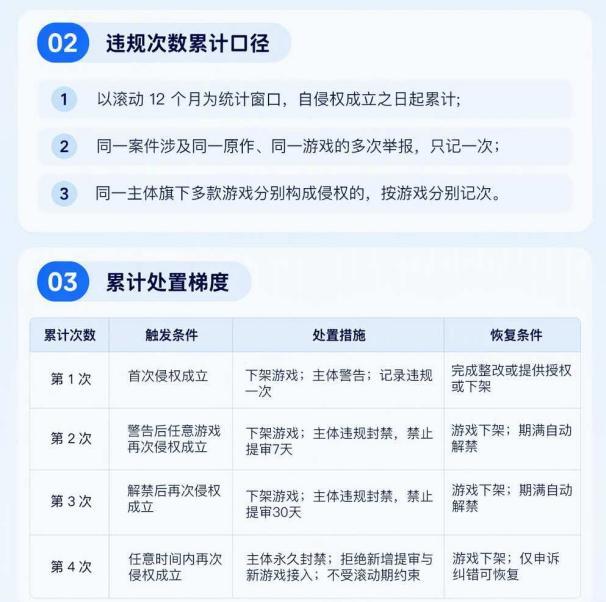
Source: Douyin Mini Games
In short, mini-game platforms actively take the responsibility of copyright protection and encourage developers to increase investment in originality and innovation.
In fact, the core demand of mini-game platforms at present is the long-term prosperity of games, and the original intention of developers should shift from making quick money to long-term operation, so as to continuously extend the vitality of games.
After all, only by precipitating long-term retained users and continuously providing stable revenue can a win-win situation between developers and mini-game platforms be achieved.
It is worth noting that AI games also have a native development route.
Take "Ask No Mortal World" as an example. It is a Xianxia RPG game with AI photorealistic art style, which uses the Seedance model to generate visual assets, and has high freedom of AI interaction, pushing interactive video games into the AI era.
DataEye Research Institute said: "The project team of 'Ask No Mortal World' defines the framework, character settings, standards and review, while AI generates or drives a large number of dialogues, branches, performances and assets according to the corresponding rules. Therefore, the work focus of developers may no longer be content production, but shift to setting standards, proofreading content, adjusting model parameters and so on."
From this perspective, large models are a double-edged sword. If used well, they can enhance the product power of games and endow games with more plasticity and playability; if used poorly, they may lead to bad money driving out good money.
No matter where AI games go in the future, the general direction of games embracing AI will not change.
LU Hongyan, Chairman of G-bits, said: "Before last year, we were still focusing on the impact of AI on reducing cost and increasing efficiency of production capacity, but this year we found that AI can greatly accelerate the iteration speed of prototype testing, and the realization of many ideas will become very fast. At this stage, AI has changed from a tool to a partner that creates together with us."
All in all, the game track has entered a new era of competition. AI games have moved from being mediocre to constantly bringing surprises, and are gradually sought after by game players. However, the ensuing problems of shoddy production and copyright protection make the native development route the right path for AI games.
In that case, high-quality development is also the ultimate destination of AI games in the future.
This article is from WeChat Official Account "Zinc Scale" (ID: znkedu), written by CHEN Dengxin, edited by LI Wenjie, and authorized for release by 36Kr.