This is Tencent's fourth attempt at producing short dramas, and it may very well be the last one.
If you play your final card and still fail to get the expected effect, you will have no more cards left to play.
A short drama product named "Green Bubble" has been launched within the WeChat ecosystem. Its weekly active users hit 89.68 million in the first week of October, up 44.1% compared with the first week of September.
This is already Tencent's fourth attempt in the short drama market. This time Tencent has shown its ace — WeChat.
But the ace is also its final card. Once you play it, there are no other cards left to use.
01 The Fourth Attempt, and Also the Last One?
Tencent started working on short dramas very early.
Back when OpenAI was still a niche geek product, short dramas had already become a market trend. In 2020, the concept of "the first year of micro short dramas" was put forward, and iQiyi and Youku had launched their short drama channels long before that.
Tencent has always been a company that "dares to be a latecomer to the market". It was not until the end of 2021 that Tencent Video embedded a channel called "Ten-Minute Theater" in its APP.
However, Tencent Video's understanding of short dramas at that time deviated somewhat from the actual development of the industry later.
At that time, Tencent Video treated short dramas as "longer but shorter long videos" or "video versions of online novels". In terms of business model, it still adhered to the membership revenue sharing model for long videos, insisted on "high-quality production of works over 10 minutes" and stuck to the horizontal screen format.
This insistence is not wrong. After all, as a long video platform, the short dramas produced by Tencent need to have certain differentiation from Douyin and Kuaishou, otherwise it will have no advantages. It is a good choice to make a differentiated product that complements Douyin.
But facts have proved that the market has not left living space for this kind of short drama that is neither long nor short. This attempt soon faded out of the public view, and few short drama users know about this theater now.
In the following years, the whole industry was constantly thinking about what short dramas should look like.
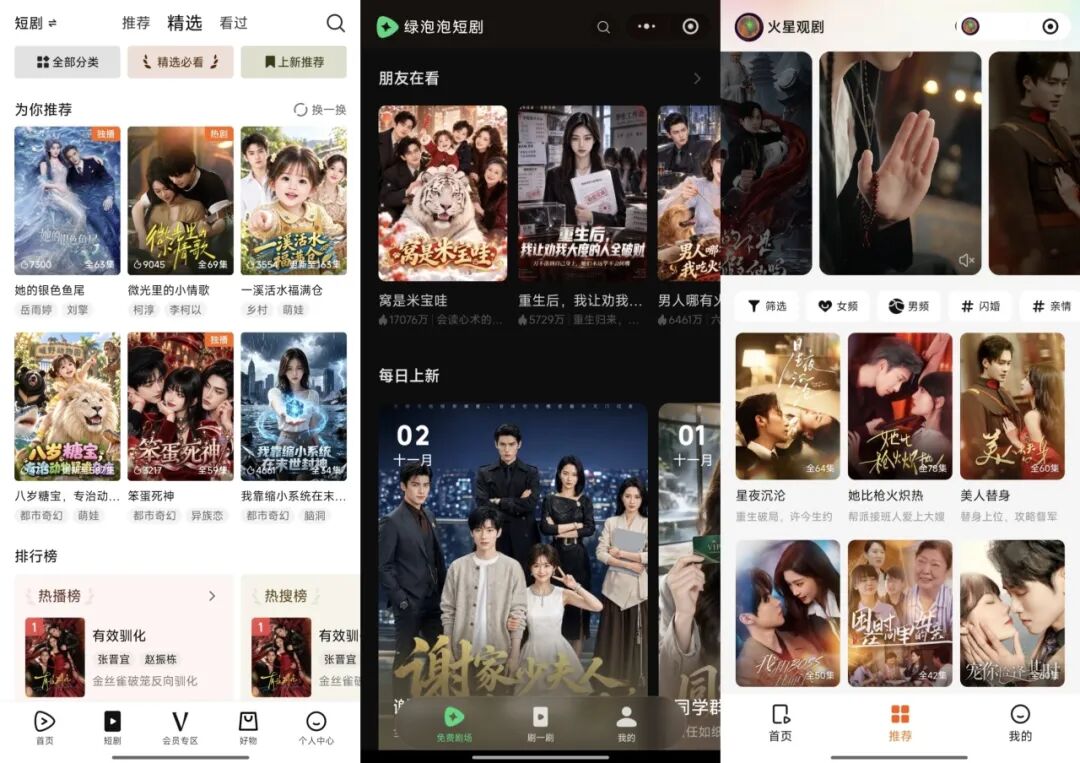
From 2022 to 2023, another form of short drama emerged in the market: paid mini-program short dramas. Users brush up a free plot on Douyin and Kuaishou, get attracted, then jump to the WeChat mini-program and pay to unlock the subsequent episodes.
WeChat unexpectedly became a part of the short drama business in this way.
But even if it was moved to the mini-program, this model did not find the right path for short dramas, and it still continued the payment model of long videos.
In 2023, ByteDance finally found the answer for the industry : the short video model, not the film and television model.
The so-called "short drama" is actually a series in the short video era, with two key words: short video model and series.
Most of the previous attempts in the industry did not break away from the thinking of traditional series, and all the focus was on the "drama" part. However, ByteDance truly develops short dramas with the original thinking of "short video": algorithm priority, free viewing, and monetization through advertising.
Since then, the development speed of the short drama industry has gradually exceeded people's expectations. In 2024, the market size of micro short dramas exceeded the total box office of films.
Tencent's thinking has finally kept up with the times.
In January 2025, Pony said at the annual meeting that long videos were impacted by short dramas. Shortly after that, the "Mars Short Drama Club" mini-program under Tencent Video was launched on WeChat, and was later renamed "Mars Drama Viewing". It has adopted the vertical screen format and the model of unlocking content for free with ads.
But in hindsight, it seems that Tencent has not put much effort into this product. The content is mainly provided by Tencent Video and its partners. Its status is no different from other third-party short drama mini-programs in WeChat, and its advertising investment is relatively restrained.
All signs indicate that this is more like a trial water test rather than a large-scale attack by Tencent on the short drama market. Eventually, it also fell into silence.
It is reasonable that Tencent did not rush into large-scale investment. The short drama market is indeed not small, but Tencent is a company with an annual revenue of hundreds of billions of yuan. The impact on long videos is indeed great, but the problem is that long videos have never been Tencent's core business. In Tencent's entire product ecosystem, it is even questionable whether Tencent Video can rank among the top 10 products.
But the arrival of AI has changed everything.
In 2025, AI short dramas saw explosive growth. The market size of micro short dramas across the country exceeded 1 trillion yuan, of which AI short dramas exceeded 120 billion yuan, a year-on-year increase of 300%. By the first quarter of this year, about 128,000 micro short dramas were launched in the whole industry, of which about 122,000 were AI micro short dramas, accounting for more than 95%.
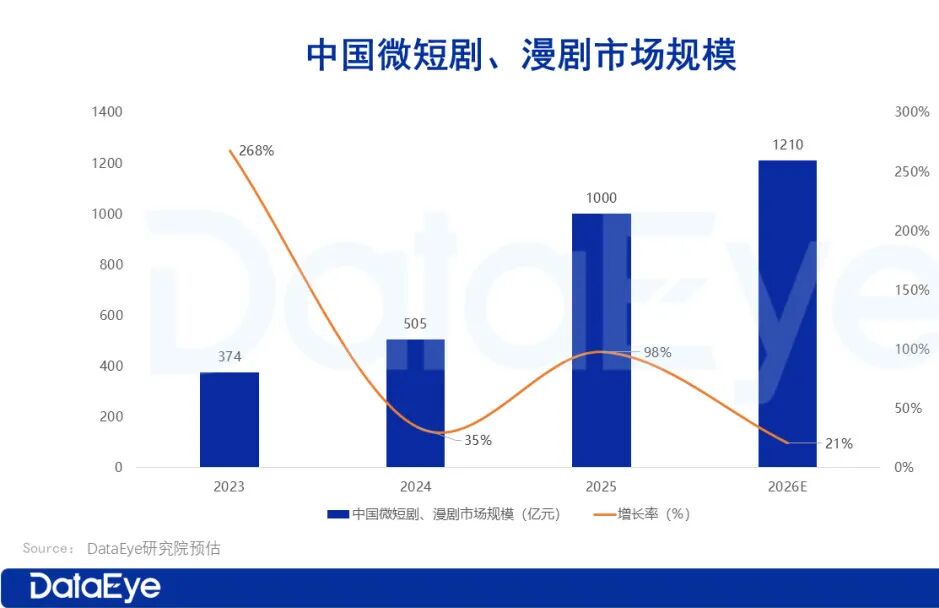
With the transformation brought by AI, the scale of the short drama business has achieved qualitative change. If it continues to develop, its market size will not just surpass the long video and film market. Its scale even has the opportunity to give birth to an independent second-tier internet giant.
For Tencent, which has long made money from entertainment business, this kind of business is worth trying no matter what.
In June 2025, Tencent finally promoted short dramas to the first-level entry of WeChat.
Although Tencent Video's short drama business is not very successful, WeChat has also accumulated a considerable scale of users. According to QuestMobile data, as of February 2026, the number of WeChat mini-program short drama users reached 427 million, a year-on-year increase of 59.9%, exceeding the total 335 million users of independent short drama APPs.
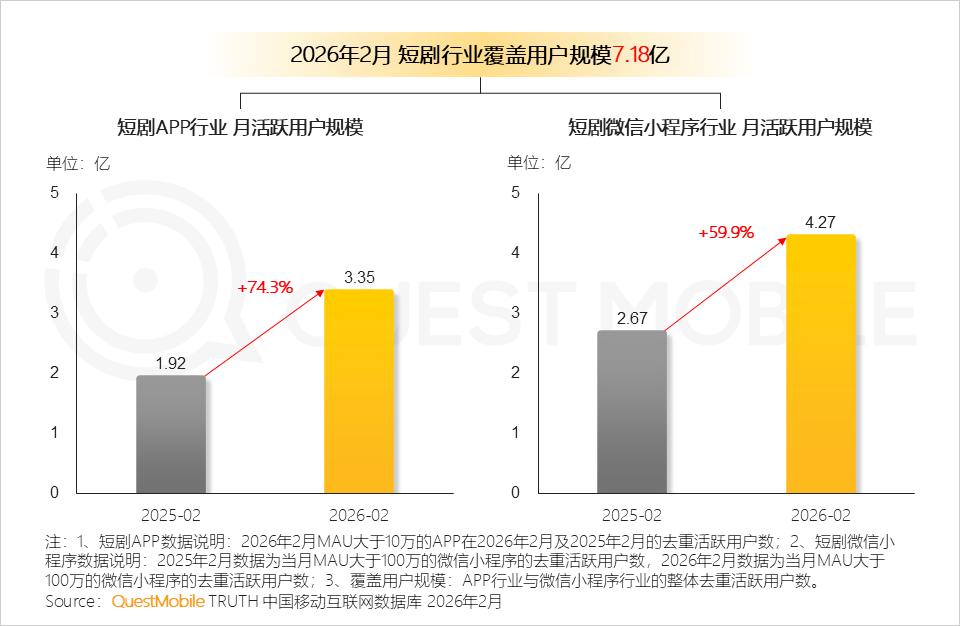
However, these traffic is scattered. WeChat only acts as a "browser" in this process, rather than a short drama platform.
In June 2025, WeChat launched the official "Short Drama" mini-program, which serves as an entry to aggregate third-party short drama mini-programs. In January this year, WeChat was revised, and this section was upgraded to an independent entry on the "Discover" page.
But this change still did not change WeChat's positioning. WeChat is just like a container, and users and traffic are still scattered in the hands of various platforms, including many short drama mini-programs with over 1 million daily active users.
Under this product form, WeChat is not a real "short drama platform", but a "platform of short drama platforms". It is still a little far from "directly entering the market".
At the same time, China Literature, an independent listed company under Tencent, has also entered the short drama track through IP adaptation, and has achieved good results. But its business model is different from that of a real mass short drama platform. A giant like Tencent probably still hopes to own a truly large-scale platform.
It was not until October this year that Green Bubble, WeChat's self-developed short drama product, was finally launched. This is likely to be the most promising attempt, and also the last one.
02 It Is the Ace, and Also the Final Card
Whenever Tencent can't beat its competitors no matter what it does, or can't accomplish a certain thing, it will use the ace of WeChat and let WeChat enter the market directly.
That's what happened to Channels, WeChat Shop, and Top Stories.
Green Bubble is no exception.
Different from the past, Green Bubble is a real "WeChat-backed" short drama product. It has an independent entry on the "Discover" page of WeChat, and has the "Friends Are Watching" function just like Official Accounts and Channels. It is a "high-level" ecological product like Moments, Official Accounts, Channels and Audio. It can enjoy most of the advantages of the WeChat ecosystem, which is the "treatment" Tencent only gives to its most important businesses.
Although we say Tencent has made four attempts on short dramas, the first three are not even a real effort for Tencent, and they never reached the level of Green Bubble.
This time, Tencent has used its "real strength". This fourth attempt is the most likely to succeed. Even if it can't seize ByteDance's market share, with the help of WeChat's three advantages: 1. No need to download the APP. 2. Acquaintance-based communication. 3. Interaction with other parts of the WeChat ecosystem. Green Bubble can at least become a unique short drama product just like Channels.
But the ace is also the final card. If you play your final card and still fail to get the expected effect, you will have no more cards left to play.
What else can Tencent do if Green Bubble fails to gain enough user duration? It has tried mini-programs, in-app functions of long video platforms, and WeChat. The only remaining option seems to be developing an independent APP.
This is not what Tencent is good at at all.
Looking back at the competition between Tencent and ByteDance, when the battlefield is moved outside WeChat and Tencent's independent products are forced to compete head-on with ByteDance, Tencent often struggles a lot. In the past, Tencent News Express was no match for Toutiao, and recently Doubao's user scale is far ahead of Yuanbao.
Tencent is a company with a comfort zone. What Tencent is really good at is fighting battles under the "fire coverage" of WeChat.
Take short video as an example.
Tencent first used Weishi to compete with Douyin, but it remained lukewarm over the years. Its peak daily active users in early 2020 were only about 31.66 million, less than one tenth of Douyin's peak value.
After struggling in the short video field for many years, Tencent finally "got a seat at the table" only after it brought in WeChat. In Q2 2026, Channels' daily active users reached 660 million, and the total user usage time increased by more than 20% year on year.
Take WeChat Shop as another example. Tencent has launched many independent products such as Paipai and Xiao'e Pinpin in the e-commerce field, but it has never become a major player in the market.
It was not until it opened up scenarios such as Official Accounts, Channels and mini-programs and launched WeChat Shop that Tencent achieved subsequent achievements in e-commerce: In 2024, the GMV of WeChat Shop reached 1.92 times that of the previous year, and the order volume reached 2.25 times. In 2025, the GMV growth rate of brand sales on WeChat Shop reached 4.3 times that of the overall platform.
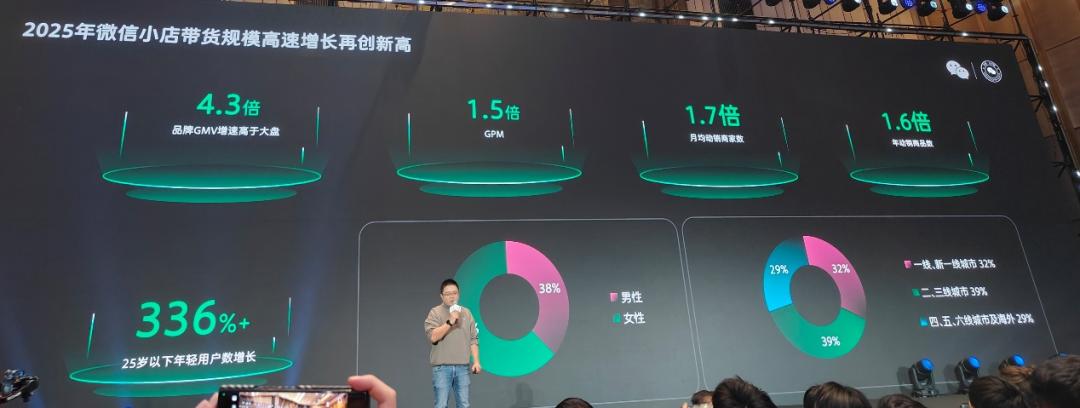
What Green Bubble needs to verify this time is whether this ecological capability can be turned into competitive advantages again.
It does not necessarily need to become the leader of the short drama industry, just like Channels did not beat Douyin, and WeChat Shop did not beat Taobao. As long as it can keep Tencent in the short drama market and let it occupy a certain scenario and segmented category, it is enough.
Tencent is a very cautious company in terms of investment. If Green Bubble, this card, also fails to achieve the expected effect, the short drama business will probably stop here.
This article is from the WeChat Official Account "Lue Reference" (ID: hyzibenlun), written by Yi Wei, authorized for release by 36Kr.