In the robotics business, leasing is a far better choice than in-house manufacturing.
When the robotics industry is still debating when large-scale real-world deployment will truly materialize, the downstream market is presenting a completely different picture.
Nowadays, when a job seeker leaves a message asking if a so-called "robot company" is still recruiting for testing positions, the party he is dealing with is likely not a robot OEM such as Agibot or Galaxy Universal, but more probably a company focused on commercialized implementation.
Their business is even far more prosperous than that of robot OEMs. These "secondary development" enterprises are familiar with the secondary development of robots from all brands, as well as various demands of downstream application scenarios, making them a quite critical presence in the robot industrial chain.

Unlike the hesitant progress on the production side, the downstream robot market has shown a phased "prosperity" scene. Among all players, Agibot has made quite active investments: it not only initiated the establishment of Qiantianzu, a unicorn in the robot leasing track, but also vigorously incubated robot content IPs and opened robot theme parks, etc. Apart from revenue from the education and research sector, Unitree has also taken dance performance as its most distinct label in application scenarios.
An increasing number of robots are flowing into scenarios such as commercial performances, exhibitions, wedding ceremonies, study tours, sports competitions and concerts, spawning a batch of leasing/RaaS (Robot as a Service) companies, and some leading leasing enterprises have even completed multiple rounds of financing.
Driven by the demand for novelty-seeking and emotional consumption, these robots have not found real PMF (Product-Market Fit), but are stuck between Demo and commercial implementation, forming a transitional business similar to popular science promotion.
This is also a rather peculiar commercial phenomenon in the development history of embodied intelligence.
01
Secondary Development Business
Humanoid robots are high-tech products that require precise adaptation, continuous parameter adjustment and optimization. Selling a robot is only the first step in its actual use process.
The original factory robot is like a car manufactured by the automaker, while secondary development means installing navigation, replacing the audio system, and adjusting power output on this car to make it more suitable for specific demands. Besides, cars are closer to standard products, while robots are inherently far more complex than cars.
There are already many robot secondary development companies on social media, which help end customers adjust movements, adapt to scenarios, and provide services such as leasing and scenario planning.
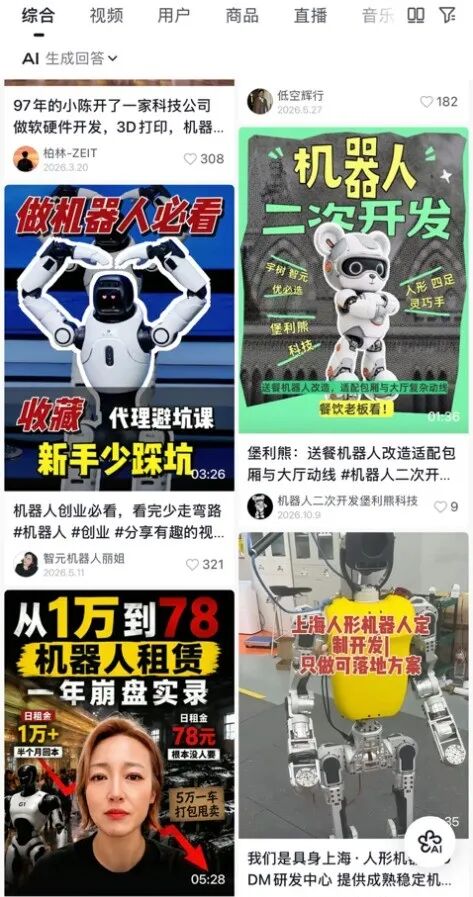
Figure: Robot secondary development information on short video platforms (Source: Douyin)
At present, a robot is very expensive, with a price ranging from hundreds of thousands to 500,000 RMB. If a customer only buys one or two units but requires a large amount of customized development, it is not cost-effective for the original manufacturer to set up a separate R&D team for this demand.
Moreover, after manufacturers complete the process "from 0 to 1" and robots realize the transformation "from 1 to N", it still takes huge time and trial-and-error costs for robots to finally start actual work. For example, Leju deployed 15 "Kuafu" robots for Zhaofeng Electromechanical, but the two sides spent nearly a year running in to make the robots "learn" these tasks. At the very beginning, the robots even struggled to grasp parts stably, and the grasping movement alone was repeatedly trained 15,000 times.
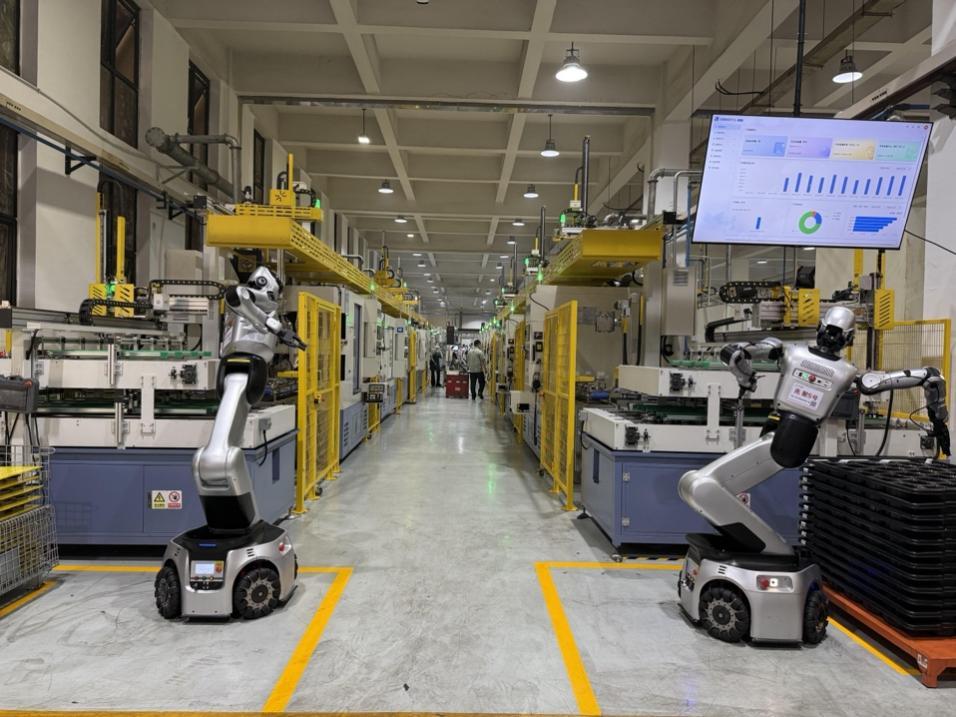
Figure: Humanoid robots operating on the production line of Zhaofeng
For end customers, it is also not cost-effective to occupy a large amount of capital through procurement, so turning to leasing is a proper compromise solution. After receiving demands, ontology manufacturers will also assign part of the work to partners according to the project scale and development difficulty. Some secondary development companies even give 10% rebates to ontology manufacturers.
In April this year, Deng Taihua, Chairman of Agibot, clearly stated that after Agibot completes the "0 to 1" process with leading customers, it still needs to rely on ecological partners to realize the "1 to N" scenario promotion. In 2025, partners of Agibot accounted for 1/4 of its total sales, and the target for 2026 is 60%, which fully demonstrates the importance of "secondary distributor" partners to the industry.
Market demand is a real reflection of reality.
At the end of last year, Agibot established Qiantianzu with Feikuo Technology and other companies, which mainly engages in robot leasing, with Li Yiyan, founder of Feikuo Technology, serving as CEO. The establishment of this company marks Agibot's high recognition of the leasing model.
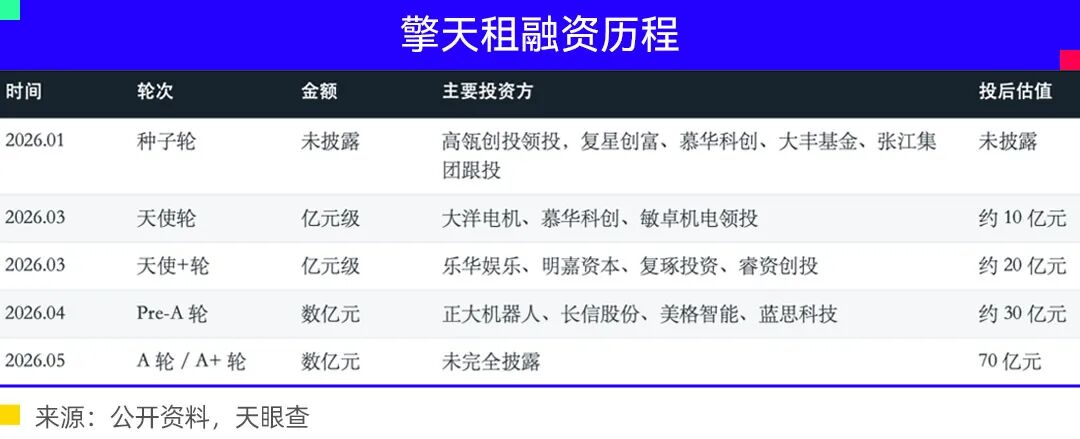
In May this year, Qiantianzu completed Series A and Series A+ rounds of financing. After this round of financing, its valuation reached 7 billion RMB, officially ranking among unicorns. Among players in the same track, Wanji Yizu's latest post-investment valuation is 1 billion RMB, and Jingdong Leasing's self-operated store has also launched various robot leasing services.
These leasing companies are just like 4S stores in the automotive industrial chain. As Li Yiyan said, leasing not only greatly reduces the trial-and-error cost, but also collects a large amount of product optimization feedback from the front line, which is fed back to robot manufacturers to iterate their products. Data shows that as long as the leasing option is provided, 90% of users will choose the leasing mode first.
Secondary development companies are equivalent to a docking hub, connecting producers at the upstream and demanders at the downstream. They can help enterprises solve most of the sales problems. Meanwhile, secondary development companies are more familiar with various robot products, so they are more capable of providing customers with adapted solutions.
Therefore, the secondary development ecology is a requirement of reality as well as the industry. It is an inevitable product of the development stage of the robot track.
02
Commercial Experiment
At the historical stage when robots have not yet entered factories and households, the whole society has launched a vigorous commercial implementation experiment.
The first type is emotional experience. Data from a leasing platform shows that about 65% of robot application orders are one-time commercial performances, including opening welcome, exhibition warm-up, wedding ring delivery and so on. To be exact, what these customers buy is not the intelligence and labor of robots, but a way to attract traffic or meet some novelty-seeking psychology of their target customers.
Many companion and psychological counseling robots have been put into use in the elderly care field. For example, Guangxi has purchased 35 Fubao KZ100 robots and deployed them in welfare homes and community elderly care centers to provide psychological counseling and daily companionship for the elderly. The small chat companion robot "Youni" has a monthly rent of 80 RMB, and only 40 RMB after subsidy for the elderly over 75 years old. It can understand Mandarin and Shanghai dialect, focusing on relieving boredom, chatting and accompanying users.
This type of robot basically has no requirements for sports ability. Its main function is to perceive and recognize human emotions, and make corresponding interactive feedback accordingly. Its core demand is to realize emotional interaction between machines and humans.
Robots also have a large space to play for the youth group. Robots are also invited to opening ceremonies, sports meetings and even children's birthday banquets, that is, rented for warm-up and interaction.
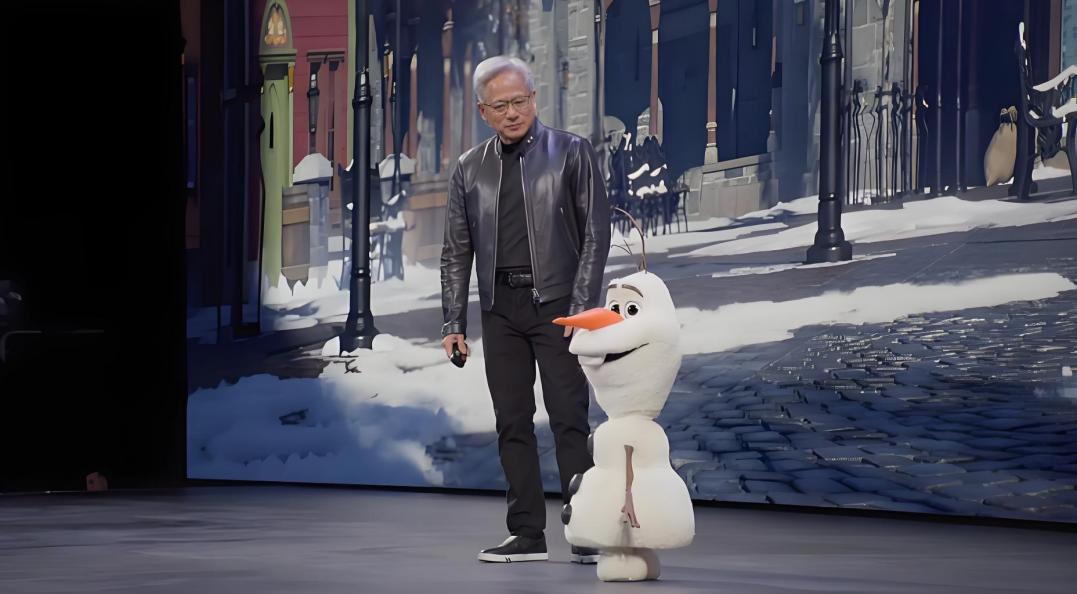
Cultural tourism and commercial performances are also scenarios where robots frequently appear. The Olaf robot built by Disney Imagineering team in cooperation with NVIDIA and Google DeepMind is "working" in Disneyland; Unitree robots are also frequent guests at Wang Leehom's concerts.
Agibot has also built the world's first large-scale embodied intelligence theme park with Chimelong Zhuhai, deploying 300 robots covering performances, research tours, tour guiding, explanation and other projects.
The other type is functional replacement, which mainly helps with luggage handling, hospital consultation / bank service navigation and other scenarios.
In Chengdu Haichang Ocean Park, the humanoid robot "Aiqiu" can work as a store manager; Changhong Hongxi works as a tour guide in Mianyang China Panda Valley, and serves as a welcome hostess and booth commentator at the Shanghai Home Appliances Expo. This type of simple mechanical work is a scenario where robots can be deployed on a large scale at present.
In addition, Robot Mall and robot theaters are two relatively novel implementation forms. In the past two years, "robot 4S/6S/7S stores" have emerged continuously. They not only sell robots, but also provide experience, leasing, training, research tour and industrial docking services.
In March this year, the world's first "dual 4S store" ("robot 4S store + automobile 4S store") deeply cooperated by Boss Group, Mechanical Eden and Ubtech opened. This project is empowered by Beijing Yizhuang Robot Mall, and has reached cooperation with Unitree, Ubtech, SenseTime, Robosen and other enterprises. In the store, visitors can not only watch robot performances, but also purchase and rent robots.
The world's first robot 6S store also opened in Longgang, Shenzhen in July last year. On the basis of sales, spare parts, after-sales service and information feedback, it has added Share (leasing) and School (training) services.
In the cultural and artistic track, some robots have already worked as actors. The stage play "Robots and Their Friends" cooperated by Luming Robot and Shenzhen Cultural Tourism has realized regular performances at present.
Agibot has also made some layouts in this field. It released the robot martial arts IP "Peerless Master" and launched a series of micro short plays; Unitree G1 played the leading female role "Lingling" in the musical "Robot Life"; The film "Centennial Echo · Star Guardian: Xiaoxia" started shooting in Ningxia, and robots have begun to compete for jobs with human actors.
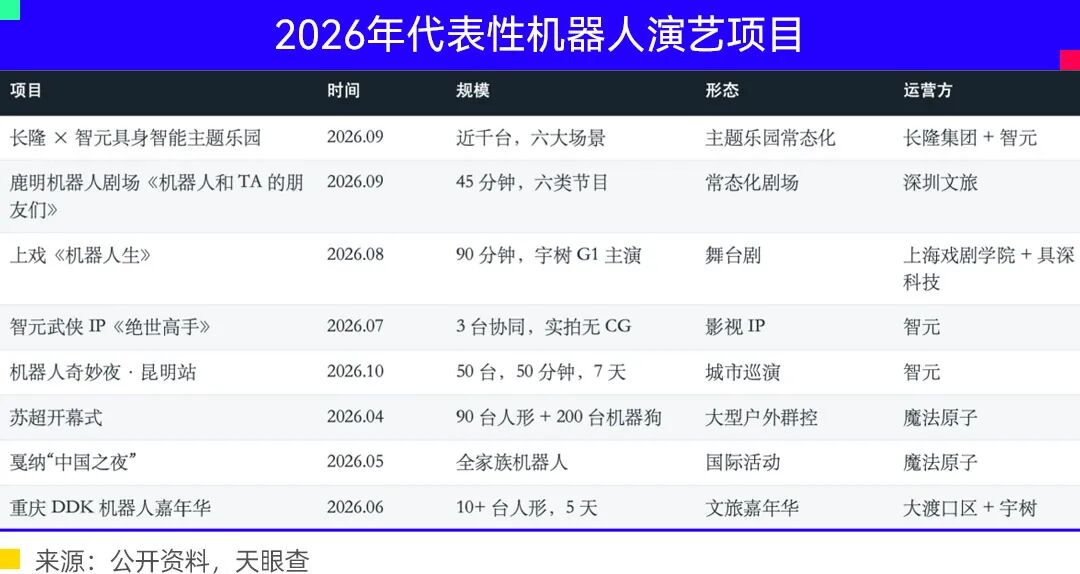
However, the above commercial scenarios are only the tip of the iceberg of robot applications. At present, robots show a situation of expanding in service scenarios, rapidly following up in emotional companionship and people's livelihood security, with B-end procurement, commercial operation and C-end consumption developing in parallel.
03
Harsh Accounting
Beneath the appearance of prosperity in downstream robot applications, the harsh commercial laws have never failed.
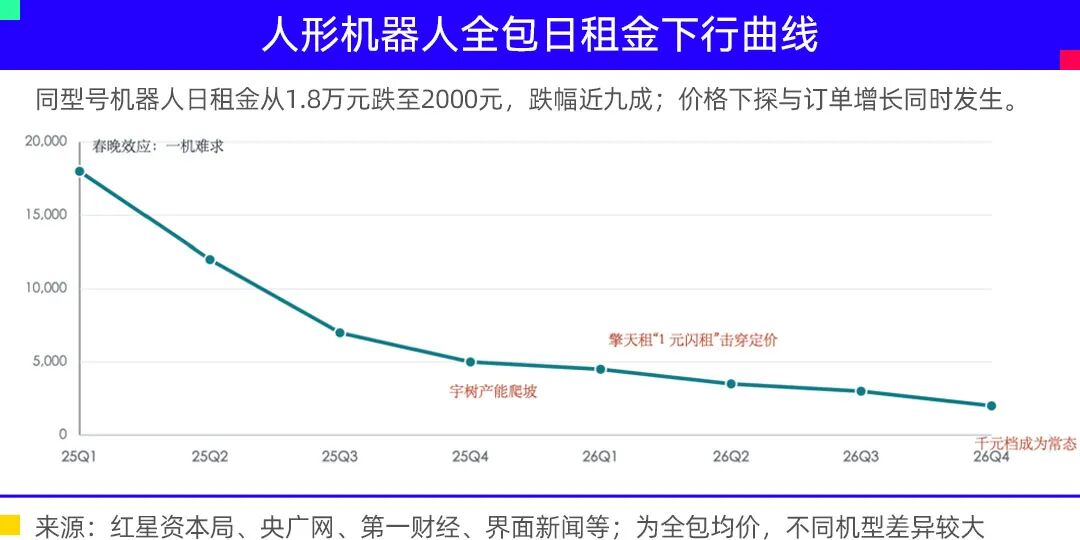
A year ago, the maximum daily rent of robots could reach 30,000 RMB, but now it has dropped to only 2,000 RMB. Last year, hot money poured into the robot leasing industry. At the most prosperous time, there was a saying of "paying back the cost in half a year" in the industry. One year later, the full-package daily rent of mainstream humanoid robots dropped to 3000-6000 RMB, the basic model fell below 2000 RMB, and the lowest daily rent of bare robot dog was only 160 RMB.
The price has dropped by 70% to 90%, but the market is increasingly prosperous. On the one hand, the shipment volume of robots has increased significantly. In 2025, the shipment volume of humanoid robots in China reached 14,400 units, while the shipment volume in the first half of this year exceeded 40,000 units. While the supply increases, the models are iterating continuously. The new models have higher computing power and stronger performance, so the old models can only be forced to rent at reduced prices.
As a leading enterprise in the industry, Li Yiyan said that the total transaction volume (GMV) of Qiantianzu in the past nearly one year was about 3.5 billion RMB, and the target for the next three years is to achieve cumulative revenue of 10 billion RMB, which is equivalent to planning to create the market scale of the whole current industry in one year within three years.
Leasing seems to be a good business on the surface. After excluding various costs, the gross profit of daily leasing is considerable, but this is based on the "ideal state" that every machine can be rented out every day, assuming that there are people renting every day.
The biggest fear of the leasing business is vacancy. After leading platforms get the support from robot enterprises and capital, a large number of small and medium-sized leasing companies and secondary development enterprises will face great challenges, and have to withdraw from the market after the vacancy rate rises sharply.
The Robot Mall format also extremely tests the capital chain of operators. Since its opening, the turnover of the Yizhuang Robot Mall robot 4S store in Beijing has exceeded 60 million RMB, which is supported by Yizhuang State-owned Assets.
The robot 6S store in Guiyang is currently facing the dilemma that its monthly revenue cannot cover the operating cost. This store located in Lixing Center is operated by Huaji Intelligent Robot Company, with a total investment of nearly 10 million RMB. Since its opening, the passenger flow of the store has significantly exceeded expectations, but there is still a 40% gap between monthly revenue and cost.
"The loss is within our expectation. We have reserved a 3-year trial-and-error period for ourselves, and strive to turn losses into profits within one to two years," the operator said. The store's target for 2026 is to achieve revenue of more than 5 million RMB, and it plans to achieve 20% to 50% growth in 2027.
Such stores are not unique cases. Statistics show that by the end of July 2026, national 6S stores have covered 23 cities, but most stores rely on the support of local policies and industrial resources, and the pure market-oriented profit model is still under exploration.