36Kr Exclusive | A PhD graduate from Shanghai Jiao Tong University, who integrates world models and six-arm robots, has secured hundreds of millions of yuan in new financing, and has established cooperative relationships with a number of Fortune 500 clients.
Source / Enterprise
This article contains approximately 3000 words, with an estimated reading time of 7 minutes
Author | Ou Xue
Editor | Yuan Silai
Hard-Kr learned that Shanghai SAZHI Intelligent Technology Co., Ltd. (hereinafter referred to as "SAZHI Intelligence"), a global industrial embodied intelligent robot enterprise, has recently completed a Pre-Series B financing of hundreds of millions of yuan. The investors include three institutions: China Construction Investment Co., Ltd., Nantong Investment Management and Yunqi Partners. The funds raised in this round will be mainly used for large model R&D, iteration of multi-arm robot prototypes, production line expansion and in-depth expansion of the global market.
Founded in 2017, SAZHI Intelligence has a core team with nearly 20 years of robot R&D experience and leading artificial intelligence algorithm genes. Zhang Jianzheng, the founder and CEO, holds a doctorate in engineering majoring in mechanical engineering (intelligent robot direction) from Shanghai Jiao Tong University, and has previously worked at STEP and FANUC.
As industrial manufacturing evolves towards flexibility and complexity, traditional industrial robots are limited by fixed operations and single tasks, while most general embodied robots cannot meet the high-precision and deterministic requirements of industrial grade. SAZHI Intelligence is targeting the gaps in complex industrial scenarios, such as precision assembly, dexterous packaging, and long-sequence testing.
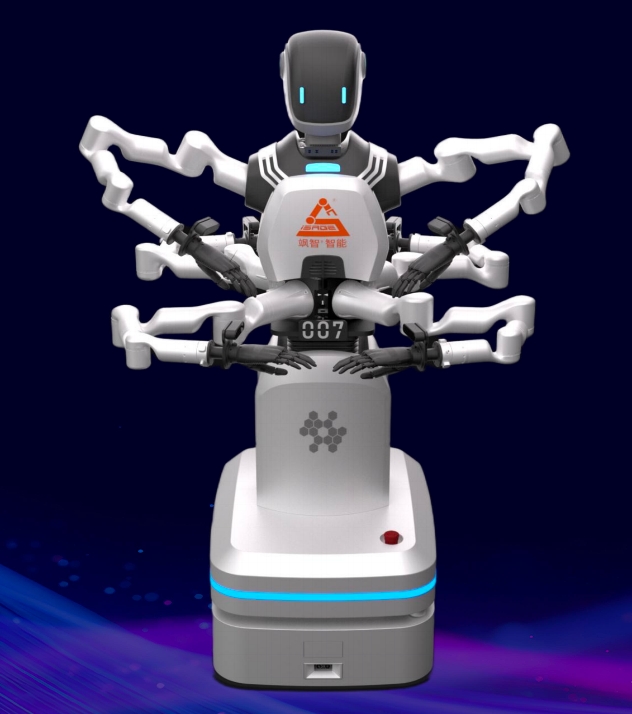
On the product side, SAZHI Intelligence has built a full-form prototype matrix covering single-arm, dual-arm, four-arm and six-arm robots. According to Zhang Jianzheng, the new generation of four-arm robots adopts a spatially symmetric configuration, with one brain controlling four robotic arms. With the help of advanced collaborative algorithms, the parallel operation efficiency of the multi-arm system is doubled compared with the previous generation. The six-arm robot "Xuanjia" adopts a spatially heterogeneous design with two arms distributed at the front waist, rear waist and shoulders respectively, which can cover multiple surrounding production lines in a full 360-degree range, realizing dual-station parallel operation and four-arm alternate operation.
"More arms do not always mean better performance. Just like a table needs at least three legs to stay stable, four or five legs are acceptable, but any more will be meaningless," Zhang Jianzheng told Hard-Kr. Supported by spatial configuration theory, six arms are the most reasonable layout at present.
Compared with the four-arm robot, the six-arm robot has 60% more degrees of freedom. How to ensure dynamic isolation of safety space, avoid collisions, and realize complex process collaboration in a narrow space puts extremely high requirements on computing power and algorithm effectiveness. At present, this spatially heterogeneous six-arm configuration is unique worldwide, whose operation complexity has increased exponentially compared with the four-arm robot, with an efficiency improvement of 50%.
At the core "brain" level of embodied intelligence, the currently widely adopted VLA (Vision-Language-Action) model in the industry has the limitation of end-to-end reflective imitation, and lacks understanding of physical causality, which leads to invalid and unexplainable scenario generalization. The solution of SAZHI Intelligence is to launch its self-developed industrial world model, XuanShu · SageNexus (WASM), at this year's WAIC.
The core breakthrough of SageNexus lies in its internalized physical causality, realizing the leap from "passive response" to "active reasoning". In terms of architecture, it maps heterogeneous data such as vision, point cloud, force feedback and process documents to a unified physical semantic space through the Encoder, then the Decoder translates high-level task intentions into executable action sequences and conducts physical feasibility verification, thus effectively suppressing large model hallucinations and avoiding generating unsafe actions that do not meet process constraints.
"We form a closed loop of five elements: data, prototype, control, model and scenario, which keeps the data flywheel spinning," Zhang Jianzheng emphasized. Based on 360TB of multi-modal real industrial data and three-stage training, this model has accumulated a scenario skill library with more than 2000 entries. Under the extremely strict deterministic requirements of industrial scenarios, the reliability of this model can reach more than 99.9%.
In addition, through real-time cloud-edge-end collaboration, SAZHI Intelligence has built a three-ring architecture of "slow closed loop" at the cloud end, "fast closed loop" at the edge side and "safety bottom line closed loop", to ensure the stable output of robots in long-distance complex tasks.
Against the background of computing power anxiety sweeping the industry, SAZHI Intelligence has proposed a differentiated path: solving the dependence on computing power by improving the effectiveness of algorithms. Zhang Jianzheng believes that continuously stacking computing power resources will push up customer input costs. Reducing the dependence on brute force computing by improving algorithm efficiency is the embodiment of the real implementation level of embodied intelligence.
Relying on the mature technology base and real application verification in lighthouse factories, the commercialization of SAZHI Intelligence has achieved rapid growth, covering four major industries: 3C semiconductors, automobiles, energy, food and pharmaceuticals, with more than 50 clients among Fortune Global 500 companies or listed enterprises.
"We have completed the full-year task of last year in the first half of this year, and the annual business has basically doubled, with a growth rate of 100% to 120%," Zhang Jianzheng revealed.
In addition, overseas markets are becoming the second growth curve of SAZHI Intelligence. The company had a large amount of business in Mexico last year, and this year it has begun to fully develop the Southeast Asian market (Vietnam, Indonesia, Malaysia, Thailand, Singapore), and has gradually won large orders in the European market. It is revealed that its overseas intended orders exceed 500 million yuan. To meet the surging demand, the factory of SAZHI Intelligence located in Shanghai Maqiao Artificial Intelligence Pilot Zone is already at full capacity, and the company plans to expand to about 4 times the size of the current site in the next three years.
The following is an excerpt of the interview between Hard-Kr and Zhang Jianzheng, founder and CEO of SAZHI Intelligence (edited):
Hard-Kr: In industrial scenarios, why do customers generally prefer multi-arm robots rather than combinations of multiple single-arm or dual-arm robots?
Zhang Jianzheng: This is mainly determined by the actual scenarios of customers. Especially in the existing stock market of production lines, the space is often very narrow, but efficient production needs to be realized. If multiple two-arm robots are used, they not only take up a lot of space, but also are difficult to achieve high-level collaboration. Our six-arm robot adopts a spatially heterogeneous method, which enables one robot to cover 4 surrounding production lines. For example, when the 3 arms on the left are working, the two lower arms pick up different workpieces for assembly respectively, and the upper arm picks up an electric screwdriver or glue gun for locking or gluing. This kind of efficient collaboration in a narrow space cannot be achieved by stacking single-arm or dual-arm robots. In addition, in packaging scenarios, bagging, inserting manuals, sealing, boxing, and capping require multiple hands to cooperate at the same time. The six-arm robot can complete all these processes smoothly at one time, which is a very challenging technological breakthrough.
Hard-Kr: You mentioned "solving the dependence on computing power by improving the effectiveness of algorithms", how is this realized at the model level?
Zhang Jianzheng: Now the industry is used to desperately stacking GPU cards, but customers often cannot accept the high cost. Our large model (XuanShu · SageNexus) does not fully rely on brute force computing. First of all, our data is very pure, all coming from actual data of industrial scenarios, which reduces the invalid consumption of model training. Secondly, we have made a lot of optimizations on the algorithm architecture, so that after the model is trained, part of it can be directly deployed on the terminal side to execute the trained skills. By improving the efficiency of the algorithm, we enable the robot to meet the 99.9% industrial-grade determinism while greatly reducing the dependence on computing power. This is the real core competitiveness of embodied intelligence enterprises.
Hard-Kr: The embodied intelligence industry is currently exploring swarm intelligence, what plans does SAZHI Intelligence have in this regard?
Zhang Jianzheng: From individual intelligence to swarm intelligence, and then to ecological intelligence, this is our strategic path from version 1.0 to 3.0. At present, we have entered the stage of swarm intelligence. We have initially realized the swarm control algorithm for joint operation of hundreds of robots in one factory. In the next step, we will further expand the R&D team through financing, iterate swarm intelligence, strengthen multi-agent linkage, and achieve closer collaboration and more precise regulation. After that, we will work on ecological intelligence, which means not only controlling hundreds or thousands of robots, but also uniformly controlling hundreds or thousands of other devices in the factory.
Views of Investors:
Nantong Investment Management: The SAZHI team has a deep understanding of industrial scenarios and embodied intelligence, and also has strong implementation capabilities. After years of R&D accumulation and business practice, SAZHI has built solid core competitiveness in multiple dimensions including high-quality industrial data, large models oriented to the physical world, and industrial on-site codec systems. Its embodied robots have achieved large-scale commercial implementation in many industrial production fields such as 3C semiconductors, automobile industry chains, energy industry chains, high-end food and pharmaceuticals, and have obtained repeated purchases from many leading benchmark clients. We believe that "replacing human labor with machines" in the industrial field is an inevitable trend. With multi-modal perception and autonomous decision-making capabilities, embodied intelligence is accelerating the breakthrough of the rigid bottleneck of traditional industrial automation. The industrial field is becoming the core scenario for the short-term implementation of embodied robots. SAZHI focuses on industrial production scenarios, with obvious leading advantages, and its business has entered a period of rapid growth.
Wang Feng, Investment Director of China Construction Investment Co., Ltd.: The lack of real and effective industrial scenario implementation and related data is the core bottleneck and challenge faced by current embodied intelligence enterprises. SAZHI Intelligence's products have achieved large-scale industrial scenario implementation in hundreds of large state-owned enterprises and Fortune Global 500 enterprises, and have accumulated massive related data, forming a solid technical barrier. At the same time, its core team has shown top industry strength in R&D and engineering implementation. Based on this, we remain optimistic about the development prospects of SAZHI Intelligence in the industrial embodied intelligence track.
Yunqi Partners stated: Robots on industrial sites need to adapt to limited production line space and complex processes, while ensuring long-term operation stability. SAZHI has been deeply engaged in industrial scenarios for many years, continuously iterating products around multi-arm collaboration, forming a product layout covering single-arm, dual-arm, four-arm and six-arm robots, and has accumulated solid technical capabilities in robot prototype, control and model. The team has realized batch delivery in many manufacturing industries and accumulated rich engineering implementation experience. We are optimistic about SAZHI's ability to combine technological innovation with real industrial demands, and look forward to the team promoting the large-scale application of industrial embodied intelligence in more production scenarios.