Big tech's AI has begun to restructure the big tech companies.
Many become one.
On October 29, at the Tencent Global Digital Ecosystem Summit held in Shenzhen, Dowson Tong launched a new office suite: Buddy One. It takes WorkBuddy as the working platform, connects Tencent Docs, Tencent Meeting, ima knowledge base and other products, allowing AI to call the user's authorized materials. "Centered around task collaboration", the Senior Executive Vice President of Tencent summarized it in his keynote speech that day.
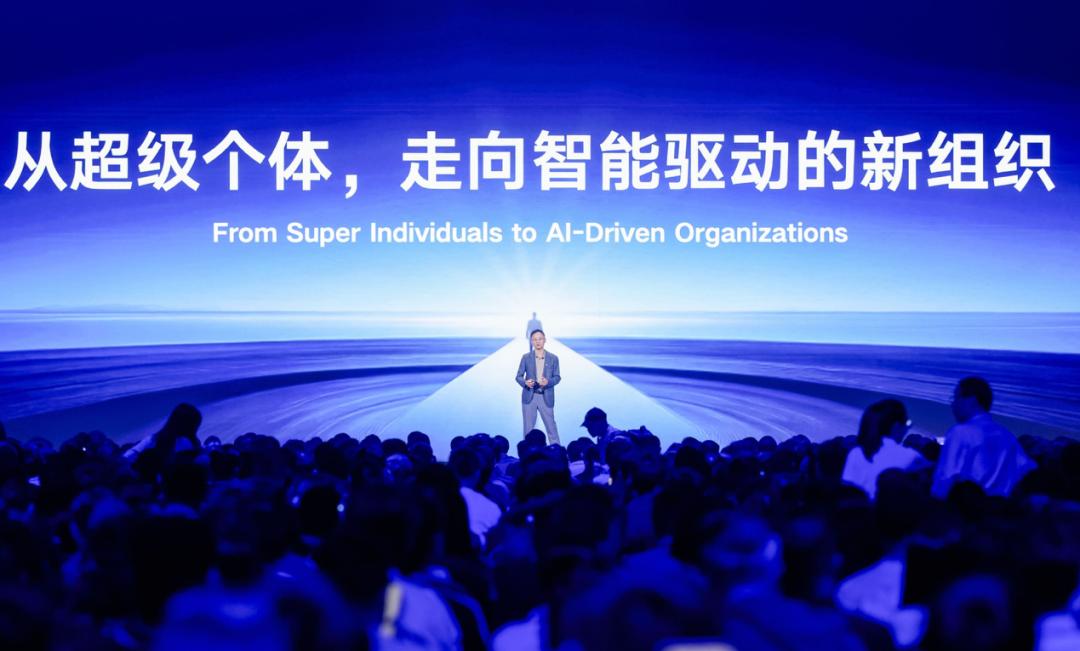
On October 29, 2026, Dowson Tong delivered a speech at the Tencent Global Digital Ecosystem Summit. Source: Tencent
Several familiar products have been integrated into a new combination.
The product names remain, but the relationship between them has changed. Docs, meetings, and knowledge bases have started to become different tools in the same AI workflow. Products that previously developed independently and sought users on their own will now cooperate again in the new working platform.
And long before the products were integrated, clues had already emerged within the organization.
In June this year, during a public dialogue with Shiyu Yao, Dowson Tong talked about the WorkBuddy organizational documents he reviewed: teams of three to five people formed small squads to conduct experiments around specific fields.
Similar changes are breaking through product interfaces in batches.
In June, Alibaba merged the Wukong and MuleRun teams; at the end of July, ByteDance combined the Feishu product team and the Doubao product team, and handed over sales and services to another team. Looking further back, Google merged Brain and DeepMind in 2023, and announced in 2024 that it would bring the Gemini application team under DeepMind. The scope of restructuring has gradually expanded, from model developers to application builders, and then to R&D, sales and service personnel in existing businesses.
In the past, large tech companies used individual products to expand their business territories. Docs, meetings, cloud drives each accumulated users and improved functions around a specific demand, and formed corresponding organizations and operation models. When AI was first introduced into these businesses, it usually followed the old inertial path: adding new features to existing products, or setting up separate teams to strive to build the next blockbuster product. Before this round of AI wave, large tech companies had already tried the middle platform that centralized shared capabilities, and adopted the horse-racing mechanism where multiple teams explored in parallel.
Judging from the experience of these companies in recent years, centralized model research, restructured application teams, and adjusted division of labor in existing businesses have roughly formed three rounds of intertwined adjustments. Companies did not start the transformation at the same time, but the restructuring has gradually gone deep into the interior of large tech companies.
1
Several "horse-racing" teams have arrived at the same entrance
What comes even earlier than logistical support is organizational restructuring.
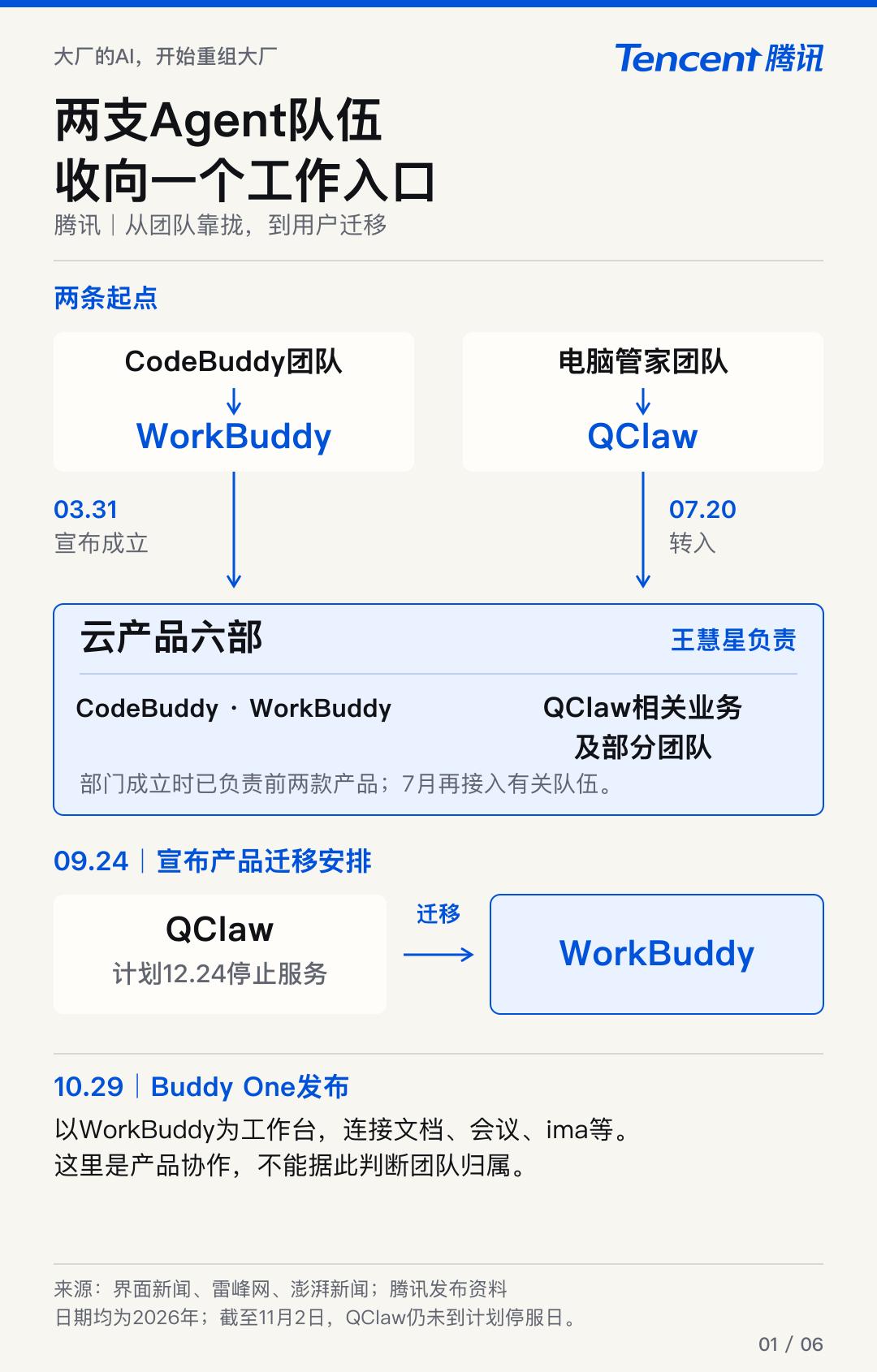
Before Buddy One was launched, Tencent had already rearranged the teams of related products. On March 31, Tencent Cloud released an internal letter.
The letter clearly stated that the 6th Cloud Product Department would be established, responsible for building AI-native code (CodeBuddy) and general productivity agents (WorkBuddy), and promoting capability building and commercialization of a series of agent products. Wang Huixing, Vice President of Tencent Cloud and CTO of Tencent Cloud, concurrently serves as the head of the 6th Cloud Product Department, reporting to Dowson Tong, President of CSIG; Liu Yi serves as the Assistant General Manager of the 6th Cloud Product Department, reporting to Wang Huixing.
Previously, Tencent Cloud's product R&D had a total of five major product departments: Product Department 1 was mainly responsible for IaaS-related products, as well as some PaaS such as databases and message queues; Product Department 2 was mainly responsible for PaaS and big data; Product Department 3 was responsible for agent development platforms, AI SaaS, knowledge engines, and computing acceleration; Product Department 4 was responsible for middle platform businesses, including AI coding for developers; Product Department 5 was responsible for CDN, audio and video related businesses.
Before this organizational adjustment, the service targets of the CodeBuddy team had already extended from programmers to general office workers. According to reports from Jiemian News, WorkBuddy was developed by the CodeBuddy team. More than 2,000 Tencent employees had participated in internal trials at that time, using it to analyze data, process knowledge bases, and write copywriting. The capabilities of writing code began to be used to handle work beyond programming.
Another team also came from a different direction.
In the spring of 2026, an agent named OpenClaw (lobster) became extremely popular. Due to the high threshold of complicated installation, many paid installation services even emerged. On March 6, long queues formed downstairs at Tencent Building, with nearly a thousand developers and AI enthusiasts coming to install OpenClaw. Tencent Cloud engineers helped users complete the cloud deployment of this open-source AI tool on site.
Two days later, Pony Ma reposted the news related to the event on WeChat Moments and wrote: "I never expected it to be this popular."
In March, QClaw developed by the Tencent PC Manager team entered internal beta testing, which also allowed users to operate computers and process tasks through conversations. According to a report from Leiphone on July 21, Tencent released an internal notice the day before, announcing that the relevant business and part of the team of the QClaw Product Center would be transferred to the 6th Cloud Product Department where WorkBuddy is located.
Two months later, the products also began to converge.
On September 24, The Paper confirmed from Tencent that QClaw will stop service on December 24, and users can migrate to WorkBuddy through the migration tool. The two routes starting from programming tools and PC managers are gradually converging to the same work entrance.
Things that have been separated for a long time will eventually combine, and things that have been combined for a long time will eventually separate.
On March 28, 2023, Alibaba issued an organizational adjustment announcement, proposing to set up boards of directors in each of its six business groups and implement the CEO responsibility system. Alibaba also proposed that the middle and back offices of the group should be streamlined, and the middle platform capabilities established since 2015 will be gradually taken over by the front business teams. However, with the development of AI, several originally different AI exploration lines are gradually getting closer.
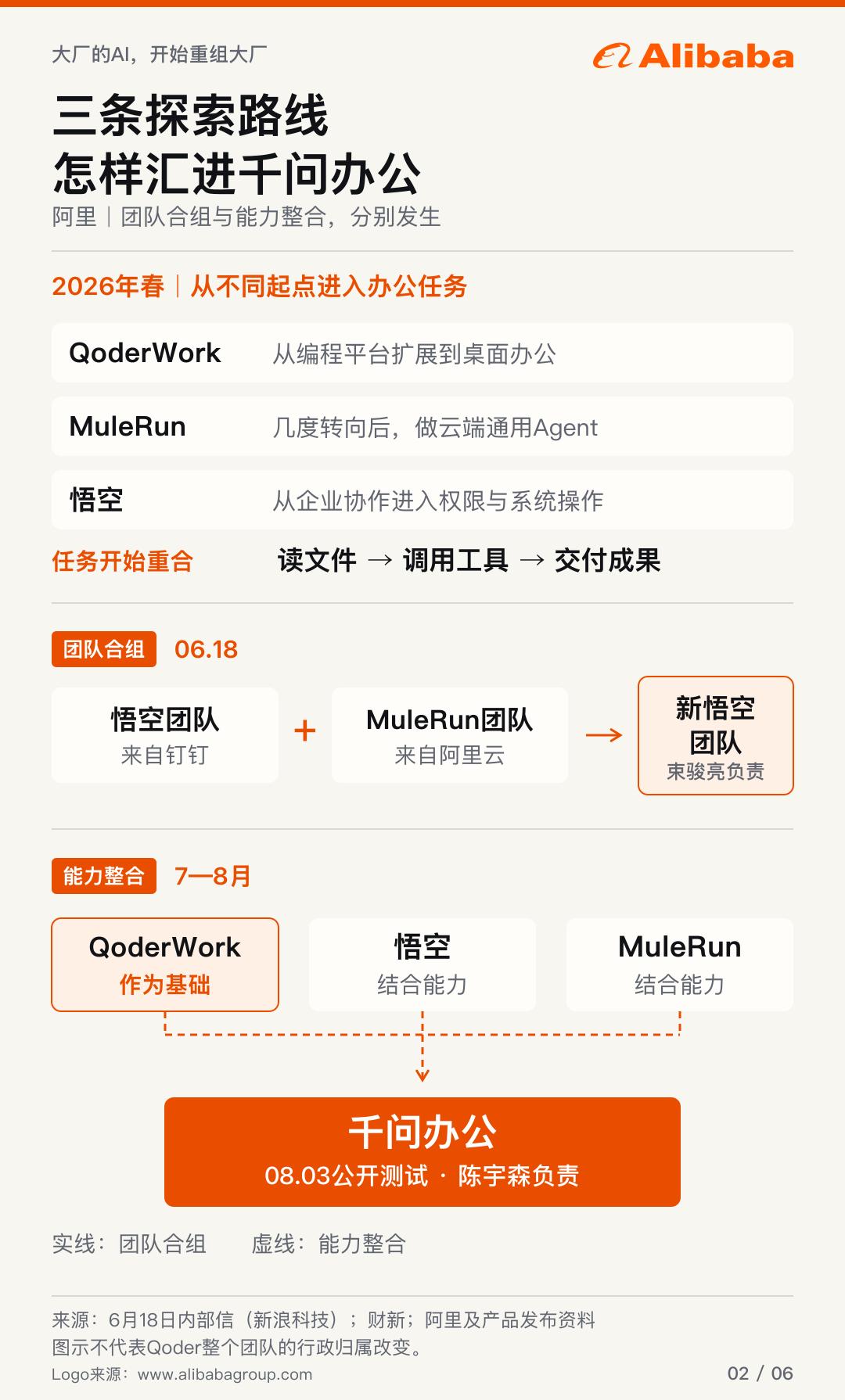
On June 18, 2026, one week after taking over as CEO of DingTalk, Chen Yusen sent an internal letter. One of the arrangements in the internal letter was to merge Wukong and MuleRun into a new Wukong team, led by Shu Junliang, the former CTO of MuleRun.
One came from DingTalk, the other was developed by Chen Yusen leading the team inside Alibaba Cloud, and now they are joining the same team.
In early June, Chen Yusen, who was still the head of MuleRun at that time, was talking about how MuleRun got to this point in an interview. In his memory, it was a route that turned back several times: online programming products, Agent application market, Agent building tools, and finally evolved into a general-purpose Agent that directly completes tasks for users.
The team once launched an online programming product named "Watt", which was never released to the public. Chen Yusen judged that it was two or three months later than the pioneers and lacked sufficient differentiation, so the opportunities were limited.
After switching to the Agent application market, they hoped that industry experts could turn their working methods into tools for users to choose from.
But they encountered another threshold. Chen Yusen concluded: "Ordinary industry experts cannot do this kind of development." The team later provided basic Agents, cloud operating environments and data access, trying to let experts only need to provide their working methods.
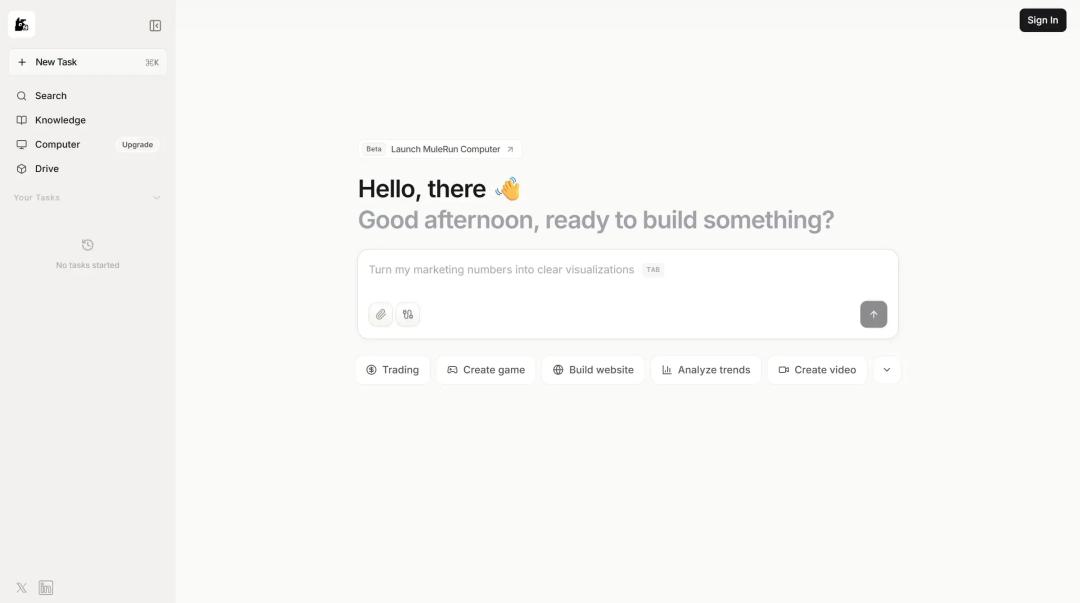
MuleRun Chat official display interface. Source: MuleRun official blog, April 13, 2026.
The threshold for building was lowered, but users were not necessarily willing to build a tool first.
Chen Yusen compared this difference in the interview: "Programmers think that if they need to do a thing 10 times, they will write code first to make the task automatic in the future; but the way ordinary users think is: I have a problem, and I want to hand it directly to the product to help me solve it."
Therefore, they finally turned to general-purpose Agents that can receive goals and call tools to execute tasks.
These detours also seem to be inevitable. After bypassing several routes, other teams have also arrived at similar positions one after another.
On January 30, in the article "QoderWork Launches: Bringing Real AI Agents to the Desktop" released by Alibaba's programming platform Qoder, it announced the launch of invitation-only testing. The example given in the article is already to read the sales Excel in the computer, find the best-selling products and regions with declining sales, and then generate charts, reports and presentations.
On April 13, in the article "Meet MuleRun Chat: One Agent, Everything Done" published on MuleRun's official blog, analyzing quarterly sales data and generating interactive reports are also listed as use cases, with tasks executed in cloud computers.
Wukong, launched by DingTalk in March, started from the enterprise work platform. In the release note on March 17, Alibaba introduced document editing, table updating, local computer and cloud system operations, and added enterprise identity authentication and permission control.
By the spring of 2026, there were at least three routes within Alibaba alone that had entered the AI office field. They have different focuses on operating environments and enterprise access, but processing files, calling tools, and delivering results have become their common work.
Technological advances have given these turns more possibilities. The original origin of the product may explain where it came from, but it can no longer fully explain where it is going.
On April 22, Sumit Chauhan, head of Microsoft Office, announced on its official blog that the Copilot agent capabilities in Word, Excel and PowerPoint were officially open to eligible Microsoft 365 subscribers.
He recalled that the first generation of Copilot could answer questions, but was not good at modifying files directly. With the improvement of the model's instruction following and reasoning capabilities, it began to "complete multi-step edits more reliably without losing your intent"." Taking Excel as an example, AI can directly modify formulas, tables and charts in the workbook.
For teams, this means that the scope of work they can try has expanded, and the intersection with other products has also increased accordingly.
After Chen Yusen took over, the scope of changes he needed to make went beyond the two new products.
The aforementioned internal letter on June 18 also stated that the core business of DingTalk established the Core Platform Business Department, led by Zhu Hong; another Corporate Information Technology Department was established, led by Deng Wu, to transform internal business systems and "make all systems easy for Agents to use". That means, for the new Agent to get things done, the old systems must also become accessible to it.
In July, Caixin reported that the new AI office product will be based on QoderWork, combining the capabilities of Wukong and MuleRun, and led by Chen Yusen. An Alibaba insider explained that multi-path exploration in the initial stage is inevitable, and there is no need to "reinvent the wheel" at this point. On August 3, Alibaba announced the public beta of Qwen Office, and the capabilities of the three were integrated into the same product.
Looking at Buddy One again, the landing point of team adjustments has also become concrete.
According to the suite usage rules announced by Tencent, after users associate their meeting accounts, they can retrieve meeting content in WorkBuddy; after joining Buddy One and associating corresponding product accounts, WorkBuddy, Docs, ima and cloud drive can share the Buddy One point balance. Agent teams doing similar tasks are being centralized, and existing products also need to connect materials, tools and paid rights together.
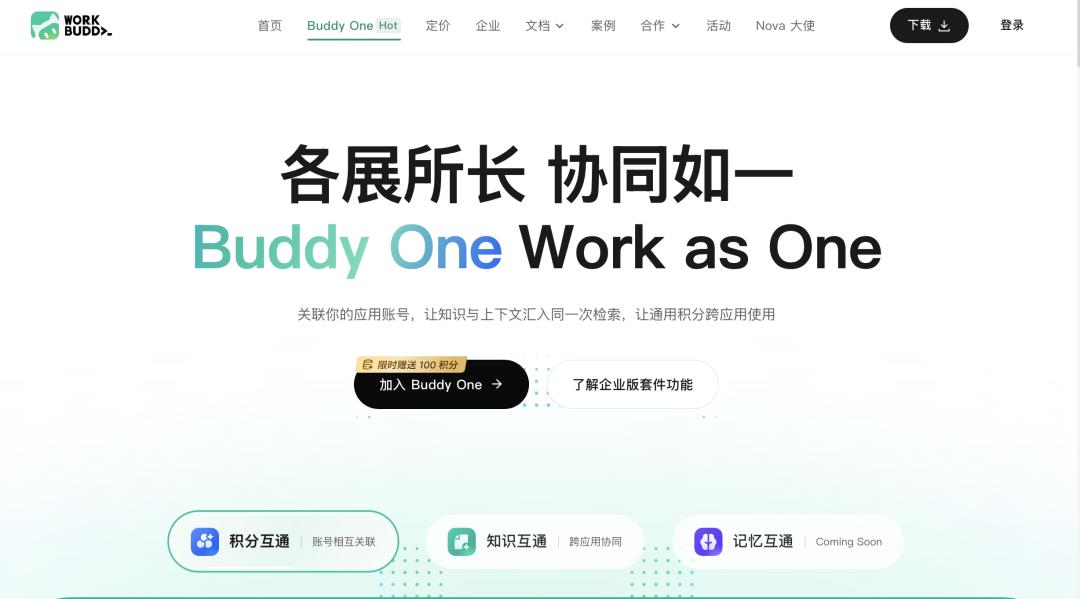
Screenshot of Buddy One official website page. Source: WorkBuddy official website.
2
When business demands begin to rewrite R&D decisions
Shiyu Yao once assigned a task to Tencent's in-house model team: first help Yuanbao make good use of DeepSeek.
On June 5, at the Tencent Cloud AI Industry Application Conference, the Chief AI Scientist of Tencent had a public dialogue with Dowson Tong. During the dialogue, Shiyu Yao recalled that the pre-training of the in-house model was not ready at that time, so he sent the key post-training personnel to continue training on the existing DeepSeek model to improve its performance in Yuanbao.
For this decision, "many colleagues in the team did not understand". His explanation was that maintaining the active users of Yuanbao is equally important for subsequent model R&D and long-term cooperation.
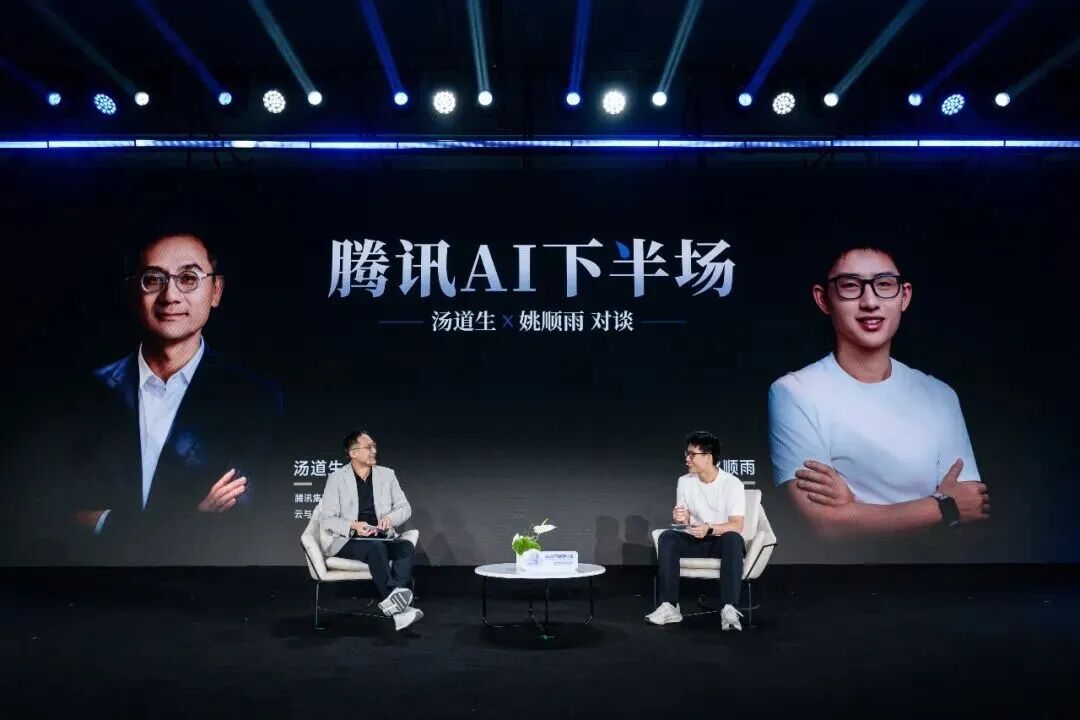
On June 5, 2026, Dowson Tong and Shiyu Yao had a public dialogue. Source: Tencent
The product has been launched and needs to win users; the in-house model still needs to consider its own R&D progress. The timelines of the two sides were originally inconsistent.
Earlier, Dowson Tong had fought for an independent arrangement for applications once.
In December 2024, while on vacation, he proposed to take over Yuanbao and recruited Wu Zurong, who had worked on QQ and Tencent Meeting. In early 2025, Yuanbao was transferred to the Cloud and Smart Industries Group under his responsibility, while Hunyuan R&D remained in the Technology and Engineering Group. His explanation was that after the chatbot becomes a frequently used product for users, dedicated product capabilities are required.
On January 20, 2025, DeepSeek released R1. On February 13