QuestMobile 2026 China Mobile Internet Autumn Report
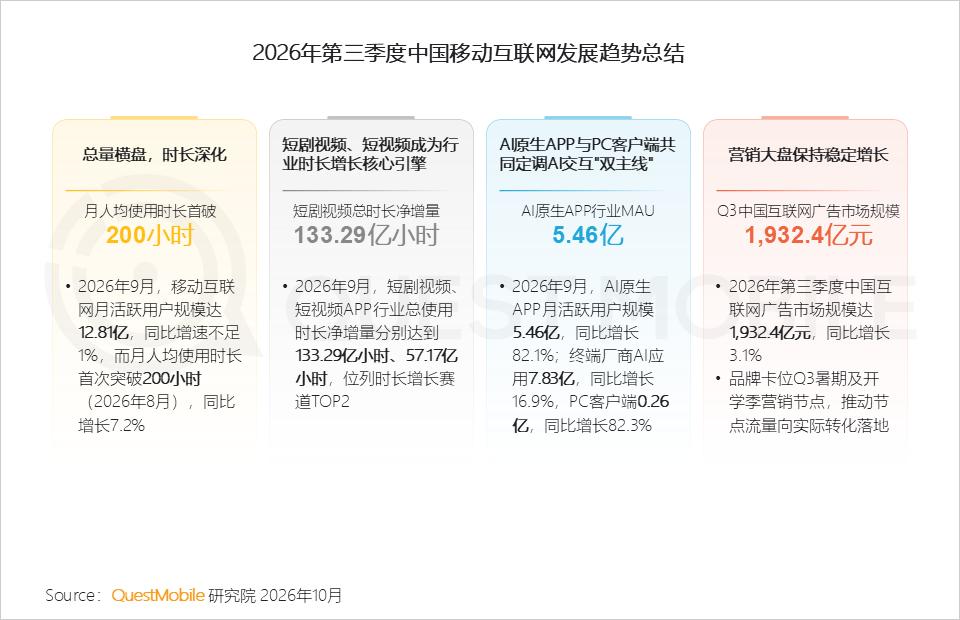
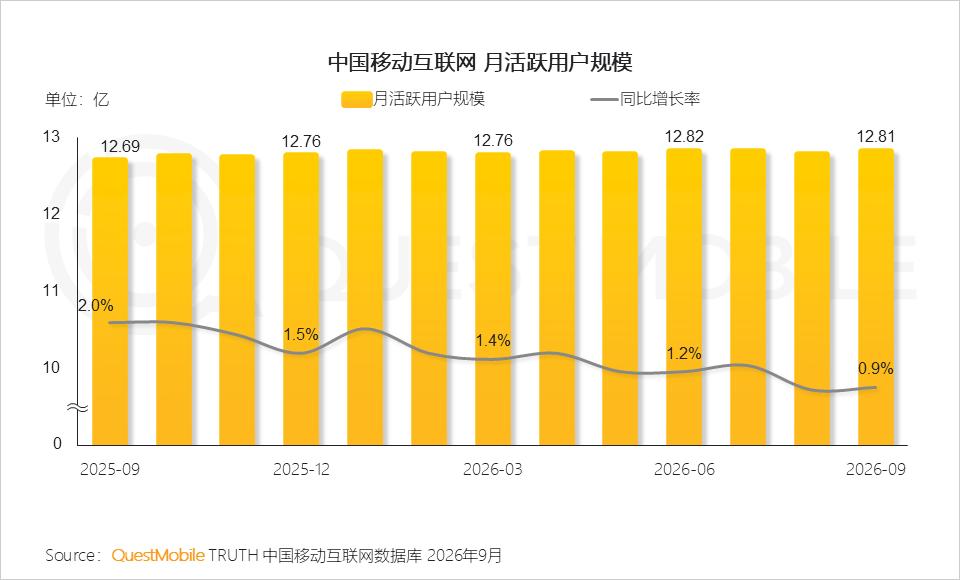
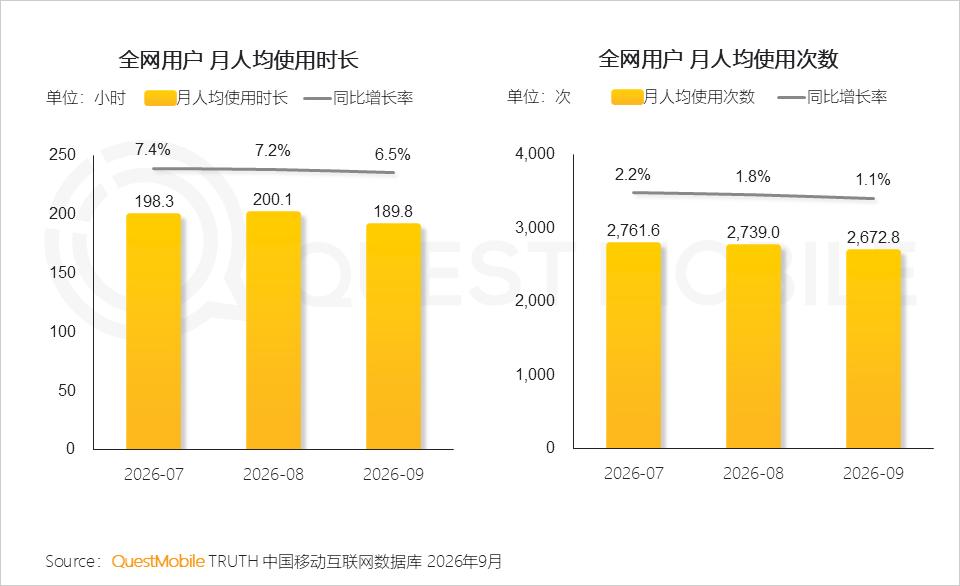
Today we are sharing the 2026 China Mobile Internet Autumn Report. According to QuestMobile data, as of September 2026, the monthly active user scale of mobile Internet has reached 1.281 billion, with a year-on-year growth of 0.9%, falling back within 1% again; however, the monthly per capita usage duration maintains a relatively high growth rate, reaching 198.3 hours and 200 hours in July and August respectively, with year-on-year growth of 7.4% and 7.2%. Although affected by the summer vacation effect, it still maintained 189.8 hours in September, with a year-on-year increase of 6.5%, showing growth resilience.
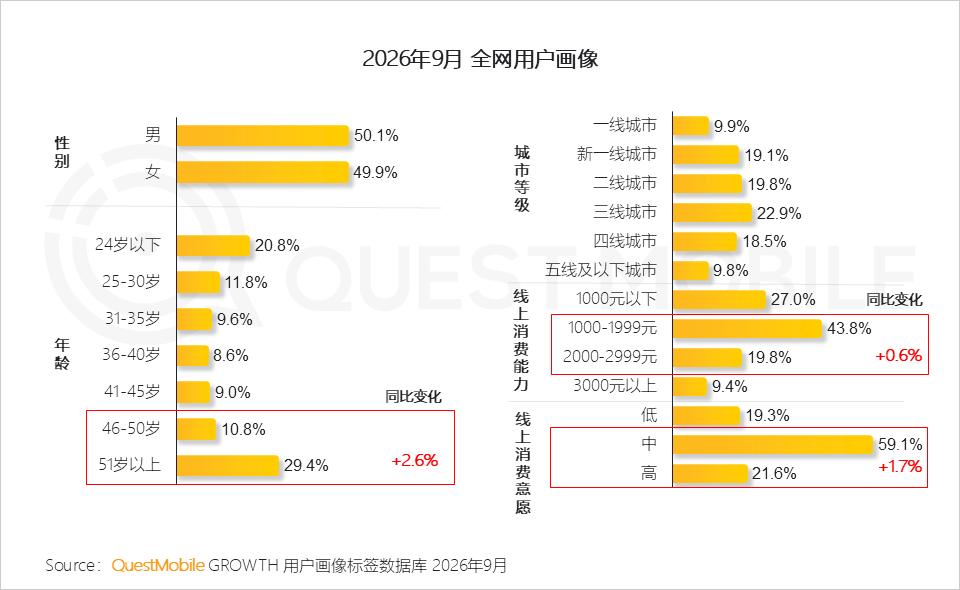
In terms of user structure, users over 46 years old account for more than 40%, with a year-on-year increase of 2.6% (among which users over 51 years old are close to 30%). In contrast, the user size in the 25-45 age range is 39%, which has fallen below 40%. This reversal shows that the "silver-haired" trend of mobile Internet users is continuing.
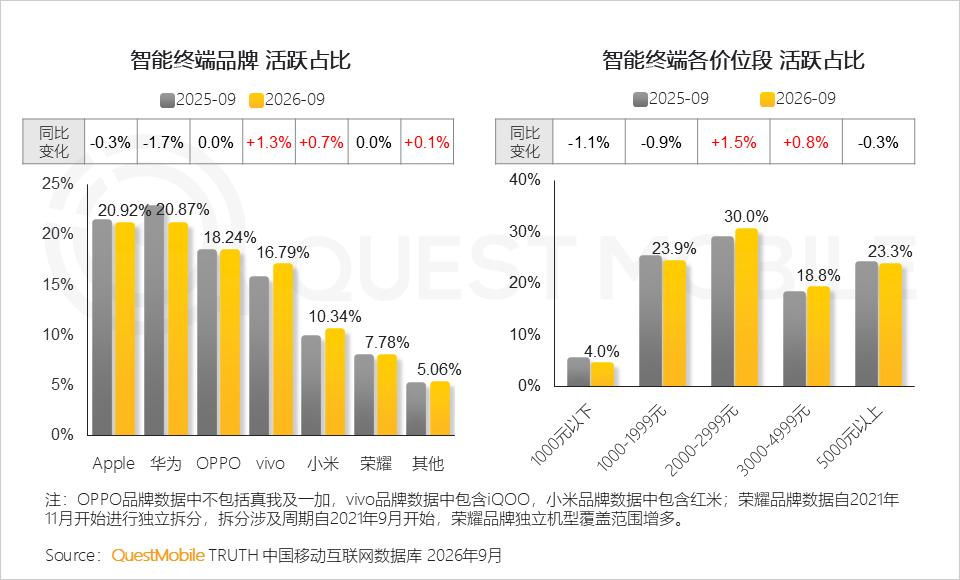
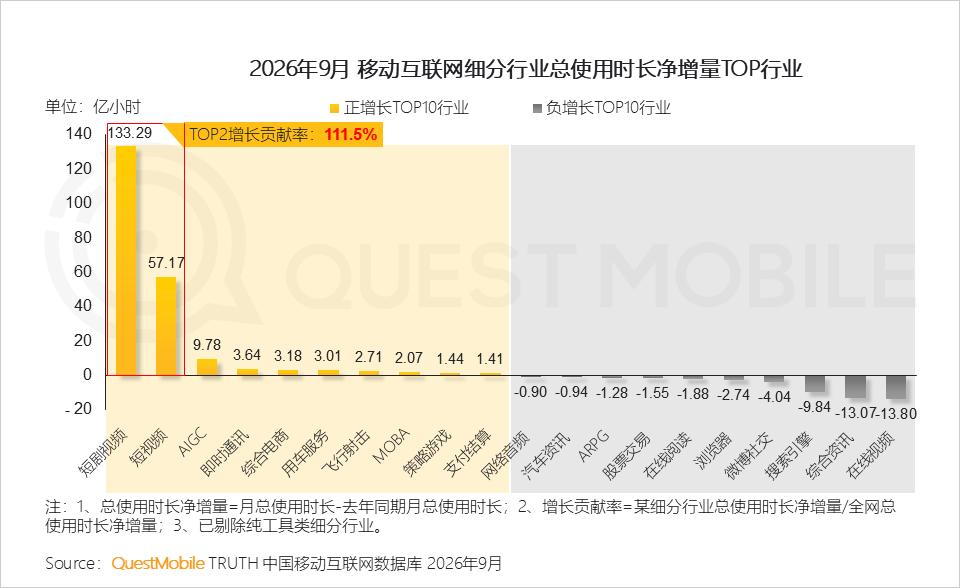
This structural change has had a far-reaching impact on the use of mobile Internet. For example, in terms of user usage duration, short drama videos and short videos contribute 111.5% to the growth (eroding the duration of online videos, general information and other fields); in terms of terminal devices, Apple ranks first with an active share of 20.92%, exceeding Huawei's 20.87%, but both have shown a year-on-year downward trend, decreasing by 0.3% and 1.7% respectively; the active shares of OPPO, vivo and Xiaomi are 18.24%, 16.79% and 10.34% respectively, increasing by 0.0 percentage points, 1.3 percentage points and 0.7 percentage points respectively;
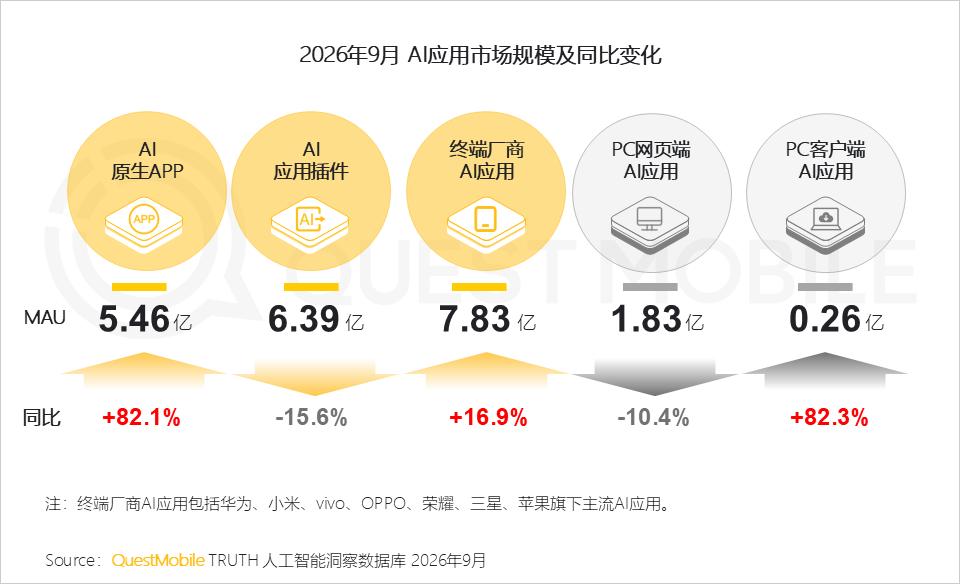
The in-depth development of AI applications, as a technical driving force, has brought another layer of far-reaching impact. In September 2026, the monthly active user scale of AI native APPs reached 546 million, with a year-on-year increase of 82.1%; the AI applications of terminal manufacturers reached 783 million, with a year-on-year increase of 16.9%; the PC client side reached 26 million, with a year-on-year increase of 82.3%. In contrast, AI application plugins and AI applications on PC web pages decreased by 15.6% and 10.4% respectively.
This shows that the "portal war" is coming to an end. Self-closed independent portals and system-level portals that connect delivery are winning. The user scale battle of "enclosure movement" has evolved into a user operation battle of "high-frequency interaction": in September 2026, the monthly per capita usage times of Doubao and DeepSeek are 72.0 times and 65.9 times respectively, and the monthly per capita usage duration is 132.5 minutes and 136.7 minutes, pulling ahead of other players. Comparing the quarter-on-quarter changes of the two, the monthly per capita times and duration of Doubao decreased by 6.1% and 7.8% respectively, while DeepSeek increased by 5.8% and 9.5%.
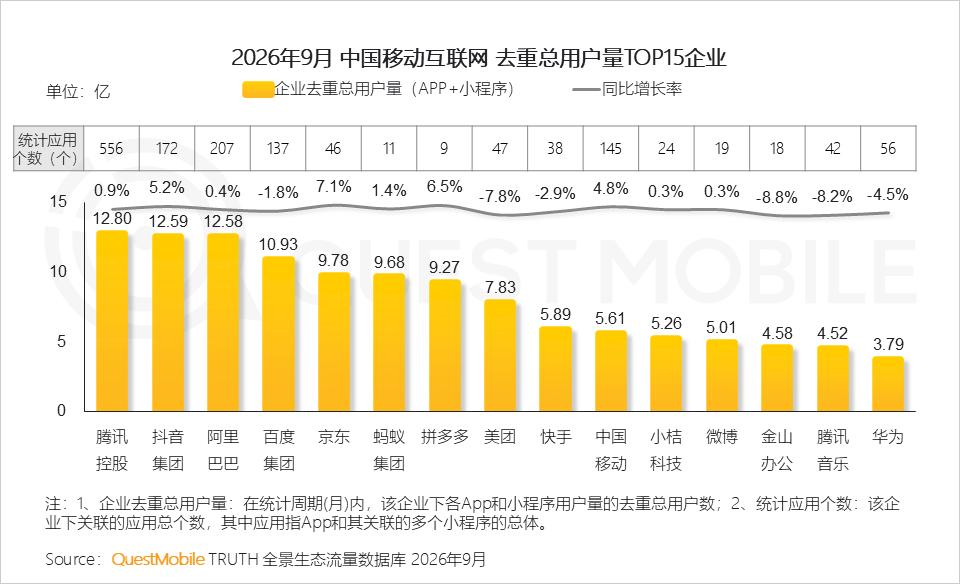
The changes brought by the interweaving of the two forces are continuously affecting the general pattern of the mobile Internet. From the perspective of changes in the head camp, Tencent Holdings, Douyin Group, and Alibaba maintain the top three positions, with the de-duplicated total user volume (APP + mini-program) reaching 1.280 billion, 1.259 billion, and 1.258 billion respectively, with year-on-year growth of 0.9%, 5.2% and 0.4% respectively; Baidu Group, JD.com, and Ant Group rank 4th to 6th, with user scales of 1.093 billion, 978 million and 968 million respectively, and year-on-year growth rates of -1.8%, 7.1% and 1.4% respectively.
What is the specific situation? You might as well read the report.
Summary of China Mobile Internet Development Trends in Q3 2026
1
Internet competition has fully shifted from "expanding user base"
to "occupying usage duration and decision-making starting points"
1. The monthly per capita usage duration of the whole network has exceeded 200 hours for the first time
1.1 Total volume remains stable while duration deepens: The monthly active user scale of mobile Internet is stable at more than 1.2 billion, with a year-on-year growth rate of less than 1%, while the monthly per capita usage duration exceeds 200 hours, with a year-on-year increase of 7.2%
According to QuestMobile data, benefiting from the summer vacation effect, the monthly per capita usage duration of all network users rose from 198.3 hours in July 2026, and exceeded 200 hours for the first time in August, with a year-on-year increase of 7.2%.
1.2 The "silver-haired" trend deepens, the regional structure is basically stable, and the online consumption capacity and willingness rise steadily and moderately
1.3 Apple's active share surpasses Huawei to rank first among smart terminals, and the user share of brands such as vivo and Xiaomi continues to rise; with terminal replacement, mid-to-high-end models show consumption resilience
According to QuestMobile data, as of September 2026, Apple ranks first with an active share of 20.92%, while the active shares of vivo and Xiaomi have increased by 1.3 percentage points and 0.7 percentage points respectively; in terms of terminal price ranges, the active share of the 2000-4999 yuan price range has reached 48.8%, increasing by 2.3 percentage points, and mid-to-high-end models demonstrate consumption resilience.
1.4 The duration increment is highly concentrated in the head tracks, and the top 2 tracks contribute 111.5% to the growth. Short drama videos and short videos have become the two core engines driving the growth of the whole network's duration
1.5 Tencent Holdings, Douyin Group and Alibaba steadily rank in the first echelon, with their user scales tending to be flat, while the volume and growth rate of enterprises in the second echelon are clearly differentiated
According to QuestMobile data, as of September 2026, the de-duplicated total users of Tencent Holdings, Douyin Group and Alibaba have reached 1.280 billion, 1.259 billion and 1.258 billion respectively. The internal differentiation in the second echelon is prominent, and the year-on-year growth rate of de-duplicated total users of JD.com and Pinduoduo leads the industry, reaching 7.1% and 6.5% respectively.
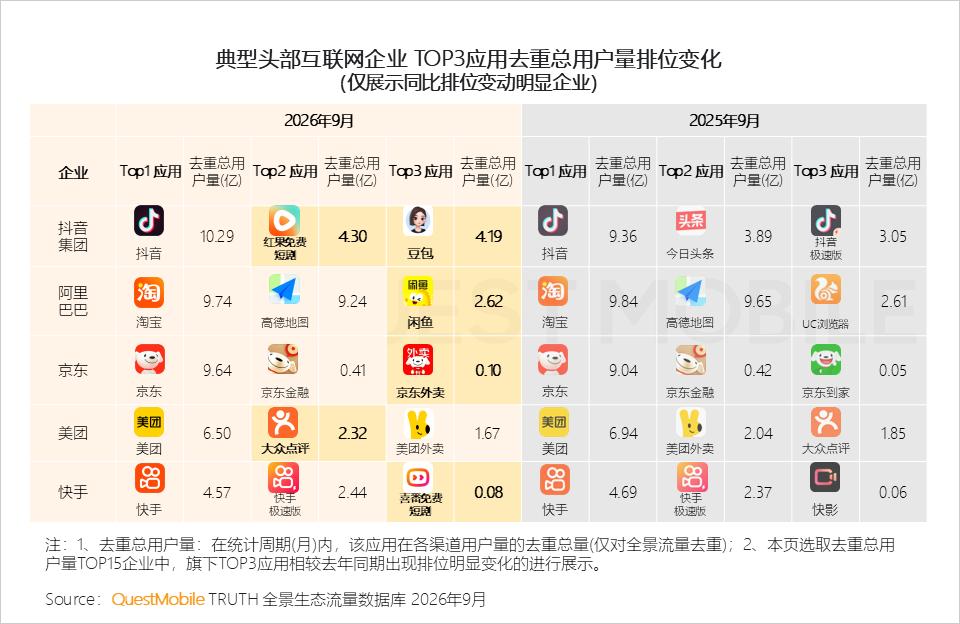
1.6 The head application matrix is changing: AI native, short drama content, community transactions, local decision-making and instant fulfillment are becoming the new main battlefield for large factories to reconstruct the traffic matrix and compete for the starting point of user decision-making
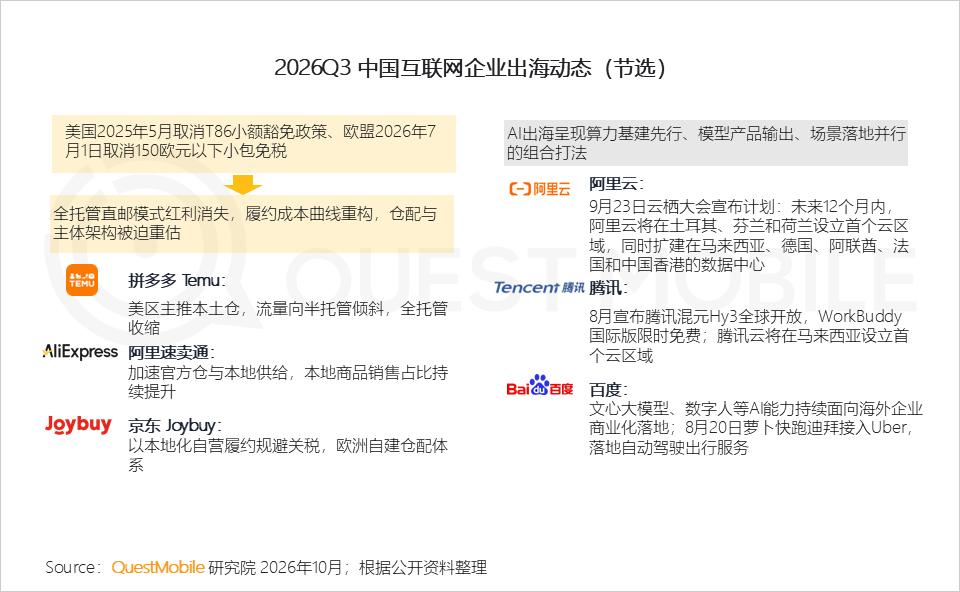
1.7 Enterprises going global: Affected by the cancellation of tax exemption for low-value small parcels in Europe and the United States, cross-border e-commerce is accelerating the transformation to overseas warehouses and local supply; AI going global is speeding up, expanding overseas markets in differentiated ways based on computing power infrastructure, combined with open models and vertical scenario implementation
2. Q3 2026: Delivery capacity enters the realization period, and AI native APPs and PC clients jointly set the "dual main line" of AI interaction
2.1 In the third quarter of 2026, policies have supplemented the compliance requirements for agents, and large manufacturers have accelerated the integration of AI Agent businesses, forming two development main lines of office productivity and life services
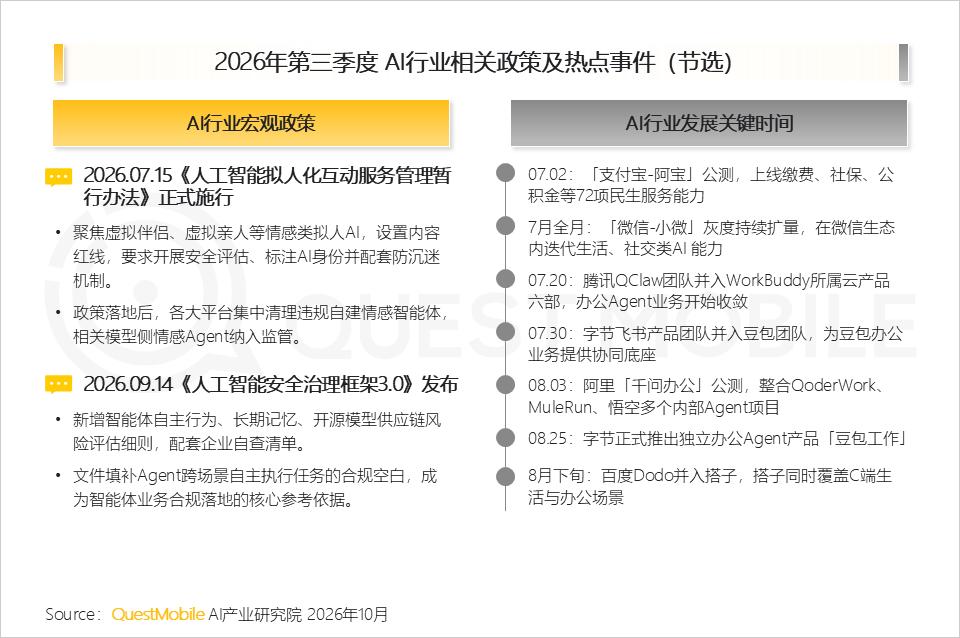
2.2 The AI application market completed a structural shift in the third quarter: self-closed independent portals and system-level portals close to the delivery end continue to expand, while multi-level transit portals shrink simultaneously — the growth logic driven by delivery capacity entered the realization period in the third quarter
QuestMobile data shows: In September 2026, the monthly active user scale of AI native APPs is 546 million, with a year-on-year increase of 82.1%; the AI applications of terminal manufacturers reach 783 million, with a year-on-year increase of 16.9%, and the PC client side reaches 26 million, with a year-on-year increase of 82.3%.
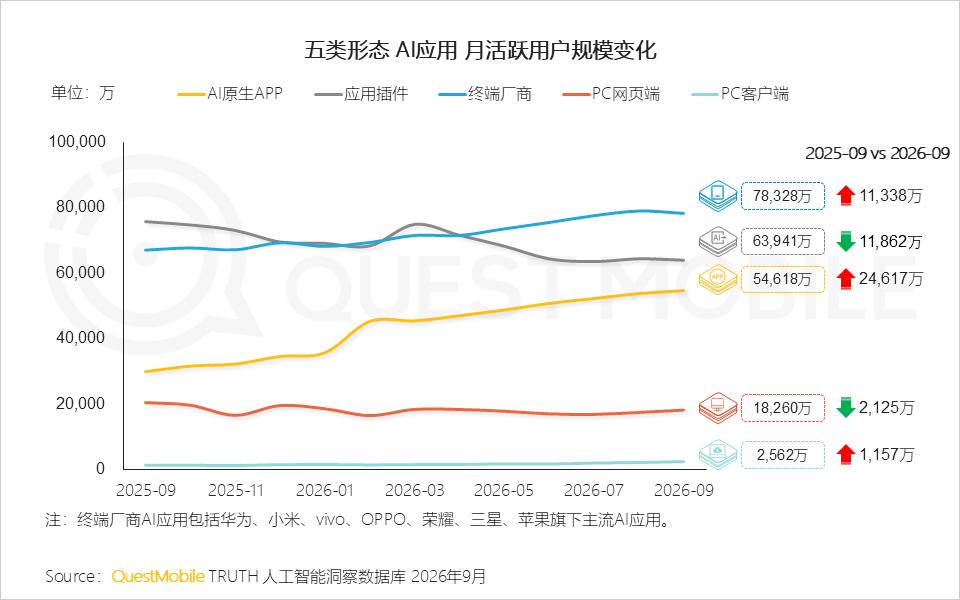
2.3 Observing the five types of applications on the timeline, the second quarter of this year is a clear watershed: the slope of AI native APPs rises sharply, with a net increase of 246 million, setting the tone for the mass closed loop; the net increase of 11.57 million on the PC client side reflects the demand for professional scenarios
Although the trends of the two are different, they both point to: user behavior has undergone structural migration, shifting from multi-level transit portals to the shortest path independent AI form.
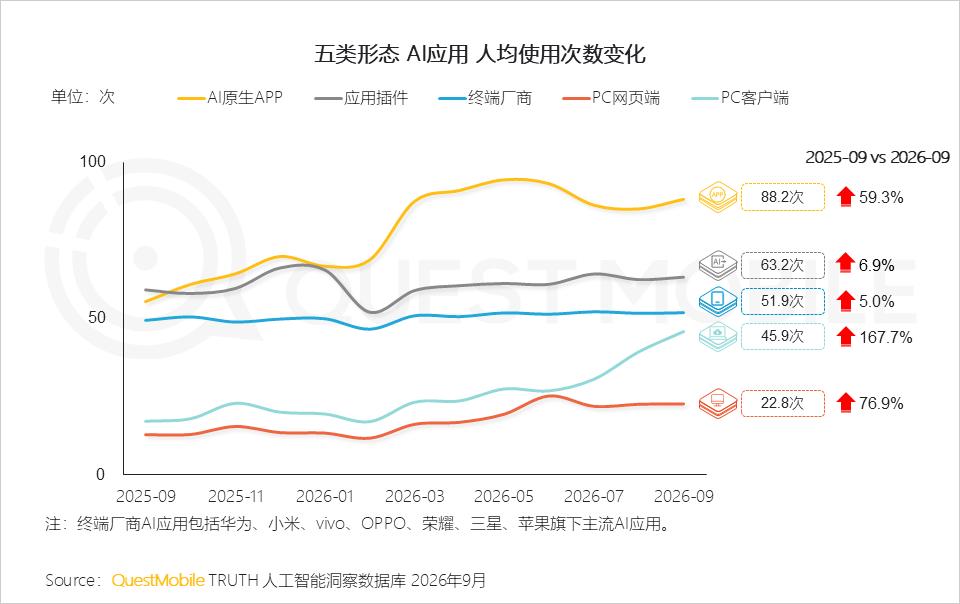
2.4 Usage depth further confirms the division of labor of the "dual main line": the PC client side undertakes heavy scenarios with a growth rate of 167.7%, and AI native APPs push the monthly per capita frequency to 88.2 times, the former contributes intensity and the latter contributes stickiness
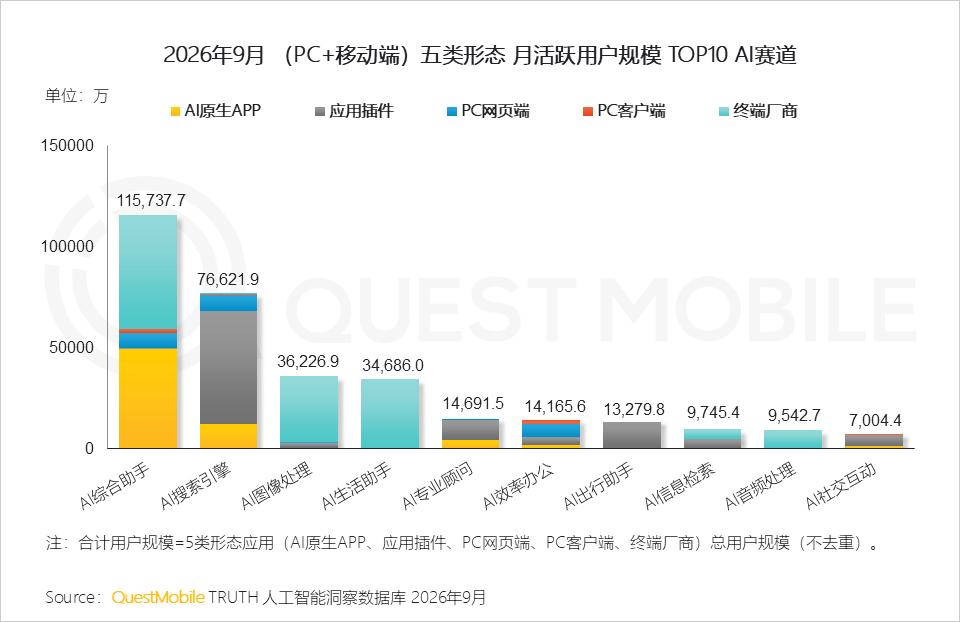
2.5 The pattern of the top 10 tracks is confirmed from the supply side: AI has shifted from a Q&A tool to a fulfillment subject. De-intermediation does not mean a single form, and deep link scenarios tend to be diversified and mixed delivery
2.6 Focusing on the head players on the supply side, the overall AI native APPs have entered a new stage of "echeloned scale, differentiated growth, and operation focusing on delivery"
The magnitude difference of head applications confirms the scale echelon, and year-on-year and