The overall market size has exceeded 10 billion yuan in half a year, and major tech giants are revaluing the Token selling business.
Cover Source | Public Network, "The Railway Bridge At Argenteuil", Claude Monet, 1873
In 2011, Marc Andreessen, co-founder of Silicon Valley venture capital firm Andreessen Horowitz (a16z), wrote the famous quote "Software is eating the world", which kicked off the decade of SaaS. Six years later, Jensen Huang supplemented the second half of the statement: Software is eating the world, but AI will eat software.
However, even two years ago, most people did not believe that selling Tokens could be a profitable business. But in 2026, this has become a reality.
Recently, IDC officially released its H1 2026 report. In the first half of 2026, the revenue of China's public cloud MaaS market reached 106.3 billion yuan, a year-on-year increase of 889.4%.
Against the backdrop of the slowing growth of the overall public cloud market for many years, there are very few markets that can rapidly reach a scale of 100 billion yuan within two years.
MaaS has become a key indicator for observing the development of the global AI market. This is a business that is often analogized to "water, electricity and coal": model vendors provide services through APIs and other forms, and enterprises or individuals do not need to build their own models and computing power, but can call models through MaaS platforms to complete tasks such as text generation and code writing. Vendors charge based on Token call volume, computing power usage duration or package subscriptions, and the more the model is called, the higher the revenue.
In the new market season of 2026, Volcano Engine took the lead — according to IDC's "China AI Software Semi-Annual Market Tracking" data, in H1 2026, Volcano Engine accounted for nearly 50% of the total domestic public cloud MaaS revenue.
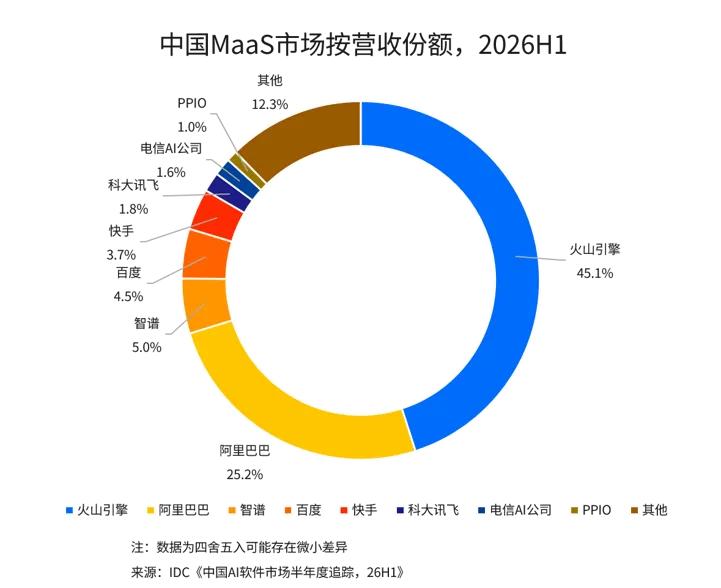
From the discussions around MaaS indicators, we can also glimpse the changes in market consensus.
In 2025, the industry was still debating which cloud had higher Token sales and better cost performance in the MaaS market; by 2026, facing a market that has grown nearly 9 times in a year, the indicator that everyone focuses on has gradually unified: MaaS revenue.
Anthropic and OpenAI are still the "role models" for Chinese manufacturers. The recent IPO prospectus of Anthropic has sparked heated discussions, because its commercial growth has once again refreshed market expectations — in the first half of 2026, Anthropic's total revenue reached 16.286 billion US dollars, 80% of which came from inference revenue billed by Token volume.
The exponential growth of Token consumption by agents has also pushed up Anthropic's average customer order value. The prospectus shows that in the third quarter of 2026, enterprise version users who did not use Claude Code spent less than 75 US dollars per month on average; the top 5% high-spending enterprise version users who used Claude Code spent about 20 times as much as the former.
This growth is far from reaching its peak, which has triggered radical investment from major domestic manufacturers. The AI office competition that started in the middle of this year — products dominated by Doubao Work, Tongyi Qianwen Office, and WorkBuddy, is essentially that major manufacturers have begun to seize the entrance of high-value task scenarios focusing on productivity.
Nowadays, the industry consensus is clearer than ever: to build top-tier models. This is the best way to rapidly increase Token consumption and make customers willing to pay for it.
The commercialization space of large models is also being opened up. The upper limit of traditional cloud computing is largely restricted by enterprises' IT budgets, while MaaS targets productivity — theoretically, the size of a country's MaaS market will eventually be linked to its GDP and population. According to this logic, the domestic market is only part of the global market. A cloud industry insider estimates that the overseas market space is at least 3-4 times that of the domestic market.
We also exclusively learned that starting from the second half of this year, Volcano Engine will focus on expanding overseas markets and has launched a radical commercialization process. By the end of the year, the proportion of overseas business revenue of Volcano Engine is expected to be close to 40%.
A business that is more like "water, electricity and coal" than cloud computing
Why did 2026 become an important watershed for the MaaS market? One phenomenon is that the market has gradually converged from pursuing Token consumption to pursuing revenue.
The pursuit of Token consumption is because the market is still in the early stage. Before 2025, most AI tasks were concentrated in simple dialogues such as AI search, with limited interaction rounds and dialogue depth.
At that time, the main task of most manufacturers was to increase Token consumption. After DeepSeek R1 became a hit in 2025, domestic manufacturers followed up immediately. Whether it was accessing as many third-party models as possible, giving subsidies for free quotas, or cutting prices, the essence was to get users to use the service first.
The turning point came from Anthropic's Claude Opus 4.6, which for the first time allowed the model to truly enter production-level Coding and Agent scenarios — planning tasks, calling tools in sequence, and recording execution status. A single task may call more than a dozen tool interfaces in sequence, and the Token consumption will rise exponentially until the task is delivered.
When tasks change from short dialogues to long-running tasks, models are no longer just sold as a single response, but truly become a service. When model vendors charge by Token, it is easier to correspond to high-value work tasks.
The change of interaction form has also changed the growth and business logic of MaaS.
"From the perspective of language models, customers' task characteristics are no longer divided by industry or modality. Customers often run all kinds of tasks, so Volcano Engine's pricing segmentation this year is based on the input length of tasks, rather than customer types," a Volcano Engine insider said.
The MaaS market has therefore further matured.
One sign is that before and after Coding opened up productivity scenarios, all model vendors have chosen their own suitable ecology and product positioning, which has become a key market competition strategy.
For example, after the release of its flagship model K2, Kimi has continued to take the open source route, and was the first to expand the parameter scale of open source models to 3T, which has also gained huge market influence.
But Zhipu AI chose to focus on the Coding scenario, launching a model with a comfortable parameter scale of hundreds of billions of parameters, but with relatively faster calling speed, which can complete most programming tasks, thus achieving rapid commercial landing.
In the first half of 2026, Zhipu AI's revenue increased nearly 4 times, rising all the way to 954 million yuan, of which more than 80% came from API calls.
Although the Seedance series of models have maintained the state-of-the-art (SOTA) performance in the global video field for nearly 8 months, most AI industry insiders we contacted said that no modality can be said to have an absolute moat at present.
This is also the most essential difference between MaaS and traditional cloud computing. In the traditional cloud era, manufacturers can keep customers' data on the platform through storage and database products, with high migration costs; but in the MaaS era, if the model call link is encrypted, it is difficult for the platform to lock customers by binding data. If another vendor launches a stronger SOTA model, customers may switch models at any time.
In other words, compared with cloud computing, MaaS is more like a pure "water, electricity and coal" business. The only way to retain customers is to truly embed the model into the enterprise's production pipeline — launch a sufficiently SOTA model and roll it out quickly; then users will use it for more challenging tasks.
36Kr learned that before its launch, Seedance was only positioned for creative scenarios, but it quickly reached SOTA in the creative field. While completing commercial coverage, some spontaneous scenario innovations from customers are also emerging — many embodied intelligence companies will also use Seedance for data processing of corner cases.
When the call volume increases, there will be more real user feedback, which in turn feeds back to the inference engineering and product design, so that the next better version of the model can be run out before competitors catch up.
Not only pursuing revenue growth, but also pursuing intelligence density
MaaS is a business more like water, electricity and coal than cloud computing, and the explosion speed of this market now seems to be more violent than the previous era: China's public cloud market started in 2009, and it took 7 years to cross the annual scale threshold of 100 billion yuan; now the MaaS market has shortened this time by half.
However, another frequently discussed question is: MaaS is more like a water, electricity and coal business, which seems to make it harder for customers to generate stickiness than traditional cloud. Why do major manufacturers still pour money into it at all costs?
On the one hand, the upper limit of traditional cloud computing is essentially restricted by enterprises' IT expenditure budgets; when AI enters core production links such as Coding, video production, and daily office work, MaaS targets the productivity budget — enterprises are not spending money to improve efficiency and reduce costs for IT, but are equivalent to purchasing a batch of virtual digital employees.
Silicon Valley research institute SemiAnalysis once surveyed more than 50 enterprises. At present, the per capita AI expenditure of most Fortune 500 enterprises is less than 100 US dollars per year, while the annual expenditure of top high-intensity users has exceeded 90,000 US dollars per employee, with a difference of nearly 660 times between the two ends. This means that the real explosion of enterprise-side Token consumption has not yet arrived.
MaaS is expected to greatly widen the upper limit of the market ceiling. Most industry insiders believe that the explosion of MaaS will be more intense than that of cloud computing. For a long period of time, the MaaS market will remain in a seller's market stage.
In most cases, the supply of AI computing power determines the overall growth rate of the MaaS market. "As long as the model can be SOTA, then all the intelligence produced can be consumed," said an industry insider.
When many cloud vendors still regard MaaS as a hook to pry large traditional cloud orders, Volcano Engine regarded MaaS as its only bet as early as 2023, believing that it can generate a much larger market than traditional cloud.
Due to the rapid iteration of models, in order to avoid scattered energy for engineering adaptation, Volcano Engine has not launched many model sizes. Whether it is language or vision models, Volcano Engine now mainly focuses on two model sizes: one is the large-size flagship model, with the first priority to explore the upper limit of intelligence; the other is the Flash model, which is responsible for expanding volume and rapidly rolling out commercialization.
In 2023, when ByteDance's self-developed basic models were still in their infancy, Volcano Engine first introduced a large number of third-party models to enter more application scenarios first. Models of similar size to Flash, although not contributing the most revenue, have already had several times the call volume of flagship models on Volcano Engine, undertaking more extensive productivity penetration and new scenario exploration functions.
In this process, Volcano Engine has also run in the collaborative link of model engineering, application and commercialization teams in advance.
"Now MaaS revenue is Volcano Engine's top priority, and all resources make way for it," an industry insider joked, "You can't even sell GPU resources if you want to, all the chips are used for inference and training."
A Volcano Engine insider recalled that since Q4 2025, after seeing the potential of productivity scenarios, Volcano Engine quickly adjusted its strategy, making revenue rather than Token consumption the core indicator of the team.
Around productivity scenarios, Volcano Engine's organization and sales teams are taking shape rapidly. After integrating the product teams of Feishu, Doubao Work and Doubao in July 2026, Volcano Engine recently completed another internal integration, establishing a "Creativity Service Platform" to merge the sales teams of Volcano Engine and Feishu, so that one salesperson can sell all products related to SaaS and Tokens.
The signal shown by a series of adjustments is that due to the opening of productivity scenarios, the business of SaaS and Tokens is increasingly converging — what users want is the delivery of task value, not just simple tool product seats.
In terms of commercialization, Volcano Engine's pricing and product principles are quite stable: first, there must be healthy gross profit, second, it must be competitive in the market, and finally, make differentiation according to different task requirements.
The amazing leap of Seedance is one of the very referable cases in 2026.
Seedance has reached extremely high coverage in just a few months. In addition to reaching SOTA in the video field in terms of parameters and generation effects, a lot of engineering work on Volcano Engine's side has also accelerated the establishment of competitive advantages.
When Seedance 2.5 was launched, Volcano Engine focused on launching the "Draft" feature, which came from the observation of the Volcano Engine team when version 2.0 became a hit: professional creators rarely get a satisfactory shot at one attempt, and often need to generate samples repeatedly. Using 1080P or even 4K to test each time is too costly, which hinders users from continuing to use the service. After the launch of Draft, users first use the cost-effective model to generate low-resolution previews, and then pay for the official generation, which can save most of the cost of invalid sample generation.
When the intelligence density of tasks is higher, the value of intelligence will also rise accordingly. As inference costs continue to be optimized, this does not damage revenue. In the end, the total cost of generating the same number of finished videos using Seedance 2.5 is generally lower than that of using version 2.0.
36Kr learned that Seedance 2.5 Draft has become an operation mode with extremely high user usage depth at present, which has greatly promoted user stickiness of the model.
Now, even with self-developed flagship models in hand, major manufacturers have become more open than ever on application entrances — on October 29, Doubao Work opened third-party large model services to enterprise customers, and the first batch of accessed models include Kimi 3.1 Pro, GLM 5.3, DeepSeek V4.1 Flash and other models.
Not only ByteDance, Alibaba's Tongyi Qianwen Office also launched GLM-5.3 and DeepSeek V4 Pro in August, side by side with its own Tongyi Qianwen model; Tencent's WorkBuddy also supported the access of external models such as DeepSeek and Kimi from the very beginning.
Whether self-developed or third-party, the considerations behind are the same: major manufacturers are trying their best to keep complex tasks in their own products — this is not only to increase current Token consumption, but also to use the high-frequency productivity entrance to figure out which scenarios are truly worth heavy investment and have higher intelligence density.
"We are now integrated with the model team," a Volcano Ark insider said. When the competition of large models returns to the arena of flagship models, if you want to keep winning in this business, the competition among major manufacturers is no longer just about whether the next generation of models can take the lead, but a comprehensive competition covering models, inference engineering and commercialization systems.