A Chengdu-based embodied intelligence company has secured a multi-million-yuan angel round of financing, and develops robot brains based on OpenHarmony | HardKr Exclusive
Writer | Nan Huang
Editor | Silai Yuan
36Kr has learned that Chengdu embodied intelligence brain enterprise "Qilinbo" recently completed an angel round financing of tens of millions of RMB, with investors including Chengdu Fangcun Engine Technology Co., Ltd. and angel investors. The funds from this round will be mainly used for core technology research and development, R&D team building and market expansion, providing financial support for the company to continuously promote the R&D, productization and application implementation of machine brain and multi-machine collaboration systems.
Founded in December 2025, Qilinbo focuses on the core software of embodied intelligence, takes autonomous robot operation and multi-machine collaboration as the core direction, and is committed to enabling robots to have the ability to continuously perform tasks, and complete more complex work through multi-robot collaboration.
Tang Zuolin, co-founder and CEO, has a composite technical background spanning AI algorithms, embedded systems and domestic operating systems. He worked at Motorola in his early years, focusing on embedded, chip and driver development. Later, as a core developer, he participated in the construction of the OpenHarmony base and the Python domestic framework.
In terms of technical differentiation, OpenHarmony, domestic computing platform adaptation and local model deployment are important R&D directions of the company. The Qilinbo team takes the domestic base as an important engineering foundation to support robot applications and adapt to different scenarios.
Its embodied robots can be equipped with the OpenHarmony system. Tang Zuolin, co-founder of Qilinbo, told 36Kr that developing embodied intelligence based on OpenHarmony can give full play to the team's technical accumulation in underlying systems and software-hardware adaptation, and also help the company carry out applications in scenarios with high requirements for independent controllability and data security. The premise of this advantage is that the system, chips and algorithms can work in coordination.
Relying on the technical accumulation in the OpenHarmony system, the company has obtained stable cash flow orders. The team migrated relevant capabilities to the robotics field, prioritizing primary and secondary schools and universities, delivering desktop crawler robots and desktop robot dogs to meet the teaching and research needs of inclusive artificial intelligence education and OpenHarmony + embodied intelligence. On the basis of desktop models, the company will further promote the application and adaptation of industrial-grade quadruped robot dogs and industrial robotic arms.
The entire technical architecture of Qilinbo is divided into two layers: end and cloud. On one side is the self-developed "Lingyan Engine", which is oriented to task understanding, planning decision-making and autonomous execution of a single robot. On the other side, the "Goose Swarm System" is oriented to task allocation, resource coordination and collaborative work of robots of different forms.
On the two-level structure of single-machine intelligence plus collaborative intelligence, the single machine completes real-time response on the end side, while the cloud completes cross-device and cross-space task allocation and resource scheduling at a higher level.
At present, the "Lingyan Engine" supports cross-form adaptation, can be deployed on different bodies such as robot dogs, robotic arms, and humanoid robots, and connected to the "Goose Swarm System".
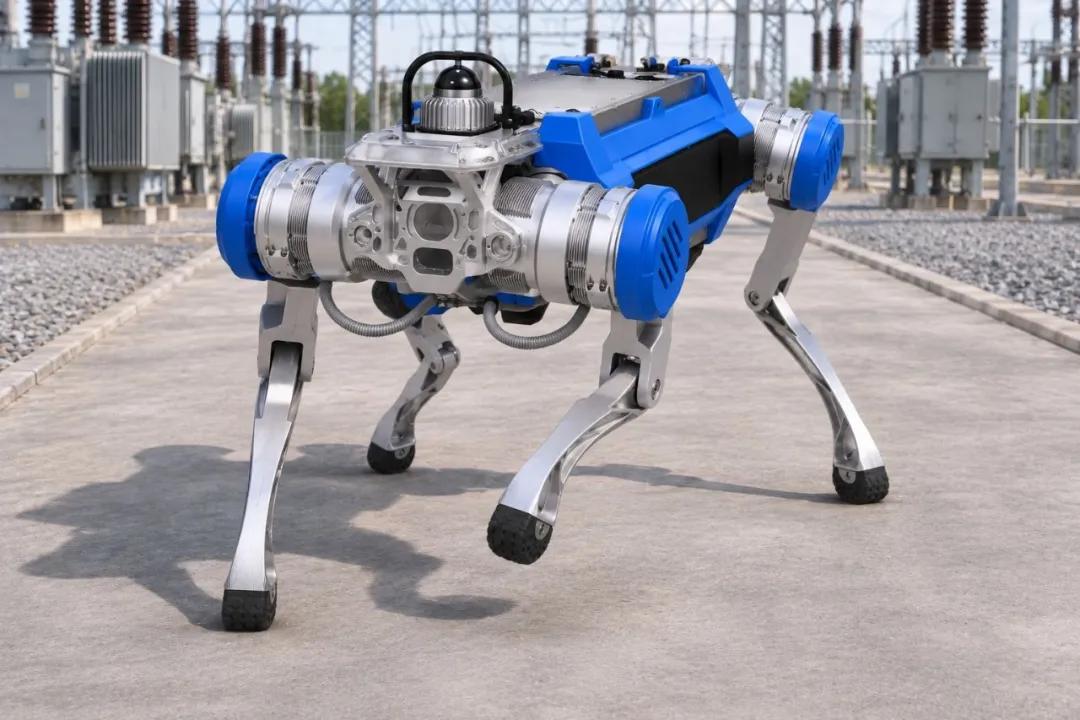
Supporting the landing and adaptation of multiple embodied robots (Source/Enterprise)
According to the plan, the education and scientific research scenario at this stage is an important polishing and verification carrier for its end-side and cloud-side systems. The team continues to iterate the "Lingyan Engine" and "Goose Swarm" scheduling system in teaching and scientific research scenarios, and gradually expands to parks, industries and other scenarios in combination with different bodies and task requirements, to promote project application and field verification.
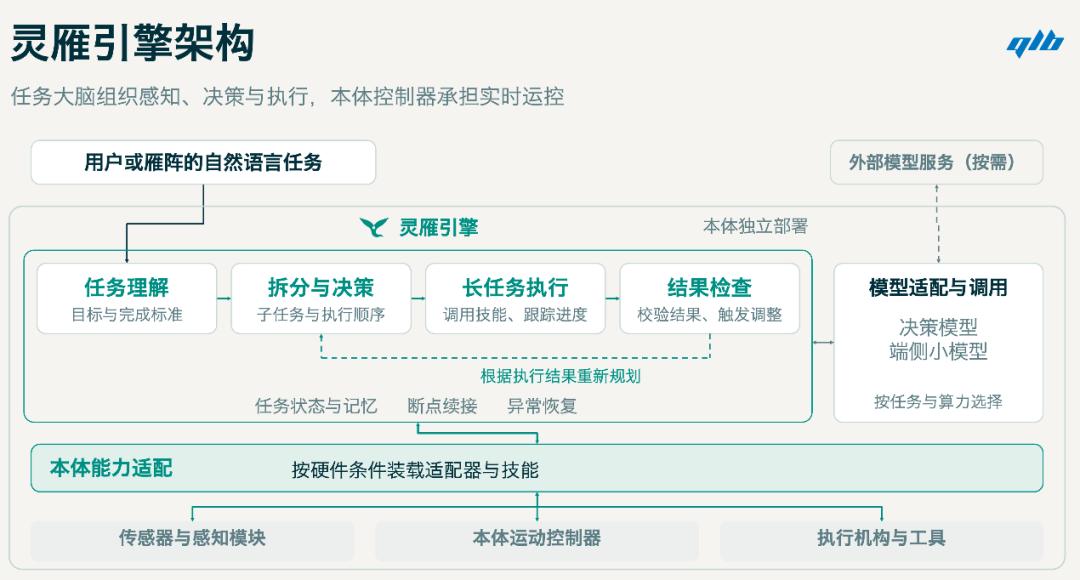
Architecture of Lingyan Engine (Source/Enterprise)
This architectural judgment stems from Tang Zuolin's observation of the structural shortcomings of the industry.
Tang Zuolin told 36Kr that with the rapid growth of the number of embodied bodies, most of the bodies are still in the stage of demonstration and single-machine operation, lacking the ability to continuously complete tasks under real working conditions. "The collaboration between bodies is the key gap in the next stage. No matter how strong the single-machine intelligence is, it cannot independently complete tasks that require the cooperation of multiple devices."
Taking the cross-floor inspection scenario as an example, when a robot dog finds an emergency during inspection and sends a request for assistance, the system needs to judge whether support is needed in combination with the task rules, and coordinate other robot resources. The cloud brain is responsible for demand research and judgment, resource matching and collaborative scheduling, and then issues tasks to the end side for execution. The end side is responsible for "how to execute the task", and the cloud side is responsible for judging "which device is responsible and how to cooperate", and the two layers of capabilities cooperate with each other.
In addition to education and scientific research, Qilinbo also focuses on working conditions with high risks, low efficiency and difficulty for manpower to continuously cover, positioning itself to form synergy and complementarity with humans. Taking the night patrol of the park as an example, manual patrol has a time blind zone, and it is difficult to continuously cover the temperature monitoring of key points; the robot dog equipped with the infrared thermal imaging module can collect thermal data at the points and transmit it back, and the on-duty personnel can complete the risk research and judgment at the central control end. Oil fields, mines, forest fire prevention, etc. are also potential application directions that the company pays attention to.
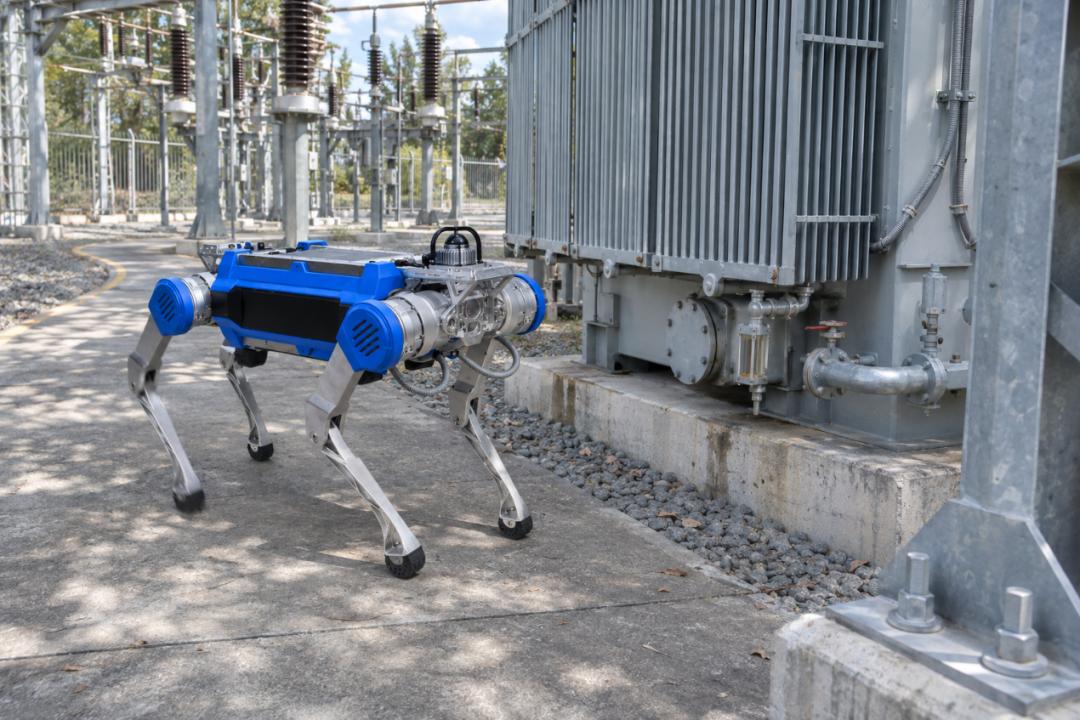
Quadruped robot equipped with "Lingyan Engine" is conducting park patrol (Source/Enterprise)
36Kr has learned that in the current exploration of park and industrial applications, the company takes quadruped robots as one of the main adapted bodies, and the core consideration is the requirements of relevant scenarios for structural stability and continuous operation capability. The quadruped structure is more suitable for inspection tasks in terms of load bearing, obstacle surmounting and complex terrain passability, and it is also convenient to promote adaptation and real machine verification at this stage. Tang Zuolin also said that the company also pays attention to humanoid bodies. In the future, if humanoid robots form a clear task closed loop in specific scenarios, the "Lingyan" system can also be deployed.
After this round of financing, Qilinbo will further strengthen the construction of robot application development, embodied intelligence algorithm and engineering teams, and implement R&D investment in links such as OpenHarmony and domestic computing platform adaptation, core software, model deployment, task skills and real machine verification. Through continuous iteration, the stability, maintainability and deployment efficiency of products will be improved, and software capabilities that can be reused in different devices and tasks will be gradually formed.
The following is an excerpt from the interview between 36Kr and Tang Zuolin, co-founder and CEO of Qilinbo (edited):
36Kr: For the domestic software and hardware stack represented by OpenHarmony, is it a differentiated narrative in the implementation of embodied intelligence, or an access condition for key industries? What practical impacts does this selection have on delivery, cost and industry expansion?
Tang Zuolin: In our view, the domestic software and hardware stack is not only the technical feature of the team, but also an important engineering condition for key industry projects. The company's equipment prioritizes the use of domestic chips, and the system layer supports OpenHarmony or Linux, without relying on a single overseas computing power ecosystem. This choice has two levels of practical logic.
The first level is industry and project requirements. Scenarios such as mines, oil fields, energy, and government affairs have high requirements for security, compliance, and independent data controllability, and some projects will also put forward clear requirements for domestic software and hardware. The supply chain, data and system capabilities need to be controllable, and the underlying computing power ecosystem needs to reduce single-point dependencies. In the past, many embodied solutions relied heavily on a single overseas computing power ecosystem, and once involved in key industry deployment or external supply fluctuations, they were easily restricted in access, delivery and long-term operation and maintenance. The combination of domestic chips and OpenHarmony helps us enhance the autonomy of the system from the bottom layer.
The second level is cost and controllability. On the premise that domestic chips meet the end-side reasoning requirements, they provide more choices for procurement costs, supply channels and in-depth adaptation. Localization requires full-stack adaptation capabilities: system tailoring, compilation optimization, driver adaptation, operator optimization, performance optimization, and the lack of any link will make it difficult to fully release hardware computing power.
This is also the long board of our team's background. Early participation in the construction of the OpenHarmony base and the Python domestic framework has given the team long-term accumulation in underlying system tailoring, compilation, driver adaptation and performance optimization, which can continuously optimize the actual operation performance of domestic hardware on the robot end side.
These underlying capabilities can also provide a basis for the adaptation of different robot forms and application scenarios. In scenarios such as education and scientific research, parks and industries, equipment forms, task requirements and deployment conditions are different. We hope to gradually precipitate reusable software capabilities through continuous adaptation and verification.
From the perspective of landing impact, domestic selection will affect the scope of project adaptation, the autonomy of delivery and operation and maintenance, and the cost structure. For embodied intelligence to enter scenarios with high security and compliance requirements such as energy, mines, and government affairs on a large scale, it is necessary to continuously improve domestic adaptation and engineering verification in combination with the requirements of specific projects.
The Qilinbo team integrates localization into the R&D of the system base, the purpose of which is to make the brain system attach importance to the engineering conditions for different devices and scenarios from the very beginning.
36Kr: Under the background that the capabilities of general large models continue to enhance, how does the end-cloud collaborative architecture make trade-offs between real-time performance, reliability and cost?
Tang Zuolin: General large models are strong in high-level semantic understanding, open scene reasoning and long-term task planning, but the really complex part of robots is a large number of strongly real-time and strongly deterministic physical closed loops. Operations such as grasping, contact, obstacle avoidance, and risk avoidance are highly sensitive to feedback delay; network jitter from cloud round trips may affect the stability and safety of action execution.
If all perception and decision-making rely on the cloud, it is impossible to avoid the practical constraints of network delay, bandwidth occupation, network disconnection risk, and unstable network conditions in different application environments. Excessive reliance on the cloud will make the operation reliability greatly affected by network conditions.
Therefore, we insist on deploying the self-developed "Lingyan Engine" on the end side, and make targeted optimization for the physical interaction of robots: through model distillation, structure lightweight, operator tailoring and hardware adaptation, we promote the local deployment of high-frequency perception, real-time response and execution capabilities, and improve the continuity of basic operations of the body under network disconnection or weak network conditions; at the same time, we retain the call channel for large models to handle relatively low-frequency high-level semantic understanding and long-term planning. The cloud "Goose Swarm" system undertakes global scheduling and multi-robot collaboration, which can reuse mature open source large model capabilities.
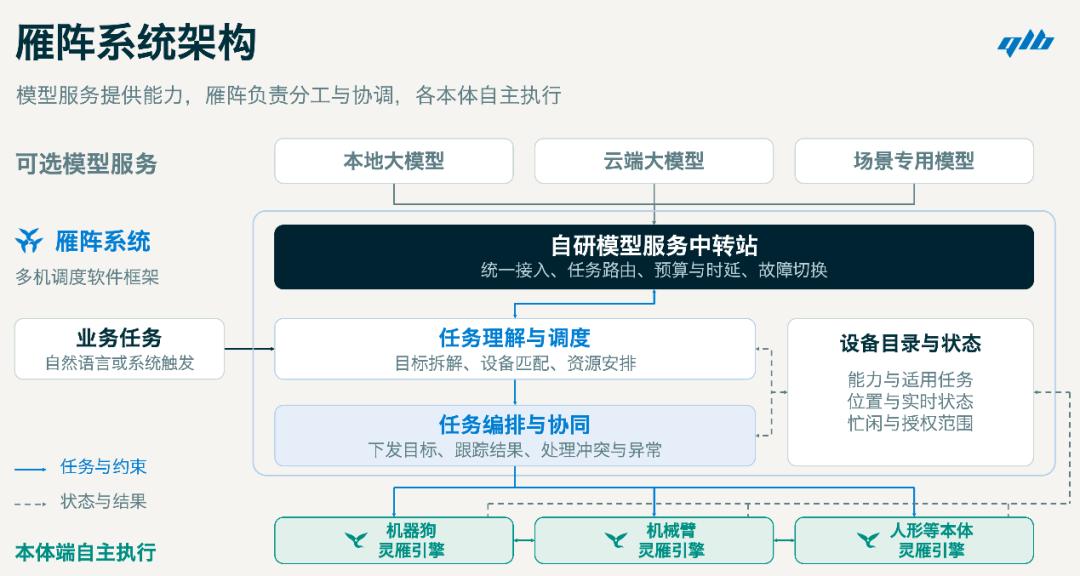
End-cloud architecture (Source/Enterprise)
The core of this end-cloud architecture is to allocate computing power and responsibilities according to task characteristics: the physical closed loop with strong real-time performance and strong reliability stays on the end side, and complex reasoning, global collaboration and multi-robot scheduling are handed over to the cloud. The end side solves "whether it can move safely and stably", and the cloud side solves "how multiple bodies collaborate and how tasks are orchestrated".
For the practical application of robots, reliability is the basic requirement. The value of end-cloud collaboration lies in achieving a balance between real-time performance, reliability and cost through architecture layering, and adjusting the deployment method according to the requirements of different devices and scenarios.