Who on earth is buying AI glasses?
The Double 11 promotion has barely kicked off when the "iPhone moment" for AI glasses has already arrived earlier.
On October 27, Zhu Mingming, founder of Rokid, stated that the changes in display and interaction methods have brought the industry to the "iPhone 1 moment". Meanwhile, Rokid launched its new-generation Glasses 2, full-color glasses Color and interactive ring.
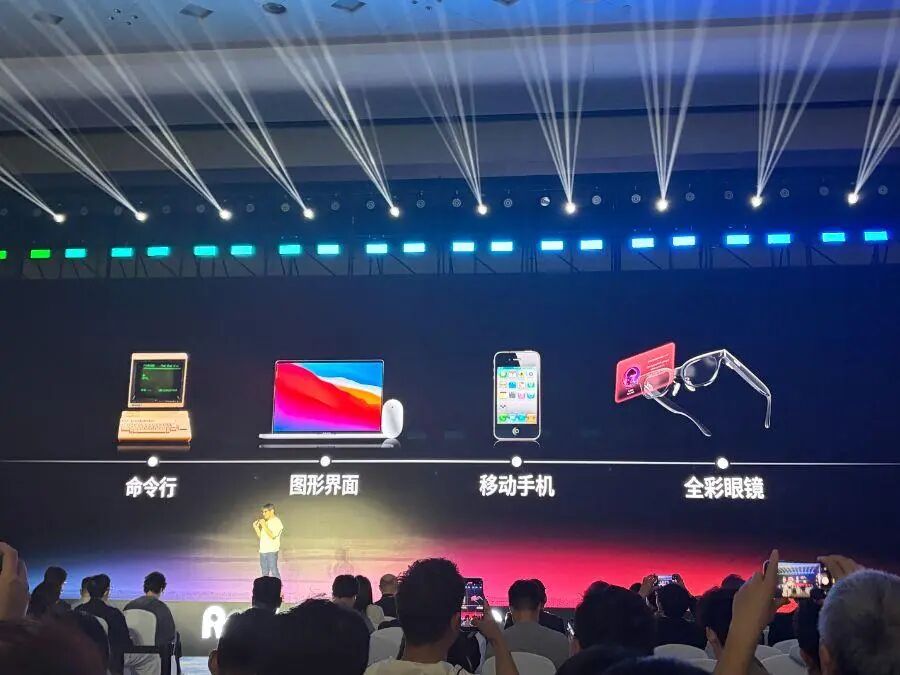
The original iPhone launched in 2007 integrated calling, music and web browsing into a multi-touch interface, allowing users to directly tap, swipe and zoom with their fingers. It completely changed the way people use mobile phones.
Is this breakthrough really that significant? What's more, I'm more curious: who on earth is buying smart glasses, especially AI glasses? And who else would want to buy them!
01
What kind of demand justifies wearing an extra pair of glasses
Smart glasses are often discussed as the "next-generation mobile phone".
But once you actually get your hands on this type of smart device, you will find that smart glasses designed to replace mobile phones are completely inseparable from mobile phones themselves.
Take the camera function that most people want most as an example: the footage shot by AI glasses is only slightly better in image quality than the footage taken by "reporters doing undercover interviews". Here I have compared the camera system configurations of mainstream AI glasses and flagship mobile phones.
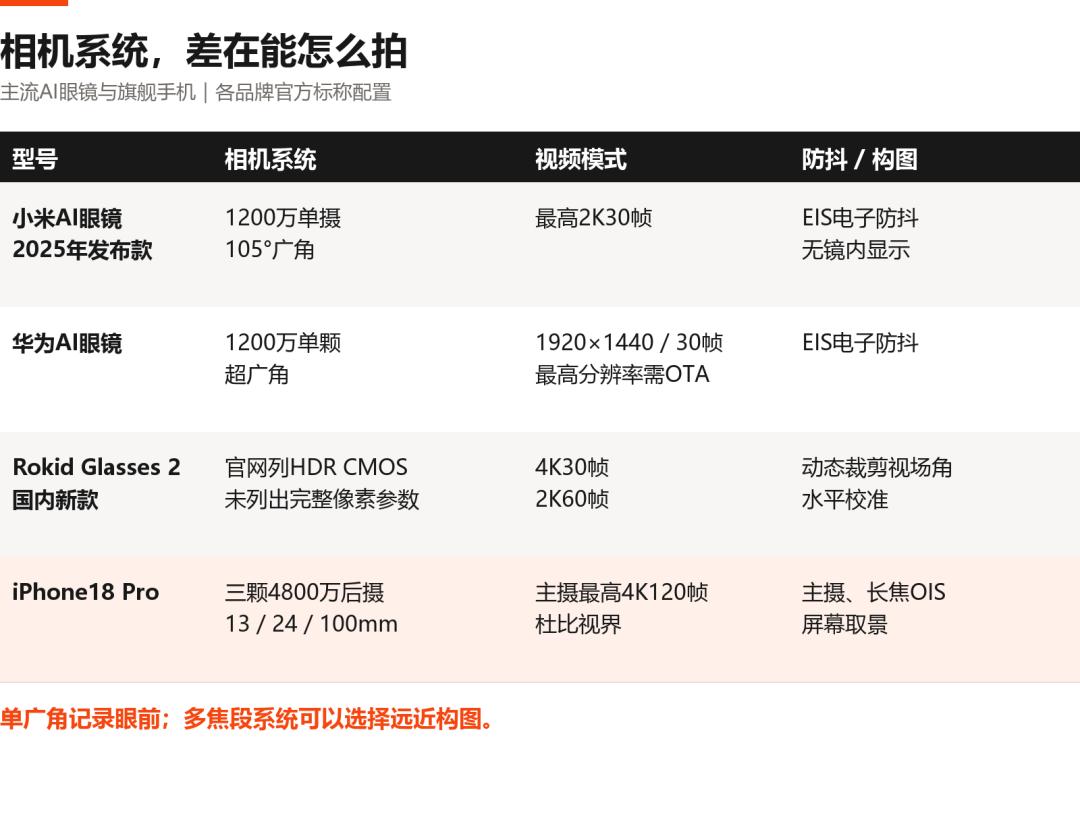
Current flagship mobile phones have integrated ultra-wide-angle, main and telephoto lenses into a complete system. The three rear cameras of the iPhone 18 Pro are all 48MP, providing three native focal lengths of 13mm, 24mm and 100mm. The main camera supports sensor-shift optical image stabilization and Dolby Vision recording at up to 4K 120fps.
In comparison, the newly released Rokid Glasses 2, which supports 4K 30fps and 2K 60fps, is already a high-spec model, while many AI smart glasses can only shoot 1080P footage at most.
If you want to zoom in on a child in the distance or take a close-up shot of a building, the telephoto lens of a mobile phone is still more convenient. After shooting, tasks such as importing, selecting photos, retouching and editing still have to be done on a mobile phone.

I've even had friends ask me if it's better to buy a pair of AI smart glasses to shoot concerts.
Apart from taking photos and videos, the native AI capabilities of AI glasses are also rather underwhelming.
AI glasses can identify flowers and objects, translate text and answer questions, all of which sound pretty good on paper. Huawei's AI glasses support asking questions about a flower and following up on when it will bloom, but if you want to review the conversation, you have to go to the Xiaoyi conversation page in the Huawei Glasses App. The photo recognition function is also limited to certain HarmonyOS phones and system versions.
If paired with an iPhone, you can use Bluetooth music and calls, but photo-based Q&A and Xiaoyi translation are not officially supported.
When listening to a foreign language at a meeting, smart glasses rely even more directly on mobile phones. Although Huawei's Xiaoyi simultaneous interpretation supports mutual translation between Chinese and 20 other languages, the supported workflow is that the mobile phone picks up the sound and the glasses broadcast the translated text. While the glasses are worn near the ear, the sound-collecting and internet-connected mobile phone still has to stay active. Just for this single function, how many people actually need to replace their regular Bluetooth earphones with a pair of glasses?
These seemingly great functions do not deliver that great an experience in practice, which is no different from just using a different ladle to drink water. I really can't figure out what earth-shattering needs smart glasses can solve.
02
AI, smart features and the glasses themselves are all not well-made
It would be acceptable if smart glasses could take over part of the mobile phone's workload, but the problem is that they can't even function properly as a pair of glasses in the first place.
Especially as an accessory, glasses need to fit both the user's aesthetic preference and face shape. But AI glasses have a very limited selection of frame styles and sizes, so people who don't get a good fit can hardly just switch to another pair of frames they like as they would with ordinary glasses.
Not to mention that all these AI glasses are pretty "heavy".
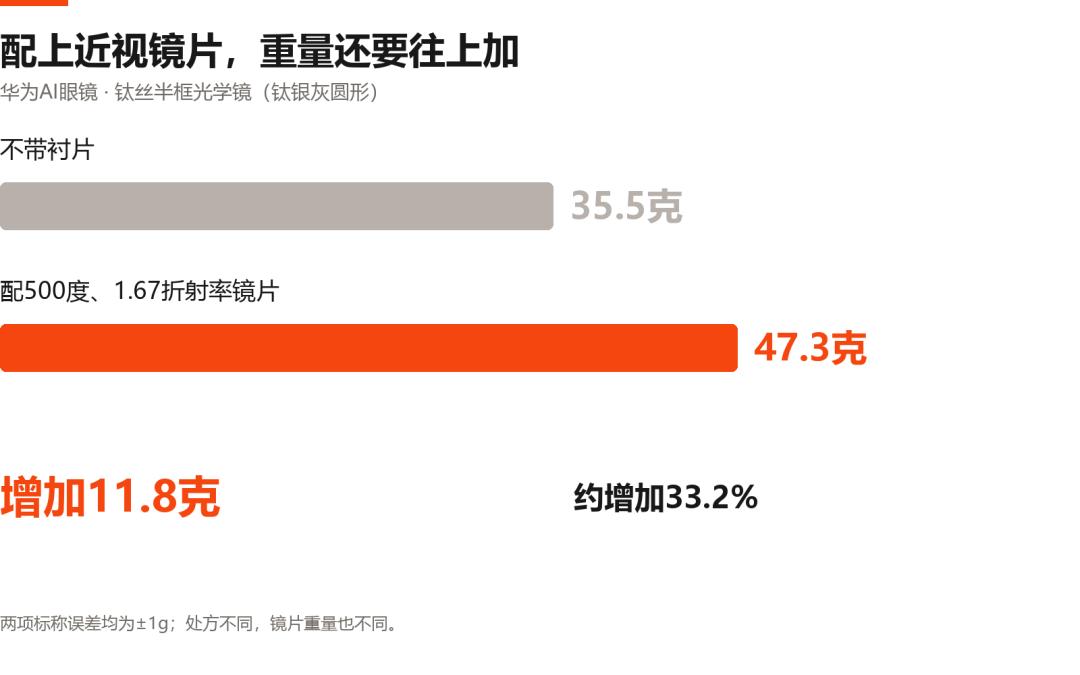
The AI glasses released by Xiaomi in 2025 are officially announced to weigh 40 grams excluding the lens, while the Rokid Style weighs 38.5 grams excluding the prescription lens. Huawei's AI glasses "Titanium Wire Half-Rim Optical Frame · Titanium Silver Gray Round" are marked at 35.5 grams excluding the spacer lens; after installing 500-degree lenses with 1.67 refractive index, it weighs 47.3 grams, about one third heavier than the frame without the spacer lens.
Moreover, once a pair of prescription glasses is fitted, returning them is much more troublesome. Customized lenses from Huawei do not support 7-day no-reason return unless there are quality issues. Of course, this is also the case for ordinary glasses.
If the glasses part, as the foundation of smart glasses, is so poorly made that it is unbearable, then the battery life is like an itch you can never scratch, which will keep making you feel uncomfortable and leave you helpless.
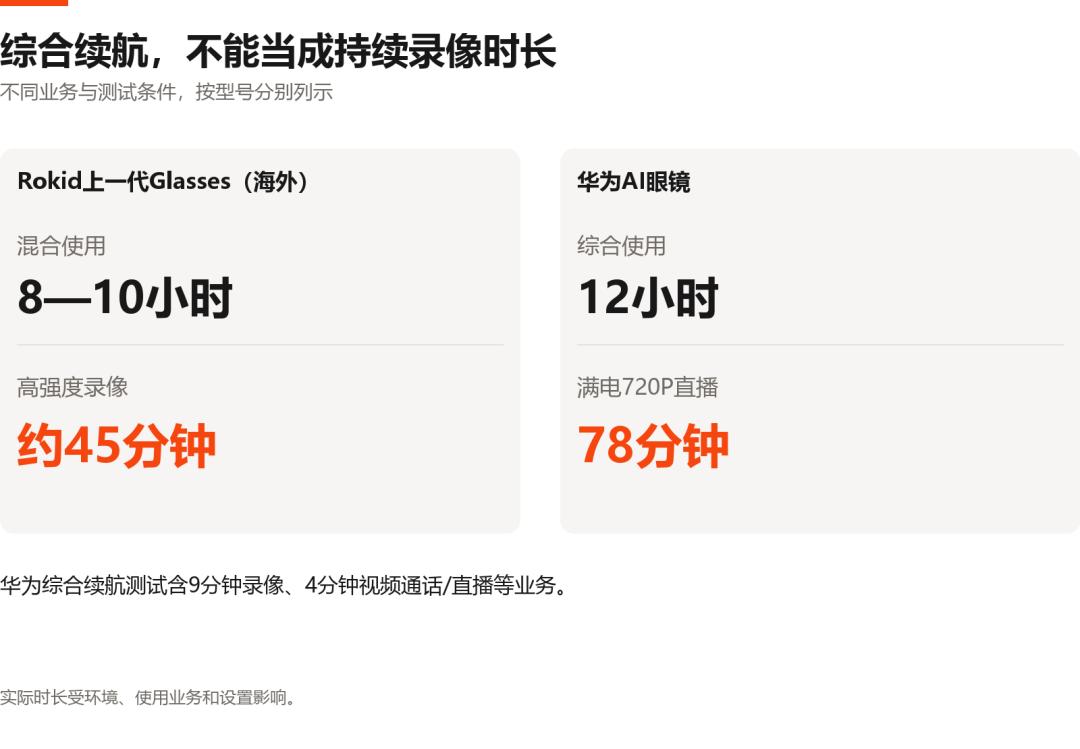
The overseas FAQ for Rokid's previous-generation Glasses lists 8-10 hours of mixed use, and about 45 minutes of high-intensity video recording; Huawei marks 12 hours of comprehensive battery life, but in the test combination, video recording only lasts 9 minutes, and video calls or live broadcasts only 4 minutes. Its nominal 720P live broadcast on full charge is 78 minutes, and continuous recording may even be paused due to overheating.
Of course, the charging case allows the glasses to be recharged repeatedly on the go. The case for the third-generation Ray-Ban Meta is officially stated to provide up to 50 hours of additional comprehensive use, and Rokid Style also has an optional charging case.
But this experience of taking them off and putting them back on repeatedly, while myopic users also have to carry a spare pair of glasses, is so frustrating that I don't even need to elaborate on it. Huawei supports using the glasses while charging via a wired cable, but isn't it a bit weird to have a wire sticking out of your face?
Finally, when wearing them in daily life, you also have to face other people's wariness towards the camera. I once went out wearing AI glasses before, and even when I was not shooting, I was asked if I was recording, which scared me so much that I never dared to wear them on buses or subways again.
I put on the glasses wanting to stay low-profile, but ended up becoming the king in his new clothes.
03
Make good glasses first, then talk about the next-generation mobile phone
In the past two years, AI smart glasses have sold extremely well.
The Ministry of Commerce disclosed that in the first three quarters of this year, the sales volume of smart glasses on key platforms increased by 1.1 times. This year, such products are also included in the national subsidy program: qualified smart glasses with a selling price of no more than 6000 yuan are entitled to a 15% subsidy based on the discounted transaction price, with a maximum subsidy of 500 yuan. The threshold for early adopters has indeed been lowered.
Many people are still pouring into this product category that is still figuring out its use cases.
According to the report released by Bilibili and CBNData this year, among 1000 respondents, the proportion of people who have already purchased smart glasses is 10.2%, and the proportion of people who want to buy them in the future is 53.9%. This survey covers different types of smart glasses, and both the proportion of existing owners and potential buyers exceed my expectations.
The survey also asked consumers what they consider before purchasing AI smart hardware: 58.3% choose whether the AI functions are actually useful, 54.9% pay attention to the real usage experience and actual test results, while only 15.9% care about whether the product is new and cutting-edge.
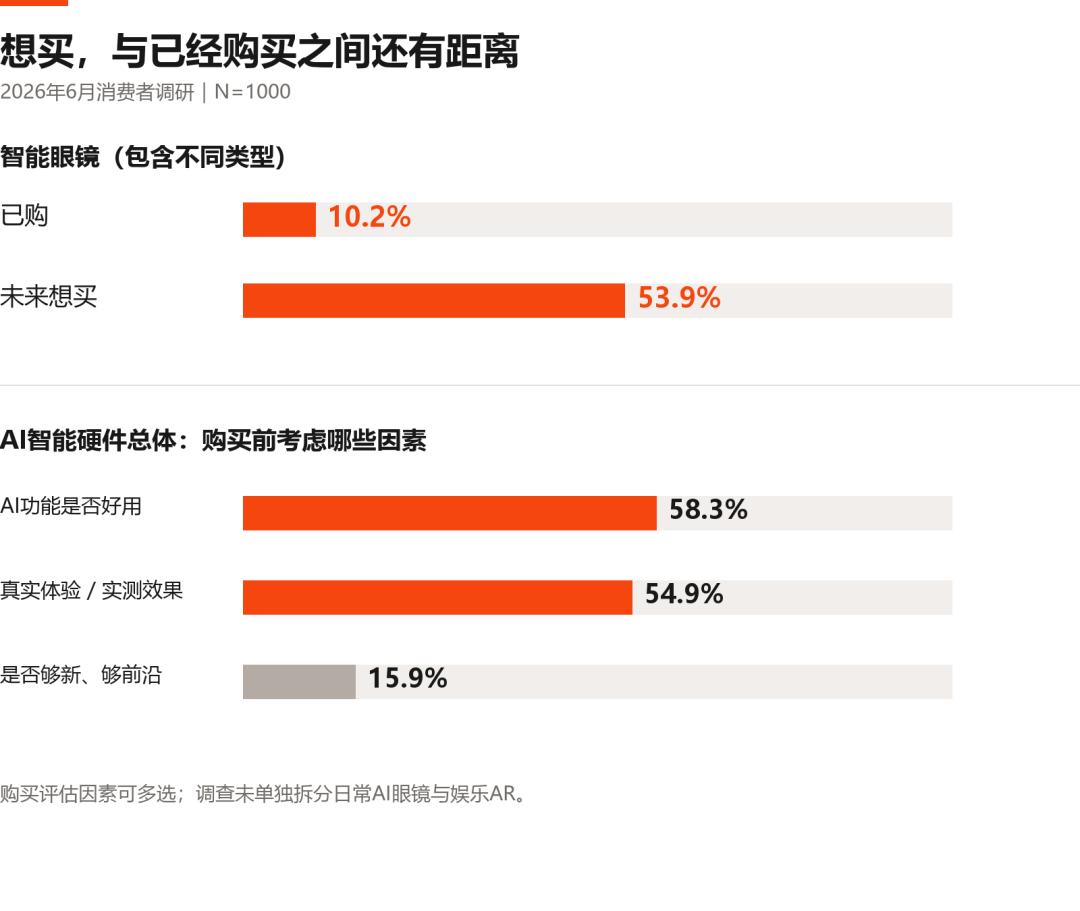
When consumers buy AI hardware, their first concern is whether the functions work well. After the glasses move the operation to the face, you need to think clearly about how much more convenient it is than using a mobile phone before placing an order.
I don't know if you've noticed, but there are fewer "reviews" and "ads" for all kinds of smart hardware products on Bilibili this year. Last September, the UP owner Dianwan Technology released a video announcing that it would no longer accept commercial orders for smart glasses. They criticized many peers for turning their content into advertising promotional videos, and also questioned domestic manufacturers' definitions of technical routes, functions and usage scenarios.
When the original iPhone was released, Apple created a new operation method for making calls, listening to music and surfing the Internet.
But even after talking about AI glasses for so long, people are still asking what on earth they can do after buying them.
If manufacturers are just targeting the "next-generation mobile phone" positioning, I hope they make good glasses first, before talking about the "iPhone 1 moment".
This article is from the WeChat Official Account "Hardcore Dashboard" (ID: yinghekb), written by Li Feng, and republished with authorization from 36Kr.