Nebius: The New Cloud "Magic Pill", Real Gold or Bubble?
Previously, Dolphin Research successively covered Oracle and CoreWeave (CRWV), two "giants" among the new cloud players. This time, we turn to the "dark horse" star stock in the new cloud track — Nebius (NBIS).
In terms of scale, NBIS is a "small player": Its 2024 revenue was only about 90 million US dollars (excluding the spun-off Toloka), less than 1/20 of CRWV's. Even based on the expected 2027 revenue, NBIS's revenue is still less than half of CRWV's.
But in terms of market capitalization, NBIS has overtaken latercomers: When CRWV went public in March 2025, NBIS's market cap was less than 1/3 of CRWV's, and it was once pulled to less than 1/8 in early June. Just one year later, NBIS overtook CRWV in June 2026. As of the close on October 26, its market cap is about 420 billion US dollars, nearly 40% higher than CRWV's.
The contrast in valuation is even more stark: NBIS's market cap is about 3.5 times its expected 2027 revenue, while CRWV's is only 1.1 times. For the same dollar of revenue, the market is willing to assign a valuation about 3 times higher to NBIS.
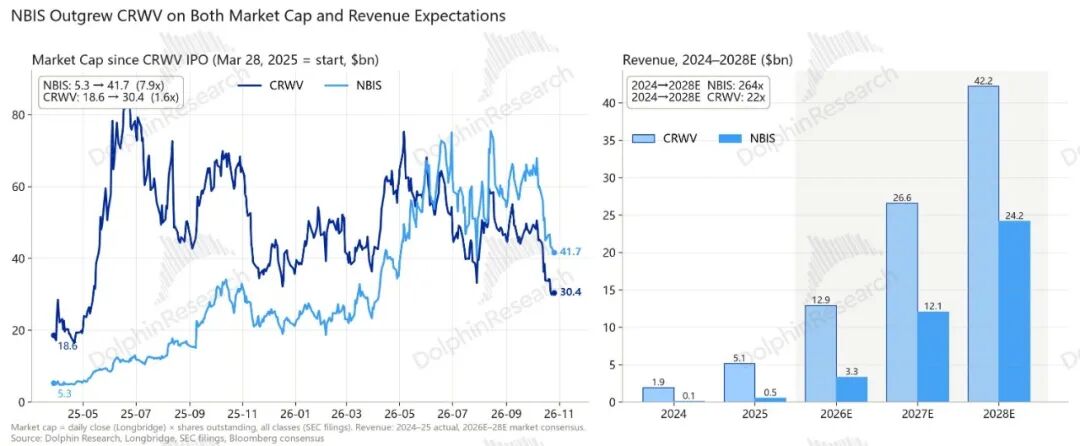
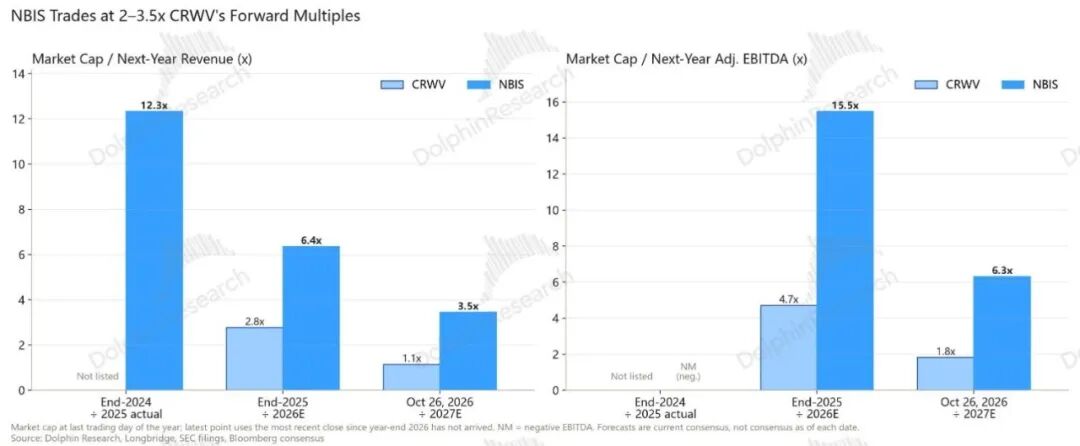
With smaller revenue, lower profit margin but much higher valuation premium, what exactly is the market paying for in NBIS? This article breaks down the details one by one:
1) What are the differences between the two companies in founding teams, development paths, and their ties with Nvidia?
2) Even though both are Neo Cloud players, are their business models, growth prospects and certainty the same?
3) At first glance CRWV has a higher profit margin, why does NBIS have a valuation premium instead?
4) Computing power and Capex: Who expands faster? Who has secured data centers and power resources?
5) The underlying foundation: Which side has better financing structure, financing capacity and balance sheet?
6) What is the actual fair value of NBIS?
The following is the detailed analysis
I. Completely different origins, why are the two getting more and more similar?
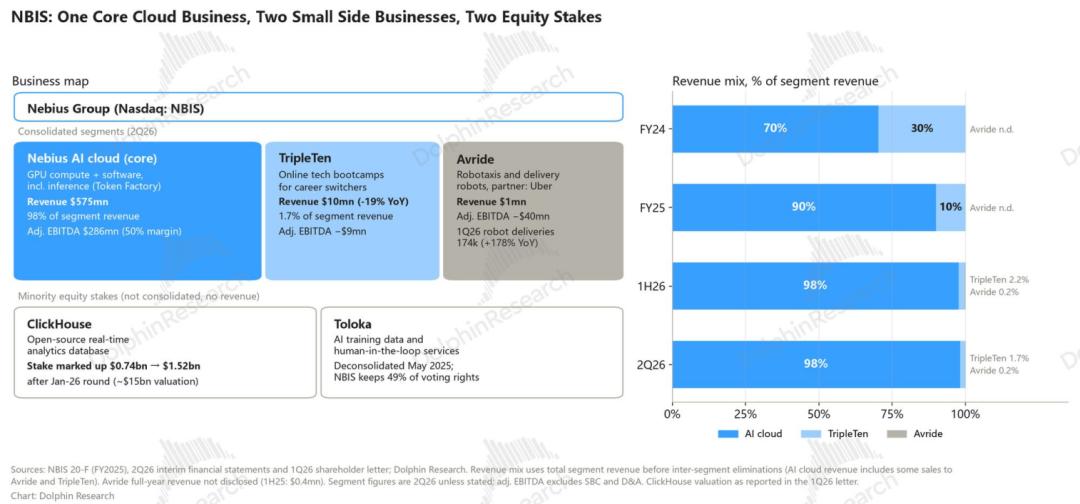
NBIS's business can be summarized as "one core business, two side businesses, two equity holdings". The core business is AI Cloud (Nebius AI Cloud): It leases GPU computing power, and supports matching software such as the inference platform Token Factory. In 2Q26, AI Cloud generated 575 million US dollars in revenue, contributing 98% of total revenue and all the profits.
The two side businesses are autonomous driving business Avride and online vocational training business TripleTen, both of which are still losing money: a. Avride covers self-driving vehicles and sidewalk delivery robots, which are mainly deployed through cooperation with Uber. The business volume is growing rapidly, but the quarterly revenue is only about 1 million US dollars, and the adjusted EBITDA loss in 2Q26 is about 40 million US dollars.
b.TripleTen is an online vocational skill training platform for adults who want to switch to tech positions, and it has recently added more AI-related content. It generated 10 million US dollars in revenue in 2Q26, with a loss of about 9 million US dollars.
In addition, NBIS also holds minority stakes in two other businesses — open-source real-time analytics database ClickHouse and AI training data company Toloka. Both have been spun off and are no longer consolidated, and only affect net profit through investment income.
In terms of revenue structure, non-cloud businesses still accounted for about 30% of total revenue in 2024. But with the rapid growth of AI Cloud, its revenue share rose to about 90% from 2Q25, and reached 98% by 2Q26. NBIS has basically become a "pure" cloud company.
1.1 Management: Different origins, but the results converge
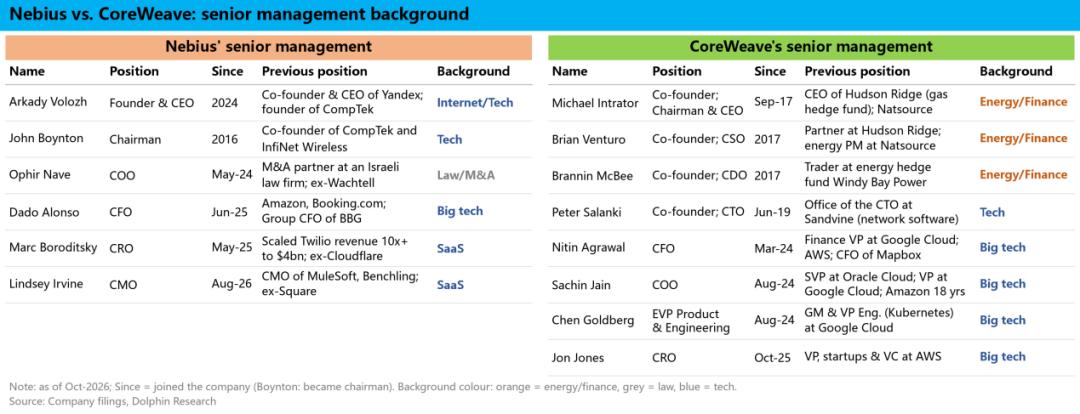
Conclusion first: The starting points of the two are almost opposite, but after going public, they have made up for their respective shortcomings, and their expansion paths and management configurations have generally converged. The backgrounds of the company and management are not important reasons for the valuation difference between the two.
At the starting point, CRWV was founded by three energy traders, started with mining, and is good at securing power resources and raising financing. Its development logic is "have business first, then supplement capabilities".
NBIS was spun off from Russian tech giant Yandex. Its CEO Volozh is the co-founder of Yandex, who restarted his business with thousands of engineers and a complete cloud technology stack, following the logic of "have capabilities first, then find business".
In terms of expansion path, NBIS is basically replicating CRWV's model: securing large enterprise anchor orders → introducing CFOs from top tech companies → using contracts to leverage financing → deepening ties with Nvidia → locking in GW-level power resources. The time gap between them is shrinking rapidly: NBIS was about 26 months later than CRWV when it secured the large Microsoft order, and the gap was only about one and a half months when it got the Meta order and Nvidia's equity investment.
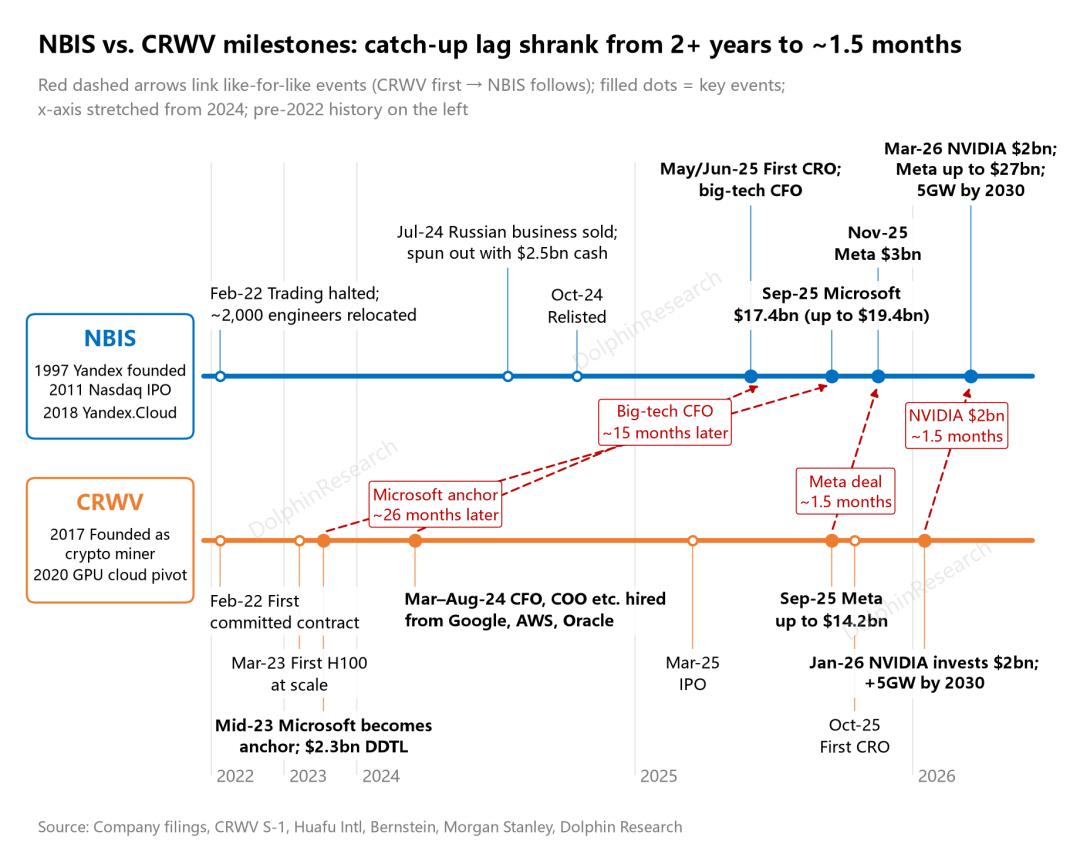
In terms of management, both have made up for their own shortcomings: One year before its IPO (2024), CRWV introduced CFO, COO, and heads of product and engineering from Google Cloud, Amazon AWS, Oracle and other companies to supplement cloud business capabilities.
NBIS lacked commercialization and capital market experience. Since 2025, it has successively introduced a CFO who previously worked at Amazon, as well as CRO (Chief Revenue Officer) and CMO (Chief Marketing Officer) from Twilio and MuleSoft.
Now the two companies have the same configuration of professional managers, and the only difference left is at the founder level.
1.2 Ties with Nvidia: Both have received equity investment, but CRWV is more deeply bound
This year, Nvidia invested about 2 billion US dollars in each of the two companies, with similar shareholding ratios, but there are big differences in the entry timing and the depth of business binding.
CRWV is Nvidia's absolute "direct affiliate", and can even be called Nvidia's off-balance sheet liability. Nvidia has been a shareholder of CRWV very early; the two sides have multiple business ties:
a. Nvidia is CRWV's main supplier; it also leases computing power from CRWV, making it CRWV's customer; it also promises to buy the unsold part of CRWV's production capacity to underpin its revenue.
b. Since this year, Nvidia has also used its own financial statements to help CRWV speed up the acquisition of land, power and machine rooms. It can be said that CRWV is the sharp tool for Nvidia to break the monopoly of cloud giants.
NBIS is more like a later "bet" made by Nvidia. Nvidia previously only participated in small follow-on investments, and this year it made a large equity investment through pre-financing warrants.
The cooperation between the two is concentrated at the technical level, including priority supply of new platforms, AI factory design, inference software and fleet monitoring. There is little difference in technical treatment between the two, but the binding in operation and capital is not deep.
1.3 The valuation gap is not as large as it seems
Before the item-by-item comparison, we first squeeze out the "moisture" in the valuation gap mentioned at the beginning: more than 60% of the seemingly 3x valuation gap comes from the difference in the capital structure of the two companies.
CRWV expanded through borrowing: Based on the closing price on October 26, market value only accounts for about half of its enterprise value (EV) (market value is about 304 billion US dollars, net debt is about 284 billion US dollars). NBIS has more cash than debt on its books, with an EV of about 450 billion US dollars, slightly higher than its market capitalization, after dilution from Nvidia's warrants and in-the-money convertible bonds (about 96 billion US dollars), and minus net cash and equity investments (about 63 billion US dollars).
Converted to EV, based on 2027E revenue, NBIS is about 3.7 times, CRWV is about 2.2 times, and the gap shrinks from about 3 times to about 1.7 times.
II. Revenue prospects: CRWV is more stable, NBIS has more flexibility
The key points on the revenue side are twofold: First, growth, which side has greater elasticity; second, certainty, which side has higher revenue visibility and stronger resistance to downside risks.
Conclusion first: The two adopt two different business models, with advantages and disadvantages coming from the same source.
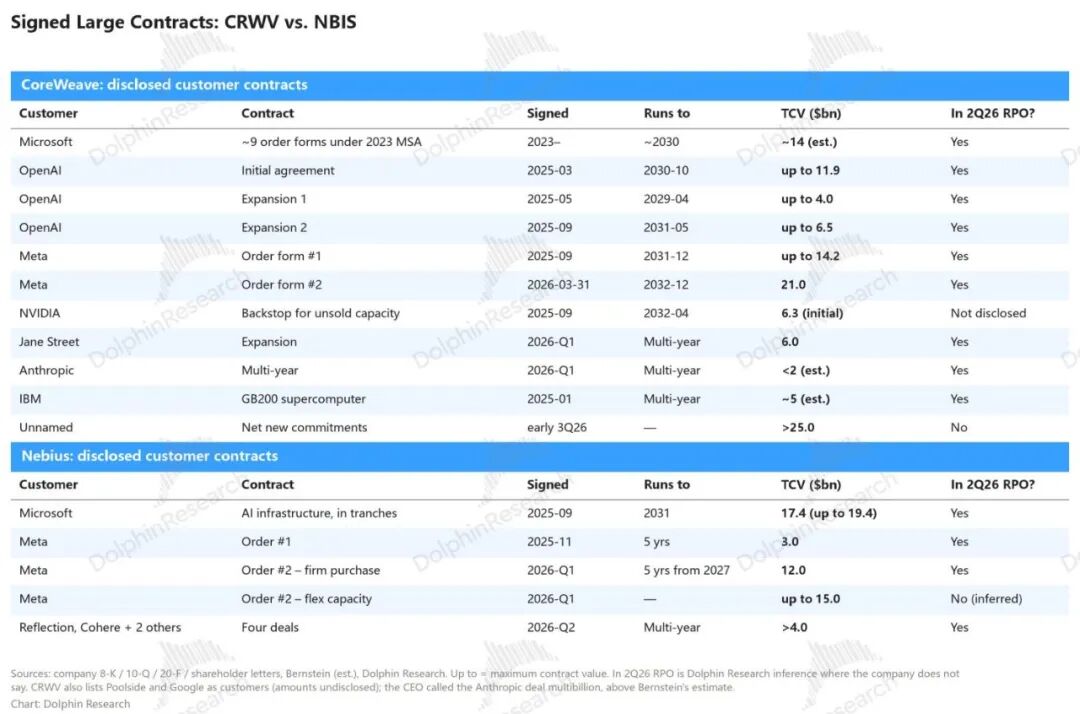
CRWV is dominated by take-or-pay long-term contracts, which is more like "operating data centers on behalf of customers" for several large clients. The usage and price are generally locked when the contract is signed. About 80% of the expected revenue in the next two years is already covered by RPO, so the risk of industry downturn is mostly borne by customers, at the cost of weak bargaining power and limited upward flexibility.
NBIS has a higher proportion of on-demand and short-term contracts, with a more diversified customer base, more like a traditional cloud platform: It aggregates the demands of a large number of customers and sets prices independently. When supply and demand are tight, the unit price, revenue and profit have greater elasticity; but RPO only covers about half of the expected revenue in the next two years, so the benefits and risks are mostly borne by itself. If the supply and demand reverse, there is no protection from long-term contracts.
2.1 Orders on hand: CRWV has higher revenue certainty
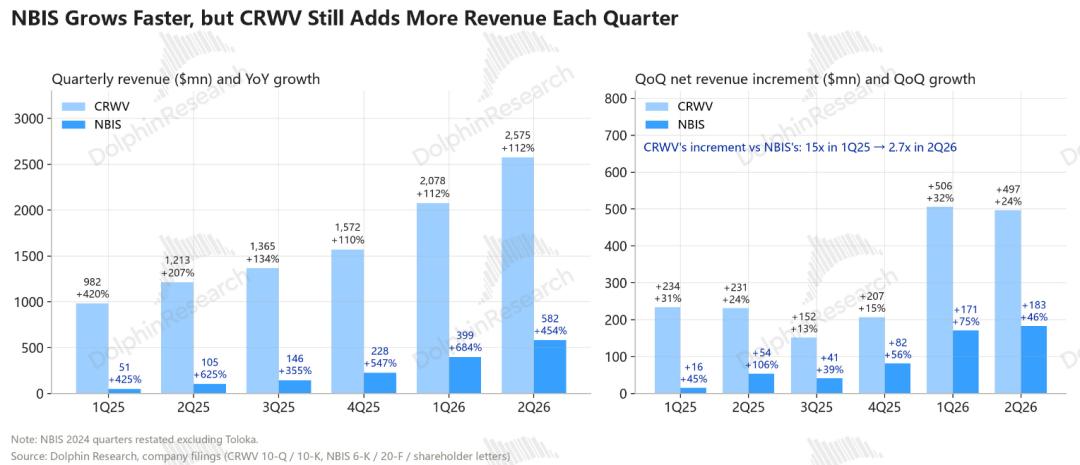
In terms of relative growth rate, NBIS is much faster; but in terms of absolute scale, CRWV is still much larger. Even based on the quarter-on-quarter increment, CRWV is nearly 2.8 times that of NBIS.
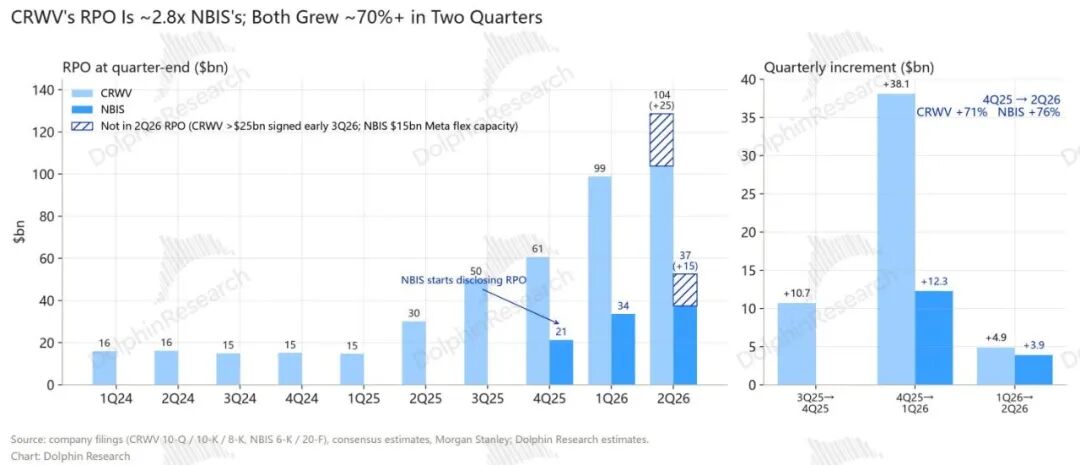
More importantly, look at the subsequent growth: Future revenue depends on orders on hand (RPO, Remaining Performance Obligation). CRWV has a clear advantage in this regard:
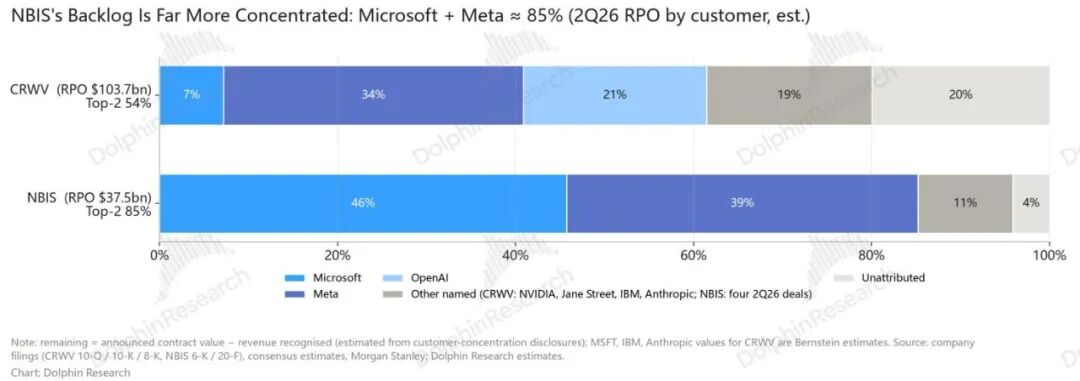
NBIS's RPO scale is only about 1/3 of CRWV's, and about 85% of it is concentrated on two customers, Microsoft and Meta; while CRWV's top 2 customers (Meta and OpenAI) contribute a total of about 54% of revenue.
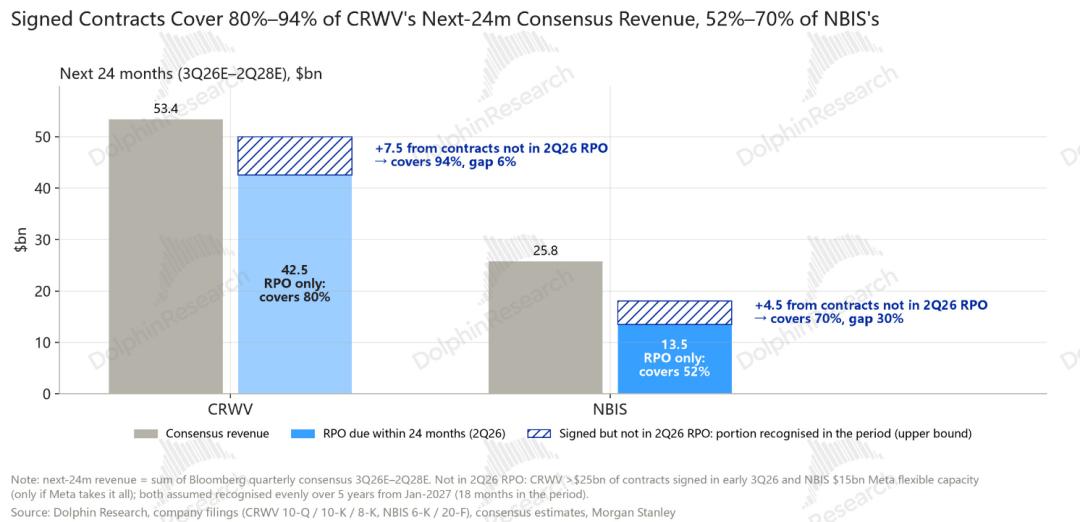
As of 2Q26, CRWV's RPO was 1.037 trillion US dollars, and NBIS's was 375 billion US dollars. About 80% of CRWV's expected revenue in the next 24 months is covered by RPO, while NBIS only has about 52% covered.
To a certain extent, NBIS chooses to let a large amount of its production capacity be priced freely, in order to sell at a higher price under the current market conditions.
2.3 Contracted vs on-demand: Two models with advantages and disadvantages coming from the same source
Although NBIS's RPO is more concentrated, its revenue sources are more diversified. In 2Q26, CRWV's three large customers accounted for 72% of total revenue, while the proportion for NBIS was 59%.
The contrast is as mentioned above: NBIS mainly relies on current sales and short-term contracts, with a large number of small customers; almost all of CRWV's revenue