Token enters the "Double 11" live streaming rooms for the first time and is placed in the shopping carts of ordinary consumers.
"OMG, just buy it!" "3, 2, 1, launch the Tokens!"
Familiar sales pitches, brand new products. At 7:30 p.m. tonight (November 2), AI computing power products were put on sale for the first time in an e-commerce livestream room.
Chen Yusen, Alibaba's youngest vice president and CEO of Qwen Office, sat in front of the livestream camera alongside top trending host Li Jiaqi. The two peers, both born in 1992, appeared on screen together for the first time, bringing 20 trillion Tokens and a wide range of AI office products to ordinary consumers.
These 20 trillion Tokens are like a welfare giveaway designed to complete large-scale market education for AI tools. They aim to bring a term that originally belonged only to engineers into the shopping carts of ordinary people.
Relevant data from the National Data Administration shows that as of July this year, China's daily average Token call volume exceeded 500 trillion, representing a more than 5000-fold increase from 100 billion at the beginning of 2024.
This year's "Double 11", computing power is placed on the shelves as a commodity for the very first time.
1
Selling Tokens in Livestream Rooms for the First Time
100 million Tokens or 1 trillion Tokens, how many AI services can they actually provide, how long can they last, and what problems can they solve? For ordinary consumers, there is no clear concept at all.
Therefore, what Li Jiaqi and Chen Yusen brought are more tangible, visible and touchable products, such as AI computers, AI voice note-taking cards and desktop robots.
The three AI computers, namely Laiku Air, MACHENIKE Light 16S Youth Edition and Lenovo Zhaoyang Yue Plus, all come with built-in Qwen Office and offer up to 3 months of free membership. This is only part of the lineup. According to the "Tmall Qwen Office AI Computer Program", 70 computer hardware models equipped with Qwen Office will be launched for the first time this year.
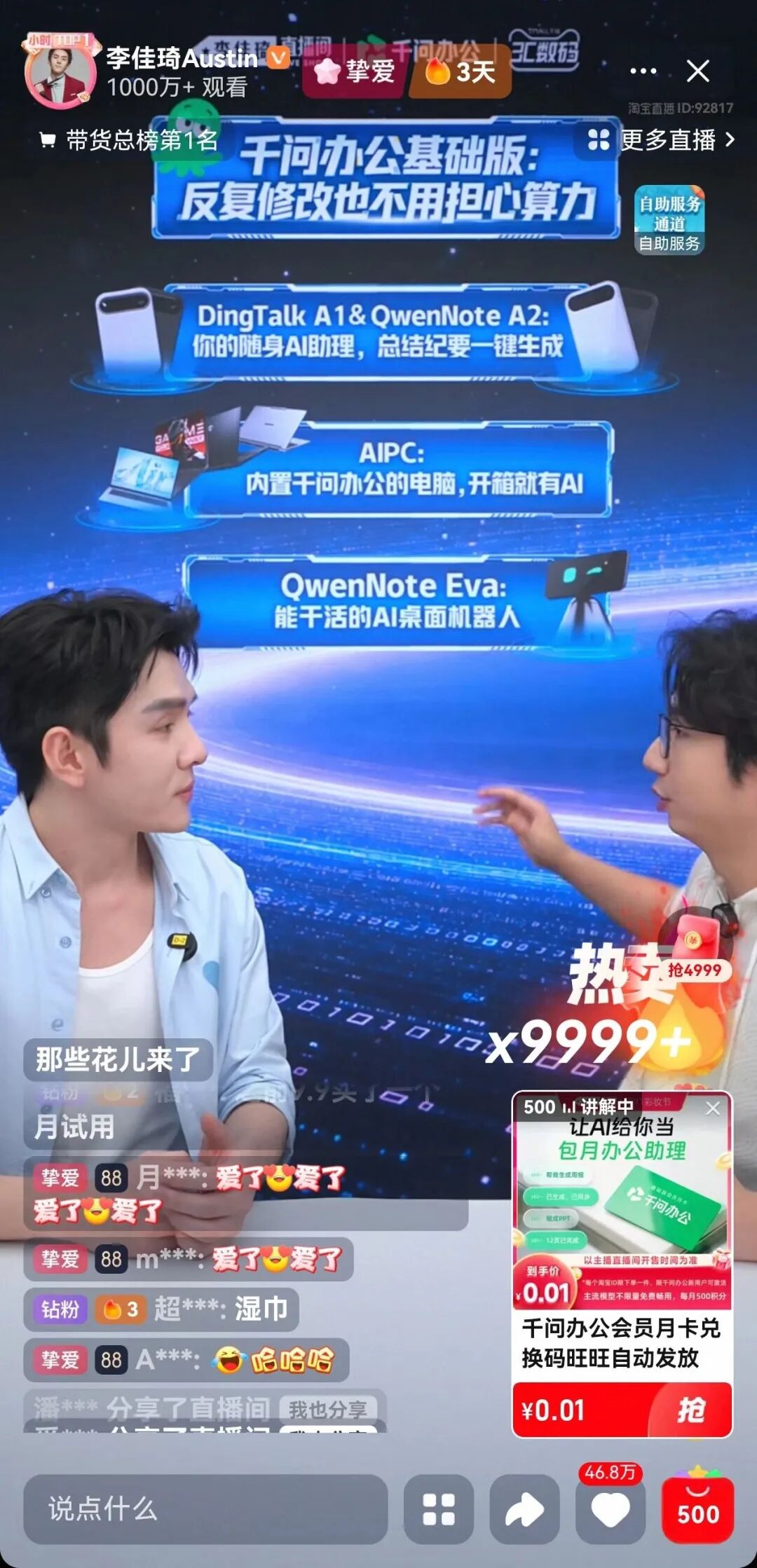
Compared with purchasing AI services separately, this type of product combines computer hardware with AI agents, lowering the psychological threshold for ordinary consumers to choose the unfamiliar Token product.
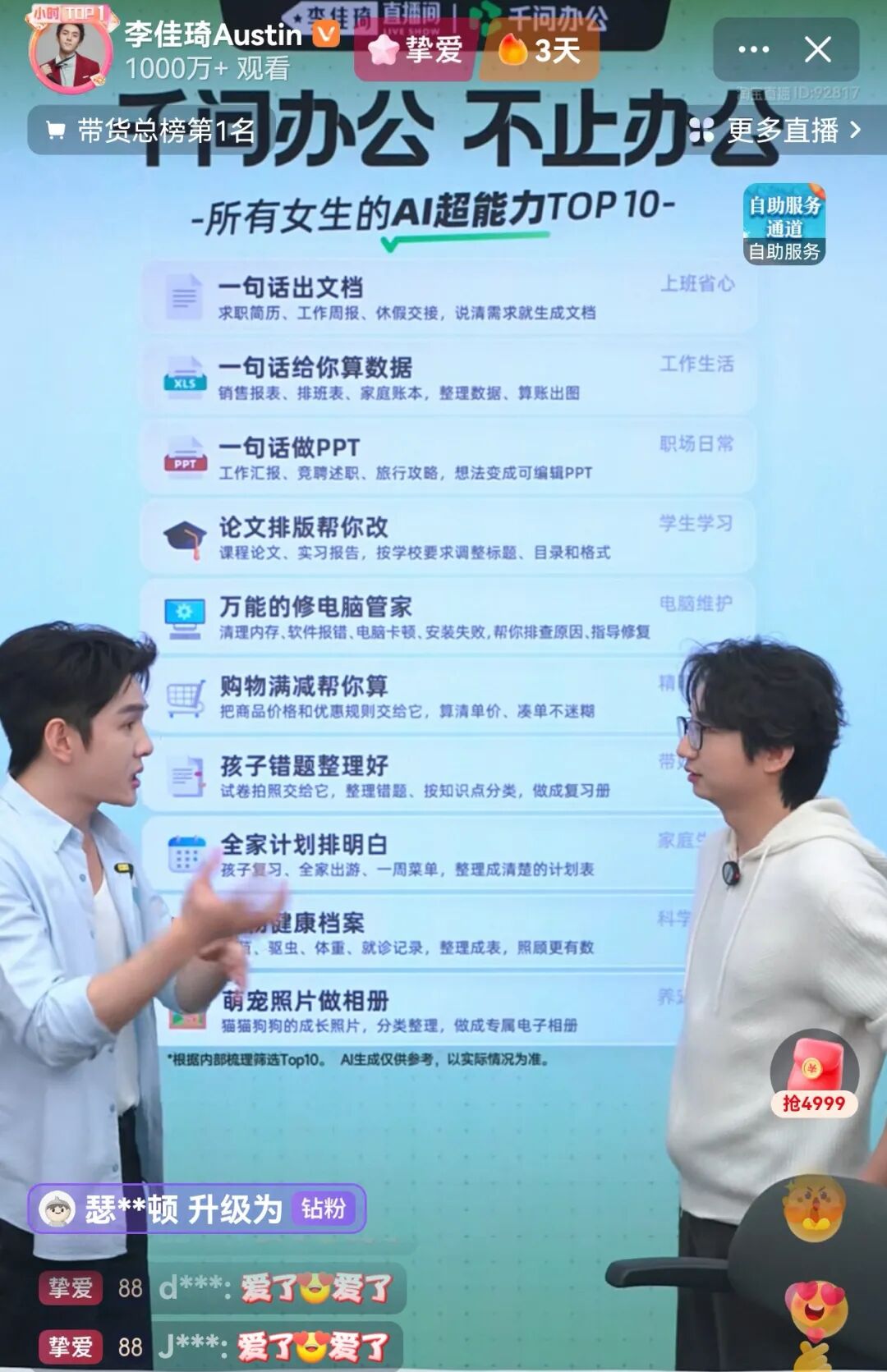
Office work and learning are the two core scenarios targeted by AI hardware. A reporter from IT Times saw that DingTalk A1 and QwenNote A2 AI voice note-taking cards were also put on the shelves in Li Jiaqi's livestream room. They provide functions such as meeting minutes summarization and cross-language translation, which can be used for meetings, client visits and lectures. The QwenNote Eva desktop robot for education scenarios supports making calls, oral English practice, generating learning reports and sitting posture reminders.
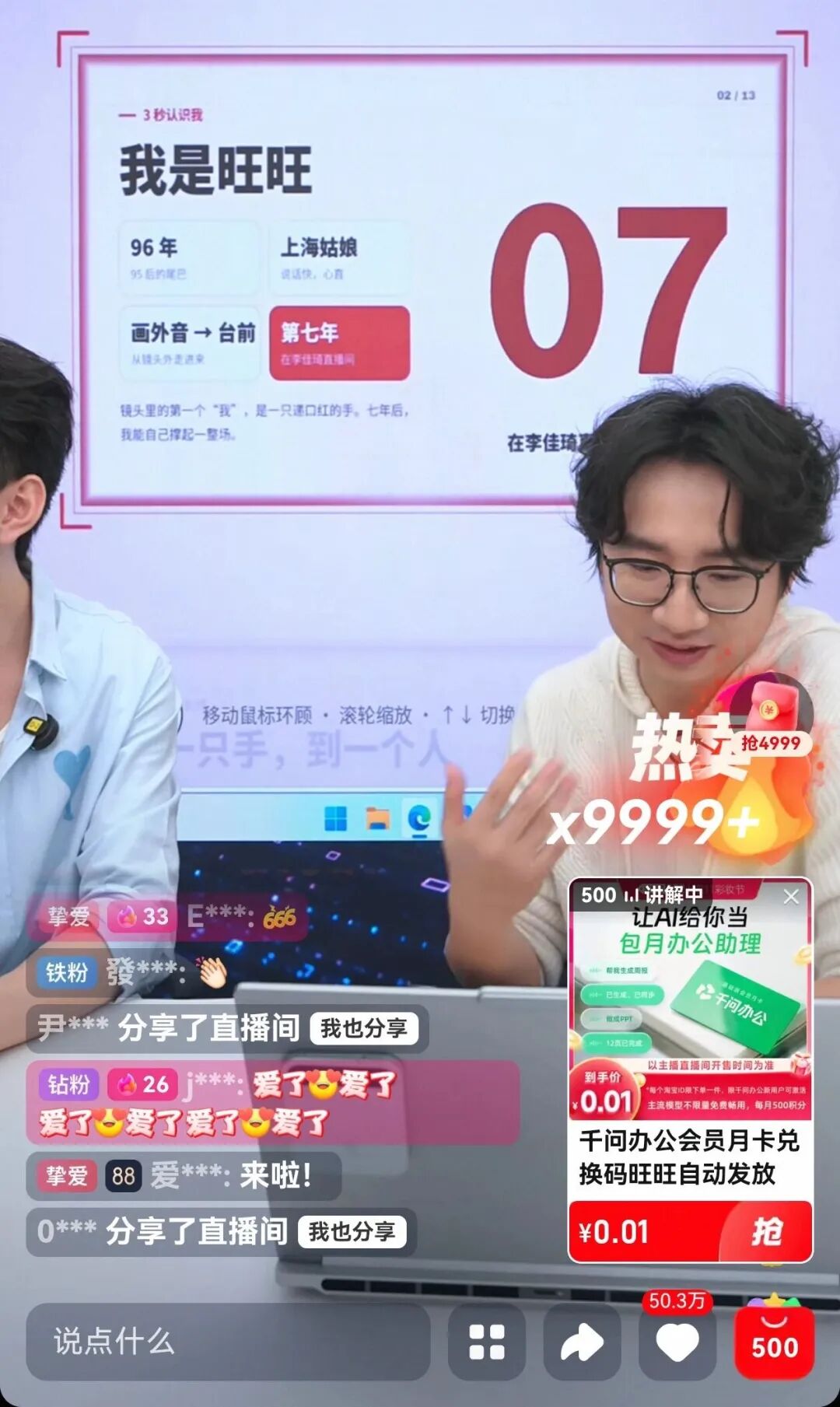
This livestream is more like a "translation" process, converting technical jargon into language that ordinary consumers can easily understand. It answers the most core question: What exactly are the Tokens that consumers pay for?
2
Tokens Join the "Double 11" Promotion for the First Time
Li Jiaqi's livestream room is just the tip of the iceberg. This year, Tmall's "Double 11" has introduced AI Tokens as an independent category into the grand promotion for the first time, and almost all major domestic large model companies have settled in collectively before the "Double 11" event.
On September 2, Zhipu's first official flagship store landed on Tmall; on September 3, Tmall launched the Token Recharge Center, with leading manufacturers including Alibaba Cloud, Zhipu, Kimi, MiniMax and DeepSeek accessed in the first batch; on October 13, MiniMax officially announced its settlement on Tmall to open its first official flagship store.
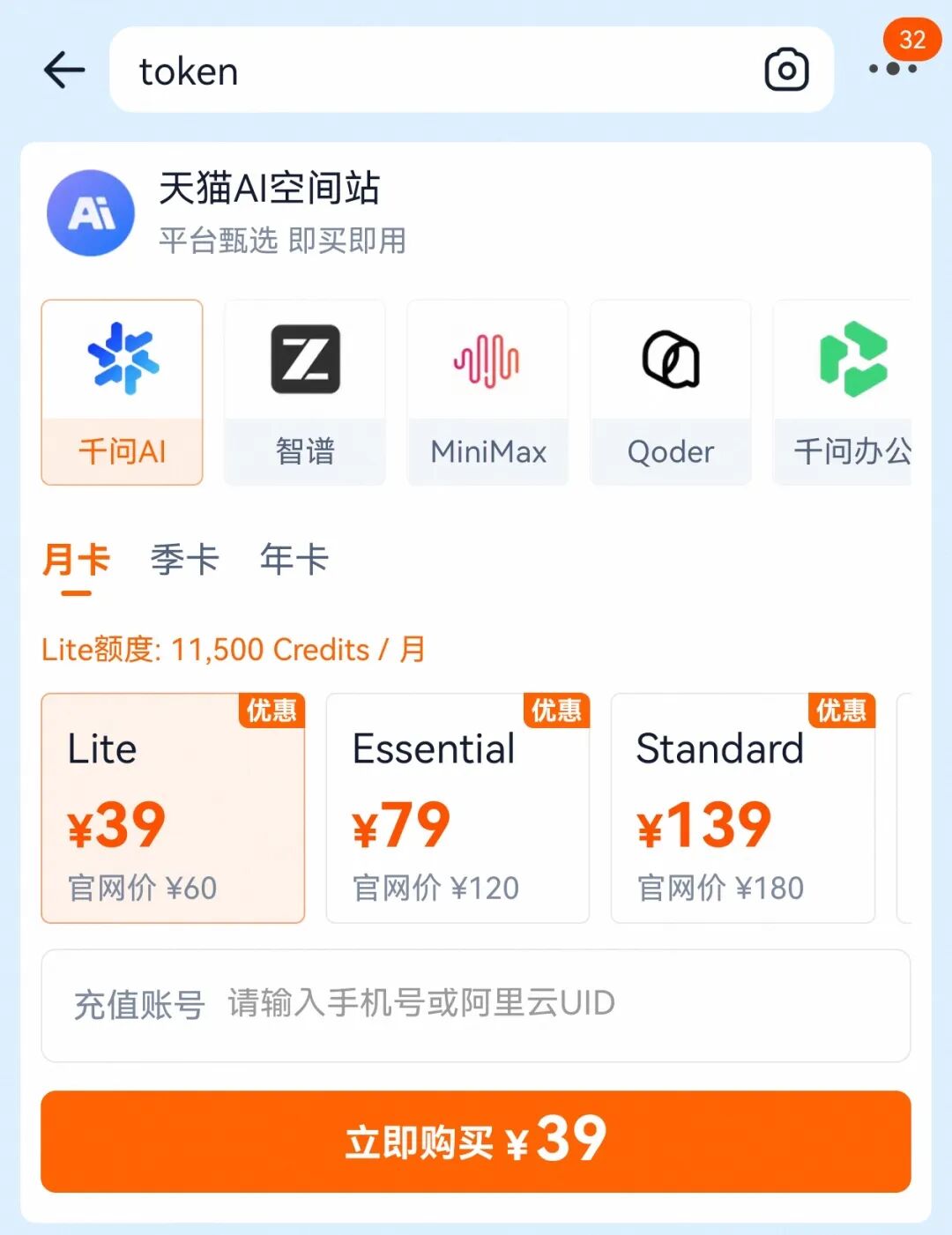
Up to now, Alibaba Cloud Bailian, Qwen Office, Qoder, Zhipu, MiniMax, Moonshot AI, StepFun and other players have fully settled in the Tmall AI Token Station, where users can buy computing power quotas just like topping up phone credits.
The products on the shelves are full of the atmosphere of big promotions: during the "Double 11" period, the M plan package in MiniMax's official flagship store launched a continuous monthly subscription activity with 50% off for the first month; the official price of Qwen AI Lite monthly card is 60 yuan, with a preferential price of 39 yuan; the official price of Qoder Professional Edition is 88.99 yuan, and the current preferential price is 58.98 yuan; the official price of Qwen Office Standard Edition is 247 yuan, and the current preferential price is 197.99 yuan.
On the first day of the "Double 11" sale, the transaction volume of the Token category increased by 450% compared with the previous month. Previously, within 48 hours of Zhipu's settlement, brand searches surged 50 times month-on-month, driving the transaction volume of subscription products such as AI Tokens on Taobao and Tmall to rise by more than 160% month-on-month.
3
Recharging Tokens Just Like Topping Up Phone Credits
Model manufacturers are already selling Tokens on their official websites, so why do consumers take a detour to Tmall?
In the past, Token purchases were targeted at professional developers, and users needed to understand terms like API Key and console, which was as obscure and difficult as purchasing parts in a professional market; while in Tmall stores, selecting packages, completing payments, and one-click login to bind accounts, technical concepts are replaced by common terms such as monthly cards, annual cards, and continuous subscriptions, and the purchase experience is not much different from topping up phone credits.
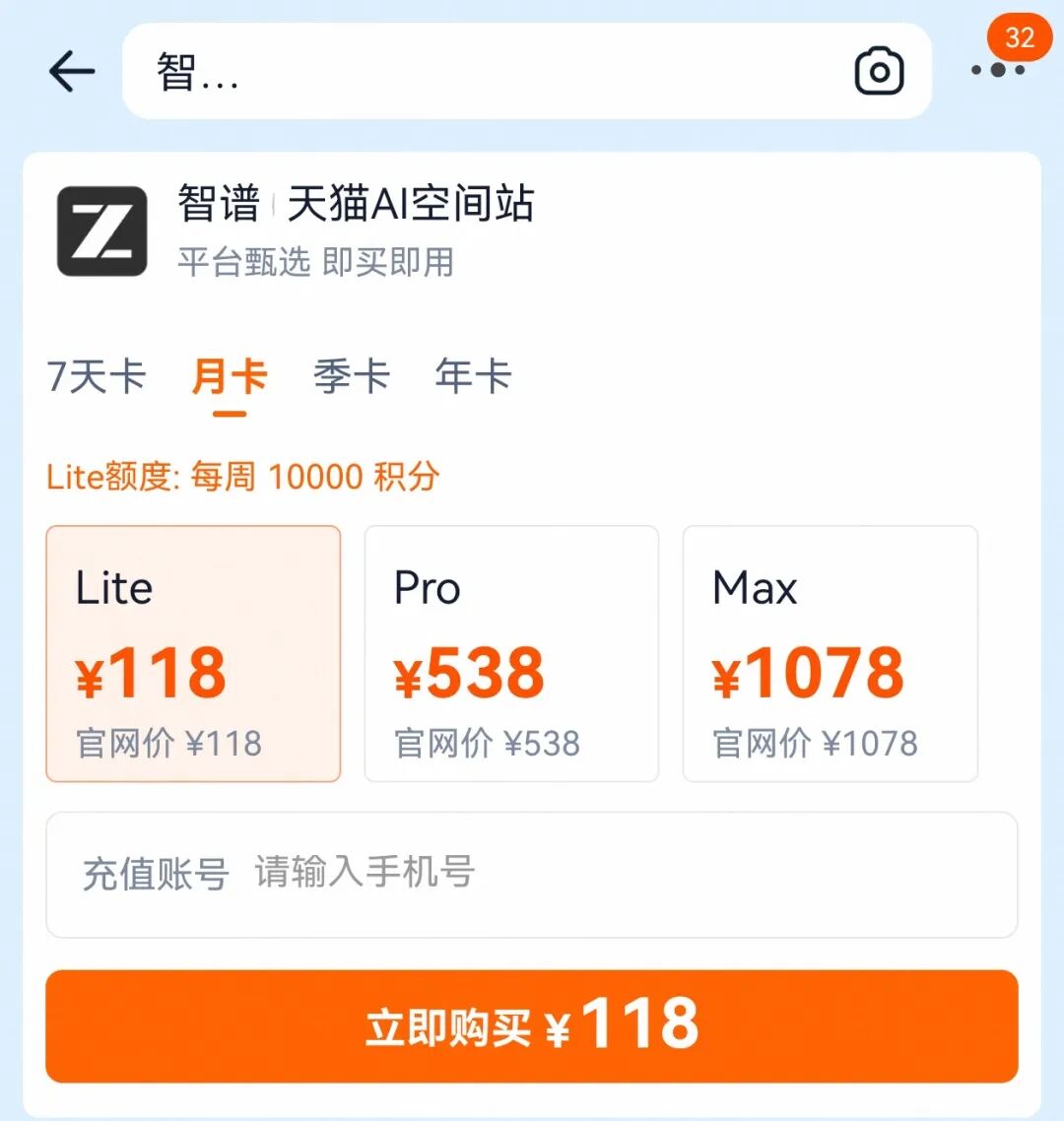
"Consumers will search on the platform 'is there a suitable Token Plan'," said Si Dengyu, General Manager of 3C Digital Division of Tmall, "We need to make buying Tokens as convenient as topping up phone credits and purchasing memberships." In the future, the covered population will start from tech enthusiasts, then expand to office white-collar workers, then to ordinary consumers who are passionate about technology, and finally reach the general public.
The "Generative Artificial Intelligence Application Development Report (2026)" released by the China Internet Network Information Center shows that as of the first half of this year, the scale of generative AI users in China has exceeded 700 million, with a penetration rate of over 50%, which means that one out of every two Chinese people is using generative AI. According to the diffusion of innovations theory, when the penetration rate of a technology crosses 50%, it is no longer a novelty product, and the public's purchase decision will shift from technical enthusiasm to practicality and cost-effectiveness.
Tokens entering livestream rooms and shopping carts happen to fall at this exact time node.
For AI model manufacturers, platforms such as Tmall are not only trading channels, but also windows to capture consumer minds. Every search and every browse from consumers is an opportunity for model manufacturers to build brand awareness. Tmall has a group of users with stable consumption habits. According to Alibaba's financial report, as of the end of June this year, the number of 88VIP members is about 64 million, and their annual per capita consumption amount is 9 times that of non-members.
The method of binding Tokens with hardware further lowers the selection threshold for consumers. AI PCs and AI mobile phones will only become empty concepts if they are separated from Tokens and large language models; even if there is a graphics card locally, cloud computing power is usually still required for large-scale reasoning, and the combination of the two can realize hybrid deployment.
When consumers buy AI hardware, the invisible computing power is also put into the shopping cart and checked out. Si Dengyu believes that consumers buy both hardware and Token Plans, which leaves huge room for imagination in the future, and may rewrite the original business model of hardware sales that only earns the difference between cost and selling price. Just like beauty brands matching sets according to different crowds, Token packages can also be sold in combinations that meet the needs of students, white-collar workers and programmers in the future, turning hardware from a one-time transaction into an entry point for continuous subscriptions.
From topping up phone credits and video memberships to recharging Tokens, the changes in shopping carts reflect the changes of the times. This "Double 11", the measurement unit of AI services begins to circulate in the form of "monthly cards" and "packages". This change indicates that the curtain of the AI consumption era has been slowly raised.
This article is from the WeChat Official Account "IT Times" (ID: vittimes), written by Sun Yan, edited by Hao Junhui, and published with authorization from 36Kr.