Doctors who use Doubao in the consultation room
On October 25, in the cardiology consultation room of a hospital in Xuzhou, Jiangsu, a doctor opened Doubao while listening to a patient's medical condition. In the end, the patient refused the prescription issued by the doctor.
After the incident went viral, the hospital where the doctor works conducted verification and released a piece of information that was missed by the patient's family's camera: the doctor was looking up a new drug and found it was not suitable for this patient, and no new prescription was issued that day.
The hospital emphasized, "AI is only an aid for obtaining information, and the right to prescribe always rests with the doctor."
With the rapid development of AI, nowadays not only many patients are used to checking Doubao before seeking medical treatment, but many doctors do use AI for supplementary information search in their daily work.
According to industry interviews and media citations, the average daily health consultation volume of Doubao is estimated at the order of 20 million person-times (ByteDance has not officially disclosed the exact number), which is equivalent to shifting the traffic of the previous "Baidu Health Search" to the dialog box
According to a survey released by Dxy on 647 medical workers, 98.5% of the doctors used AI in their work in the past three months, 70.8% of the doctors used it at least several times a week, and 81.4% of the doctors used Doubao.
In those few seconds of stagnation in the consultation room, the communication that originally only belonged to doctors and patients was inserted by an invisible and intangible third party, and the traditional doctor-patient relationship was quietly changed.
In this issue, Micro Stories interviewed doctors who use AI in the consultation room:
We asked them how they really view AI, under what circumstances they usually use AI assistance, and what deserves our more attention is at which step these doctors actually use it, and at which line they stop by themselves?
The following are their real stories:
The Pharmacopoeia is in the inpatient department, and Doubao is in the mobile phone
Since last year, Dr. Hong has tried to use Doubao during face-to-face consultations.
Among Dr. Hong's patients, there is a 52-year-old middle-aged and elderly woman who has a history of rheumatoid arthritis for 8 years and has been taking methotrexate tablets orally for a long time, with well-controlled clinical symptoms.
That registration was because the patient said she had frequent urination and urgent urination in recent days. After a series of outpatient examinations, the results showed bacterial infection, and Dr. Hong considered it as simple urinary tract infection.
Dr. Hong said that at that time, he first judged that he wanted to prescribe the corresponding compound sulfamethoxazole, "This is one of the first-line drugs for this disease, and it is cheap and effective." Dr. Hong told Micro Stories.
Halfway through writing the prescription, Dr. Hong suddenly remembered that this patient had used methotrexate tablets before, and he had the impression that there seemed to be a certain repulsive reaction when these two drugs were used together.
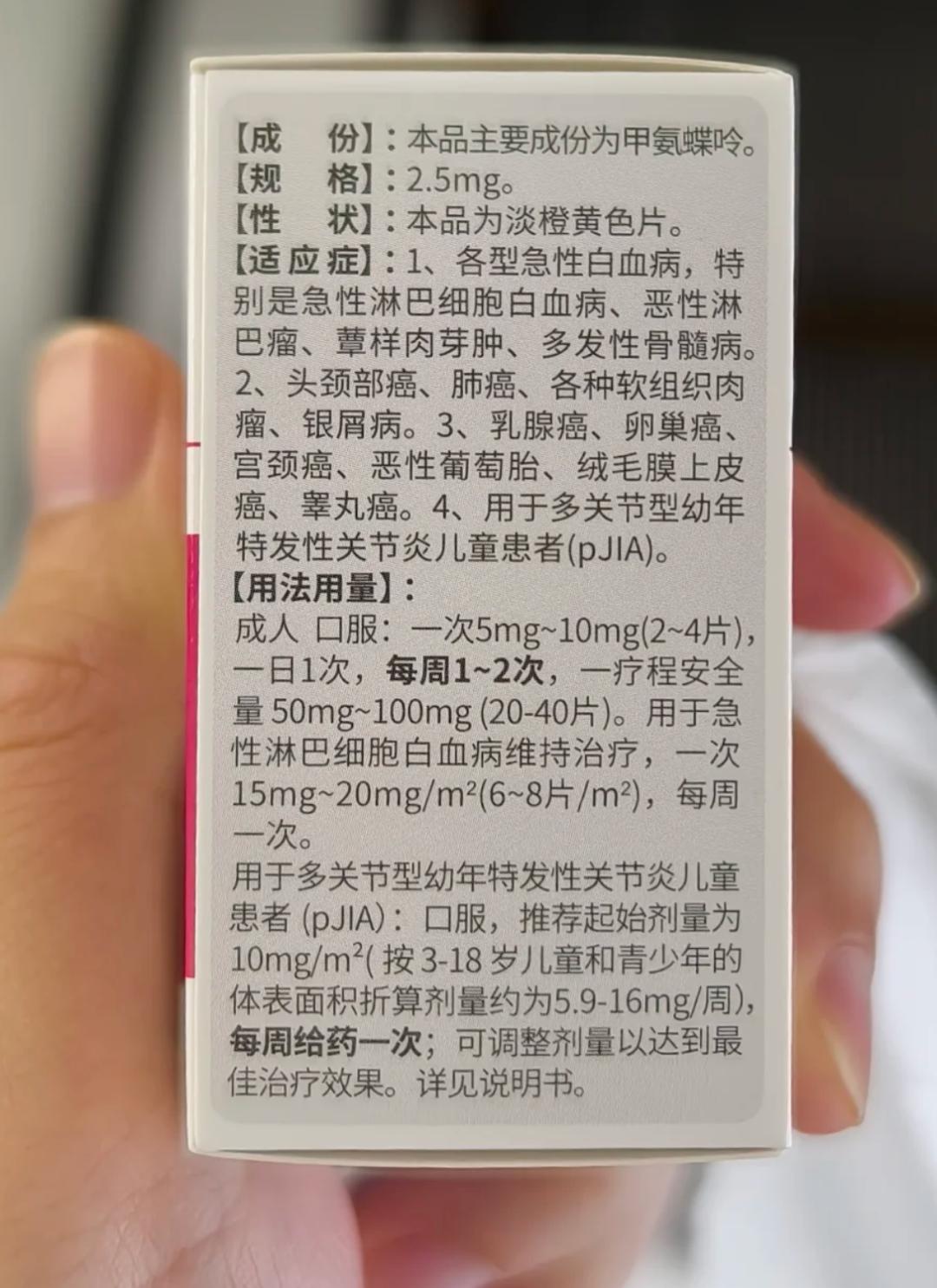
Figure | Instruction manual for methotrexate
"Methotrexate is mainly excreted through renal tubular secretion, and trimethoprim in compound sulfamethoxazole also follows this path. Theoretically, they will compete for excretion and raise the blood concentration of methotrexate. But how big is the clinical risk? Should we avoid it as much as possible, or can we use it with close monitoring of blood routine?"
In the past, in this situation, Dr. Hong would flip through the pharmacopoeia to confirm. But that day the pharmacopoeia was placed in the office of the inpatient department, not at hand, so Dr. Hong subconsciously took out his mobile phone and entered "methotrexate, compound sulfamethoxazole, interaction, bone marrow suppression" in Doubao.
Doubao quickly gave a few lines of prompts. One of them is very clear:
Compound sulfamethoxazole can significantly increase the blood concentration of methotrexate, the risk of bone marrow suppression increases when the two are used in combination, which can lead to pancytopenia in severe cases, and it is recommended to avoid combined use;
Another prompt is that if combined use is necessary, it is necessary to closely monitor the blood routine and methotrexate blood concentration, and consider reducing the dose.
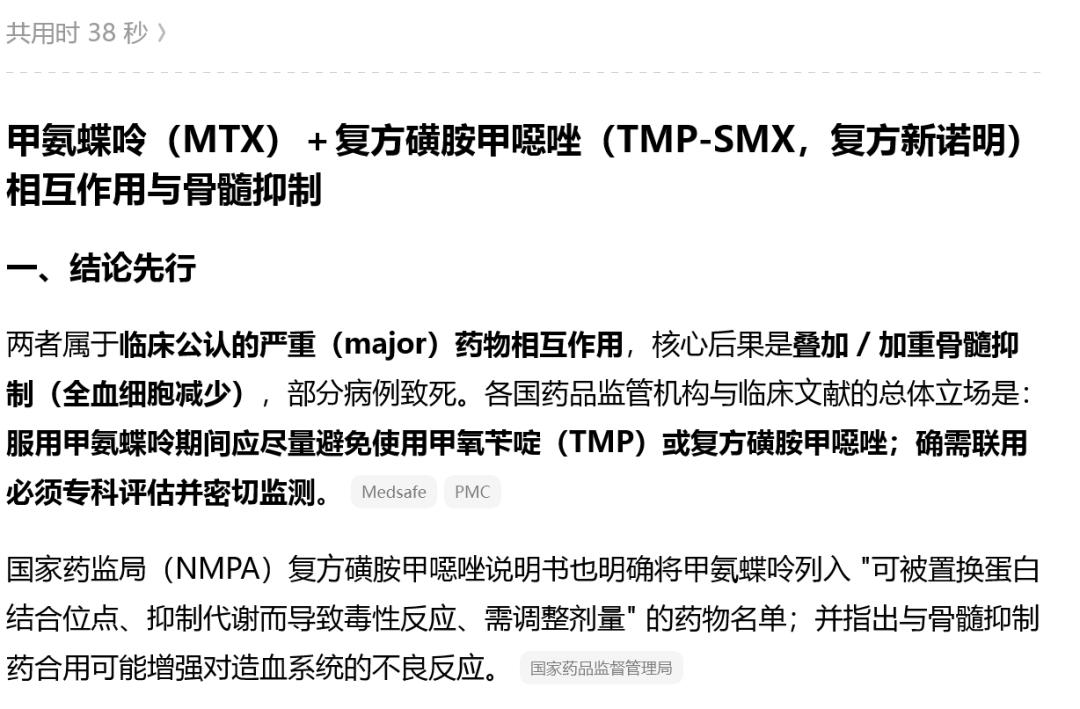
Figure | The drug repulsive reaction searched by Dr. Hong
Another one she still remembers until now: this interaction also exists in low-dose regimens, not only to be vigilant in high-dose chemotherapy.
So Dr. Hong deleted compound sulfamethoxazole and replaced it with another antibiotic. "I didn't use it to prescribe medicine or make a diagnosis. This tool is more like a portable pharmacopoeia."
"Doctor, look, Doubao really said that"
Unlike Dr. Hong, what Dr. Luo of the respiratory department has been most distressed recently is that patients repeatedly use the results they searched on Doubao to "interrogate" him.
The one who takes out the mobile phone to query AI first in the consultation room may not be the doctor, but also the patient.
What impressed him most was a middle-aged male patient in his fifties this year.
The patient found a pure ground-glass nodule of about 6mm in his right lung during the physical examination organized by the company.
Dr. Luo looked at the patient's CT examination report, which showed that the nodule had clear boundaries, uniform density, and no solid components.
According to Dr. Luo's diagnosis, in accordance with the consensus on the diagnosis and treatment of pulmonary nodules, for pulmonary nodules of this degree, regular follow-up and regular CT reexamination are the first choice.
But the patient handed over the mobile phone first. On the screen was the conversation of Doubao: "Ground-glass nodules may be early lung adenocarcinoma, and it is recommended to surgically remove them as soon as possible."
"Dr. Luo, look, I checked, Doubao said it might be cancer, I want to cut it directly."
If it was a few years ago, Dr. Luo would definitely say to the patient "Do you believe whatever is said on the Internet?".
But now it is different, Dr. Luo is very clear in his heart that in the technology era where AI is prevalent, these patients cannot access medical knowledge only through doctors and hospitals. They will search, think, and have more opinions to refer to.
But the problem is that patients have no medical background, most of them describe symptoms in the search process, but cannot accurately point out the medical-related prompt words, and different description methods will lead to completely different AI results.
Dr. Luo pulled up the patient's chest CT, found the location of the nodule, began to explain the current situation to the patient in detail, and finally guided the patient to modify the question asked to Doubao to fit his own condition better.
The patient modified it, the answer on the screen changed, and the conclusion given was roughly the same as Dr. Luo's suggestion.
"AI is not wrong. Sometimes it gives different answers to different people. For the same question, if our doctor asks it, it will give targeted guidelines; if a patient without medical background asks it, it may give a broad and general answer." Dr. Luo explained to Micro Stories.
But this approach still did not reassure the patient, because a neighbor he knew also had a lung nodule, and the surgery showed it was cancer.
In order to further reduce the patient's anxiety, Dr. Luo had to break down all the information he knew and explain it to the patient clearly:
The current probability of malignancy is not high, and follow-up is a more reasonable choice; if surgery is performed now, the lung function of a lifetime will be cut off, and what is exchanged may be a nodule that "does not need to be cut at all".
Even with such patience, the patient was not persuaded on the spot, and then asked Dr. Luo, "What if the nodule is still getting bigger during the follow-up?"
That day in the outpatient clinic, Dr. Luo spent nearly half an hour on this patient.
"If every patient comes in and discusses with me with the content searched on Doubao, the overall medical efficiency will become slower and slower," Dr. Luo said.
Perhaps without that AI part, this patient could have been communicated within ten minutes. But the patient came in with an answer of "may be cancer", so we must first take this answer apart, and then put the doctor's judgment back.
In the same consultation room, the same tool, in the hands of doctors and in the hands of patients, triggers completely different trust reactions.
Doctors regard AI as a pharmacopoeia, while patients directly regard AI as a doctor.
"Nice words" in medical records
Medical consultations that occur in AI tools such as Doubao, Yuanbao, and Qianwen have become the general trend in the AI era.
In essence, people who use them to check illnesses are the same kind of people as those who use Baidu to search for illnesses. But the difference is that search engines can give limited answers, and AI usually asks about your condition in more detail, giving more "seemingly professional" suggestions.
Some time ago, a hot picture once appeared on the Internet: a note was pasted on the door of the outpatient room of the hospital, which read "Patients who have obtained a diagnosis on Doubao, please do not ask us for advice again."
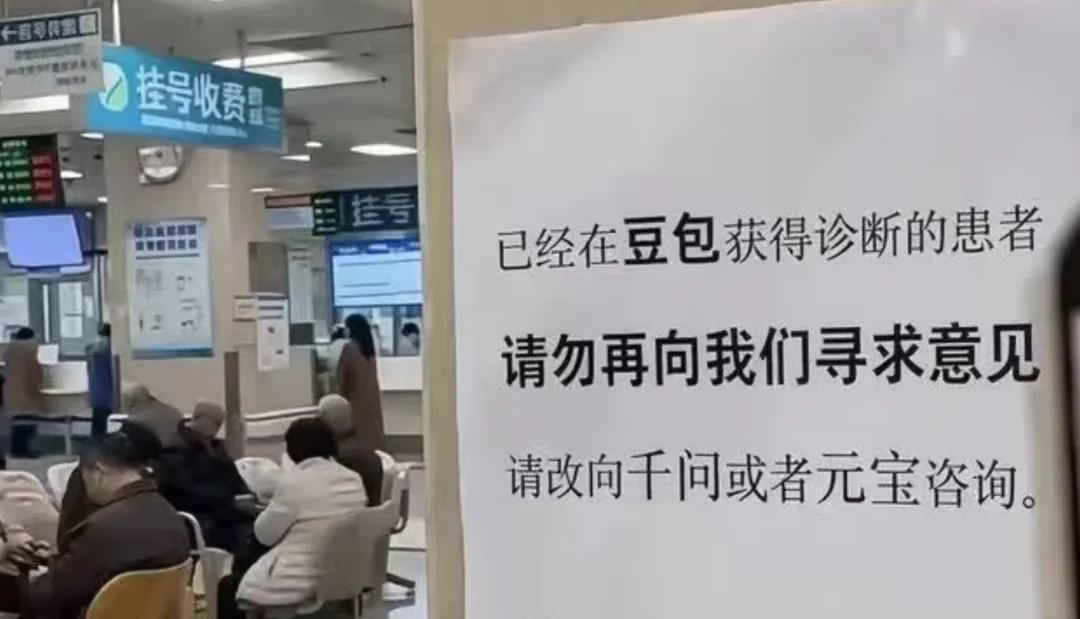
Figure | The picture circulated on the Internet
Although this picture has been identified as artificially generated and not a real picture, it still reflects the attitude towards tools like Doubao AI in the doctor-patient relationship in some areas at present — "If there is Doubao, why do we need doctors?"
But the fact is that several doctors from tertiary hospitals we interviewed said that AI is not a beast, and the use of AI in medical treatment has long been a general trend. The key point is not whether to use it, but how to use it? When to use it? In which aspects to use it.
Dr. Chen, director of the respiratory department of a secondary hospital in southwest China, told Micro Stories that the hospital has held several meetings in recent months to solicit opinions from middle-level cadres, mainly discussing whether to introduce AI into the doctor's work system.
In Dr. Chen's eyes, the benefits of AI to medical care are very clear.
Speech-to-text, structured first draft, and missing item reminder can significantly reduce document time, and the standardization of medical records is also more stable.
"The AI of the medical record system is indeed getting stronger," Dr. Chen said. After some hospitals launched the large model medical record system, the writing efficiency has increased several times, and the rate of Class A medical records has increased to more than 97%.
In addition, previous media reports also said that after a hospital in Wuhan put AI voice medical records into use, doctors saved nearly three hours per day on average, and the qualified rate of medical records increased to 99%.
"From the perspective of quality control indicators, AI's answer sheet is quite good-looking," Dr. Chen said. But Dr. Chen still voted against the introduction of AI at the meeting.
"The disadvantages of AI are also obvious," Dr. Chen said.
Dr. Chen told the young doctors in his department about his experience of writing medical records by hand when he was a resident doctor. In his opinion, during ward rounds every day, the patient's condition changes must be recorded in person by the attending doctor — even if the record is only one line in the end.
"AI will not go to ward rounds for you, nor will it observe the patient's condition changes for you. What AI writes is what a perfect medical record should look like, not what this patient actually looks like."
Patients may hide their medical history, and AI may miss key information; at a deeper level, young doctors may skip the training of "induction, identification, judgment by themselves" and only learn to click "confirm".
Therefore, what Dr. Chen cares most about is not how good-looking the medical record is written. He is most worried about the hidden dangers brought by blindly introducing AI when the rules and usage methods are not well defined.
"The rate of Class A medical records is secondary. What is really related to patient safety is how much of this medical record is actually observed by the doctor, and how much is 'supplemented' by AI according to the template and context."
For example, if the patient only says a sentence at the bedside "I had a fever up to 39 degrees last night", then AI can quickly complete the onset urgency, fever type, and accompanying symptoms of the patient along the context, all of which are plausible.
"These sentences may be fabricated, inconsistent with the facts, or miss key details," Dr. Chen said. The scary thing is that at present, they may not be caught by our current AI quality control.
"Our quality control system is also using AI, but at this stage in the quality control of medical records, AI checks whether the medical record structure is complete and whether the logic is consistent", Dr. Chen said, "As for whether this sentence is the actual situation of the patient in the consultation room, AI cannot judge."
"No matter how standardized a medical record is written, if there is a false sentence in it, it is a false medical record. The quality control score will not tell you this, but the lawyer will tell you when something goes wrong with the patient."
In January this year, Zhang Wenhong also stated at the 10th Anniversary Forum of Hong Kong Alpine Academy, refusing to introduce AI into doctors' daily life, "You can use it by yourself, but AI is not allowed to be used in my medical record system."

The reason for Zhang Wenhong is that if intern doctors directly draw conclusions through AI without systematic training, it will be difficult for them to identify whether AI is right or wrong in the end.
The regulatory line has actually been drawn: the "Internet Diagnosis and Treatment Supervision Rules" implemented on a trial basis in February 2022 clearly states that prescriptions must be issued by the attending physician himself, and the use of artificial intelligence and other methods to automatically generate prescriptions is prohibited. After that, Beijing, Shanghai, Fujian and other places have followed up one after another, with the same caliber.
When it comes to medical records, it is the same truth — AI can write, but the person who signs must be the one who takes responsibility.
Health and efficiency should not be on opposite ends of the balance
Back to that question, should doctors and patients use AI? The answer is yes, but the method of use needs attention.
In several hospitals we visited, doctors said that from