Automakers have suffered a major fiasco in their KPI performance.
"The peak season failed to deliver expected sales, which is the most fatal problem."
Right after October ended, automakers began releasing their sales results. Before diving into specific figures, let's first look at the overall market trend.
In October, the retail sales of narrow-sense passenger vehicles reached around 1.6 million units, down 1.1% month-on-month, compared with 1.618 million units in September, marking a 28% year-on-year decline. For two consecutive months, the year-on-year decline has hovered around 28%. The China Passenger Car Association (CPCA) predicts that the total retail sales of passenger vehicles in 2026 will hit 18.5 million units, down 22% year-on-year.
This marks the first time the Chinese automotive market has recorded a double-digit annual decline.
As for the sales targets of automakers, they were originally designed to achieve a sales surge in the "Golden September, Silver October" period and then make a final sprint at the end of the year. Without the expected growth in the first surge period, there is no solid base for the subsequent final push.
With the above figures in mind, when we look at the target completion rates of automakers in the first ten months of the year, it looks more like a mathematical verdict.
Geely sold 2.5457 million units, corresponding to its annual target of 3.45 million units, with a completion rate of 73.8%. Chery Group posted a completion rate of 78.2%, which is already the most decent performance among traditional automakers, but its exports in October accounted for more than two-thirds of its total sales volume.
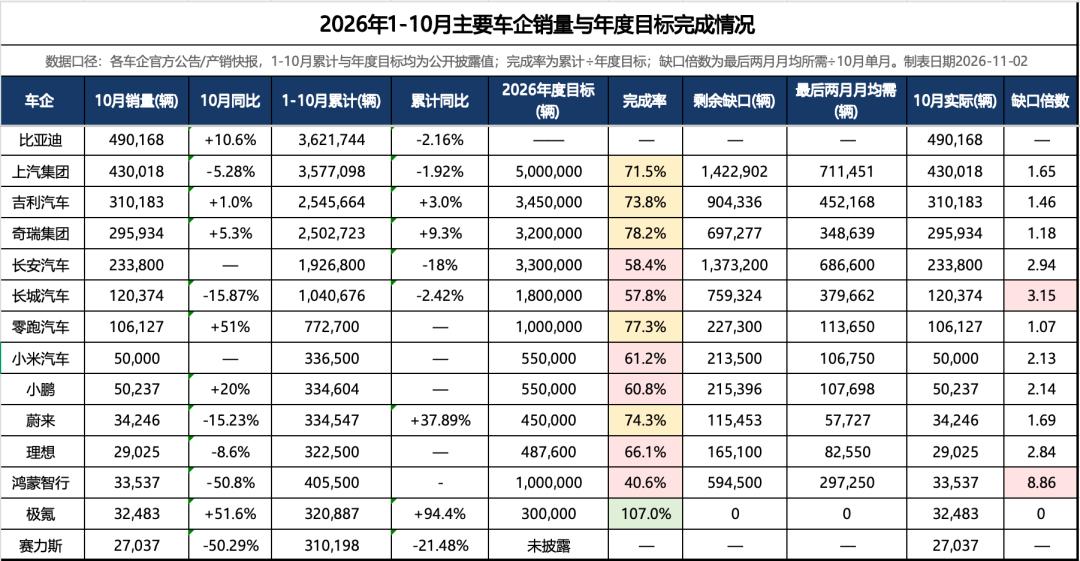
Chart by: SuperEV Lab
As for new EV makers, Zeekr is the only one that can close its annual books ahead of schedule this year. It delivered 320,887 units from January to October, against its annual target of 300,000 units, with a completion rate of 107%. Leapmotor ranks second with a completion rate of 77.27%, but it still needs to sell 227,300 units to hit its 1 million unit target, meaning it has to deliver an average of 113,700 units per month in November and December, which is even higher than the 106,127 units it just set as a new monthly record in October.
The year-on-year decline in October retail sales is close to 30%, and the "Golden September, Silver October" peak season has disappeared in this way for the first time. With only two months left, completing the KPI is an unreachable dream for most enterprises.
01. Failing to hit the KPI is not a shame
According to common industry sense, only if a company completes more than 80% of its annual target in the first 10 months can it have enough room for adjustment in the last two months.
In 2026, Zeekr is the only automaker that has crossed this line.
Among new EV makers, Xpeng delivered 50,237 units, hitting a new all-time monthly high, with 13,326 units delivered overseas, up 166% year-on-year. Xiaomi delivered more than 50,000 units, climbing three steps in three months from 30,000 units in August and 40,000 units in September. On the other hand, NIO delivered 34,246 units, Li Auto delivered 29,025 units, and Harmony Intelligent Mobility delivered 33,537 units, with a year-on-year decline of 50.8%.
Leapmotor is the most outstanding performer among new EV makers, firmly occupying the top 1 position. Among the six manufacturers that were competing in the same echelon last year, the sales volume of the top one this month is 3.7 times that of the last one.
BYD sold 490,200 units in a single month in October, which is already a historically high level, up 11% year-on-year, with exports of 170,000 units more than doubling year-on-year. But if calculated based on its 5 million unit annual target, it means that the remaining 1,378,300 units have to be squeezed into two months, requiring an average monthly sales volume of 689,000 units.
Geely sold 2.5457 million units from January to October, against its annual target of 3.45 million units. The remaining 904,300 units divided by two months means an average monthly sales volume of 452,000 units. Geely just exceeded 310,000 units in a single month for the first time in October, and it needs to increase its sales by nearly 46% further.
SAIC sold 3.5771 million units from January to October, against its annual target of 5 million units, leaving a gap of 1.4229 million units, which requires an average monthly sales volume of 711,000 units. Great Wall Motors sold 1.0407 million units from January to October, against its annual target of 1.8 million units, leaving a gap of 759,300 units, which requires an average monthly sales volume of 379,700 units, while it only sold 120,400 units in October.
A simple division calculation of these figures will tell the result: the target is completely out of reach.
At the beginning of 2026, the targets of mainstream automakers were generally set as "a 20% to 50% increase based on the 2025 performance". This is the standard practice in the past decade: when the market is growing, set the target slightly higher than the market growth rate to force yourself to grab more market share.
But the market in 2026 is on a downward track. On one hand, targets are set based on a "20% growth" assumption, on the other hand, the market is declining by "22%", leaving a gap of 40 to 70 percentage points.
Assuming an automaker sold 1 million units in 2025 and set a 2026 target of 1.2 million units, while the total market size drops from about 23.7 million units to 18.5 million units. To hit its target, its market share has to rise from 4.2% to 6.5% — a 55% increase.
This cannot be solved by "selling more", which means it has to seize an extra 55% of market share from other competitors.
There are only two months left in the fourth quarter, and even adjusting the target cannot fill the gap. So there is only one conclusion: it is not that automakers are not working hard, but that the denominator of the target and the numerator of the market are moving in opposite directions, which is the simplest mathematical problem.
02. Why did this happen
Looking back, the target list at the beginning of the year is like an optimistic memo.
SAIC set its target at 5 million units, BYD at 5 million units, Changan at 3.3 million units, Leapmotor at 1 million units, and Harmony Intelligent Mobility at 1 million to 1.3 million units. In a year when the annual retail sales is expected to record a double-digit negative growth, the implied growth rate of these figures is generally double-digit, even above 30%.
People who set the targets are not unaware that the market is going down. Some industry analysts judge that automakers are aware of the difficulties, but the targets are not anchored on end-user demand, but on the need to not fall behind competitors. In a market where new energy penetration rate exceeds 50% and incremental market has turned into stock market, the targets have changed from navigation tools to a gesture shown to the capital market and supply chain.
More importantly, in 2026, the tools for driving sales volume have been taken away.
On January 1, 2026, the new energy vehicle purchase tax policy was adjusted from full exemption to 50% reduction, with the maximum tax reduction per vehicle cut from 30,000 yuan to 15,000 yuan. The rush purchase at the end of 2025 advanced and digested the demand at the beginning of 2026, and the expected year-end sales surge that was supposed to appear did not materialize either.
In February, the "Guidelines for Compliance with Price Behaviors in the Automotive Industry" was officially implemented, which clearly defines selling below cost as a major compliance risk. The toolbox for price wars has been narrowed at the legal level. In the past, there was a last resort for failing to hit KPI — cutting prices, pushing inventory to dealers, and boosting sales volume. In 2026, the cost of this move is so high that most players cannot afford it.
Dealers have given the answer first: the average gross margin of new cars is -21.4%, nearly 80% of dealers face price inversion, and the inventory coefficient is 1.58, far exceeding the warning line. In the first half of 2026, more than 1,800 authorized dealer stores closed or quit the network, with an average of 10 stores closing every day, hitting the peak of store quit rate in the past five years.
Under this channel status, pushing inventory to boost the wholesale figures in the last two months will destroy the cash flow of dealers and the residual value of the brand.
The profit statement also does not support the final sales sprint. From January to September 2026, the sales profit margin of the automotive industry is 3.3%, and the figure for September alone is only 1.4%, at a low level in the past four years. The profit per vehicle of Changan ranges from 619 yuan to 811 yuan, and the profit per vehicle of Leapmotor is 589 yuan, meaning the money earned from selling one car is not enough to pay for a decent meal.
03. Scale is no longer the top priority
So we find that the practice of "setting KPIs" has failed for the first time in 2026.
In this process, it is not a set of figures that fails, but a systematic adjustment. Some enterprises have made a U-turn in advance, converting sales targets into revenue targets that can better reflect operating quality.
For example, Dongfeng lowered its annual target from 3.25 million units to 2.6 million units, Great Wall Motors cut its sales assessment target from 2.49 million units to 1.8 million units, while keeping its assessment target of no less than 10 billion yuan in net profit unchanged.
These moves are often interpreted as admitting defeat, but a more accurate interpretation is that when scale no longer automatically translates into profit and cash flow, continuing to put the sales KPI at the core of the business logic is itself a kind of dereliction of duty. The choice of Great Wall Motors is particularly clear: sacrifice part of the sales volume to keep the profit indicators.
Looking at those figures with good completion rates from January to October, the moisture and real quality are completely separated.
Leapmotor's 77.27% completion rate relies on extreme cost control and optimized product launch rhythm. Its profit per vehicle is only 589 yuan, but it uses real products to exchange for real orders, rather than pushing inventory to generate inflated wholesale figures. Xpeng broke the 50,000 monthly sales mark for the first time in October, with 13,000 units delivered overseas, up 166% year-on-year, and its growth comes from the new space opened up by exports, rather than snatching market share from the shrinking domestic market. Xiaomi's first monthly sales of 50,000 units comes from the first full delivery month of its Pengcheng series, rather than a year-end sales sprint.
Chery Group's 78.2% completion rate looks high, but its sales structure speaks for itself: it exported 201,000 units in October, marking the third time its monthly exports exceeded 200,000 units this year, and exports account for the vast majority of its total sales. BYD exported 170,000 units in October, up 103% year-on-year; Geely exported 107,000 units, up 158% year-on-year.
These growths are not the product of hitting KPIs, but the second growth curve of exports is covering the involution pressure of the domestic stock market.
On the other hand, Harmony Intelligent Mobility's sales volume in October halved year-on-year, marking the fifth consecutive month of year-on-year decline. Dongfeng Honda's sales continued to fall, and GAC Toyota's sales decreased by nearly 25% year-on-year. The market share of Japanese brands in China has already fallen below 11%. The differentiation of completion rates from January to October is essentially the differentiation between "enterprises that are still exchanging real products for real demand" and "enterprises that are still propping up figures by inertia".
The real signal sent by 2026 is not that setting a lower target is enough. Instead, when the vast majority of players in the industry cannot complete the targets they set at the beginning of the year, the problem does not lie in the high or low of the targets, but in the fact that the act of setting targets itself has been decoupled from the actual business operation.
When the industry profit margin is only 3.3%, cash flow determines life and death more than market ranking. So it is time to remove sales volume from the altar of KPIs, and put profit, cash flow, per-vehicle value and real demand back to the core position.
This is not a step back, but to let the industry untie itself from the worship of scale and start a long-overdue correction.
This article is from WeChat Official Account "SuperEV Lab" (ID: SuperEV-Lab), written by Qin Zhangyong, authorized for release by 36Kr.