All the AIs present here are "trash"

AI companies are still sprinting toward a trillion-dollar valuation, but credit rating agencies have already started pouring cold water on the hype.
On October 30, foreign media outlets revealed that global investment giant Blackstone has revised its expectation for Anthropic's future credit rating. Previously, Blackstone believed that the soon-to-be-listed AI company was on track to secure an investment-grade rating by the end of this year, but it now predicts that even after completing its IPO, Anthropic will likely remain in the BB tier, commonly referred to as "junk grade".
On the same day, S&P adjusted Meta's credit rating outlook from "Stable" to "Negative", warning that its expanding AI investments could lead to negative free operating cash flow for consecutive years.
Oracle was downgraded as early as July this year, leaving it just one step away from junk grade.
Financial data is also starting to show signs of pressure.
In the first three quarters of this year, the combined operating cash flow of Microsoft, Alphabet, Amazon, Meta and Oracle hit an all-time high, but their capital expenditures nearly doubled to reach $5.569 trillion, surpassing operating cash flow for the first time. The five companies saw their combined free cash flow turn from positive to negative, and their stock repurchase plummeted by 83%.
AI is still driving revenue growth, and tech giants still retain strong profitability. But this investment race is forcing them to pour in increasing amounts of cash in advance, even drawing on their own credit and that of their partners.
Rating agencies are growing wary of risks, while Wall Street continues to extend loans. Increasingly complex financing arrangements are tying the interests and debts of more enterprises together. However, whether the massive investment in AI can eventually translate into sufficient cash returns remains an unavoidable issue for the entire industry.
A.
In June this year, US credit rating agency KBRA assigned Anthropic an issuer credit rating of BB+, just one notch below the lowest investment-grade rating of BBB-, which still falls into the speculative grade category — commonly known as "junk grade".

If you only look at the operating data Anthropic subsequently disclosed, it is hard to associate the company with the "junk grade" label.
According to the IPO prospectus made public on October 26, Anthropic generated revenue of $162.86 billion in the first half of this year, up 1300% year-on-year, and its operating loss narrowed to $693 million.
On the customer side, as of the end of September, Anthropic had more than 11,900 customers that contributed at least $100,000 in revenue over the past 12 months, compared with only around 950 a year ago; among them, over 1,900 customers contributed at least $1 million in revenue.
Anthropic's cash reserve performance is also not poor: as of the end of June, Anthropic held $1.124 trillion in cash and cash equivalents, and around $193 billion in short-term investments, totaling more than $1.3 trillion. However, this huge cash reserve was accumulated mainly through external financing — in the first half of this year alone, Anthropic's net cash obtained from financing activities reached $1.108 trillion, mainly from the issuance of preferred shares.
Even such impressive growth still failed to meet the expectations of some equity investors.
According to foreign media reports, as Anthropic's Q3 revenue quarter-on-quarter growth rate slowed from around 145% to 45%, some shareholders and potential IPO investors began discussing lowering its expected listing valuation from around $2 trillion to $1.5 trillion.
At the same time, Anthropic's computing power expenditure is expanding rapidly.
In the first half of this year alone, the company's computing power and infrastructure operating expenses reached $89.45 billion, equivalent to 55% of its revenue in the same period, up around 283% year-on-year.
The prospectus discloses that Anthropic has committed to purchase at least $1145 billion, $1100 billion and $449 billion worth of computing power from Google, Amazon and Microsoft respectively over the coming years, with total minimum purchase commitments reaching $2694 billion.
The performance period of the relevant contracts extends from 2033 to 2036, and most of them include minimum payment obligations. Even if the actual computing power usage is lower than the agreed level, Anthropic is still required to pay the corresponding fees.
In addition, Anthropic has signed a computing power procurement agreement with SpaceXAI with a maximum total value of $1205 billion, which is valid until 2029 and can be terminated with 90 days' advance notice after the initial non-cancellable period ends. The equipment finance lease agreement signed with Broadcom involves around $1612 billion in lease payments, excluding interest, and the lease term is in principle non-cancellable.
These contracts span multiple years and have different payment terms, but all of them mean Anthropic will need to bear huge computing power and infrastructure expenditures in the future.
It remains uncertain whether the corresponding revenue can continue to grow.
In September this year, a bank syndicate led by Morgan Stanley raised Anthropic's revolving loan line from $3.25 billion to $15 billion, extending the maturity to September 2031. This means Anthropic can borrow from the bank within the credit line, repay and re-borrow.
But the banks also put forward corresponding conditions: according to the agreement, Anthropic needs to pledge the assets of the company and some of its important subsidiaries as collateral, and some subsidiaries also need to provide guarantees for the loan. If the company fails to repay the debt as agreed, the banks can dispose of the collateral assets in accordance with the contract, or pursue recourse against the guarantors. In addition, the agreement also restricts Anthropic's behaviors such as incurring new debt, selling assets, and distributing funds to shareholders.
Only after Anthropic obtains an investment-grade debt rating from at least two of the three major rating agencies, Moody's, S&P and Fitch, with a "Stable" rating outlook, and meets other contractual conditions, can it apply to lift these collaterals and guarantees. Even if Anthropic successfully goes public, these financing constraints will not be automatically lifted.
Blackstone's latest judgment further reflects the market's doubts about its ability to obtain an investment-grade rating in the short term — previously Blackstone expected Anthropic to secure an investment-grade rating by the end of this year, but now it believes that even after completing its IPO, the company may still remain in the BB tier.
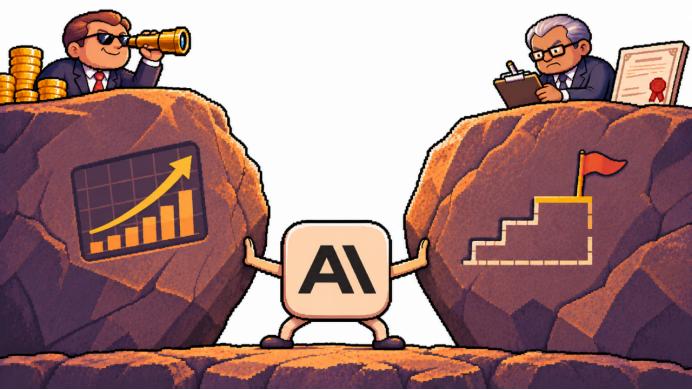
Equity investors focus on growth, while debt investors focus on credit. Anthropic, which is pushing forward its listing process, is caught in the middle, facing considerable pressure from both sides.
B.
Apart from Anthropic, tech giants with mature business support are also starting to face credit pressure brought by AI capital expenditures.
According to foreign media reports, in the first three quarters of this year, the combined operating cash flow of the five tech giants Microsoft, Google's parent company Alphabet, Amazon, Meta and Oracle reached $5429 billion, up 29% year-on-year, hitting an all-time high. But the five companies' capital expenditures in the same period nearly doubled, reaching a staggering $5569 billion.
This is the first time since relevant statistics became available in 2011 that the combined capital expenditures of the five companies have exceeded their operating cash flow.
After deducting capital expenditures, the combined free cash flow of the five companies turned from a positive $1435 billion in the same period last year to a negative $140 billion.
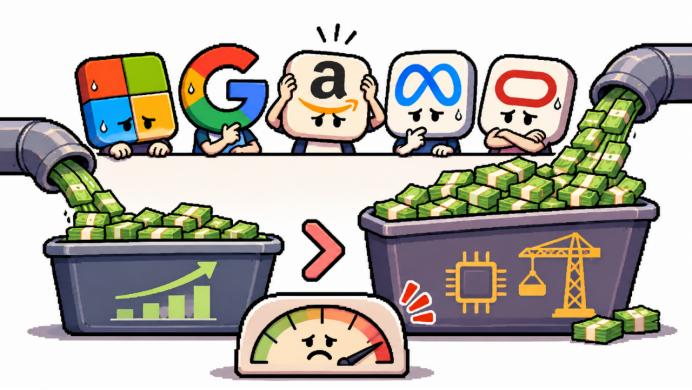
Rating agencies are worried that such huge capital expenditures will continue for many years, and the financial pressure on enterprises may further increase in the future.
On October 30, S&P adjusted Meta's credit rating outlook from "Stable" to "Negative", while keeping its AA- credit rating unchanged.
S&P pointed out that Meta is investing huge sums of money in building AI infrastructure, but compared with other tech giants, its AI investment has more limited monetization capacity, and there is still uncertainty as to whether it can generate enough revenue to cover the new costs in the coming years.
According to the Q3 financial report, Meta's operating cash flow in the quarter reached $32.79 billion, but its capital expenditure was as high as $34.91 billion, resulting in negative free cash flow of $2.12 billion.
Meta expects its full-year capital expenditure this year to reach $1350 billion to $1450 billion, while S&P predicts that Meta's capital expenditure in 2027 may exceed $2250 billion, with a free operating cash flow gap of $710 billion.
However, Meta does not agree with S&P's judgment. The company stated that AI has already improved the performance of its advertising business, and will create new revenue opportunities in the future.
Oracle has already been subject to an actual downgrade.
On July 9 this year, S&P downgraded Oracle's credit rating from BBB to BBB-, leaving it just one step away from "junk grade". The reason also points to the huge capital investment, debt and long-term lease burden brought by AI infrastructure construction.
On October 28, Oracle announced its financing and cash flow plan for the next four years: it expects capital expenditures to peak in FY2027-FY2028, and free cash flow will not turn positive until the second half of FY2028. To support this transition, the company plans to raise no more than $200 billion in additional financing from the capital market by FY2030, including $100 billion in equity financing and $100 billion in debt financing.

In addition to affecting credit ratings, the continuously expanding capital expenditures have also begun to squeeze the space for tech giants to return cash to shareholders.
Reuters statistics show that in the first three quarters of this year, the total stock repurchase of the above five companies plummeted from $81.8 billion in the same period last year to $13.6 billion, a drop of 83%. Among them, neither Alphabet nor Meta conducted any stock repurchases in the first three quarters of this year.
Including cash dividends, the five tech giants returned only 9.3% of their operating cash flow to shareholders, down from 27.4% in the same period last year, hitting the lowest level in at least 15 years.
Tech giants are still making money, but the money they earn is no longer enough to cover their spending.
C.
Although credit rating agencies have issued successive warnings, financing activities on Wall Street have not stopped as a result.
The most typical example is Blackstone: Blackstone has lowered its expectation for Anthropic's future credit rating, believing that even after a successful listing, the company may still remain in junk grade, but at the same time, Blackstone has just joined hands with Bank of America, Citi and Morgan Stanley to announce an AI computing power financing transaction worth as high as $630 billion.
This transaction adopts a special financing structure: financial institutions provide funds to a newly established special purpose entity, which purchases Broadcom's AI chips and network equipment, and then leases them to Anthropic for a long term.
Among them, Bank of America, Citi and Morgan Stanley arranged around $435 billion in senior financing, which enjoys priority in debt repayment order; Blackstone participated in around $90 billion in subordinated financing, with a lower repayment order, taking on higher risks, and an expected rate of return exceeding 10%.
Wall Street has not ignored Anthropic's credit risk, but priced the risk through different return and repayment arrangements.
There is another special role in this transaction — Broadcom, which provides equipment residual value support for the senior financing.
If the value of these chips and equipment falls in the future, Broadcom will need to bear corresponding risks within the agreed scope to provide additional protection for creditors.
Through such arrangements, Anthropic can lock in future computing power in advance, financial institutions are expected to obtain interest income, and Broadcom also gets large-scale equipment orders.
But credit risk has also been distributed out. Anthropic needs to pay rent continuously, financial institutions rely on future lease income to recover their investment, and Broadcom needs to bear the agreed equipment residual value risk.
Once Anthropic's revenue growth in the future falls short of expectations, these interconnected contracts and financing arrangements may face pressure.
Moreover, this transaction structure is not an isolated case.
Previously, Apollo and Blackstone also participated in another $350 billion financing for Anthropic's computing power expansion, with Broadcom providing up to $290 billion in support for the transaction.
In August this year, NVIDIA disclosed that it would provide up to $1050 billion in conditional guarantees for OpenAI to lease data centers built by SoftBank's SB Energy in Ohio, USA. This guarantee will take effect as the data centers are put into use in phases, mainly covering the lease and power payment obligations within the agreed scope, and will only be triggered under specific circumstances such as default.
It is worth noting that both of these two chip suppliers themselves hold high credit ratings. On October 27, Fitch confirmed Broadcom's long-term credit rating at A-, maintaining a "Positive" outlook; NVIDIA was upgraded by S&P from AA- to AA in June this year, and maintained its AA rating with a "Stable" outlook after disclosing the above guarantee in August.
From Broadcom to NVIDIA, chip suppliers are no longer satisfied with selling equipment to AI companies, and have begun to use their own credit to help customers obtain the funds needed to build and lease AI infrastructure.
Rating agencies have already noticed this change. On October 27, Moody's released a report pointing out that AI infrastructure construction is driving the rapid expansion of the private credit market, and a large number of loans maturing one after another from 2027 to 2029 may leave some enterprises with weak financial positions facing refinancing difficulties.

Moody's also specifically warned of the increasingly obvious circular financing risks in the AI industry: tech giants, chip suppliers and AI developers are mutually investing in, lending to and purchasing from each