$17 Billion, Is the World's Largest Instant Retail M&A Deal About to Be Born?
Let's start with the conclusion: For this $17 billion acquisition, what I, Liu Laoshi, care most about is not the figure itself, but the question behind it — how many attempts do food delivery platforms need to make to get their fresh grocery business fully on track?
On October 27, multiple media outlets reported that US food delivery provider DoorDash is in advanced negotiations to acquire Maplebear, the parent company of fresh grocery shopping platform Instacart, for roughly $17 billion, and the deal could be announced as early as this week. However, people familiar with the matter also emphasized that no final decision has been made and the negotiations could still fall through.
Interestingly, there is more than one potential buyer.
It was previously revealed that Instacart is exploring a sale and has contacted both DoorDash and Uber, while Uber's negotiations are no longer active — DoorDash is currently in the leading position, but it still needs the official announcement and transaction closing to "win the bid".
Then look at the price. At $17 billion, based on a rough estimate of the market capitalization before the news broke, it is 30% to 40% higher than the level of about $12 billion to $13 billion before the report; in terms of the publicly disclosed transaction valuation, it also exceeds Uber's previous offer of about $14.8 billion for German food delivery group DeliveryHero.
After the news came out, the market reaction was straightforward: Instacart's stock price rose, while DoorDash's fell.
The rise and fall clearly reveal the essence of this negotiation — the buyer is paying for a ticket it has failed to get for a long time, and the seller is waiting for a decent exit.
But what Liu Laoshi wants to talk about is not this $17 billion.
PART 01
What DoorDash is buying is not delivery speed, but "supply depth"
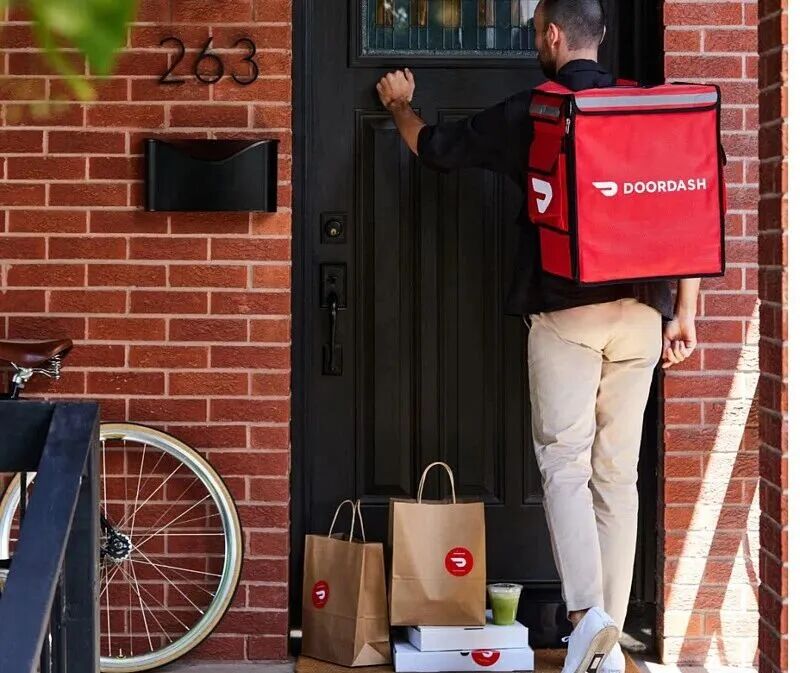
DoorDash is the absolute leader in the food delivery sector. In the first quarter of 2026, its revenue reached $4.036 billion, up 33% year on year, with total orders hitting 933 million, Marketplace GOV reaching $31.6 billion, and member registrations hitting an all-time high; its revenue further rose to $4.454 billion in the second quarter. Its business covers more than 40 countries, and international revenue accounts for more than 22% of its total revenue.
It is worth noting that the 33% growth rate is partially driven by the consolidation of acquired businesses. DoorDash completed the acquisition of British food delivery platform Deliveroo in 2025. Excluding this impact, the organic revenue growth rate in the first quarter was 21%, and the organic GOV growth rate was 24% — according to DoorDash's financial report, Deliveroo contributed $362 million in revenue in that quarter.
Its international footprint is largely built through acquisitions.
With the previously acquired restaurant management system SevenRooms, it has become very skilled at mergers and acquisitions, which can be summed up in eight words: exchange capital for time, make up for shortcomings by acquiring mature businesses.
This $17 billion deal is just the third episode of the same playbook.
But there is one thing it has never managed to crack: fresh grocery. In the third-party fresh grocery delivery market, DoorDash only holds a share of roughly 10%.
The platform has connected to a large number of supermarket stores, but the fresh grocery category requires a completely different set of capabilities from food delivery.
Food delivery deals with standardized prepared meals: merchants finish the food, riders pick it up and deliver it to customers.
What about fresh grocery? Tens of thousands of SKUs, out-of-stock item replacement, fresh product selection, weight specification matching — every order is a small-scale supply chain scheduling operation.
No matter how dense DoorDash's delivery network is, it cannot solve the problem on the "supply" side.
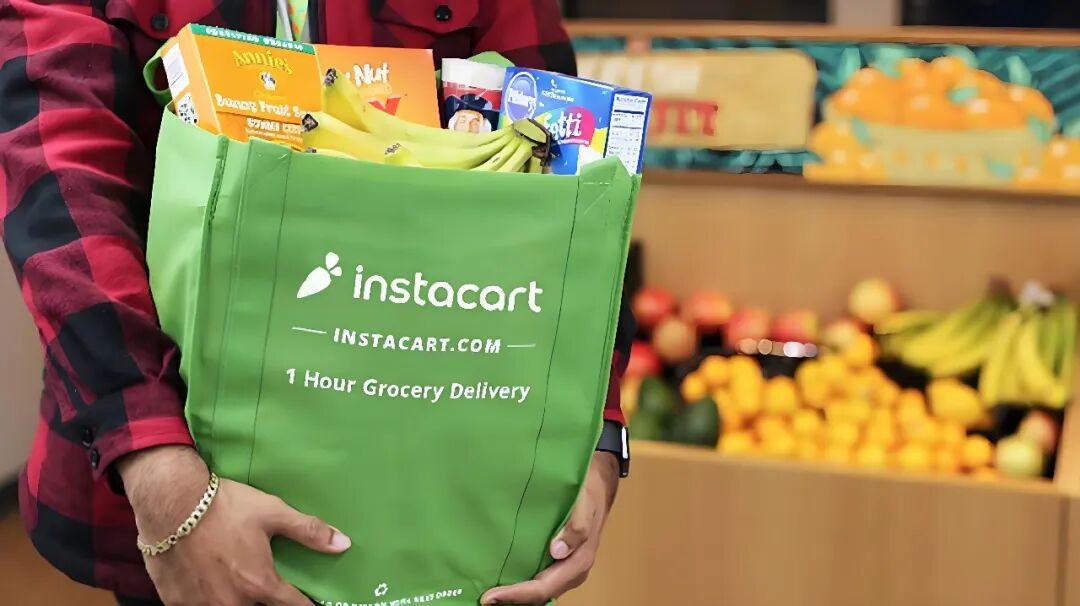
Instacart is exactly strong on that other side. It does not operate a single physical store of its own, but covers more than 2,200 supermarket brands and 100,000 stores, supported by about 600,000 independent contract shoppers.
According to its 2026 Q2 financial report, its GTV reached $10.351 billion, revenue hit $1.043 billion, and the adjusted EBITDA margin was about 30%.
More importantly, advertising and other revenue grew 16% year on year, outpacing GTV growth continuously.
DoorDash has traffic, members and a delivery network, but lacks fresh grocery supply and fulfillment density; Instacart has supply, fulfillment and high-margin advertising business, but lacks a sufficiently large traffic entry. This is not a full acquisition of one party by the other, but two puzzle pieces that fit together perfectly.
PART 02
The real value lies behind the "delivery fee"
If you only interpret this deal as "a food delivery platform buying a fresh grocery platform", you are missing the bigger picture.
What really makes DoorDash willing to pay for Instacart is not the delivery orders from its 100,000 stores, but the consumer brand budgets behind these orders.
Fresh grocery is the scenario that consumer brands most want to reach — what a person is putting in their shopping cart right now is far more valuable than what they liked on social media.
The reason why Instacart's advertising business can maintain 16% growth when GTV growth is only 14% is that brands are willing to pay a premium for the user's attention "at the moment right before placing an order".
DoorDash's own advertising business is also a business with an annual revenue scale of over $1 billion.
After the merger, the high-frequency consumer data from both sides will be combined, which will further enhance their bargaining power against brands.
Essentially, instant retail is not just a single business, but a "Noah's Ark ticket" in the era of major consumption migration. But tickets for different cabins have different values.
Delivery itself is a low-margin tough business. What really determines who can stay on the ark is who can turn "the moment when the transaction happens" into monetizable advertising inventory and merchant service revenue.
When DoorDash buys Instacart, it is buying fresh grocery supply, and more importantly, the layer of attention in the fresh grocery scenario that has not been fully monetized.
PART 03
They have never been each other's real competitors
The most common misconception about this deal is that the combined DoorDash and Instacart will become a "giant" in the US instant retail sector.
Data will wake people up.
According to statistics from market research firm Brick Meets Click, based on the total online grocery calculation, Walmart's share of US online grocery sales is close to 40%, and it continues to expand its penetration in fresh grocery with its same-day and next-day delivery network. US online grocery sales have maintained a year-on-year growth rate of more than 20% for multiple consecutive quarters. The faster the overall market grows, the more obvious the leading advantage of the giants becomes.
However, the share of third-party delivery platforms in the entire food and grocery consumption is still very small. The combined DoorDash and Instacart may get a considerable combined share in the narrow scope of "online fresh grocery", but in front of Walmart and Amazon, they are still challengers, not established market leaders.
Walmart's "stores as warehouses" model and Amazon's "central warehouse plus physical stores" model both come with inherent supply chain depth.
They do not need to purchase supply from third parties, because the supply is already in their own hands.
The significance of the merger between DoorDash and Instacart lies precisely in the fact that they have acknowledged one thing: for the fresh grocery category, a pure platform model cannot make up for the supply chain gap, and the fastest way is to acquire the player that has already mastered this capability.
This scenario has already played out once in China.
Meituan Flash Shopping expanded from its food delivery rider network to the "everything to your door" business, and took "next stop, physical goods" as its core instant retail strategy in 2026; Ele.me was upgraded to Taobao Flash Shopping, and its instant retail business is expected to achieve overall profitability in fiscal year 2029, and is expected to contribute 30% of the platform's total transaction volume in the long run; JD integrated its related businesses into "JD Instant Delivery", supported by its self-operated supply chain and fulfillment capabilities.
Although their paths are different, the core underlying question is the same: The end game of instant retail is not who delivers faster, but who can improve both supply depth and fulfillment density at the same time.
PART 04
Liu Laoshi's judgment
The biggest variable in this deal is regulation.
The two companies have obvious overlapping businesses, and this is a typical merger of horizontal competitors.
Some analysts pointed out that if regulators define the market narrowly enough — for example, only looking at online fresh grocery delivery, or examining it from the perspective of retailers choosing technology and fulfillment service providers — the approval will be far more difficult than it seems on the surface.
The two parties discussed an acquisition back in 2021, when Instacart's valuation was reportedly as high as $40 billion to $50 billion, but the deal eventually fell through due to regulatory concerns.
Five years later, the price has been cut by more than half, but the regulatory hurdle has not become any easier to cross.
There is also a thought-provoking detail: around the same time the negotiation news came out, Instacart confirmed in its SEC filing that it will shut down its Caper Cart smart shopping cart business before the second quarter of 2027, which is expected to generate pre-tax expenses of $55 million to $80 million.
Cutting the hardware burden and focusing on the high-margin core business is more of a typical "pre-sale grooming" rather than a strategic contraction — tidying itself up to sell at a good price.
So, do not take "about to be born" as "already born".
The negotiations could fall apart at any time, and regulators could block the deal at any time — before the official announcement and transaction closing are actually completed, all of this is still just a possibility.
But one thing is already certain: the competition in instant retail is shifting from "food delivery competition" to "full-category decisive battle".
When food delivery platforms move into retail, what they have never lacked is traffic, but supply chain depth and fulfillment density. Only the party that fills this shortcoming first is qualified to enter the next round of the game.
DoorDash chooses to buy time with $17 billion, and Instacart chooses to exit the solo operation with a decent price.
Walmart and Amazon, on the other hand, are still standing on the other side of the table, holding their supply chain advantages, waiting to see if this huge sum of money is worth spending.
The three major instant retail platforms on the other side of the Pacific are also working on the exact same question.
The answer does not lie in delivery speed, but in supply depth.
That's all!
This article is from the WeChat official account "Instant Retail Insights", and is republished with authorization from 36Kr.