Overnight, both GPT-6.2 Astra and Fable 5.5 were exposed, and the crazy November for the AI community is coming.
Right after November kicked off, the AI industry is buzzing with new developments again.
In the past two days, Anthropic and OpenAI have successively released news about their new models. Some users found the name of Claude Mythos 5.5 in the source code of Anthropic's official website, and some developers shared 3D games and interactive works that are suspected to be generated by Claude Fable 5.5.

On the other side, GPT-6.2 Astra, which has not been officially announced by OpenAI, has also appeared in some users' Codex usage statistics and API response records, and some people even claimed that they have successfully called it.
Clues of new models from the two companies emerged almost at the same time. Combined with previous rumors about Qwen4, GLM-5.5 and Hy4, the AI community has begun to speculate whether there will be a new round of concentrated flagship model updates in November.
Claude 5.5 was accidentally exposed on the official website, is the new model coming?
The incident started with an accidental discovery on Anthropic's official website.
Late at night on November 1, tech blogger @kimmonismus posted on X platform that the unofficially announced Claude Mythos 5.5 appeared in the HTML source code of Anthropic's official website.
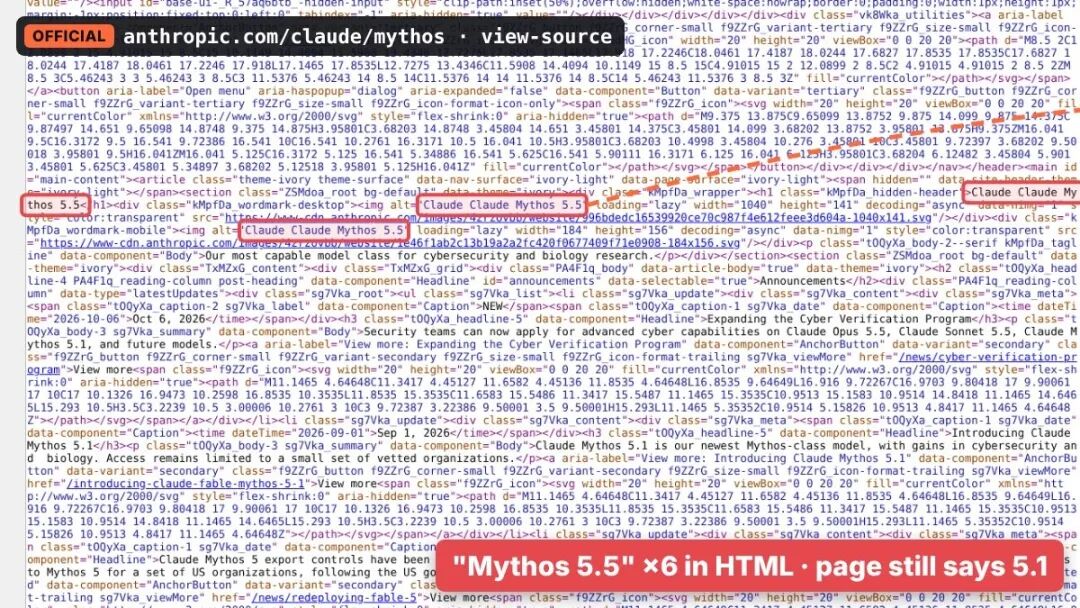
According to the screenshots, in the Mythos product page of Anthropic, the hidden H1 title and the alt attribute of the images both contain the words "Mythos 5.5".

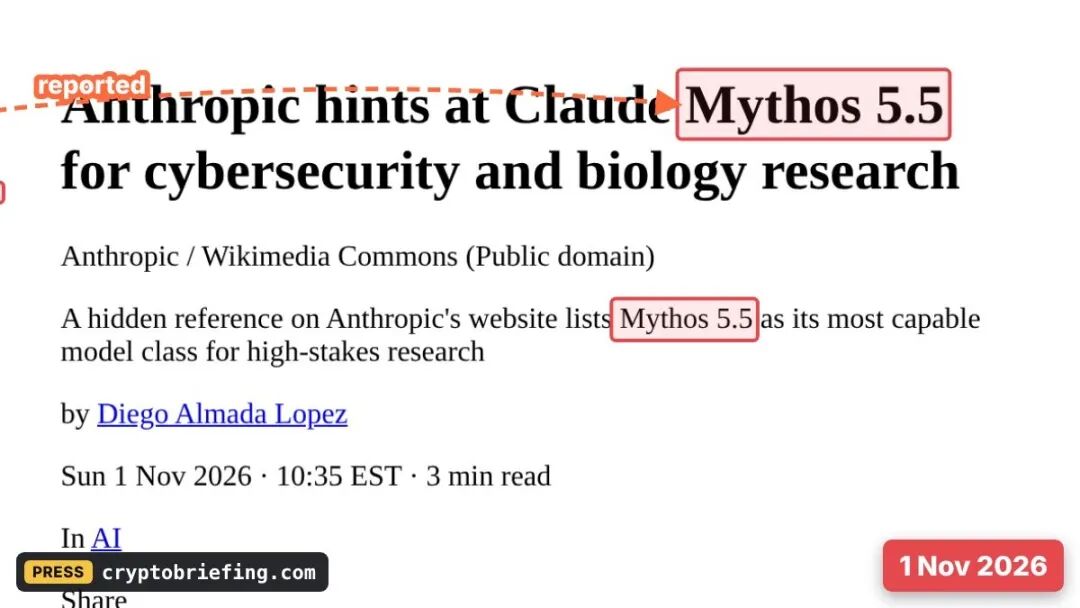
Subsequently, technology media TestingCatalog also noticed this change, and speculated that Anthropic may be preparing for a new generation of models.
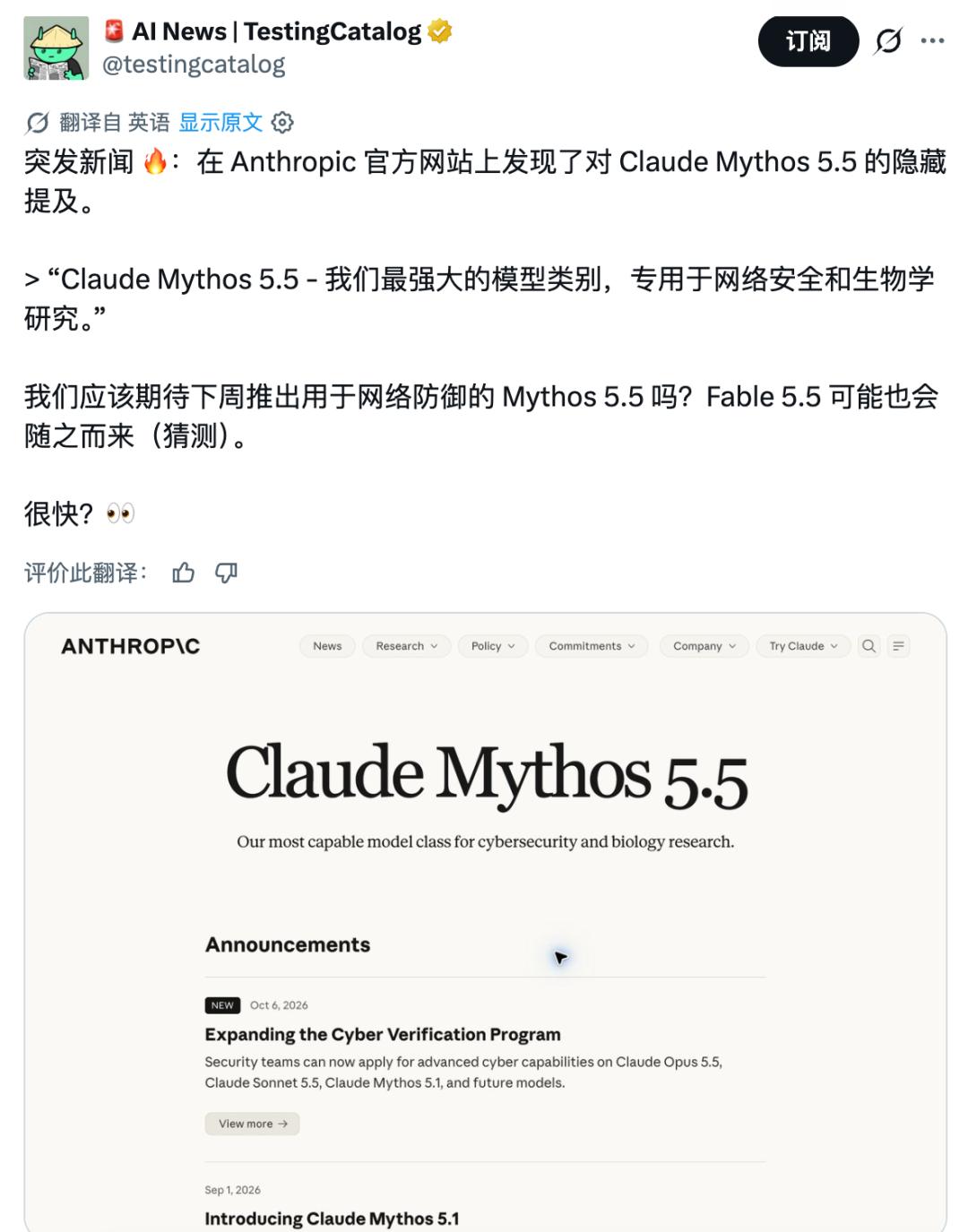
For readers who are not familiar with Anthropic's product line, it can be simply understood that Mythos is mainly oriented to high-risk research fields such as cybersecurity and biology, and its access rights are strictly restricted; Fable adds security protection based on the same underlying model to provide services to a wider range of users.
Therefore, the accidental appearance of the Mythos 5.5 name on the official website also makes the outside world speculate whether Fable 5.5 for ordinary users is about to debut.

It is worth noting that early this morning, developer @chetaslua further found that Mythos 5.5 appeared six times in the official website HTML, but the main text introduction still stays at Mythos 5.1.
Subsequently, another user @pankajkumar_dev said that Anthropic has deleted the web content involving Mythos 5.5.
At the same time, another clue about Fable 5.5 was also unearthed.
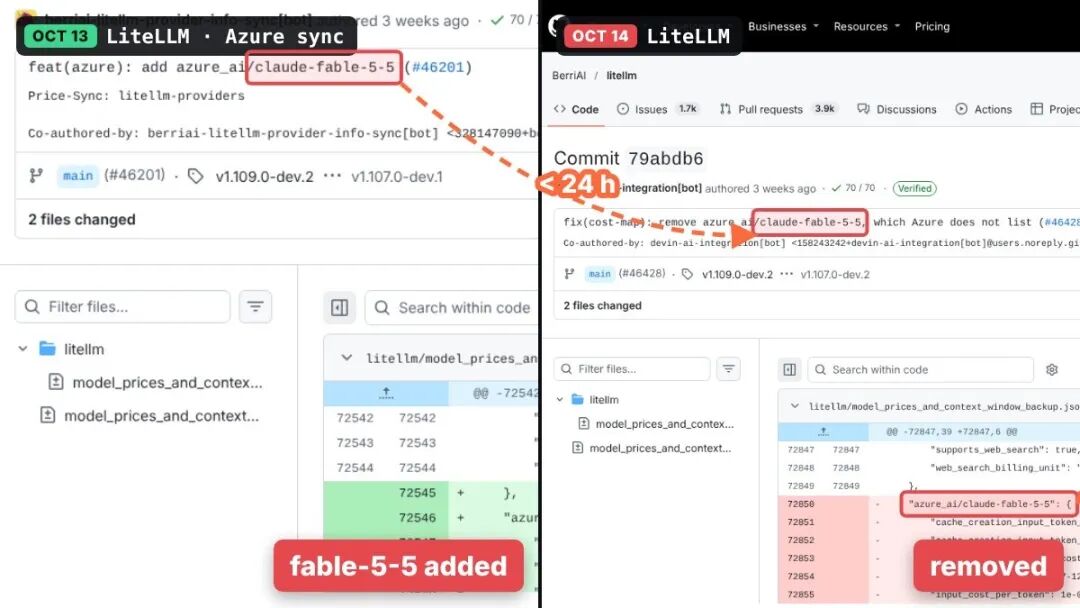
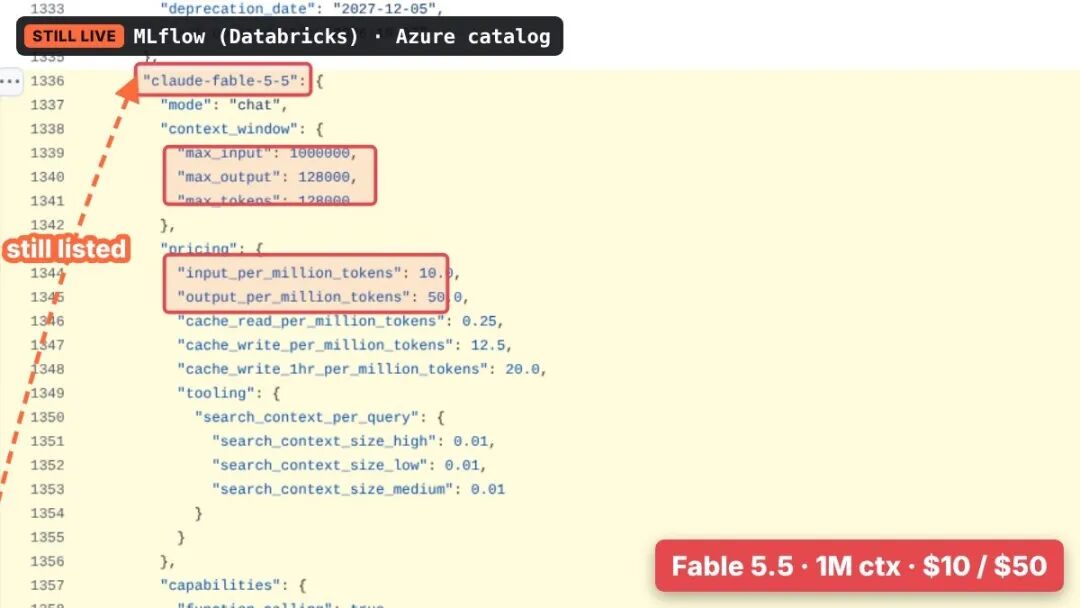
As early as October 13, the model identifier of azure_ai/claude-fable-5-5 appeared in the Azure price configuration of the open-source large model API gateway LiteLLM. The relevant configuration was later removed, but the third-party MLflow model directory still retains the corresponding records.
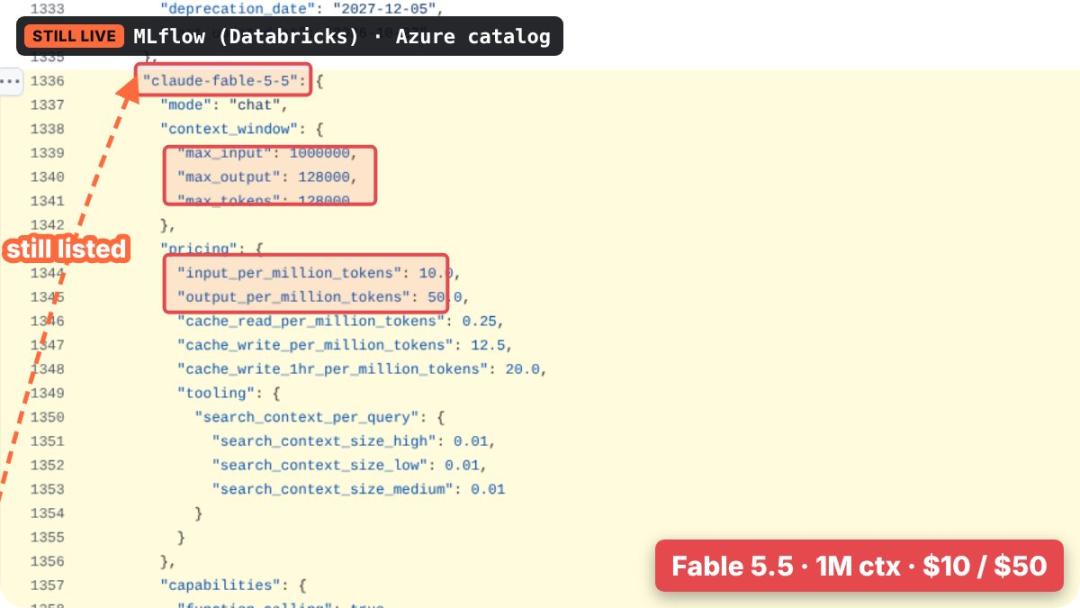
According to the circulating configuration information, Fable 5.5 may support 1 million tokens of input context, 128,000 tokens of maximum output, with a price of 10 US dollars per million input tokens, 50 US dollars for output, and 0.25 US dollars for cache reading.
As for when the new model will be released, the community has different opinions. Some predict it will be this week, some predict next week, and others think it will have to wait until mid-November, because this may be the best gift for Anthropic's listing.
Claude Fable 5.5's programming capabilities exposed, can 3D games be generated with a single sentence?
Compared with the few characters in the official website source code, what excites developers more are the consecutive Fable 5.5 demo videos that appeared on the X platform.
On November 1, developer @notjazii released a 36-second comparison video, claiming to use the same prompt to let Claude Opus 5.5 and Fable 5.5 generate 3D scenes respectively.
In the footage, Opus 5.5 mainly presents natural landscapes of lakes, parks, fountains and four-season changes, which is more like a miniature model display as a whole. On the Fable 5.5 side, there are dynamic events such as four-season changes on the farm, gradual growth of urban buildings, day and night alternation in the harbor, and even volcanic eruptions and rocket launches.
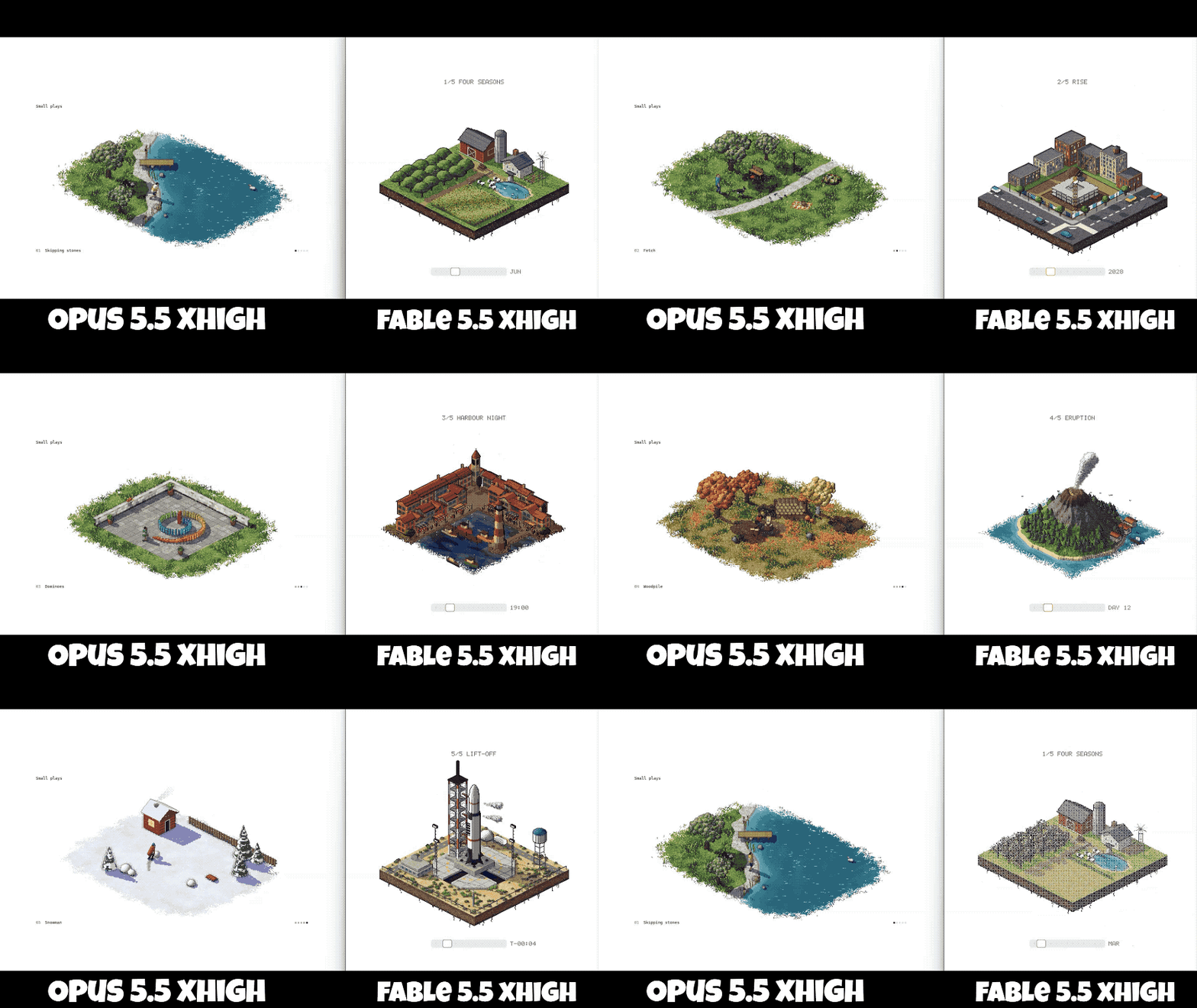
Compared with static scenes, Fable 5.5's works put more emphasis on continuous animation, time change and object status.
The publisher believes that the new model has won comprehensively in this comparison.
Shortly after, he also showed a Minecraft-style game that is claimed to be generated by Fable 5.5.
In the 92-second video, players can explore the block world from a first-person perspective, pass through forests, caves, coasts and desert rivers, and even see lava areas, pink canopy forests, and dynamic lighting on the water surface.
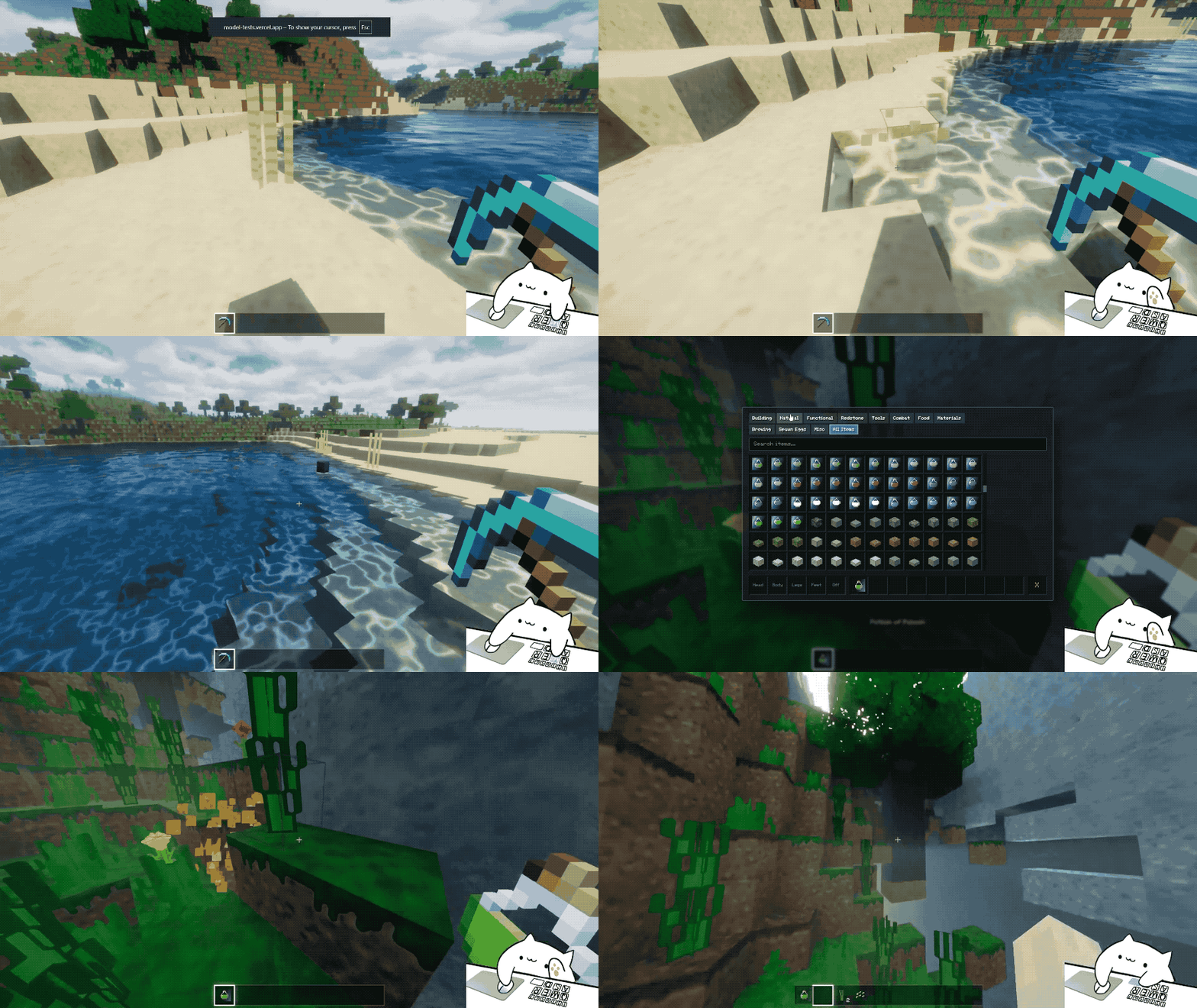
The game interface is also quite complete, including common elements such as pickaxes, quick item bars and classified backpacks. The author claims that the entire work only used one prompt, and it took one to two hours to complete the generation.
The other two demos are also quite interesting.
Developer @abhinavflac showed an interactive historical sailing ship that is claimed to be generated by Fable 5.5 through zero-shot prompts.

The camera can move around the hull to observe the deck, gun ports, sails and rope structures, and the waves, stern wake and water surface reflection under the sunset are also presented.

Another developer @chetaslua showed a sports car application based on Three.js. Users can observe the vehicle from different angles, and can also switch between car paint colors such as red, blue, silver, black and fluorescent green at any time.

From these works, developers have begun to try to let AI undertake more complex tasks of 3D modeling, scene animation and interactive development. However, the relevant videos do not come with complete prompts, call logs and source code. The model identity, generation time consumption and whether it is completed in one go still mainly depend on the author's own statement.
If it can be verified in the follow-up, Fable 5.5's performance in the development of complex interactive applications is indeed worth looking forward to.
GPT-6.2 Astra is also here, have Codex users used the new model in advance?
While Anthropic keeps releasing news, OpenAI also has new movements.
On November 1, X user @TokenGremlin posted that in some users' Codex usage statistics, an unofficially announced model name appeared.
gpt-6.2-astra
According to the screenshots from netizens, in the model usage ratio of a certain account, GPT-6 Astra accounts for about 80%, and GPT-6.2 Astra accounts for 19.8%.

Interestingly, what users see on the model selection interface is still GPT-6 Astra, but the background statistics show the new model identifier.
Subsequently, developer @Mr_Salio also shared a piece of API response data, in which the response.model field is displayed as gpt-6.2-astra.
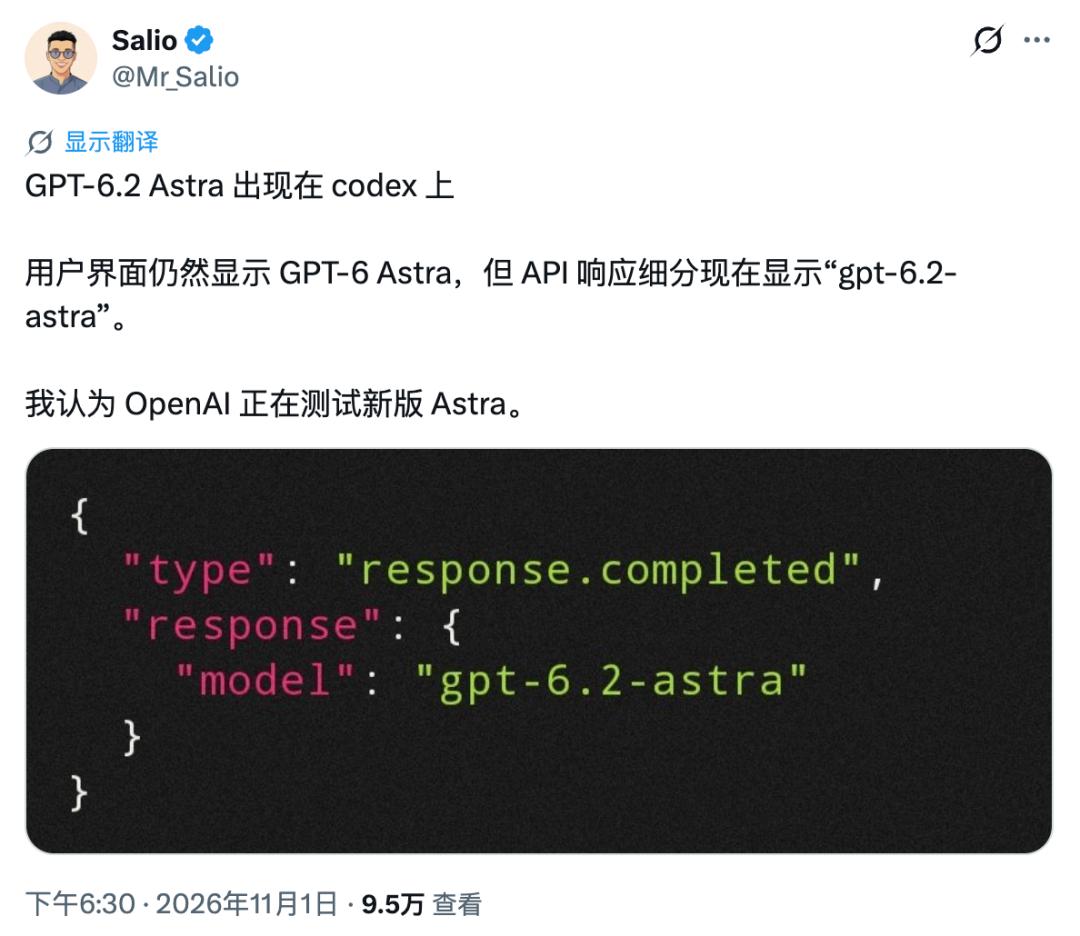
The two clues come from usage statistics and response records respectively, making the outside world speculate that OpenAI may have begun to test the new version of Astra.
Furthermore, early this morning, user @ai_funss said that after upgrading Codex CLI, you can specify the model name through the terminal and try to call GPT-6.2 Astra.
The screenshots he showed not only have the gpt-6.2-astra medium identifier, but also show 1M window, that is, a 1 million token context window.

As for performance, two completely different evaluations have emerged in the community.
@TokenGremlin believes that GPT-6.2 Astra has made significant progress compared with the previous generation, especially in design, technical capabilities and programming performance, and some tasks may even surpass Claude Opus 5.5.
