Stanford alumni are developing robots, attracting a collective influx of industrial capital.
At the turning point of embodied intelligence, a new round of financing has been completed against the market trend —
Today (November 2), RoboScience announced the completion of its A2 round financing of several hundred million yuan, jointly led by Amber Capital, Horida Investment, and Shanghai Semiconductor Industry Investment, with participation from Shuang Capital, 360 Strategic Investment, Guolian Tongbao, Jinding Capital, and multiple listed company platforms.
Looking into the founding team of RoboScience, it is backed by two former classmates from the AI Lab of Stanford University — Tian Ye and Shao Lin. Back in their campus days, they often discussed how robots could enter human daily life. Years later, after witnessing the outbreak of embodied intelligence in China, they chose to return to China to start their business, and RoboScience was established shortly afterwards.
Stanford is almost one of the birthplaces of global embodied intelligence research: Li Fei-Fei, the initiator of ImageNet and the founder of the vision and data-driven paradigm, Chelsea Finn and her REAL Lab, geometric computing scholar Leonidas J. Guibas, as well as the founding team of Pi, a leading foreign embodied intelligence company, all come from Stanford. Around 2016, the geometric computing group led by Professor Leonidas J. Guibas (member of three U.S. national academies) at Stanford gathered a group of Chinese students, including Wang He, Shao Lin, and their junior fellow apprentice Su Hao.
The research accumulation at Stanford, ranging from 3D geometry, robot learning to physical interaction, has provided important inspiration for this group of entrepreneurs to explore general embodied intelligence. This is also reflected in the technical DNA of RoboScience: at present, the self-developed Visics general embodied large model has broken through the ontology generalization problem; the self-developed physical simulation engine RoboMirage has further lowered the data threshold. On the road to general embodied intelligence, RoboScience has chosen to directly aim at the most challenging checkpoint.
At this moment, investors' choices are often more indicative of market trends. Taking the opportunity of the completion of the financing, the investment community had an in-depth exchange with Tian Ye, founder and CEO of RoboScience, and an embodied entrepreneurship story that is quite different from most previous cases was gradually unfolded.
Two Stanford classmates teamed up to start a business
Focus on solving the core problem of embodied generalization
The Stanford background is the first impression that RoboScience leaves on most people.
The germination of the team actually started at Stanford — Tian Ye graduated from the University of Science and Technology of China with a bachelor's degree, and went to Stanford for further study in 2014, studying under Professor Andrew Ng, thus stepping into the AI world.
This period of study became one of the most valuable experiences in Tian Ye's life. At that time, deep learning was just emerging globally, and Andrew Ng was one of its earliest advocates. Under the guidance of his mentor, Tian Ye not only got access to the world's most cutting-edge technologies, but also made a large number of attempts to apply technologies to real scenarios.
Many great entrepreneurship stories in the business world often originate from the purest friendship on campus — it was also on this campus full of geek and innovation atmosphere that Tian Ye formed a bond with his classmate Shao Lin. The difference is that Shao Lin studied under Jeannette Bohg, an embodied intelligence manipulation expert, and Leonidas Guibas, a giant in geometric computing, focusing on the field of robot learning.
Although their research directions are different, their curiosity is surprisingly aligned: how to enable AI capabilities to enter the physical world, interact with robots and perform operations using general natural language? "Since Stanford, we have been talking about when robots can truly enter the large-scale production and life of human beings," Tian Ye recalled to the investment community.
But at that time, the concept of embodied intelligence had not yet exploded, and the timing for entrepreneurship was not ripe. Therefore, Tian Ye chose to join Apple first, where he participated in the core construction of Apple's AI product ecosystem and AI application ecosystem, grew from an engineer to a technical leader all the way, and led the development of Apple Intelligence, the world's first end-cloud collaborative large model reasoning system, as well as CoreML and CreateML, the core platforms known as "Apple's PyTorch and CUDA"; Shao Lin joined the Department of Computer Science of the National University of Singapore as an assistant professor, continuing his research on robot learning and dexterous manipulation.
It is these two completely different experiences that completed the last piece of the puzzle for entrepreneurship: starting from Stanford together, Tian Ye accumulated engineering experience at Apple to deploy technologies to large-scale devices and users; a series of researches led by Shao Lin also became the technical foundation for future entrepreneurship. Thus, an entrepreneurial combination of "academics and engineering" complementing each other was formed.
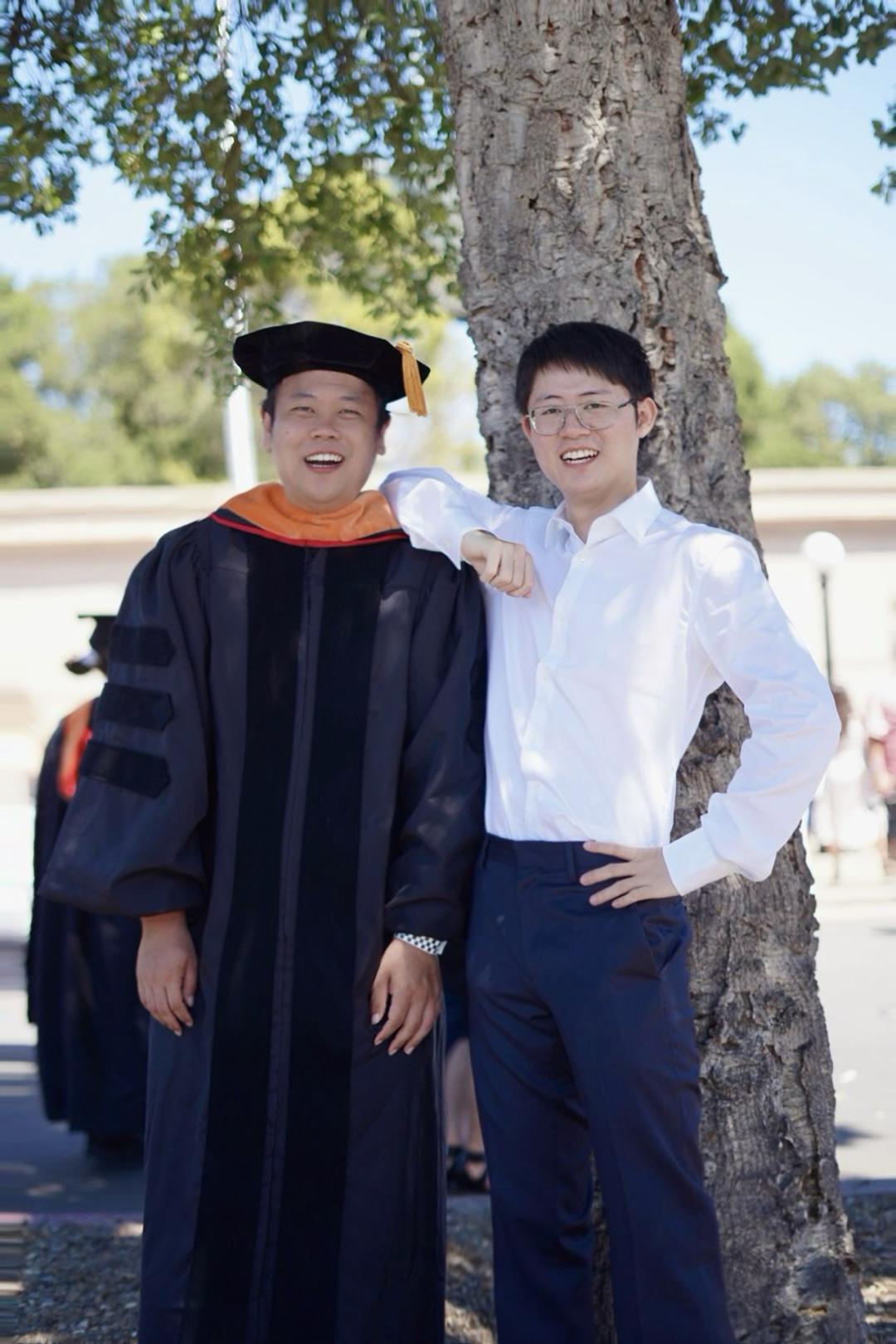
*Group photo of the two founders of RoboScience (Shao Lin on the left, Tian Ye on the right)
In the twinkling of an eye, it was 2024. The universality of large language models exploded with the emergence of ChatGPT, and both academia and industry began to try to replicate this Scaling Law to robots in the physical world. Finally waiting for the opportunity, Tian Ye resolutely left his job and returned to China to start a business, founding RoboScience. The two continued to fight side by side — Tian Ye serves as CEO, and Shao Lin is the chief scientist.
Around this time, China's embodied intelligence track completely exploded, with all kinds of capital and top entrepreneurs entering the market one after another. Looking back on this wave, the Stanford-related group is particularly eye-catching: Su Hao, founder of Hillbot, Wang He, founder of Galaxy Universal, Lu Cewu, founder of Qiongche Intelligence... all of them come from the Stanford robotics and AI academic lineage. As Tian Ye put it, "In the AI field, Stanford is undoubtedly the global cutting-edge position, where countless academic and engineering innovations take place." Quietly, a "Stanford Legion" has risen in China's embodied intelligence track.
The higher the starting point, the greater the vision. RoboScience has chosen a more difficult path: through the full-stack technical route of integrating software and hardware, it independently develops general embodied large models, and also develops robot ontology and physical simulation.
"The two most important things for embodied intelligence are models and data," as Tian Ye said, which basically interprets the growth path of RoboScience — in order to break through the generalization problem faced by embodied intelligence, the team has independently developed the Visics general embodied large model.
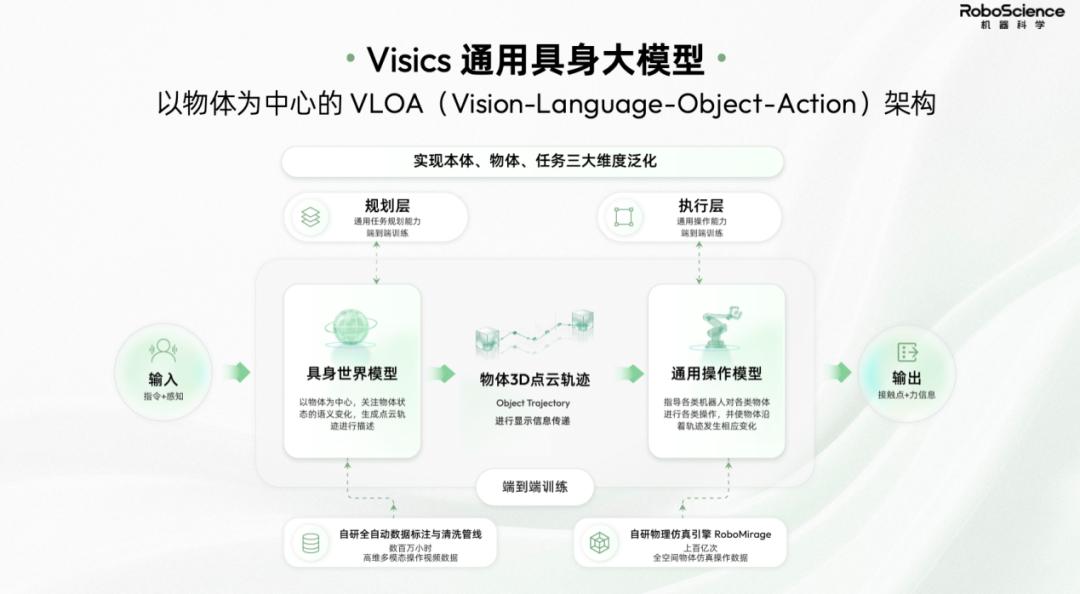
Specifically, the Visics general embodied large model adopts the VLOA (Vision-Language-Object-Action) architecture, and uses Object Trajectory (3D point cloud trajectory of objects) as the unified intermediate representation standard. This design completely decouples "cognition" and "execution" — the upper embodied world model is responsible for predicting and deducing the physical motion trajectory of objects, and the lower general operation model converts the trajectory into control instructions adapted to any robot ontology.
At the same time, the company has independently developed a high-precision simulation engine RoboMirage. Andrej Karpathy, former AI director of Tesla and co-founder of OpenAI, proposed in his article "Verifiability" that when a task has a sufficiently efficient and comprehensive verification environment that allows repeated, efficient trial and error and can automatically provide reward feedback, the possibility of AI solving this problem through continuous training will be greatly increased.
RoboMirage has achieved high concurrency, real-time performance and full coverage of the object space, which provides extremely high momentum for the development of RoboScience's embodied models. Combined with the fully automatic video annotation and cleaning pipeline, a dual data flywheel of "simulation + video" has been built. Tian Ye shared a set of data: the data route of RoboScience has reduced the acquisition cost of a single piece of data to 0.05 yuan, which is 1/20 to 1/200 of the cost of the traditional solution. From the beginning of 2026 to October, the video training data of RoboScience has exceeded 4 million from 1 million and continues to expand, fundamentally breaking through the dual bottlenecks of data scale and cost, and creating conditions for the Scaling Law of embodied intelligence.
As general large language models continue to demonstrate spatial understanding capabilities, the capital market's inquiries to embodied intelligence companies are becoming more and more direct: when the capability boundary of general models continues to expand, what exactly is the independent value and long-term barrier of the "brain" independently developed by embodied companies?
Tian Ye's judgment is that general large language models are good at tool invocation, task decomposition and intent orchestration, but there is still a threshold in the physical world from understanding tasks to driving robots to complete operations stably. For embodied companies, the core value lies in whether different hardware can complete operations at a sufficiently fast speed and a sufficiently high success rate in complex environments, and replicate this set of capabilities to more ontologies and tasks. Behind this, models need to learn physical laws such as contact, friction, and elasticity, and continue to accumulate physical interaction data that is difficult to obtain directly from text and videos, so that the system can complete real tasks efficiently and robustly in the physical world.
This is also the underlying logic for RoboScience to lay out the Visics large model and the RoboMirage simulation engine: generate physical interaction data on a large scale through the simulation engine to reduce the data cost of model training; connect object motion understanding and robot operation through a layered decoupling architecture to reduce the dependence of model capabilities on specific hardware. Both point to a commercially valuable goal: to make the same set of operation capabilities reusable across ontologies and tasks, and reduce the marginal cost of new hardware adaptation and new scenario deployment. From the perspective of venture capital, the imagination space of this route lies in converting the continuous accumulation of data and models into general operation capabilities that can be delivered on a large scale, and serving more robot manufacturers and application developers through the unified Visics model interface.
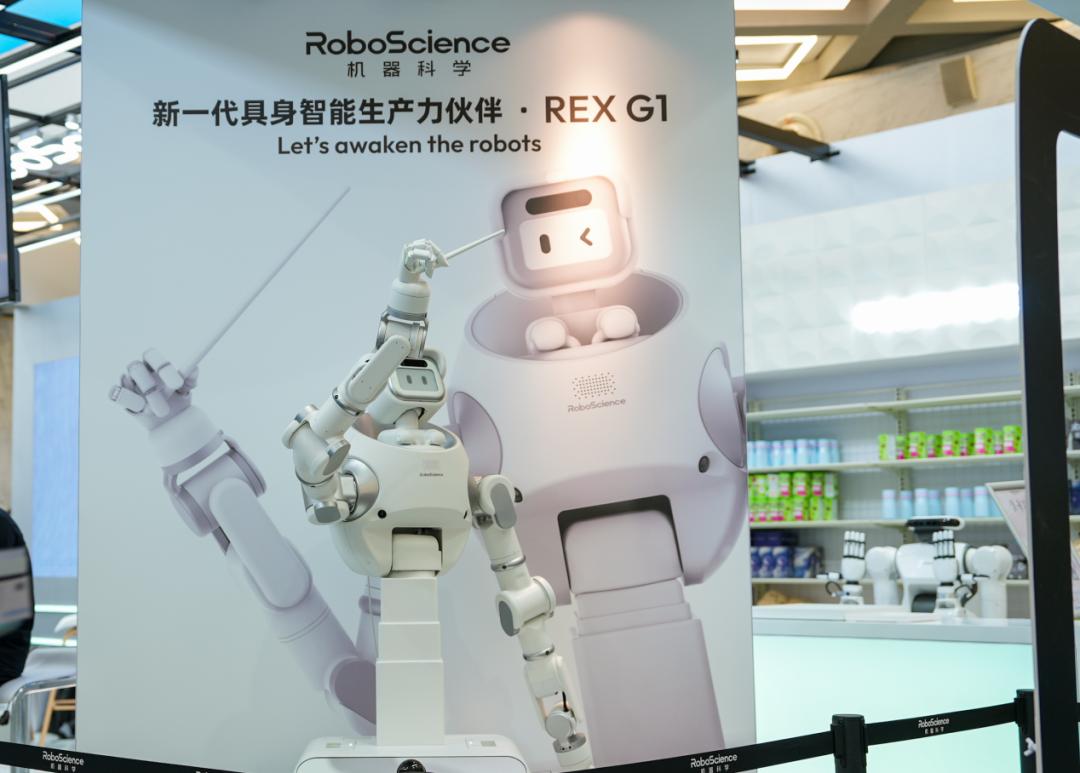
After huge leaps on both the model side and the data side, RoboScience has released its first-generation robot ontology — REX G1 wheeled humanoid general robot, which can be widely used in scenarios such as logistics, retail, factories and households.
Just like Apple, the real barrier has never been a single point technology, but the systematic capability of integrating software and hardware. The same is true for RoboScience — by building full-stack capabilities, it creates next-generation robots that can independently perform complex tasks with a faster iteration speed.
Financing against the market trend
Complete the full-stack closed loop of embodied intelligence within one year
Investors noticed this pair of Stanford classmates very early.
In the AI era, investors often establish connections in advance with large enterprise executives and university professors who have entrepreneurial potential, so that they can invest at the first time when they decide to start a business. This scene also happened to Tian Ye — as he recalled, before he and Shao Lin left their jobs, investors came to visit one after another and maintained regular exchanges.
Everything came naturally. Shortly after RoboScience was established, the seed round of tens of millions of RMB exclusively invested by Zero One Venture was quickly received. Two months after the financing was completed, Shao Lin's team won the Best Paper Award in the direction of robot operation and motion with their general dexterous grasping framework D(R,O) Grasp, becoming the first team from an Asian institution to win this honor as the first author unit in the past five years. This research is also the technical origin for RoboScience to break through the cross-ontology dexterous operation problem.
After that, investors continued to increase their investment: in July of the same year, the company completed a nearly 200 million yuan angel round financing, led by JD.com, with participation from China Merchants Venture, SenseTime Guoxiang Capital, and old shareholder Zero One Venture increased their stake; in February 2026, the company completed a Pre-A round financing of several hundred million yuan, with investors including well-known investment institutions such as Puhua Capital and Dachen Caizhi, and China Merchants Venture, Zero One Venture continued to increase their investment; until now, the company has completed several rounds of A-series financing of several hundred million yuan.
RoboScience has always maintained a steady and pragmatic pace in financing. In fact, after the financing boom in the first half of the year, the embodied intelligence track has cooled down significantly in the second half of this year, investors are becoming more cautious, and investment standards are more stringent. The lower the industry trough, the more valuable the financing is.
What made investors make firm decisions are the milestones that RoboScience has achieved at each financing node: in September 2025, it released the high-precision simulation engine RoboMirage, opening up a low-cost, large-scale data flywheel; in June 2026, it officially launched the Visics general embodied large model, proving the generalization ability across ontologies, objects and tasks with the VLOA architecture; only two months later, the first wheeled humanoid robot REX G1 was unveiled. In other words, within one year, the key links such as data, model and robot ontology were connected to form a full-stack closed loop of general embodied intelligence.
It is worth mentioning that before the completion of this round of financing, RoboScience also reached a strategic cooperation with Tencent Cloud to build the world's first cloud-side EaaS (Embodied-AI-as-a-Service) embodied intelligence service. Based on this cooperation, Visics has become the world's first cloud-side embodied large model, opening up the calling ecology to the public.
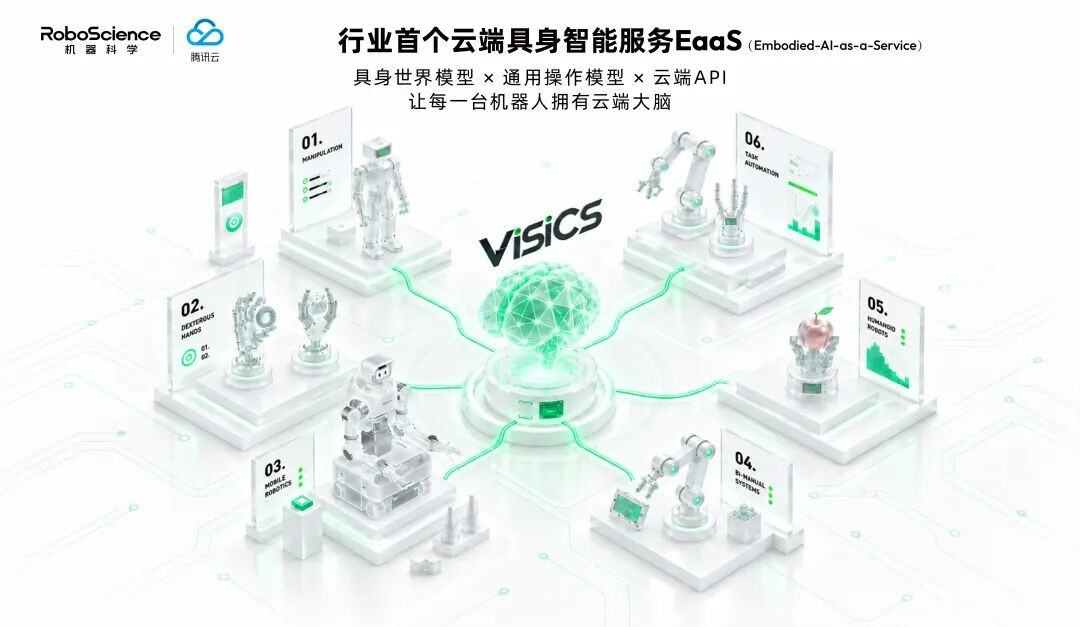
Behind this lies RoboScience's thinking on commercialization. Tian Ye revealed that the team currently has three industrialization routes: providing overall embodied solutions for end applications; providing EaaS, a model service that can be called from the cloud, as well as controllers deployed on the end side, opening up model capabilities to a wider range of developers, ontology companies and scenario integrators.
In Tian Ye's words, these three routes take into account "depth and breadth": the full-stack route deeply cultivates key scenarios, and the controllers and EaaS extend the capabilities, so as to cover a wide range of application scenarios that a single company cannot fully master.
All these are also the points that impress investors. As Amber Capital stated: "The iteration of embodied intelligence technology is accelerating, and it is going through the stage from technical verification to large-scale application in different fields. The general capability of open scenarios and landing cost are the key to industrial breakthrough. Focusing on this core proposition, RoboScience has built a full-stack technical system that connects data, models and ontologies, further improving the generalization ability across ontologies, objects and tasks, and realizing continuous data accumulation and capability iteration in real working conditions. We highly recognize the team's forward-looking judgment on the technical path and systematic execution ability, and are optimistic that the company will accelerate verification in real scenarios, promote the large-scale reuse of model capabilities, and gradually grow into an important infrastructure platform in the era of general embodied intelligence."
Facing the test of commercial mass production and large-scale verification, the shot of industrial capital is often regarded as a vane. For all players, such investors are extremely precious — not only for financial support, but also for providing real verification scenarios.
Looking at RoboScience's shareholder camp, such faces are not uncommon: JD.com has dozens of "Asia No.1" intelligent logistics parks and thousands of warehouses all over the country; behind Shuang Capital is the Lee Kum Kee family, a Hong Kong-based hundred-billion-dollar wealthy family, which has a huge production base and supply chain network all over the world. Their businesses are full of a large number of non-standard, tedious and difficult-to-automate processes, which are exactly the ideal alternative scenarios for embodied intelligence.
This round of financing also includes many industrial capitals and listed company platforms, who have collectively cast a vote of confidence for RoboScience. Tian Ye revealed that the company is cooperating with a number of industrial parties internally, and the news