The multi-layered transactions behind a single GPU have stirred the sensitive nerves of technology stocks.
On October 30, the US stock technology sector suffered another heavy setback. The Nasdaq Index fell 2.86% in a single day, Intel plummeted 28.6%, and chip stocks including NVIDIA and AMD were also impacted. Throughout October, tech stocks experienced the worst monthly adjustment since March 2025.
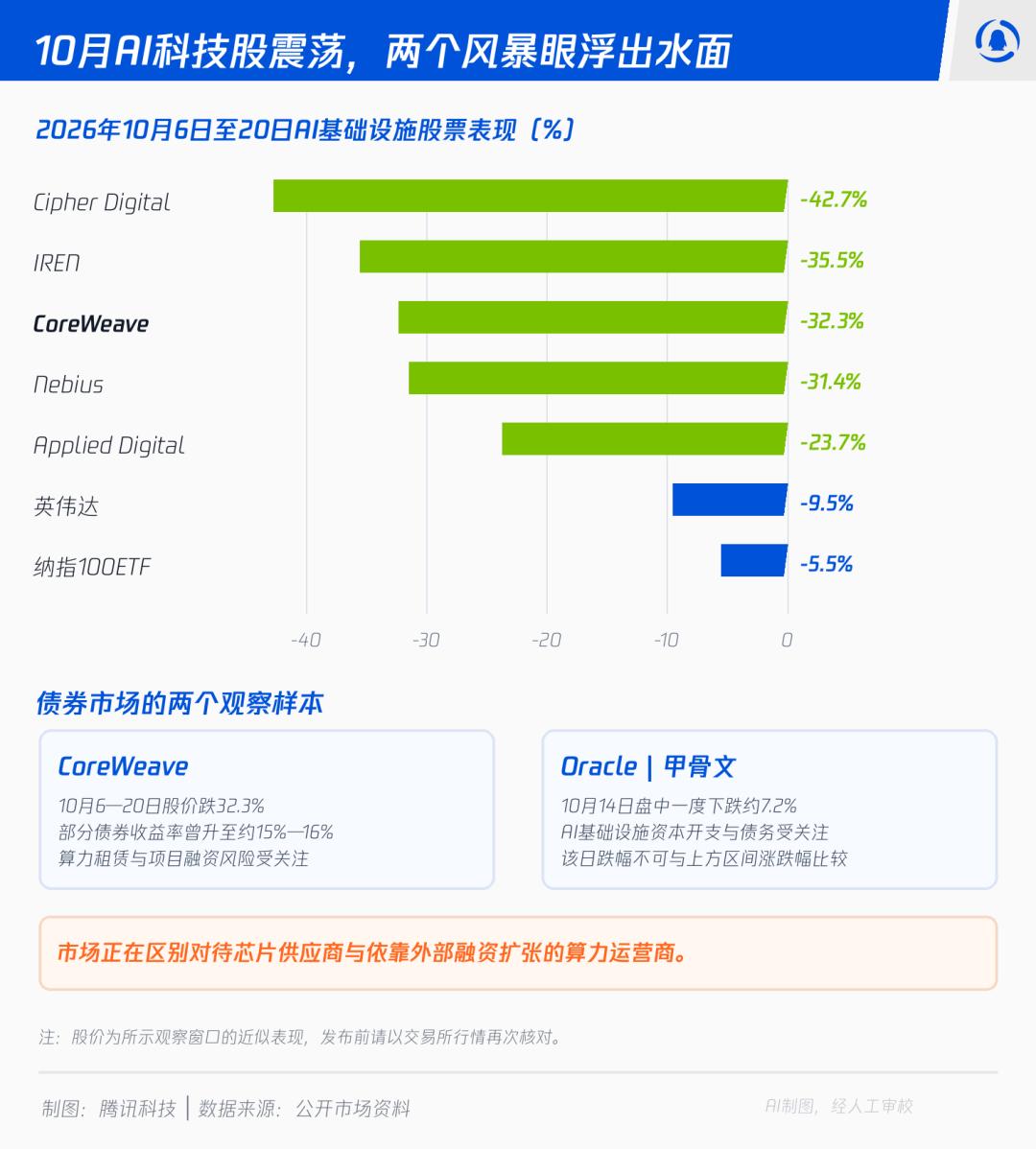
In this round of adjustment, AI infrastructure enterprises saw the most drastic fluctuations. CoreWeave, which rose rapidly relying on GPU leasing, saw some of its unsecured bonds sold off in mid-October, with the market yield once climbing above 15%. On October 28, Axios further found that the pressure in the bond market had been transmitted to enterprises building data centers for CoreWeave.
Oracle has also drawn the attention of investors. This traditional software giant is aggressively expanding its AI cloud business, but its massive data center construction plans have also brought continuous financing needs. On October 28, Oracle specifically announced a financing control plan at its Investor Day, trying to respond to market concerns about capital expenditure and debt scale.
However, just as the bond market is reassessing the risks of AI infrastructure, Wall Street is still raising more capital.
On October 26, Bank of America, Citi, Morgan Stanley and Blackstone Group announced a $63 billion financing arrangement to support Anthropic's use of Broadcom's AI chips and network equipment. According to the published structure, financial institutions provide financing for equipment procurement through a specially established entity, and then lease the equipment to Anthropic. Broadcom provides support within the agreed scope for the future residual value of the equipment.
While bonds of some computing power enterprises are being sold off, tens of billions of dollars in new financing continue to advance. The market's attitude towards AI investment is diverging: capital is still willing to enter this industry, but the conditions for different enterprises and projects to obtain financing have begun to show obvious differences.
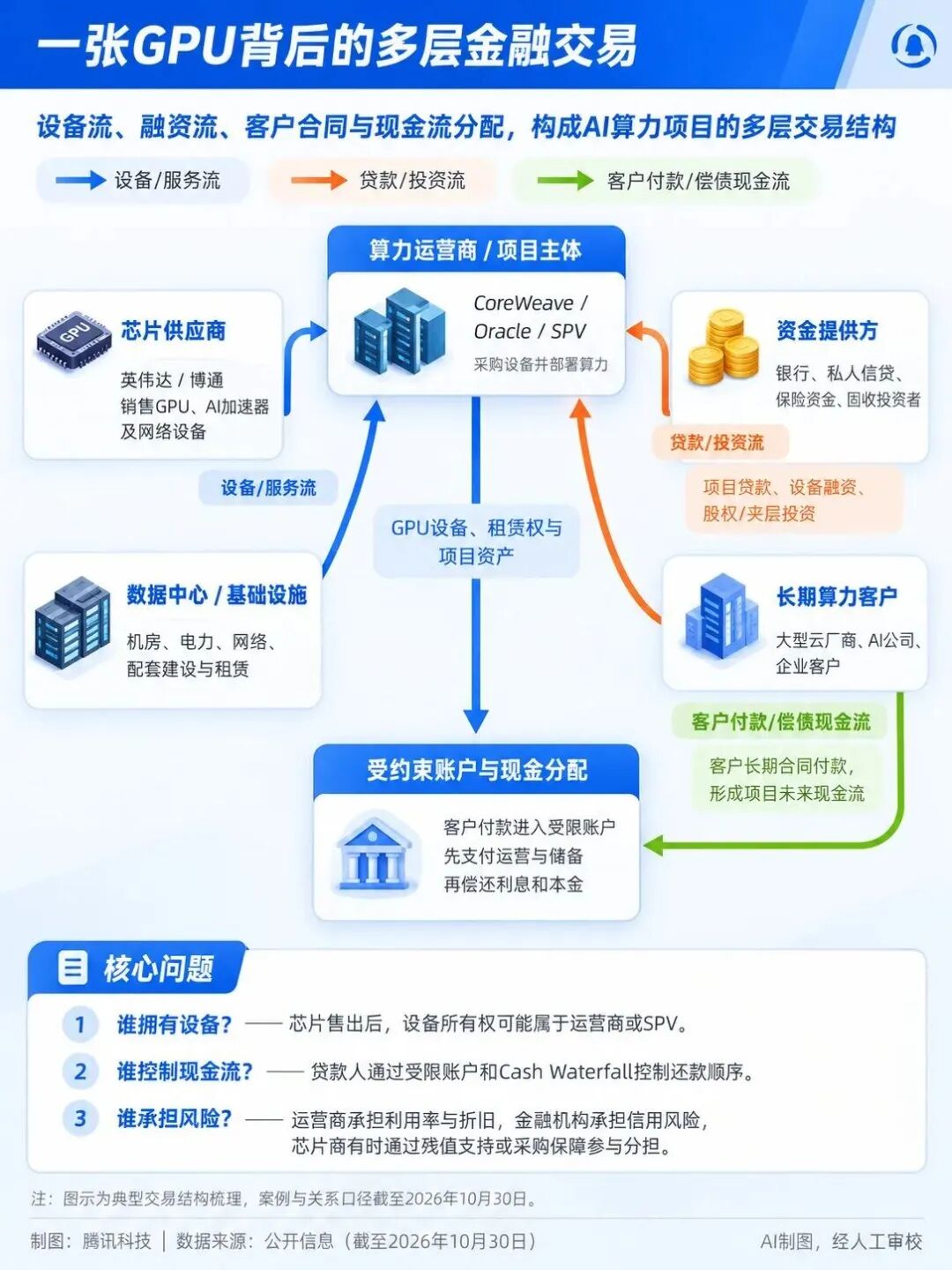
Continuing to track along these transactions, a complete set of complex financial arrangements has been connected behind the whole process of a GPU being sold from the chip manufacturer, deployed in the data center, and generating computing power revenue. Equipment can become collateral assets, long-term computing power contracts can support loans, and customer payments in the next few years become the basis for debt repayment.
Chip iteration may only take one or two years, but related loans may last for six or seven years. When the financial market begins to recalculate the long-term value of these devices, pressure may be transmitted from computing power operators to data center developers, and even affect the next round of chip procurement.
The multi-layer transactions behind a single GPU are affecting the sensitive nerves of the entire tech stock market.
01
A $8.5 Billion Loan
CoreWeave and Oracle have become the two storm centers of this round of AI tech stock adjustment, and there is a common problem behind them: huge computing power orders have been signed, but the GPUs and data centers required to deliver these orders require a large amount of capital investment in advance.
CoreWeave's model is particularly typical. The company leases GPU computing power to customers such as Microsoft and Meta. To meet the rapidly growing demand, it needs to continuously purchase NVIDIA chips, build or lease data centers, and gradually recover its investment relying on computing power revenue in the next few years.
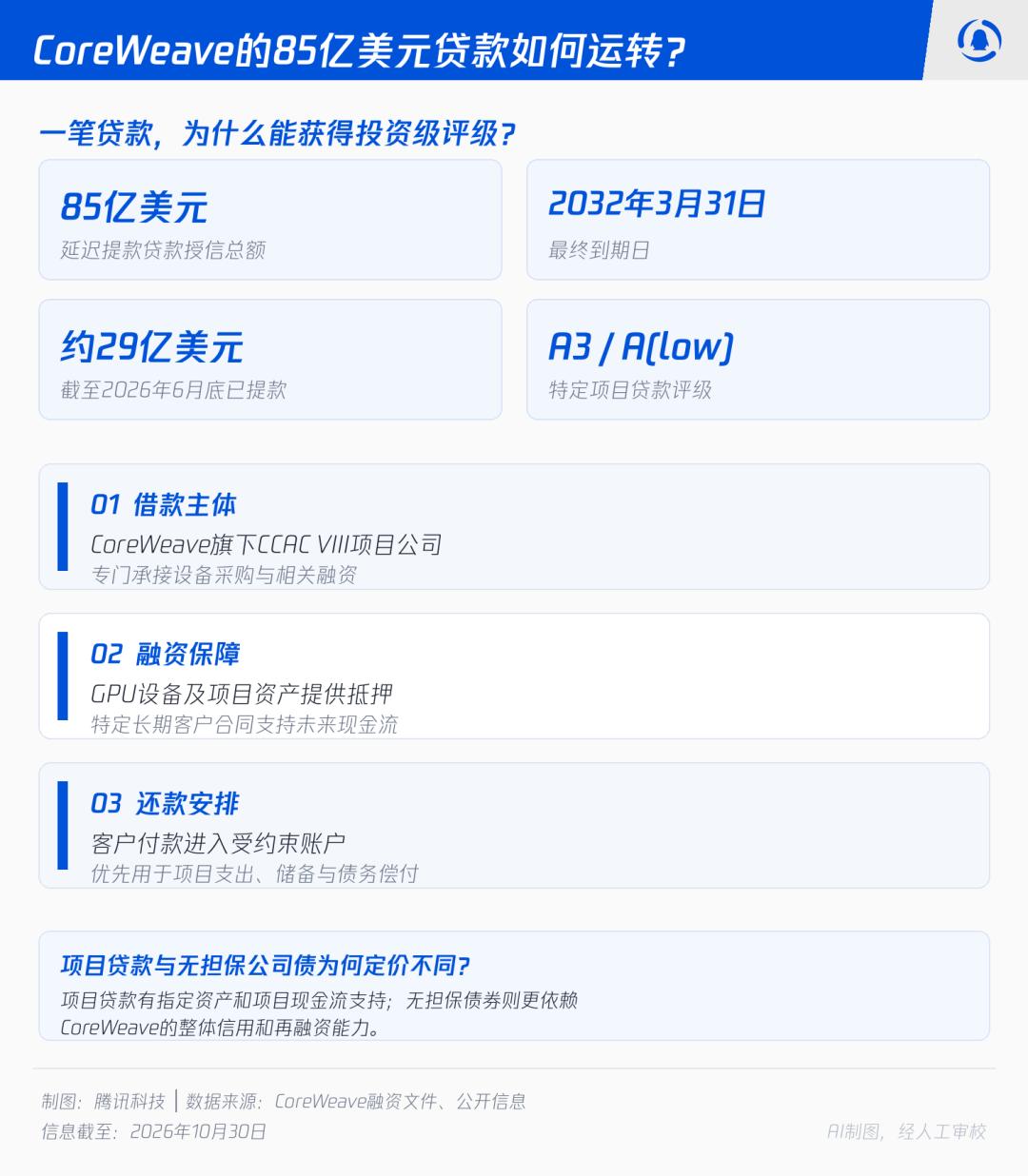
On March 30 this year, a $8.5 billion loan signed by CoreWeave revealed the financial structure behind this business.
According to documents submitted to the U.S. Securities and Exchange Commission (SEC), the direct borrower is CoreWeave Compute Acquisition Co. VIII (CCAC VIII), a specially established entity under CoreWeave. This is a delayed drawdown loan (DDTL 4.0), which is mainly used to purchase GPU servers and supporting infrastructure to fulfill long-term computing power contracts of specific customers, with a final maturity date of March 31, 2032.
$8.5 billion is the credit line, not the total amount credited at one time. As of the end of June 2026, about $2.9 billion of this loan has been drawn.
This financing involves multi-layer transaction relationships.
The first is equipment. CoreWeave purchases GPUs through the project entity, and the related servers, infrastructure and other project assets become part of the loan collateral.
The second is customer contracts. The loan is also supported by specific long-term computing power procurement contracts and related rights and interests. Financial institutions evaluate not only the mortgage value of the GPU itself, but also whether customers can continue to pay computing power fees in the future.
The next part is the capital providers. Institutions such as MUFG and Morgan Stanley participate in the financing arrangement, and financial institutions such as Blackstone Credit & Insurance provide capital support. The arranger, agent bank and final lender have different responsibilities.
The last part is repayment. CoreWeave's loan agreement sets up a Cash Waterfall mechanism, where project revenue enters a restricted account, and pays operating expenses, debt principal and interest, and related reserves as agreed. Only after the loan conditions are met can the remaining funds be distributed.
Lenders thus obtain not only the mortgage right of the equipment, but also a complete set of constraints and protection mechanisms for the future cash flow of the project.
This set of financing arrangements has also brought a very interesting phenomenon: for the same CoreWeave debt, Wall Street's risk pricing varies greatly.
In March this year, this $8.5 billion project loan of CoreWeave obtained investment-grade ratings including Moody's A3, with a floating interest rate of SOFR benchmark rate plus 2.25 percentage points, and the initial fixed interest rate part was about 5.9%.
But by mid-October, another unsecured corporate bond of CoreWeave was concentratedly sold off, and the market yield once climbed above 15%.
The difference mainly comes from the financing structure. The former loan is supported by GPU equipment, project assets and long-term customer contracts, and lenders can also control the debt repayment order of project revenue through special accounts; the latter unsecured bond lacks the same level of specific asset protection, and investors need to consider more about CoreWeave's overall operation, debt burden and future refinancing capacity.
Wall Street is still willing to provide capital for AI computing power investment, but it has begun to calculate the risk of each loan more carefully.
Compared with CoreWeave, Oracle has a mature software business and operating cash flow, but the expansion of its AI cloud business has also brought huge demand for GPU procurement and data center construction.
Facing investors' concerns about capital expenditure and debt scale, Oracle proposed a financing control plan at its Investor Day on October 28, and plans to make more use of supplier financing, customer prepayments and customer-provided hardware to reduce its own upfront cash demand.
Despite different financing methods, both CoreWeave and Oracle are trying to solve the same problem: how to support the increasingly huge AI computing power investment at a lower capital cost.
As the scale of GPU procurement continues to expand, chip transactions have been deeply bound to the financial market. More and more financial institutions are participating in it, providing capital for AI infrastructure construction, and beginning to take the risks of equipment depreciation and future revenue falling short of expectations.
02
Wall Street Is Turning GPUs Into New Financial Assets
CoreWeave is not an isolated case. As the scale of computing power procurement reaches billions and tens of billions of dollars, banks, insurance companies and private credit institutions are building more and more diversified financing arrangements around AI chips.
On October 1, Lambda, another GPU cloud service company, announced the completion of $1.008 billion fixed-rate financing, maturing in May 2033, with an interest rate of 6.78%.
This loan is supported by three confirmed computing power deployment projects, involving two customers with investment-grade credit qualifications. GPU servers, related infrastructure and customer contract cash flow together form the financing guarantee basis.
Compared with CoreWeave's project loan, Lambda's transaction has another noteworthy change: it pushes financing to insurance companies and fixed income investors, and obtains investment-grade ratings of Moody's Baa1 and Morningstar DBRS A(low).
Lambda CEO Michel Combes said in the financing announcement that this type of capital invested in infrastructure considers a time span of ten years.
For a GPU cloud company, being able to enter the market of long-term institutional investors such as insurance funds means that financing sources are no longer limited to traditional banks and private credit funds.
But larger-scale transactions have just emerged.
On October 26, Bank of America, Citi, Morgan Stanley and Blackstone announced a $63 billion financing arrangement to support Anthropic's deployment of Broadcom AI accelerators and network equipment.
The transaction will be executed through a newly established SPV. This entity uses the capital committed by financial institutions to purchase equipment, and then leases it to Anthropic. Broadcom provides support for the residual value of the related equipment.
This arrangement is significantly different from the traditional direct enterprise purchase of chips: equipment ownership, right of use, capital providers and residual value risk bearers can be distributed among different entities.
This transaction also shows that the financing system formed around AI chips is no longer limited to the NVIDIA ecosystem. In fact, NVIDIA has previously deeply participated in the financing and expansion of computing power customers through other methods. In January 2026, NVIDIA added a $2 billion equity investment in CoreWeave; earlier, the two sides also signed a computing power procurement agreement with an initial value of $6.3 billion, under which NVIDIA will purchase part of CoreWeave's unsold computing power under agreed conditions.
Compared with Broadcom's method of providing residual value support for equipment, NVIDIA provides different forms of support for customers through equity investment and computing power procurement commitments. The two companies adopt different specific arrangements, but both reflect a trend: chip suppliers have begun to participate more deeply in the construction of the downstream computing power market and take corresponding commercial risks.
In January 2026, NVIDIA announced the purchase of CoreWeave shares for $2 billion to deepen the cooperation between the two sides. And in September 2025, NVIDIA also signed a computing power procurement arrangement with CoreWeave with an initial value of $6.3 billion, agreeing to purchase part of the computing power of CoreWeave that has not been sold to other customers when conditions such as delivery and availability are met.
Therefore, NVIDIA has multiple identities for CoreWeave: chip supplier, shareholder, and also a computing power purchaser under specific conditions.
This arrangement helps CoreWeave reduce the risk of partial idle computing power, and also allows NVIDIA to obtain more computing power resources and ecological cooperation opportunities. But NVIDIA also bears the risk exposure brought by equity investment and procurement contracts.
Oracle has adopted another method. At the Investor Day on October 28, the company clearly stated that in the future, it will make more use of supplier financing, customer-provided hardware and customer prepayments to reduce its own upfront cash demand.
Supplier financing may delay equipment payment, customer prepayments can bring cash in advance, and customer-provided hardware may reduce the scale of equipment that Oracle itself needs to purchase
The common point is that the capital responsibility for GPU procurement and data center construction has begun to be shared by suppliers, customers, operators and financial institutions in different ways.
For chip manufacturers, this also means that competition is emerging in new dimensions.
In the past, AI chips mainly competed around performance, price, energy consumption, production capacity and software ecology. Now, when a computing power order requires billions or even tens of billions of dollars in upfront investment, who can help customers obtain long-term financing and reduce equipment residual value risk may also affect procurement decisions. Those AI infrastructure projects that can obtain sufficiently cheap capital will also be more competitive in the eyes of Wall Street.
03
Chips Are Iterating Continuously, Who Will Repay The Six-Year Loan?
Behind these financial transactions, there is another longer-term risk: the speed of GPU iteration may be much faster than the maturity date of the loan.
CoreWeave's $8.5 billion project loan will mature in 2032, and Lambda's latest financing will last until 2033. In the next six or seven years, new generation chips may continuously improve performance and energy efficiency. Even if old equipment can still operate, it may face falling lease prices and shrinking residual value.
Long-term computing power contracts can provide certain protection, but if customers default, projects are delayed, or the contract cannot be renewed at a reasonable price after expiration, lenders may face both reduced revenue and depreciated collateral. This is why CoreWeave's loan agreement sets up a strict debt repayment protection mechanism.
The tech stock volatility in October made different risks of AI infrastructure investment appear concentratedly. CoreWeave was impacted by rising financing costs and debt burden, and Oracle faced the pressure of huge capital expenditure. On October 30, Intel's stock price plummeted by nearly 29% again. Despite strong demand for AI servers, production bottlenecks limited delivery, and the manufacturing business continued to consume capital, the market began to worry whether its recovery could be transformed into stable profits.
Of course, this round of decline also has a macro background. In mid-October, US inflation data pushed up the market's expectation of another interest rate hike, and then hedge funds continued to reduce their holdings of tech stocks. According to statistics from Sherlund Partners, from October 9 to 23, stocks related to data center infrastructure fell by 18.2% in total, significantly exceeding the 5.9% decline of large cloud manufacturers in the same period.
High interest rates first hit enterprises that rely on external financing, and capital withdrawal amplified stock price fluctuations. Intel's plunge was superimposed by problems such as poor performance guidance and high manufacturing costs. The adjustment in October was driven by a variety of factors. The high debt and continuous capital expenditure of AI infrastructure enterprises made their stock prices particularly sensitive to changes in the market environment.
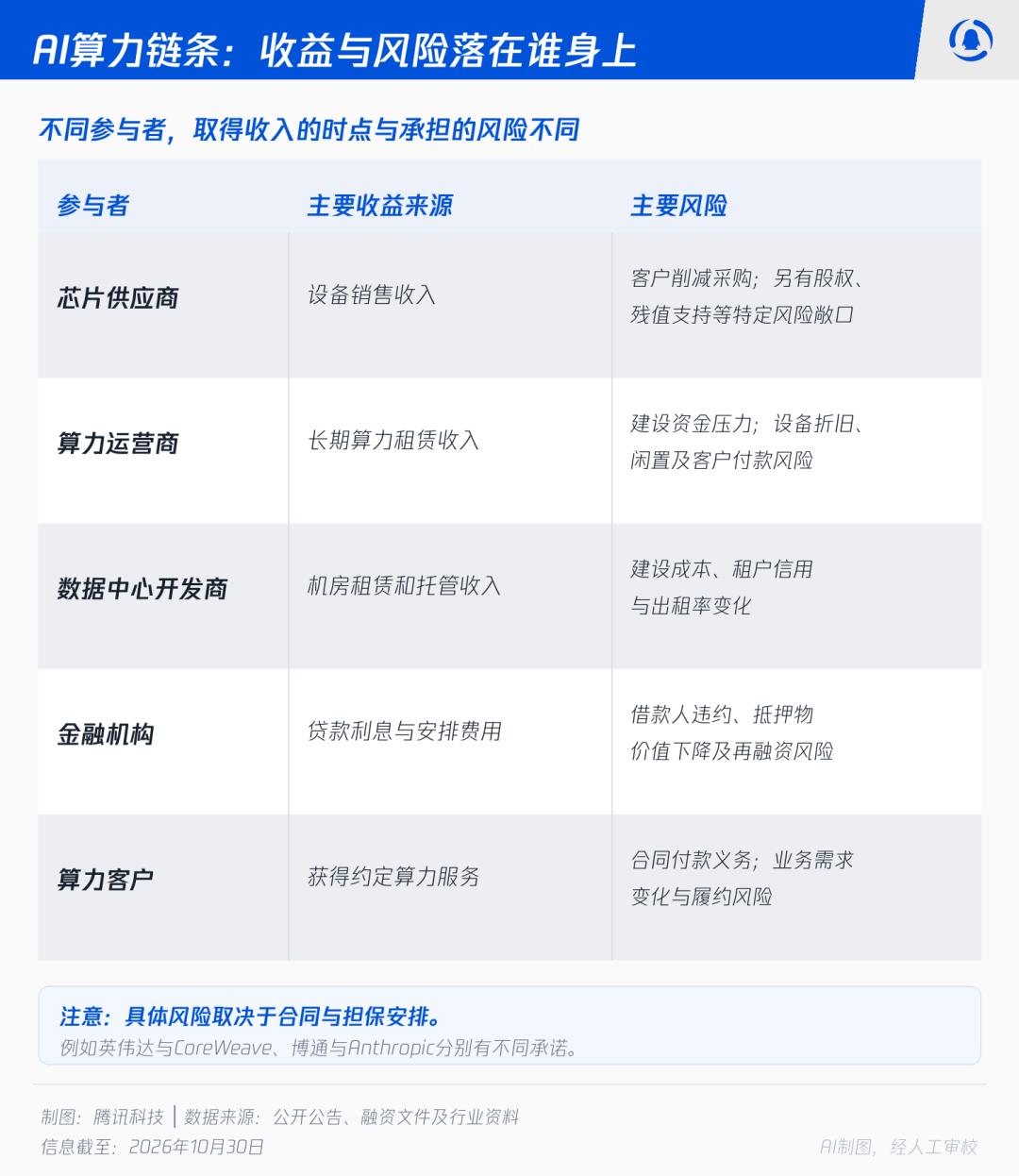
What is more noteworthy is the reaction of the bond market, where investors have begun to re-differentiate the debt repayment capacity of different projects. This means that even if the demand for AI computing power continues to grow, some enterprises may slow down their expansion due to excessively high financing costs.
The closer the interests are bound, the more the market worries, and the first domino has quietly fallen.
This article is from the WeChat official account "Tencent Technology", author: Xiao Jing, editor: Xu Qingyang, released by 36Kr with authorization.