ChatGPT will share the usage quota with Codex, and the era of free quota resets is over.
OpenAI's 28-day launch event is drawing to a close, and today it finally rolled out a major update — but it's not good news: ChatGPT and Codex will share the same usage quota.
Starting in December, the usage of ChatGPT and Codex for Plus, Pro, and Business plans will be merged, measured in tokens. Instant chat is excluded and will not consume this shared quota.

If you are used to first letting ChatGPT help you refine your plans, then letting Codex handle the implementation work, all usage counted towards the shared pool will be deducted from the same quota from now on. The more you use on one side, the less you have left for the other.
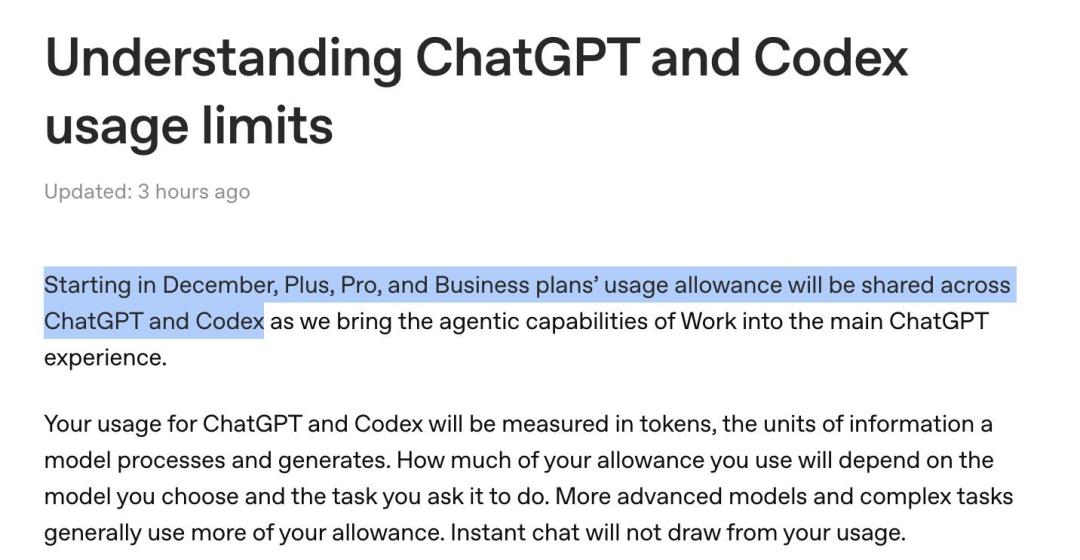
Screenshot from OpenAI's help page, source: attachment of the original post by Veee on X.
As soon as the news came out, a large number of users shouted "We are cooked" on X. Although OpenAI only announced a few days ago that it would double the quota, everyone is now worried whether the combined quota of the two services will last longer than the current one.
announced the quota doubling, but everyone is now concerned that after the two quotas are combined, will it be more durable than now?
How will the quota be merged? Will it last longer than before?
First, for the most concerned issue: your casual chats via Instant will not take up the shared quota. (Instant is a chat mode in ChatGPT that focuses on fast responses, suitable for daily Q&A scenarios.)
The shared part is measured in tokens. A token can be roughly understood as the unit of information processed and generated by the model: a simple question and a task that requires repeated reasoning and tool calling do not consume the same number of tokens. The more advanced the selected model is and the more complex the task is, the more tokens it usually consumes.
Therefore, which model you choose and how heavy the workload you assign to it will both affect how long your quota lasts.
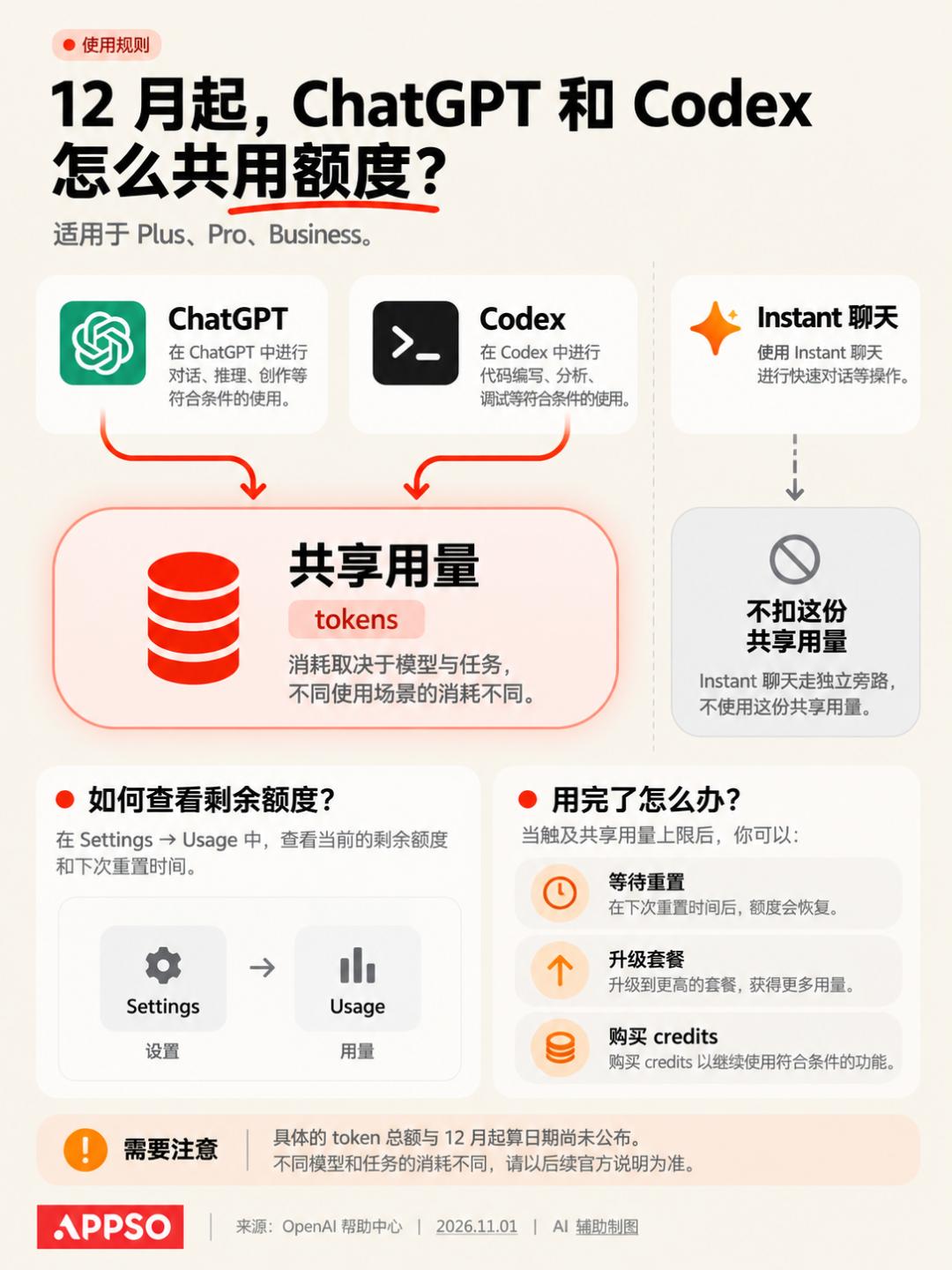
Compiled based on OpenAI's help documentation, AI-assisted illustration.
After the merger, remaining usage and reset time can be viewed at Settings → Usage. After the quota is exhausted, you can wait for the reset, upgrade your plan, or purchase credits, which are points for supplementary usage, to continue using eligible features.
OpenAI expects that most users will not need to wait for resets more frequently than now. However, the exact number of tokens in each tier's shared pool and the specific date in December when the new policy takes effect have not been announced yet.
This is also the part that users cannot figure out for now. Putting the two sets of quotas into one pool makes it easier to view and arrange usage in a unified way, but how much more work the same subscription can support still depends on the size of the pool and how tasks are counted.
In fact, Work, Codex and some office Agent features already have a shared usage mechanism before.
Work is the experience in ChatGPT for longer research and delivery tasks, and the limit for regular Chat is specified separately. This time, OpenAI will bring the Agent capabilities of Work into the main experience of ChatGPT, and the scope of sharing will be adjusted accordingly.
The new document clarifies the exception for Instant, but has not yet provided the full correspondence table between each model, feature and the new quota.
A few days ago, Tibo said that the company "graduated from being a company that resets quotas to a company that provides tokens", which now appears to be "premeditated".
On Day 26 of the 28-day event, he previewed the arrangements for the last two update days: banked resets, which are reset opportunities that can be saved and used when needed.
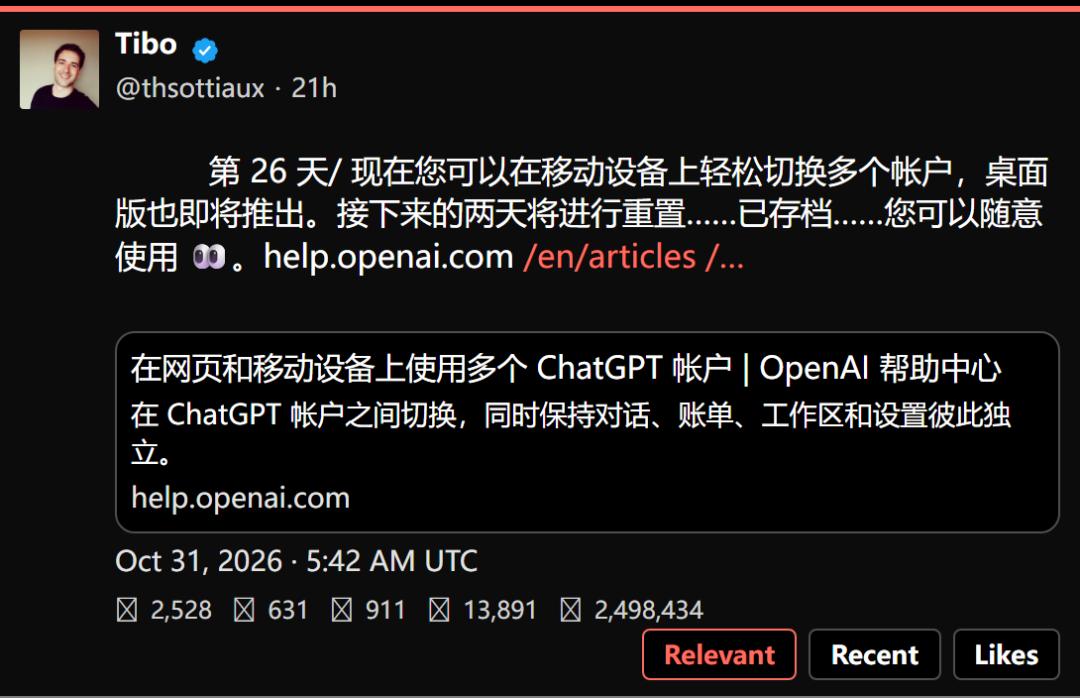
Tibo's original post on Day 26
For users who hit the usage limit while tasks are running, resets can really help in an emergency. Once the quota is restored, tasks can resume, so that the day's work does not get stuck.
But relying on repeated events to keep tasks running always makes people wonder: can these resets buy the team some time to solve the problem of excessive consumption together? After the event ends, users won't have to keep an eye on the resets all the time.
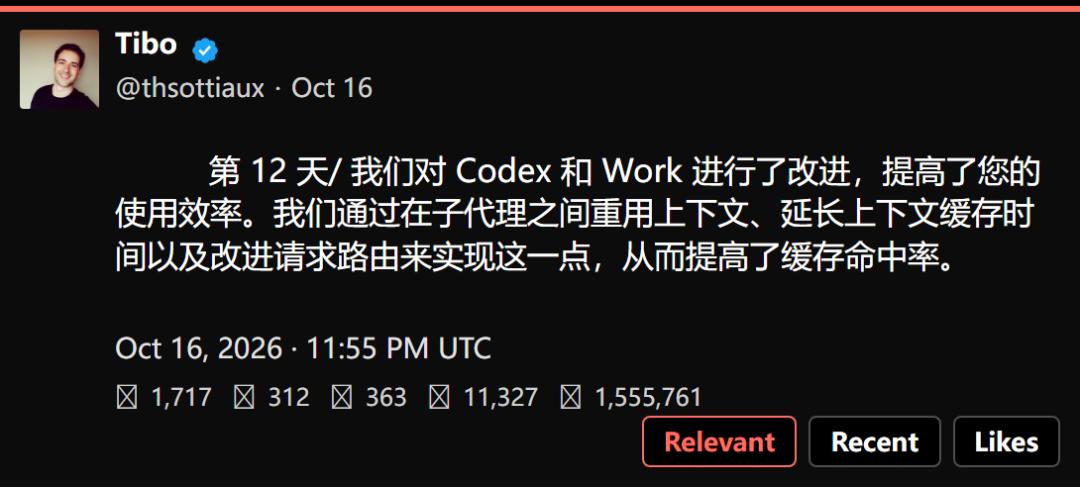
During this period, the team has indeed made efficiency optimizations. On Day 12, Tibo mentioned that Codex and Work started to reuse contexts across sub-agents, extended cache retention time, and improved request routing to increase cache hit rate. As a result, the same subscription can get more effective usage.
On October 29, OpenAI raised the quota for some plans again. The Work/Codex usage of Pro 100 and Pro 500 was doubled; the originally planned quota reduction for Pro 200 was canceled, users who already had a higher quota kept their existing usage, and users with lower quota were raised to the same level. Business Premium was also included in this upgrade.
Plus is not on the list of this round of quota increase.
This is what confuses users the most: there are already cache optimizations, quota has been increased for some plans, and now the usage scope is going to be merged. After the additional resets are over, can the daily quota last stably until the next regular reset?
Plus users: Are we cooked?
On October 29, someone found a new prompt on ChatGPT's checkout page: Starting in December, ChatGPT and Codex will share the same usage cap.
Afzal relayed Tibor Blaho's discovery on X, opening with the line:
"Plus users, we are cooked!"
He is worried that after the two services share the quota, the already tight usage will become even more insufficient.
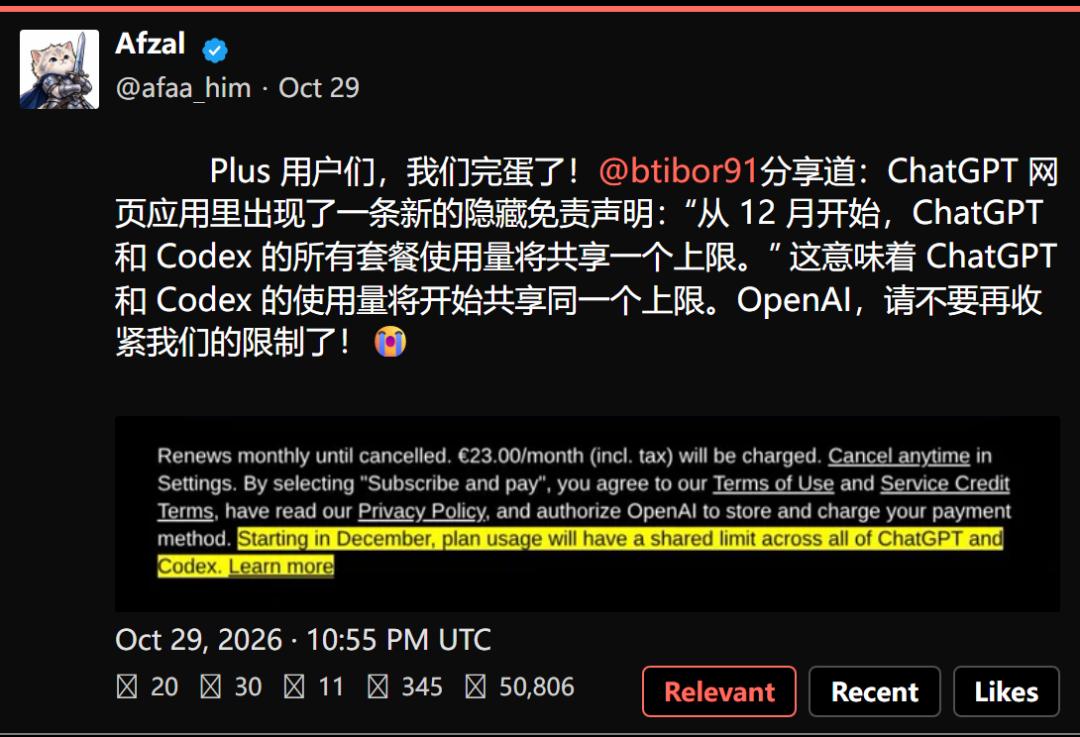
Afzal's reaction when the early prompt was circulated
The next day, Salio discussed the subscription value of Plus. He believes that ChatGPT's usage limit has always been part of the subscription's appeal, but Plus users have not received corresponding quota increases before hearing the news of merged quotas. He hopes OpenAI will listen to the opinions of this group of users before making adjustments.
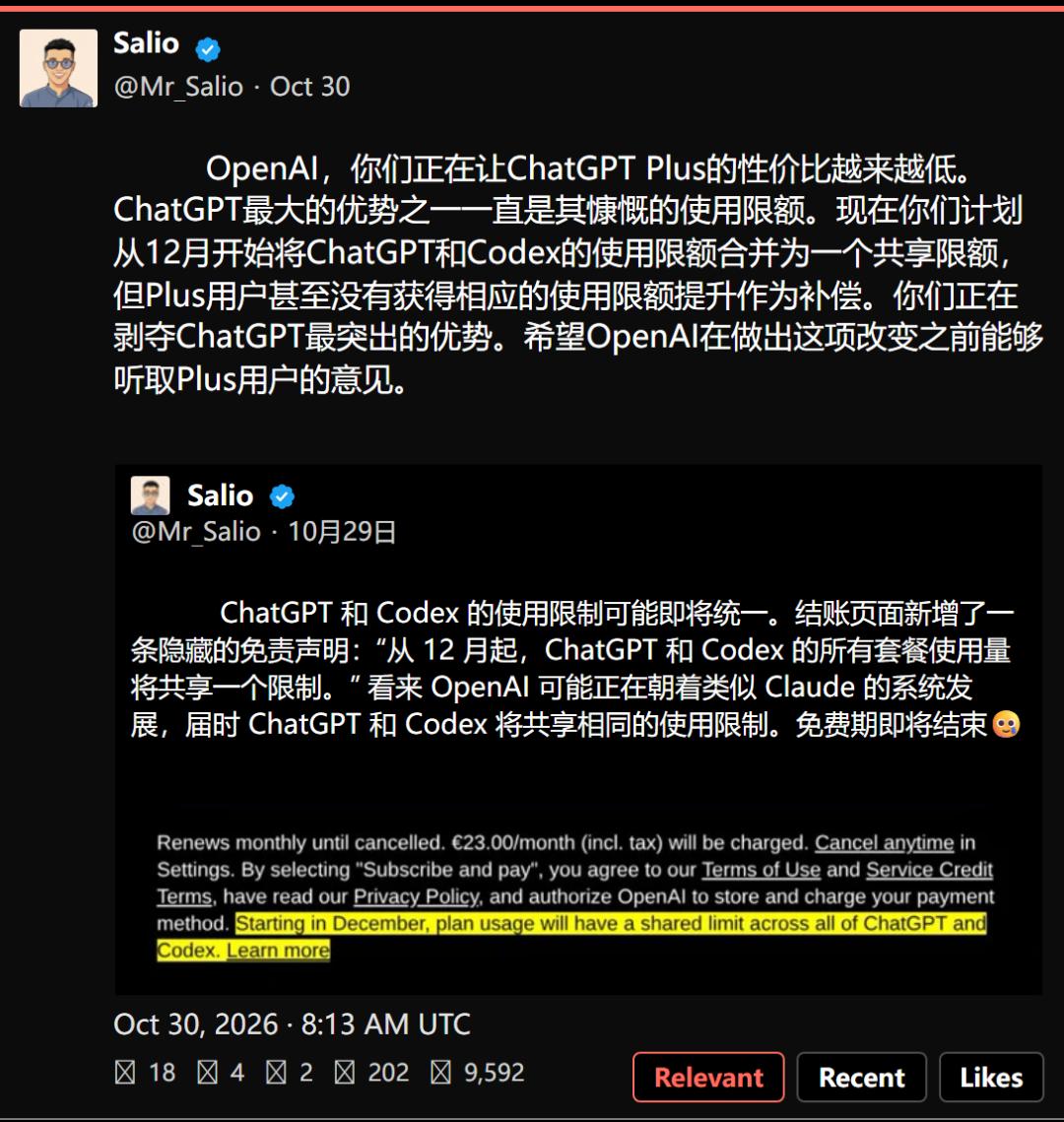
Salio's discussion about Plus on October 30, screenshot from the public reading page of the original post.
Many users regard "unlimited chat" as the experience they are most reluctant to give up. They also dug up previous statements like "so cheap that no metering is needed" and "benefit all mankind" to complain about the gap between regular users and high-priced plans.
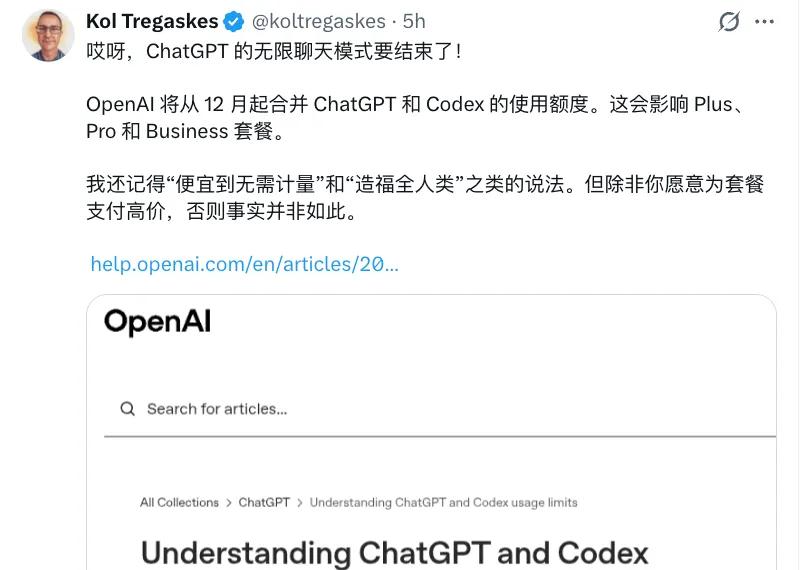
Aymane spoke in a very intense tone, directly describing this move as "the worst mistake in AI history".
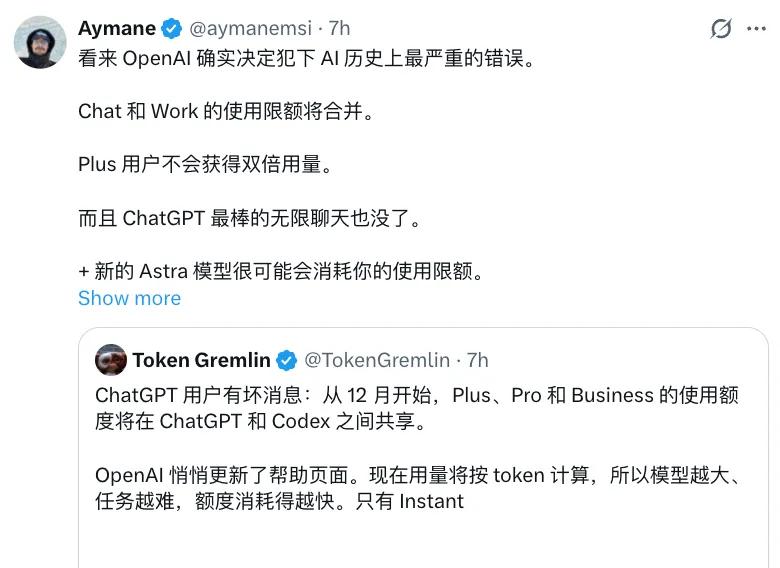
Some users even directly took the quota limit as a factor for tool selection. Paul Cleverly said in his reply to Tibo that affected by the 5-hour usage limit, he no longer assigns long tasks to Codex, and instead uses DeepSeek or GLM. He thinks these tools are sufficient for his needs, and as a result, he uses OpenAI less often.
For him, the quota limit has already influenced which tool he chooses to assign tasks to.
Is it feasible to buy multiple accounts and switch between them?
When the quota is insufficient, some users may think of buying another account and switching between them.
This path is also going to be blocked. Codex has launched a stricter policy: if too many paid accounts are bound to one device, the accounts may be banned.
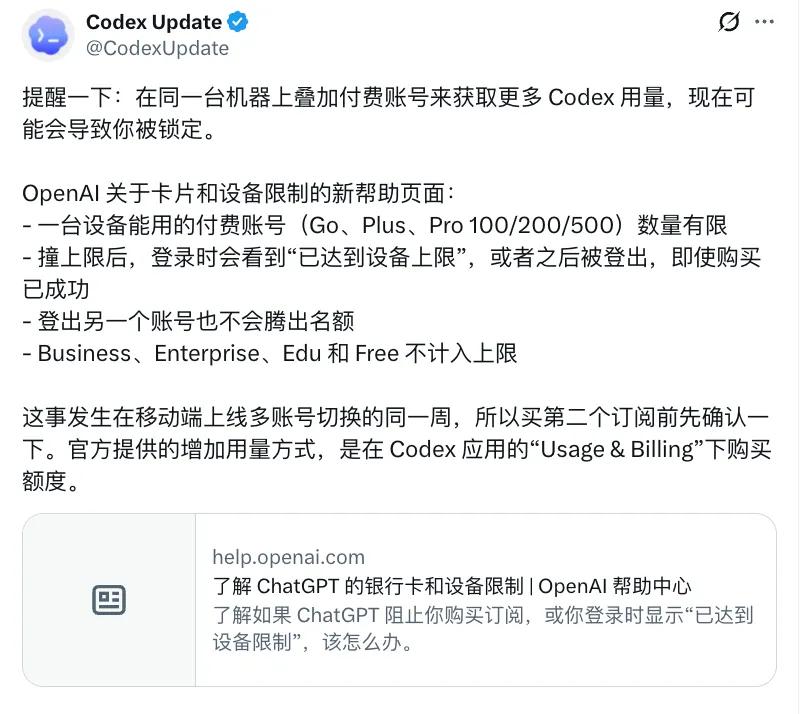
According to the official description, too many subscriptions associated with the same payment card or the same device may prevent new subscription purchases. The device will also limit the number of personal paid accounts that can be used: you may see the prompt "Device limit reached" when logging in, or you may be logged out after a period of usage after purchase.
The "locked" here means that the paid account cannot be used on this device, which does not equal a permanent ban. Simply logging out of another account does not guarantee that a new slot will be freed up.
What is most confusing is that OpenAI just launched the account switching feature, and now it is restricting multiple accounts?
The switcher supports keeping up to two accounts logged in at the same time, and using one of them at a time; the device restriction controls how many personal paid accounts can be used on one device. The "two" for the former is not the public upper limit for the latter. The official has not specified the exact number of the latter.
The device restriction covers Go, Plus, Pro 100, Pro 200 and Pro 500; Free, as well as Business, Enterprise, and Edu workspace plans are not counted.
For users who have already purchased multiple subscriptions, subscriptions purchased before the restriction takes effect can continue to be used; canceling one of them does not guarantee that you can buy a replacement later. On family or public devices, where multiple people use their own accounts, you may also hit the restriction, and you can contact support to explain the situation.
Purchasing credits or using reset opportunities will not clear the device restriction.
Despite all the complaints, merged usage is not entirely without benefits. Chatting, researching, and coding are increasingly becoming a continuous task, and users no longer need to repeatedly calculate how much remaining quota they have in different entrances.
But after paying for the subscription, what users care most about is how much work they can get done every day.
If the shared pool is large enough and efficiency continues to improve, the experience after the merger may be better. But as users, there are still many unclear points: how many tokens are allocated to each tier, how long can you run tasks using the same model for the same workload...
In any case, the era of unlimited free chatting on ChatGPT is coming to an end.
This article is from WeChat Official Account "APPSO", written by APPSO who launches tomorrow's products, authorized for release by 36Kr.