Dowson Tong on WorkBuddy's Commercialization: No Pushing the Team with Revenue Figures
Tencent is integrating more office capabilities into WorkBuddy.
On October 29, at the 2026 Tencent Global Digital Ecosystem Summit, Tencent released the cross-application office collaboration system Buddy One, which connects products including Tencent Docs, Tencent Meeting, ima and Tencent Cloud Drive, to promote the interconnection of accounts, AI points and part of service rights. WorkBuddy will further open up its product architecture to support access to enterprise self-developed agents, third-party agents and third-party communication systems.
In June this year, Dowson Tong, Senior Executive Vice President of Tencent Group and CEO of Cloud and Smart Industries Group, once stated that the WorkBuddy team would not be set with commercialization targets for the time being. At this summit, when Intelligence Emergence asked again about commercialization related issues, Dowson Tong did not give a specific figure.
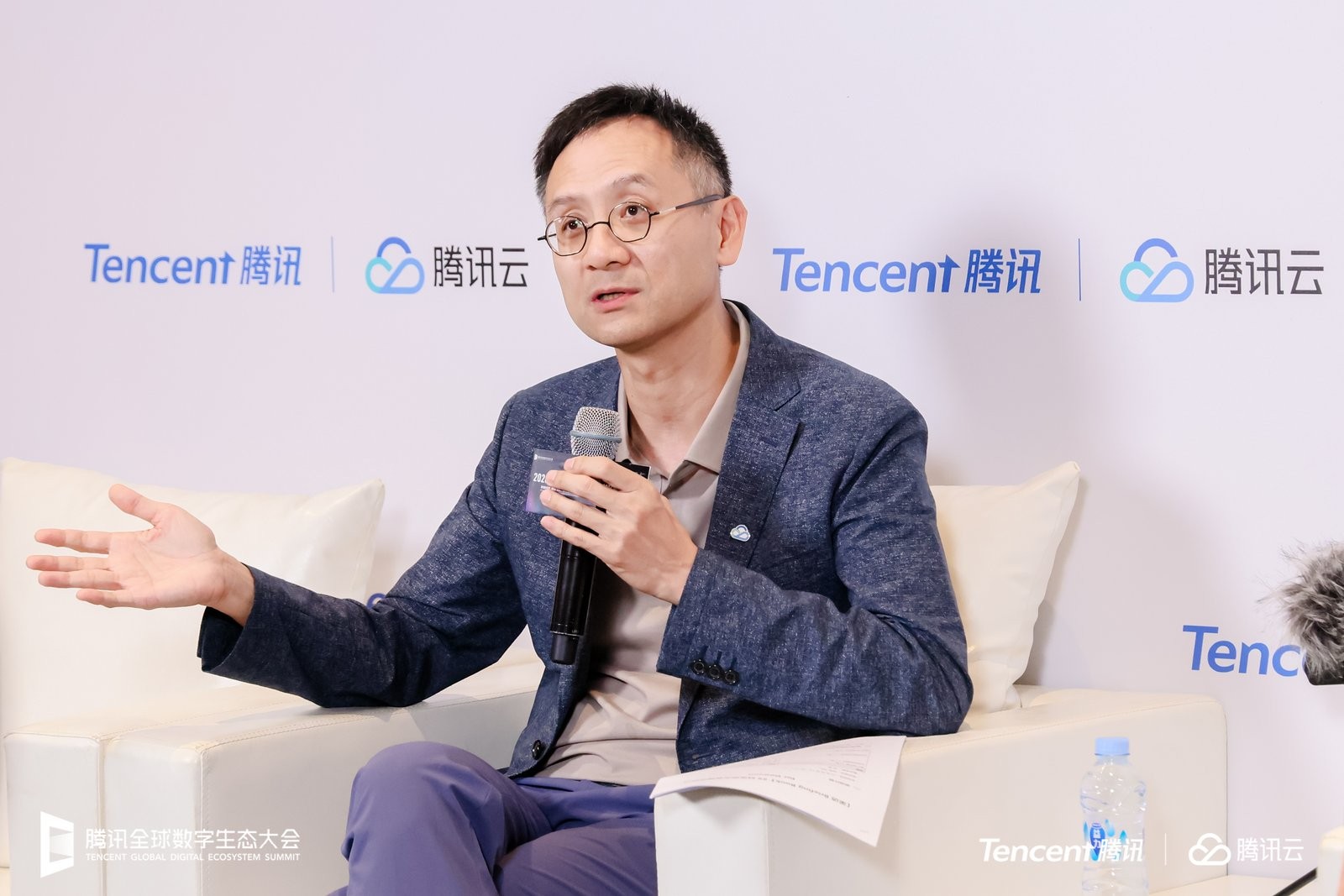
Dowson Tong being interviewed
"For the commercialization of WorkBuddy today, I think we consider it more from the perspective of supporting the development of this product and service, instead of setting a certain number to force the team to meet," Dowson Tong responded.
He further explained that some of the third-party partners introduced by Tencent are dedicated to providing FDE services for customers, which means engineering personnel go deep into enterprises to participate in deployment and process transformation. "They also need a business model, and they cannot work for free."
The expansion of customer scale has also brought cost pressure for continuous services. When talking about enterprises' demands for security, observability and management, Dowson Tong said, "A small amount of revenue is mainly used to make this business develop better."
After this summit, product integration and commercialization of WorkBuddy will be promoted simultaneously. The former needs to solve the problem of how to connect office applications, enterprise data and third-party capabilities, while the latter needs to cover the input of customer implementation and continuous services in addition to subscription fees.
01 Office Capability Integration, Independent Product Entries Remain
The newly released Buddy One is mainly designed to connect materials and tools in different applications, supporting WorkBuddy to retrieve and integrate content of documents, meeting minutes and knowledge bases within the authorized scope; products including Tencent Docs, ima and Tencent Cloud Drive also share the Agent base of WorkBuddy.
Dowson Tong linked this integration to the changes in office collaboration methods: in the past, collaboration often relied on the back-and-forth transmission of file versions; he hopes to connect content generation, browsing and modification through the WorkBuddy workspace.
When asked whether the products will be further merged, Dowson Tong left the retention of independent entries to users' choice: "If users only need this capability, and this UI method allows them to complete tasks most efficiently, this independent entry has a reason to exist."
The joint version of WeCom and WorkBuddy released on October 14 has adopted the coexistence of two entries: employees can use WorkBuddy in WeCom, and can also call authorized WeCom data in WorkBuddy.
"These two systems advance side by side," Dowson Tong said. WeCom still needs to meet the demands of person-to-person communication and enterprises' services for their customers. "This makes WorkBuddy meaningful, as it can obtain valuable signals from it."
The connection between entries is also restricted by enterprise permissions and business rules. Taking Tencent itself as an example, Dowson Tong explained that tens of thousands of employees use WorkBuddy, and it is impossible for everyone to access data arbitrarily. Enterprises need to implement the requirements of managers and data owners on the server side.
"The challenge actually lies on the server side: how do you ensure data permissions, how do you ensure that the use and calling process will not infringe on others' privacy, and will not cause unreasonable operations because the large model does not understand some requirements of the underlying system," he said.
In addition to Tencent's own office products, WorkBuddy has launched its open platform on September 2, introducing industry applications, developers and hardware partners.
Dowson Tong explained on this point: "The open ecosystem itself is a way to access many capabilities and data that Tencent does not possess." In this process, Tencent provides basic capabilities such as document processing, and partners build applications serving users in specific industries on this basis.
02 Commercialization Needs to Support Services, and Enterprise Customers Also Expect Returns
Launched synchronously with Buddy One is the commercialization solution Buddy One VIP, which integrates rights including WorkBuddy Flagship Edition, Tencent Meeting Professional Edition, and Tencent Docs Super Member Plus into one single solution.
For the overall charging strategy of WorkBuddy, individual subscription and enterprise procurement plans are being promoted in parallel. When Intelligence Emergence asked which side grows faster, Liu Yi, Tencent Cloud Vice President and Head of CodeBuddy and WorkBuddy, said that both sides "are growing very fast". He provided two sets of scale data: "Now 50% of China's top 500 enterprises are using WorkBuddy, and more than 9 billion tasks have been submitted on the WorkBuddy platform in total."
In addition to subscriptions, enterprise applications also involve third-party development and implementation services. Liu Yi introduced in the group interview that there are already 200,000 Skills on the open platform, and Tencent hopes that partners will develop applications for fields such as finance, finance and accounting, legal affairs, and sales.
Delivery for key customers requires in-depth engagement with specific businesses. Liu Yi introduced that Tencent connects the platform with internal processes, data and permissions of enterprises through FDE, but there is a learning process for engineering personnel to enter the customer site. "We have no idea about many positions and processes at BYD." Taking BYD as an example, he explained that FDE needs to learn and build together with the enterprise IT team to connect the skills and links in the production process.
For small and medium-sized enterprises, Liu Yi proposed a different service path: "Micro, small and medium-sized enterprises are served by partners, not by FDE. Only partners can achieve large-scale coverage."
Since office Agents need to execute complex task scenarios, continuous model calls and computing power consumption are the main sources of Agent costs. This summit previewed the new models of Hunyuan that are about to be released: Hy4 and Hy4 Flash. Tencent positions the latter as a version focused on cost-effectiveness.
In response to the question raised by Intelligence Emergence about "what models are more suitable for the Agent platform", Liu Yi focused on how model manufacturers adapt to tasks: "They do not adapt to WorkBuddy as a unique platform vendor, but adapt to user scenarios." He further explained that high-frequency, easy-to-verify and clear-goal tasks in daily productivity work are the priority scenarios that WorkBuddy will cover in 2026. Products can benefit directly only when models are trained and improved in these directions.
Dowson Tong said that multi-model access will continue to be retained. Models differ in optimization for different tasks, pricing and even Token usage effects. "Allowing users to use different models for different tasks" is the direction that WorkBuddy will continue to adhere to.
Regarding the cost pressure brought by high-complexity tasks, Liu Yi said: "We have never thought of cutting off some high-complexity and high-value scenarios, but thinking about how to provide good services for them." He hopes to reduce processing costs through declining Token prices and technological optimization. As for when the overall gross profit margin will improve significantly, his estimate is "probably two or three years".
The platform aims to reduce service costs, while enterprise customers need to judge whether purchasing AI services can bring operational returns. The global AI survey released by McKinsey in August shows that 80% of respondents said AI has improved their personal work efficiency, and 37% said AI has made a positive contribution to the EBIT of their enterprises.
In the view of Wang Huixing, Vice President of Tencent Group and CTO of Tencent Cloud, organizational efficiency improvement should eventually be reflected in business growth, or completing work at lower operating costs, but different enterprises still lack consensus measurement indicators. Enterprises have very specific questions now: "We have spent so much money and used so many Tokens, and enterprises are asking who is using it, where it is used, and what the effect is?"
"This problem needs to be faced and solved jointly by WorkBuddy and enterprises, because it is also difficult for us to measure the effect of this business," he said. Recording usage can help track consumption, but operational returns still need to be judged in combination with customers' businesses.
Back to Tencent's own investment, when asked whether Tencent will make "unlimited" investment in WorkBuddy in the next two years, Dowson Tong said: "Any enterprise has limited capital, and there is no such thing as unlimited investment. WorkBuddy is indeed a very important strategic product for us at this stage."
Talking about how to judge whether a business is worth sticking to, he put forward two criteria: whether users will stay after subsidies are stopped, and whether the price users are willing to pay can match the service cost. Large upfront fixed investment without net profit yet, and the situation that new revenue cannot cover new costs need to be treated differently.
"If users are willing to pay, and the revenue can cover your operating costs at the same time, then this business can truly achieve healthy and sustainable development," Dowson Tong said.