AI plagiarists are going all out to destroy the gaming industry.
Recently, the issue of AI plagiarism has been widely discussed, causing widespread panic among people.
I can only say that the situation is probably more serious than most people imagine.
As AI becomes more user-friendly, to the point where you can generate a whole game with just one prompt, some people will naturally start to think of crooked ideas. If a group of indie game creators hadn't spoken out, most ordinary people might not have realized that AI has been so wildly misused.
Earlier this year, Swedish indie game developer Freya Holmér shared a gameplay prototype video of a rotating Tetris-style game on X. Back then, Freya just wanted to share the idea sincerely, without even figuring out the specific rules. But in less than five hours, someone used AI to produce the Demo. Isn't that infuriating?
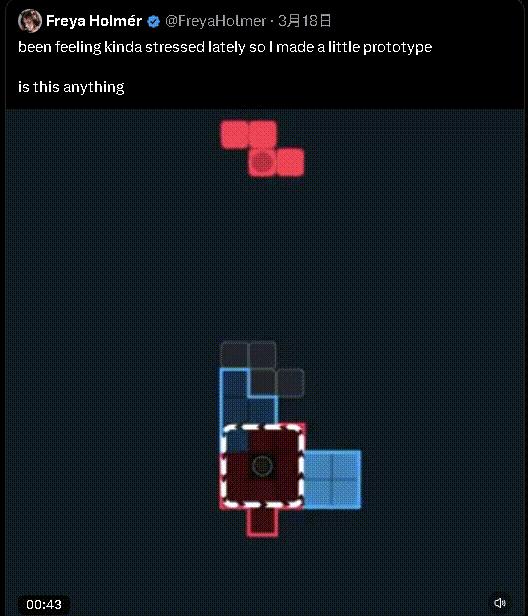
There are countless similar cases, especially for casual/creative gameplay concepts. Whether you have released a Demo or not, as long as there is a gameplay demo video, development recording, or even a single screenshot, the idea is likely to be copied quickly. Overseas people call this "cloning", which is a pretty accurate description...
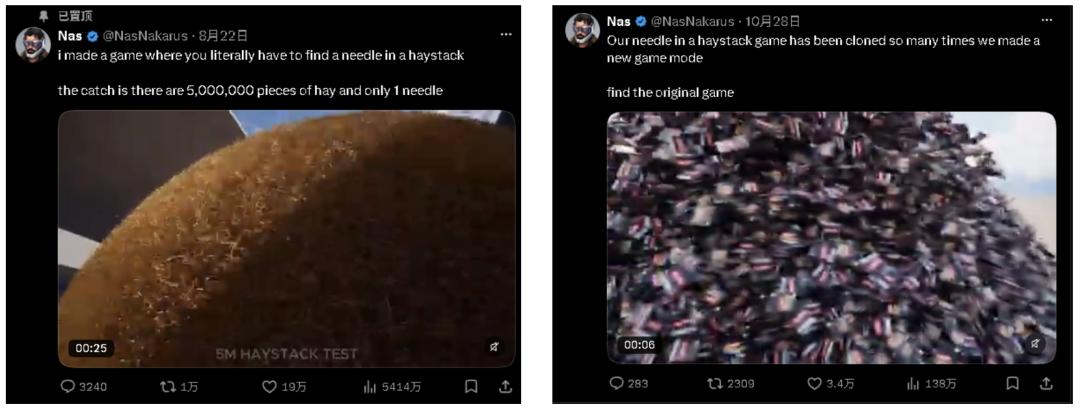
For example, there is a game called *Needle in a Haystack Simulator*, whose gameplay is to find a needle in a haystack. It has received 50 million views on X. As soon as this video went viral, a dozen clones popped up on Steam, some of which even explicitly marked that they were developed with AI assistance. At that point, the original creator hadn't even released the Demo yet.
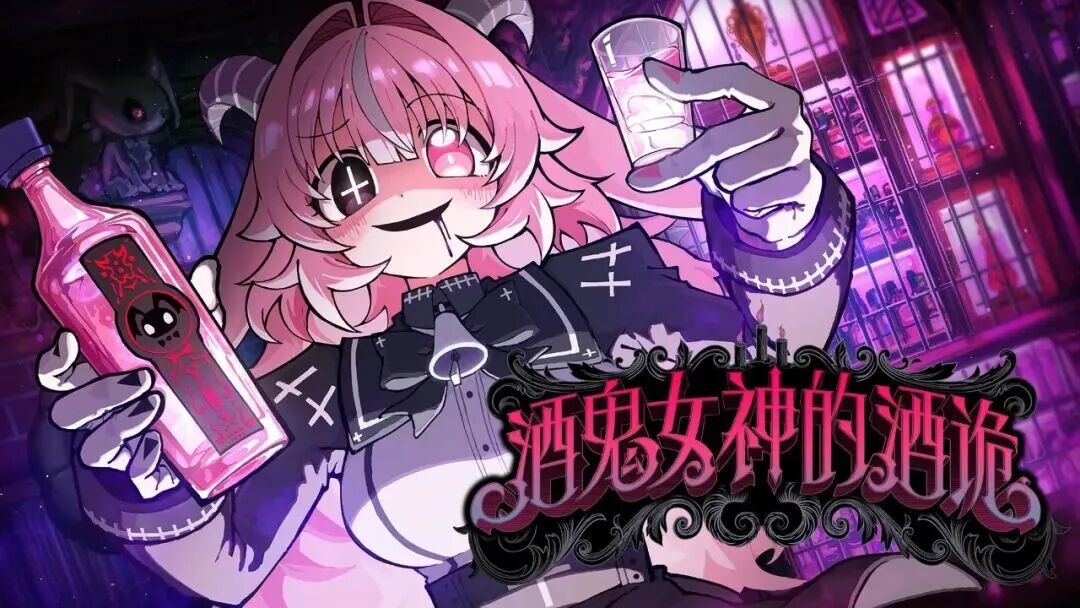
As these annoying incidents pile up, more and more creators have started to become extremely cautious — Japanese game producer Kazuki Hayashi previously announced that their game *The Drunken Goddess's Wine Tricks* will no longer release a free public Demo, and will instead adopt a small-scale lottery-based trial system; the new title *ReVamp* from the team behind the well-known Roguelike game *Moonlighter* also announced the cancellation of public beta testing, and will only keep closed tests for the Discord community.
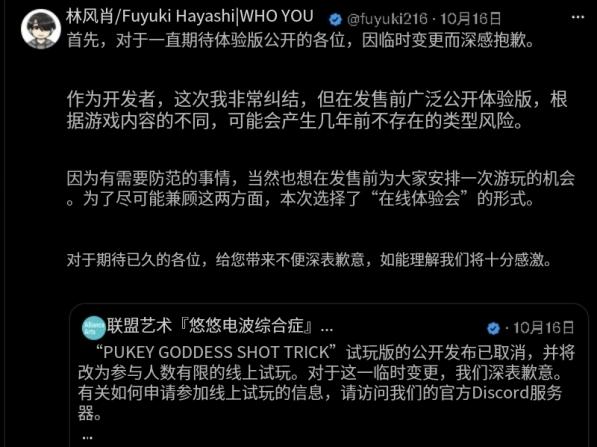
Many other teams have followed suit, deciding to keep their Demos hidden from the public... They are afraid that once they release the Demo, or even just a gameplay recording leaked by players, someone will immediately use AI to plagiarize it and release the game before them.
What? Do you think only indie game teams are victims? No way, even some commercial games that are still in testing or operation have been overtaken by private servers that copied them with AI...

In the past two years, the most common negative comment about AI in the gaming industry might have been that game developers abused AI art assets; from last year to the beginning of this year, people started to complain about the flood of low-quality AI-generated games. But now the problem is no longer just "how many low-quality games AI can make" — more and more people are using AI to monetize other people's painstaking efforts.
To put it exaggeratedly, many of these teams are working hard to destroy the entire gaming industry.
01
AI Cloning Has Become a Profitable Business
Why do I say the situation is so serious? Because from our perspective, those cases of plagiarizing indie game ideas and Demos are just the tip of the iceberg.
What is truly terrifying is that in the deep end of the industry, many teams have seriously started thinking: how to leverage AI capabilities to turn "cloning" into a mass-producible assembly line, and then use this assembly line to impact the entire market.
Putao Jun has heard of the practices of a type of team before: they focus on monitoring various leaderboards to find games worth cloning. They feed the screen recording materials to AI, which can automatically disassemble the game's systems and numerical structure, and generate an editable white-box project directly.
It is said that with such a pipeline, it takes less than a month and costs around 100,000 RMB to complete the cloning of a mature game, and AI's cloning capability can cover most products on the market.
What's even more exaggerated is that they have developed a complete business logic around this capability.
Many people think that cloning games is nothing more than selling copies or releasing the game before the original developer to make money. But in fact, there are even more radical approaches — first use AI cloning capabilities to drive down R&D costs, then build their own platforms and distribution channels, let users play AI-generated games for free, and monetize through advertising and other means.
It is not a unique case. In previous roadshows, Putao Jun also met some teams that directly wrote similar ideas into their project initiation PPTs.
One clear idea is to target Steam products, especially multiplayer cooperative games, find games whose promotional videos have gone viral but have not yet released a Demo, and use AI to quickly mass-produce small-sized games with more refined graphics. This strategy has indeed won recognition from some capital institutions and game publishers.
At the end of the day, these teams don't think they are doing anything wrong. In their view, as long as costs can be reduced and market share can be seized, this is a smart business strategy. They probably never consider how much effort and time the original development team has invested in the project.
02
Truly Great Games Are Not Afraid of Being Cloned... Right?
These phenomena make it hard not to feel pessimistic about future development.
First of all, from the perspective of AI technology development, it is impossible to slow down or stop its progress. Although Anthropic has begun to deliberately counter this behavior by adding rules to Claude that refuse to clone games, it is difficult to solve the problem fundamentally. I believe that methods to bypass these restrictions will appear sooner or later.
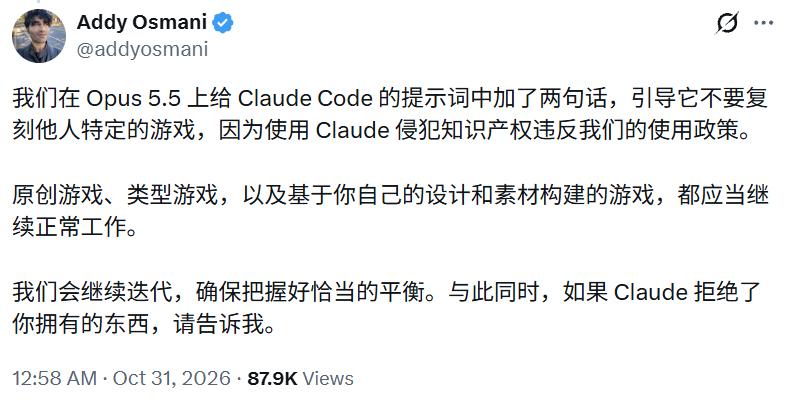
Of course, there will definitely be people who stay optimistic, believing that truly good games are not afraid of being cloned.
After all, according to our long-standing common sense, a good idea is only the first step of a long journey. No matter how creative the idea is, it still needs to go through long-term development, polishing and testing to become a truly fun game.
But the problem is that AI is so powerful now that many people haven't realized how much AI is involved in their daily lives — the answers you read on Zhihu may be written by AI; the videos you watch on video platforms may be generated by AI that automatically finds those high-upvote answers and uploads the generated videos; the comment sections are full of AI that automatically posts comments, and the ads below the videos may be for AI mini-games or short dramas, whose content is all made by AI...

At this rate of development, AI's creative output next year will most likely exceed most people's imagination, leaving us all stunned.
Experience from the past few years has already proven one fact: the impact of AI on the content industry can hardly be resisted by artificially setting restrictions. Today you may still think AI-generated content is rough and cheap, but things will be different before long — the short drama industry is a vivid example.
If there is anything that remains the last line of defense for human creators for the time being, it is probably only our niche, quirky personal preferences.
Secondly, from the perspective of the gaming industry, if the competition in the past was about "who can make a better game", part of the logic now seems to have become "who can find the target more accurately and faster".
In fact, even before the AI era, there was a default rule in the business world: gameplay concepts are difficult to be strictly protected. If you create or improve a gameplay genre, others can of course invest resources to follow up. As a result, no matter how talented the idea is, creators can hardly get 100% of the benefits — just like Jumbird set the first spark for the auto-battler genre, but the subsequent followers took up the largest market share.
But now AI's technical capabilities have largely overturned this rule: others can quickly make what you want to make, and even make it better than you. Most of the traffic and revenue will be divided by a large number of counterfeit products through competition, making the original creator's share of revenue infinitely close to zero.
Leaving benefits aside, in the past we would always trace back to find out who originally created a certain gameplay, and give the original creator the well-deserved praise or sympathy. But in the AI era, the number of cloned versions of a game is likely to be so large that they will drown out the original work, making people have no idea who the real innovator is. Because the first product you see and play may all be made by AI.
When there are not many victims at the beginning, we only see complaints from a few creators. But in the long run, when original creation becomes less and less cost-effective and original creators get more and more discouraged, will the creative motivation of the entire industry be eroded, and even the entire production logic be subverted...? It's hard to say. But once we go down this path, it is equivalent to slowly destroying the gaming industry.
After setting aside fame and fortune, what else do creators have left? Probably only the so-called passion and idealism.
People who love games probably all have an ultimate dream: just like the producers of games such as *Stardew Valley*, *Animal Well*, *Balatro* and so on, they work alone or with partners for many years, complete a great work with painstaking effort and creativity, and finally not only achieve self-fulfillment at the creative level, but also gain both fame and fortune...
All along, many game practitioners move forward with this dream. After all, it is well known that the gaming industry encourages innovation and rewards innovation. Even if the society may hit you and tell you that this is not necessarily the case, at least everyone still has the qualification to dream.
But in the AI era, every creator may become a child shivering in the dark forest, and this most simple idealism may become a luxury. It's a bit sad to think about this future.
I just hope that in this era, there will still be enough passion to break through the obstacles and fight against this dark trend.
This article is from the WeChat official account "Game Grape" (ID: youxiputao), written by Yisa, authorized to be released by 36Kr.