Putting in the most aggressive investment but reaping mediocre returns, has Amazon essentially become a mere worker for NVIDIA?
Amazon released its Q3 earnings report on the 30th Beijing time, and the overall performance is slightly worse than Dolphin Research's neutral expectation: the three most-watched metrics by the market all fell short of expectations — AWS growth rate was lower than buy-side expectations, where bullish funds expected a growth rate above 43% and a profit margin above 40%, neither of which was met.
In addition, after excluding the impact of Prime Day, advertising revenue still slowed down significantly. Capital expenditure far exceeded expectations, resulting in a deeply negative free cash flow, and the management stated that capital expenditure in 2027 will be significantly higher than this year. Only profit exceeded the upper limit of guidance as usual, which was the only bright spot that saved the quarter.
1. Overall Performance: Revenue in Line with Expectations, Profit Far Exceeds the Upper Limit of Guidance
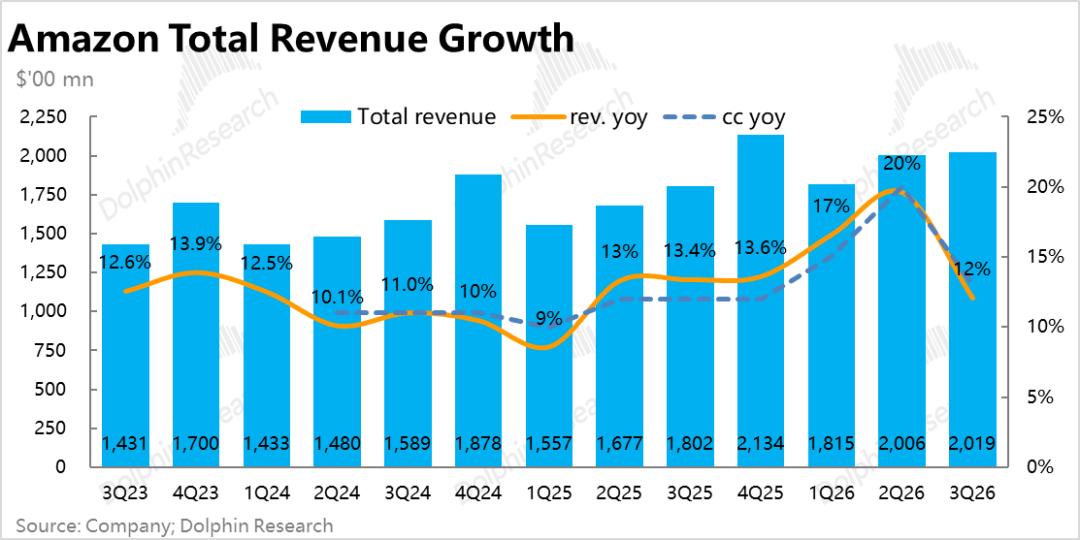
Total revenue for this quarter reached USD 201.9 billion, up 12.1% year-on-year (up 13% excluding exchange rate impact), which was basically in line with the Bloomberg consensus estimate. In terms of trend, the growth rate dropped significantly from 19.6% in the previous quarter, mainly because Prime Day was moved to the second quarter, dragging down the growth rate of this quarter by about 4 percentage points, and the exchange rate dragged down another 0.5 percentage points.
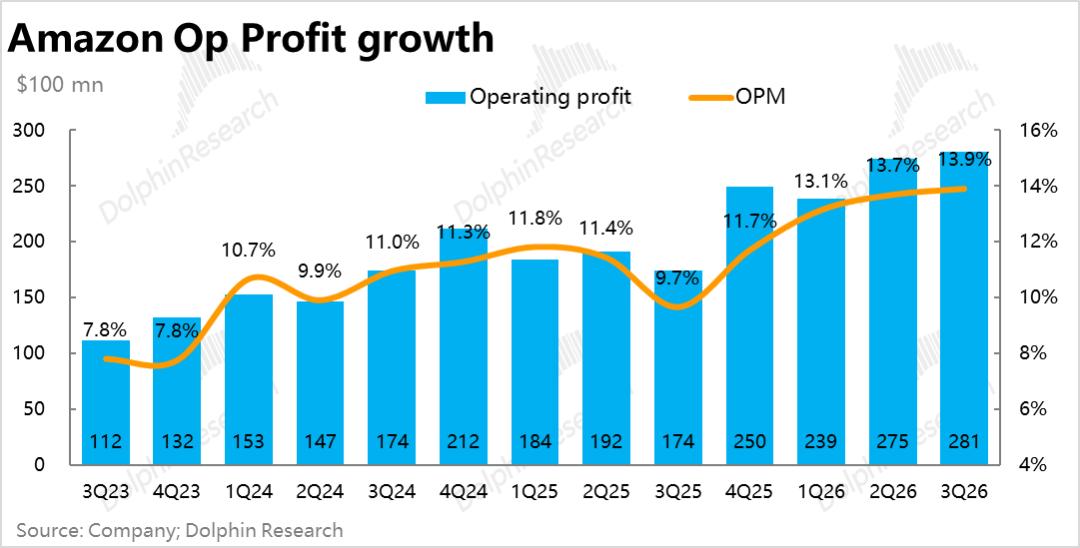
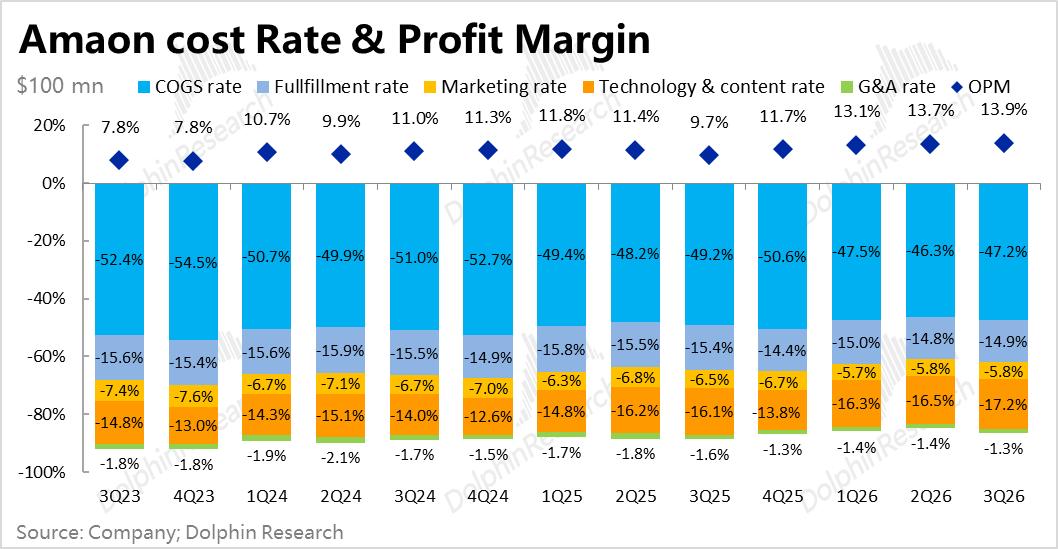
Operating profit reached USD 28.1 billion, up 61% year-on-year (the same period last year included one-off expenses such as FTC settlement, leading to a low base), about 8% higher than the consensus estimate, exceeding the previous upper limit of guidance as usual; operating profit margin reached 13.9%, hitting a record high, rising by another 0.2 percentage points quarter-on-quarter.
2. AWS: Continued to Accelerate, But Failed to Reach the ~43% "Pass Line" Expected by the Buy Side
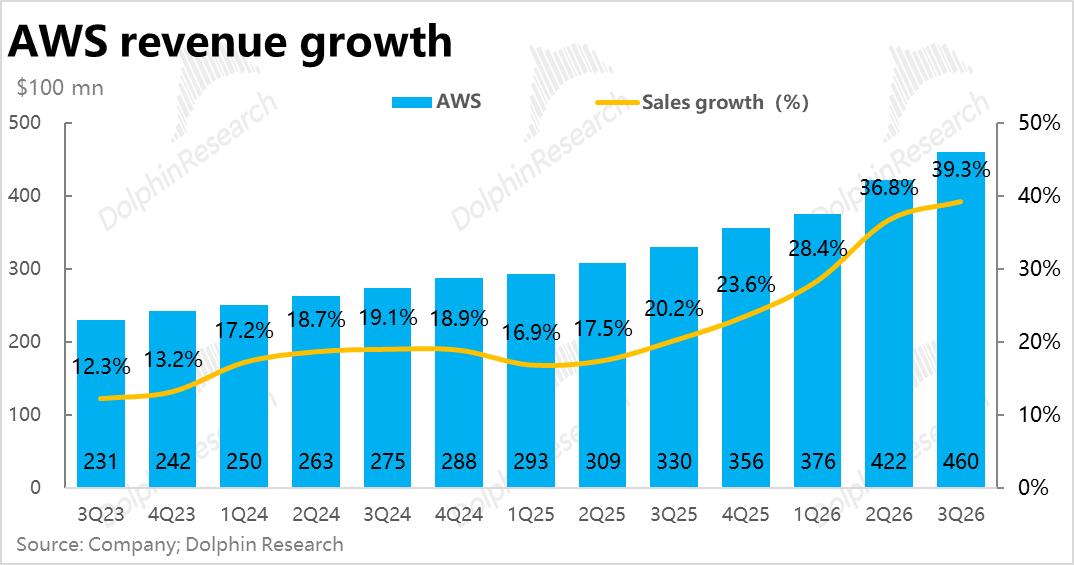
AWS revenue reached USD 46 billion, up 39.3% year-on-year, accelerating by about 2.5 percentage points from the previous quarter. However, the general expectation of the buy side was around 43% (range 42%~44%), with a actual gap of about 3~4 percentage points; the quarter-on-quarter incremental revenue was USD 3.75 billion, less than USD 4.65 billion in the second quarter, meaning the incremental amount shrank instead. The management only explained that the capacity launch was uneven across quarters.
Fortunately, the management stated that AWS revenue growth rate in 2027 and 2028 will both stay above 40%, which is in line with the major banks' expectations for 2027, but far exceeding the ~35% expectation for 2028 before the earnings release.
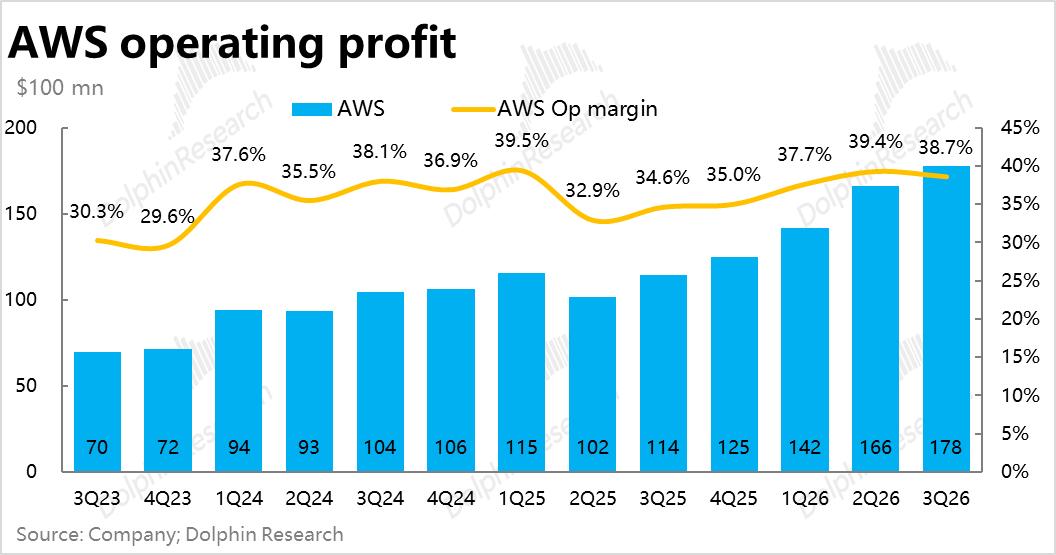
The segment's operating profit reached USD 17.8 billion, about 12% higher than the consensus estimate; the profit margin was 38.7%, down 0.7 percentage points quarter-on-quarter, also failing to reach the ~40% psychological level expected by the buy side. However, the profit margin of the previous quarter was abnormally high, including a one-off gain of about USD 600 million from energy contracts, after exclusion it was about 38.1%, the actual profit margin of this quarter increased quarter-on-quarter. It can be regarded as the scenario where profit saved the day despite the underwhelming growth performance.
The earnings call disclosed that the backlog of orders at the end of this quarter reached USD 578 billion, up USD 82 billion quarter-on-quarter and growing at a triple-digit rate year-on-year, the management said the customer base is diversified. AWS has added about USD 100 billion in net new orders for 3 consecutive quarters, and the current backlog has reached 3.1x of AWS's annualized revenue, so the medium and long-term growth prospects are still guaranteed.
3. Advertising: Still Slowed Down Significantly Even After Adding Back the Prime Day Impact
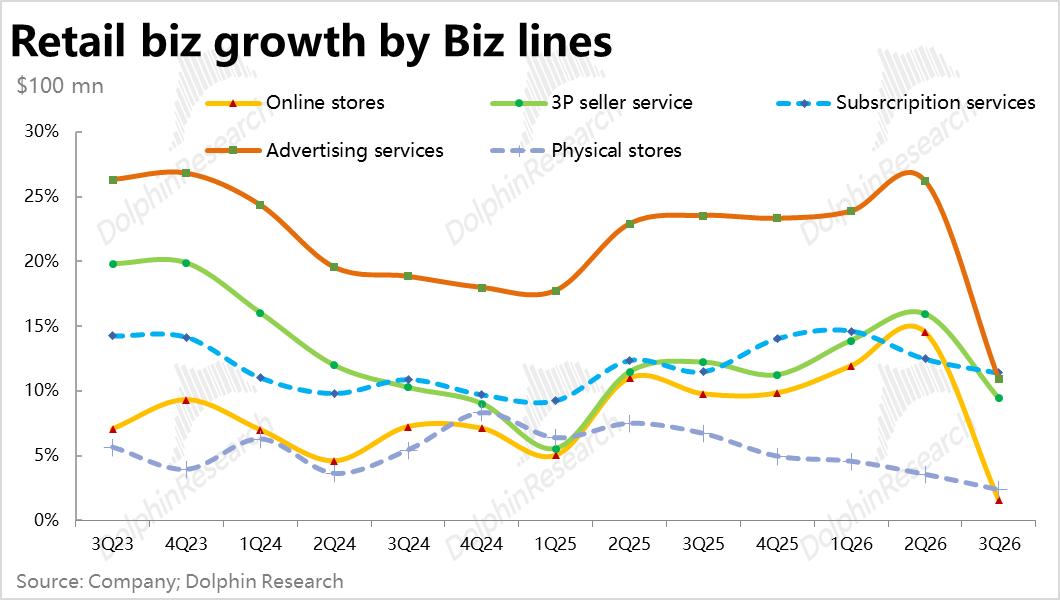
Advertising revenue, the biggest growth driver in the retail segment, reached USD 19.6 billion, up 10.9% year-on-year (up 12% excluding exchange rate impact), about 6% lower than the consensus estimate, and the growth rate dropped sharply from the previous quarter. The management explained the reasons: Prime Day was moved to the second quarter, bringing a quarter-on-quarter drag of about 8.5 percentage points; there were NBA first season games in the second quarter, but no such games in the third quarter.
Although the company guided that the advertising growth rate in the fourth quarter will rebound to "a high level of teens", it is still lower than the 20%+ level in multiple previous quarters.
Combined with channel research, the reasons for the continued slowdown in advertising growth are as follows: First, the total cost borne by merchants (commission, fulfillment, advertising) has approached the upper limit, and the growth of in-site search advertising is already limited, which needs to be driven by advertising on non-transaction channels such as video and Twitch. Second, although the impact of AI assistants should be limited, it is also diverting traffic from the transaction platform to AI.
Among other retail businesses, online retail revenue reached USD 68.5 billion, up 1.6% year-on-year, also slowing down significantly and falling short of expectations; while the growth of third-party seller services and subscription services was relatively stable, and better than market expectations.
Why did subscriptions and 3P services not weaken? Dolphin Research believes that subscription revenue is recognized on a monthly amortization basis, which is less affected by factors such as Prime Day rescheduling, while the 3P business has recently added fuel and logistics surcharges as a bottom support, hedging the impact by increasing monetization rate (it can be seen that the burden on merchants is indeed increasing).
4. Retail by Region: North America Profit Margin Exceeds Expectations, International Segment Drags Performance
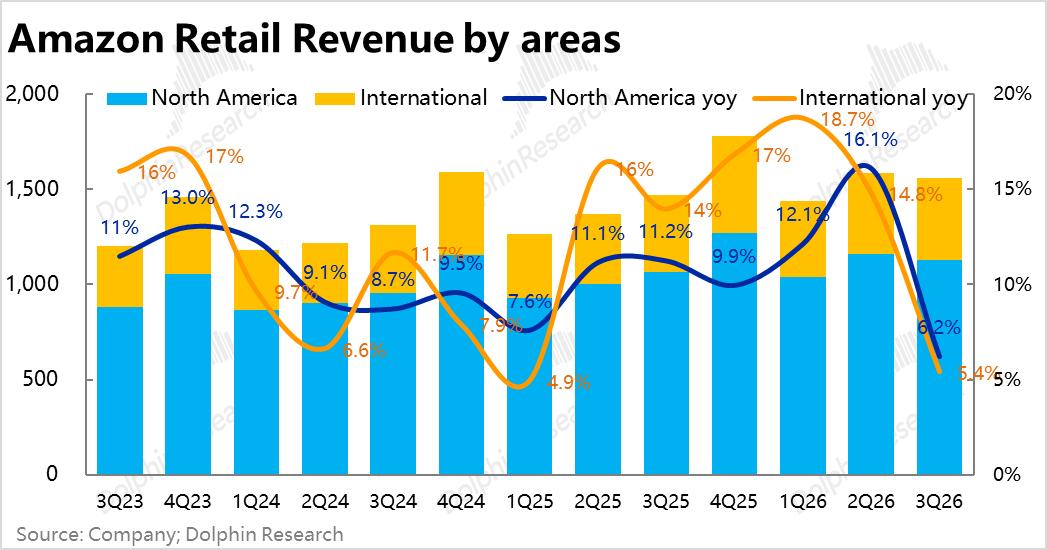
By region, North America retail revenue reached USD 112.9 billion, up 6.2% year-on-year, in line with the consensus estimate; international retail revenue reached USD 43.1 billion, up 5.4% year-on-year (up 8% excluding exchange rate impact), slightly lower than expectations in nominal growth terms.
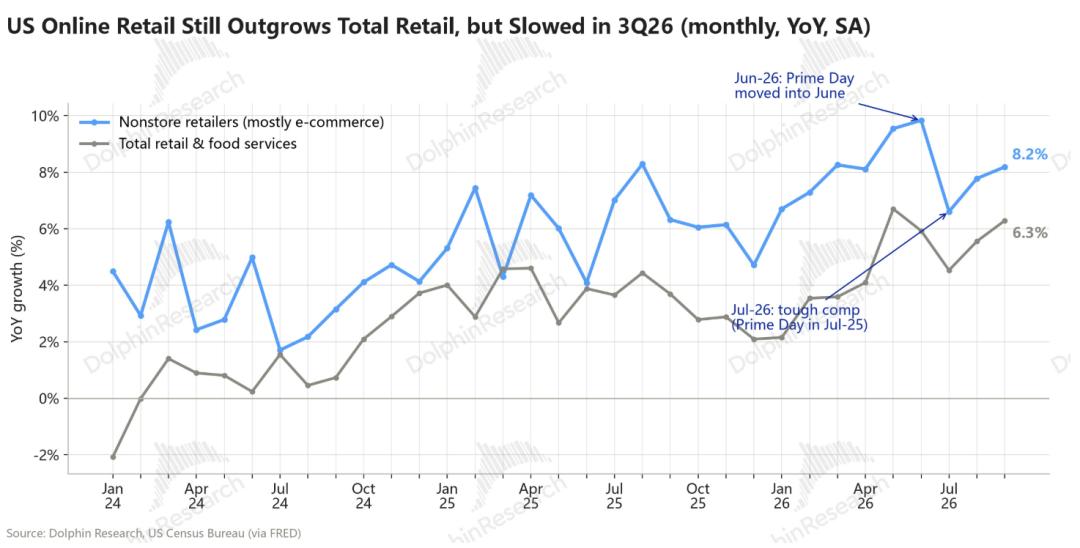
Compared with the overall performance of the industry, according to the seasonally adjusted data released by the U.S. Census Bureau, non-store retail sales in the third quarter increased by 7.5% year-on-year, down from 9.2% in the second quarter, and the combined growth rate of the second and third quarters was 8.3%. The combined revenue of Amazon's North America division in the second and third quarters increased by about 11% year-on-year, about 3 percentage points higher than non-store retail, still gaining market share.
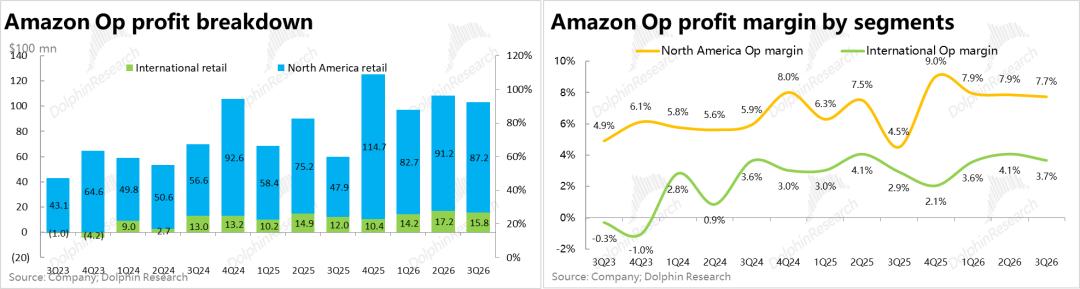
In terms of profit, North America operating profit reached USD 8.72 billion, with a profit margin of 7.7%, about 1.1 percentage points higher than the consensus estimate; although the profit margin also seemingly decreased quarter-on-quarter, the previous quarter had a positive one-off tax refund benefit, after exclusion, the profit margin of this quarter still increased quarter-on-quarter. The international operating profit reached USD 1.58 billion, with a profit margin of 3.7%, lower than the consensus estimate of 4.5%, of which the exchange rate dragged down about USD 130 million.
5. Capital Expenditure Far Exceeds Expectations, More to Come in 2027, Cash Flow Deeply in Negative Territory
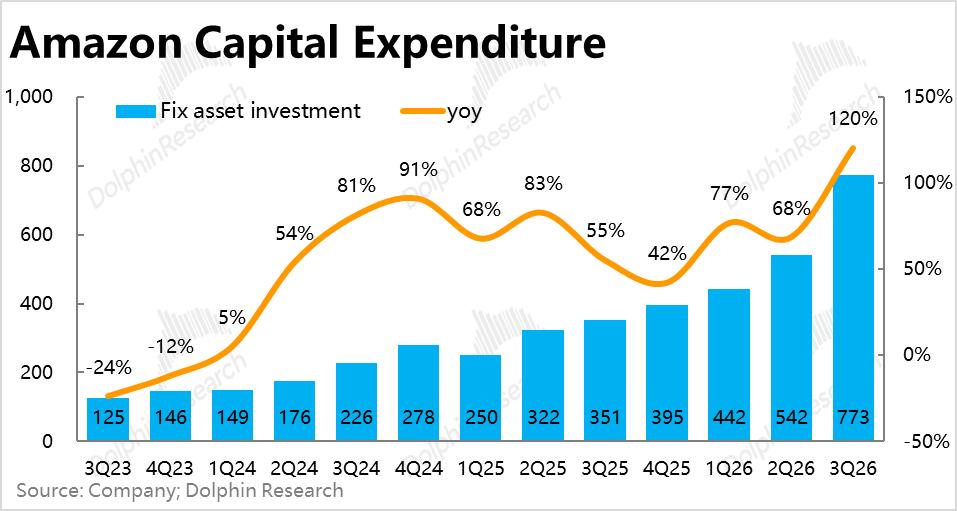
Cash capital expenditure in this quarter reached USD 77.3 billion, 31% higher than the consensus estimate, rising by another 43% quarter-on-quarter from Q2, far exceeding expectations. The management did not directly explain the reason for the increase, only stating that the investment pace follows the visibility of demand. We believe that rising prices of hardware such as storage and payment rhythm may be the reasons.
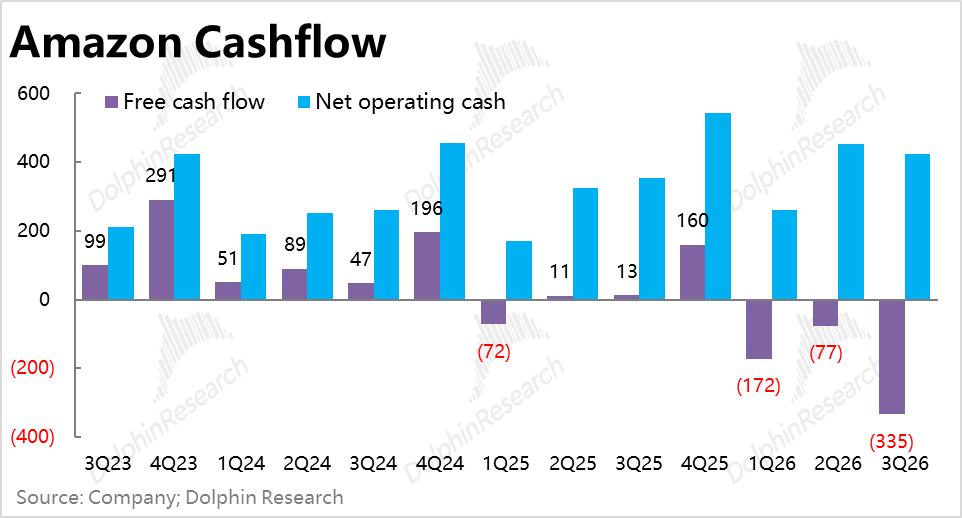
Operating cash flow reached USD 42.4 billion, up 19% year-on-year, but free cash flow was -USD 33.5 billion, deeply negative and far lower than expectations. Under the circumstance that AWS growth did not bring surprises, the significantly deteriorated cash flow will undoubtedly make the market question ROI, and worry about the damage of financing to the balance sheet or shareholders' equity. In fact, Amazon has begun to raise funds frequently, adding about USD 48.1 billion in long-term debt this quarter alone.
According to the full-year guidance, capital expenditure in the fourth quarter will be about USD 49 billion, significantly lower than the consensus estimate of about USD 65 billion, which will fall back to the normal level, indicating that this quarter is indeed an abnormal point. But at the same time, it also stated that capital expenditure in 2027 will be "significantly higher" than that in 2026 (the buy-side expectation before the earnings release was about USD 325 billion ~ 350 billion), which implies that the subsequent cash flow and financing pressure will be greater.
6. Gross Margin and Expenses: Gross Margin Better Than Expectations, Technology and Infrastructure Expenses Are Relatively High
Gross margin reached 53.2%, about 1.1 percentage points higher than the consensus estimate. The revenue structure continued to tilt towards high-margin businesses such as AWS and third-party seller services, driving the gross margin to rise trend-wise. On the expense side, technology and infrastructure expenses reached USD 34.8 billion, about 3% higher than the consensus estimate, which was the only item that significantly overspent, in line with the AI R&D investment trend of major tech companies;
Other expenses were generally lower than expectations, among which marketing expenses remained flat year-on-year, and management expenses recorded negative growth year-on-year. Similar to Microsoft, the company is vigorously controlling or even reducing expenditures in non-AI technical fields.
7. 4Q Guidance: Revenue in Line with Expectations, Upper Limit of Profit Slightly Higher Than Consensus Estimate But Lower Than Buy-Side Expectations
Revenue guidance is USD 240~247 billion, up 12%~16% year-on-year, the midpoint is about 0.4% lower than the consensus estimate, which is basically in line with expectations, of which the exchange rate is expected to drag down by about 0.6 percentage points; but the upper limit is only at the lower edge of the buy-side expectation (about USD 247~248 billion).
Operating profit guidance is USD 28.5~33.5 billion, as usual we only look at the upper limit, which is slightly higher than the consensus estimate, but lower than the buy-side expectation of about USD 34~35 billion; the implied operating profit margin is about 13.6%, up about 1.9 percentage points year-on-year.
The inferred retail growth is still slightly low: assuming AWS growth rate in 4Q is 40%, then the retail segment revenue will increase by about +7%~11% year-on-year, with the midpoint at about +9%, lower than the overall 11%~12% level of the first three quarters, only reaching the upper limit of guidance can it be flat.
8. Overview of Core Indicators
