Challenge the forerunner, XHEART: "Our opportunity comes from the reshaping of chip demand by large models"
By Fan Shuqi
2028 is regarded as the industry inflection point for L4 autonomous driving. Cao Xudong, CEO of Momenta, predicts that the parameters of in-vehicle autonomous driving models will reach the level of tens of billions or even hundreds of billions by then. However, amid the rapid evolution of models, the industry has long been lacking chips that can support the deployment of ultra-large models on vehicles.
The X7 Ultra, recently released by XHEART, has filled this industrial gap to a certain extent.
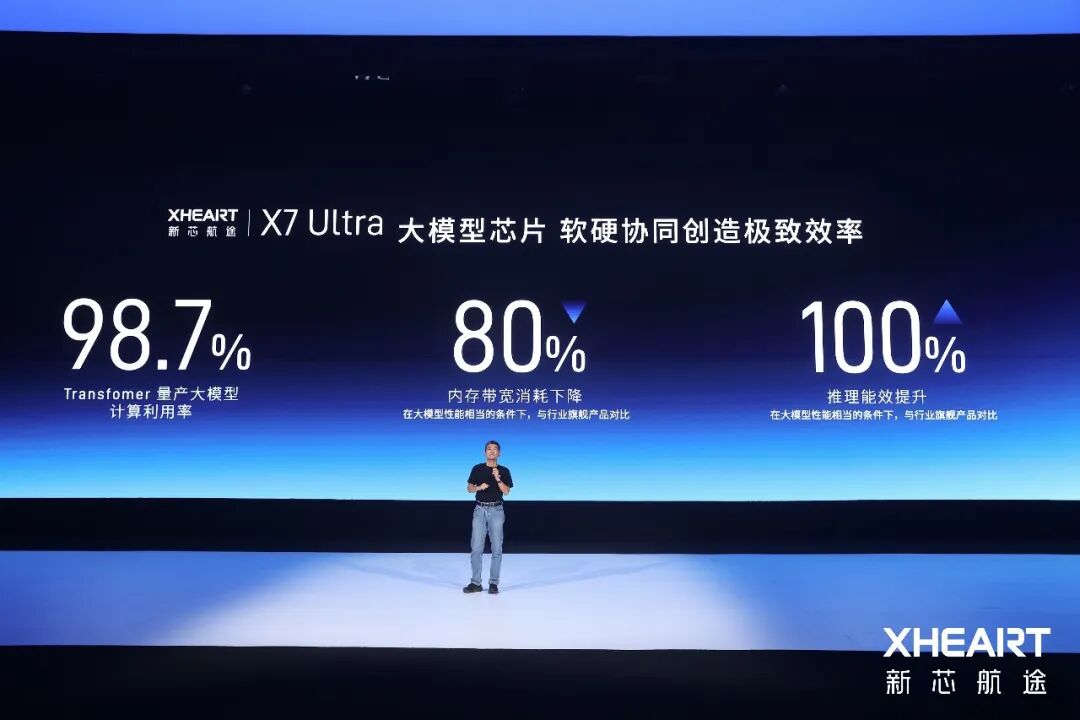
According to official disclosure from XHEART, the large model computing power of this chip reaches 700 TOPS, the memory bandwidth consumption is 80% lower than that of industry flagship products, and the energy efficiency is increased by 100%.
Different from the traditional practice of piling peak computing power in the autonomous driving chip industry, the X7 Ultra follows the concept of "large model defines chip" from the very beginning of its design, focusing on balancing multiple performance indicators of the chip such as computing power, bandwidth and energy consumption, and finally creates such a chip adapted to large models.
XHEART is a large model chip company established only in 2023. Compared with international giants such as NVIDIA and Qualcomm, XHEART is undoubtedly a latecomer in the industry.
Nevertheless, even with the extremely fierce competition in China's automotive market, XHEART has still achieved remarkable commercial results. As of October, XHEART's first-generation product, the X7 series, has been deployed in more than 10 vehicle models, with cumulative shipments exceeding 200,000 units, and there are still 40 other vehicle models with designated orders pending delivery.
The capital market also pays close attention to XHEART. On October 16 this year, XHEART completed its strategic round of financing, with Groupe Renault making its first investment, Chery Automobile increasing its stake, and CXMT, China's leading memory enterprise, also participating in this round of financing. So far, the total financing amount of XHEART has reached 5 billion yuan.
The core reason why this company, established for less than three years, can stand out in both the industrial and capital sectors lies in its outstanding product strength and technical strength.
XHEART's first-generation product was developed through deep collaboration with its partner Momenta. Based on the technical concept of "large model defines chip", the X7 series products can support the model evolution in the next few years. This breaks the previous practice of other chip manufacturers that restrict software with hardware. Li Zonglin from XHEART told 36Kr that the assisted driving experience realized by the X7 series chips paired with end-to-end large models is highly recognized by customers.

To a certain extent, the recognition of XHEART by car enterprises reflects the industry's strong demand for chips more adapted to large models against the background of the transformation of autonomous driving technology to AI.
Why do large models define chips
Autonomous driving technology has long evolved from the early rule-based modular algorithms and BEV+Transformer to today's new AI paradigm based on large models, including end-to-end, VLA, world models and other technologies.
Moreover, a distinct trend is that in-vehicle autonomous driving models are evolving rapidly, with parameters growing larger and larger, expanding from the millions level to the tens of billions level.
The moves of leading new energy vehicle brands can well reflect this trend.
As early as at the XPeng Tech Day at the end of last year, XPeng Motors publicly stated that its Ultra version models with 2250 TOPS computing power are equipped with the second-generation VLA with tens of billions of parameters. Another leading new energy vehicle brand Li Auto also released its redefined in-vehicle VLA model, MindVLA, in May 2025, with the parameter volume reaching 4 billion. This year, the parameter volume of Li Auto's in-vehicle models has shown exponential growth.
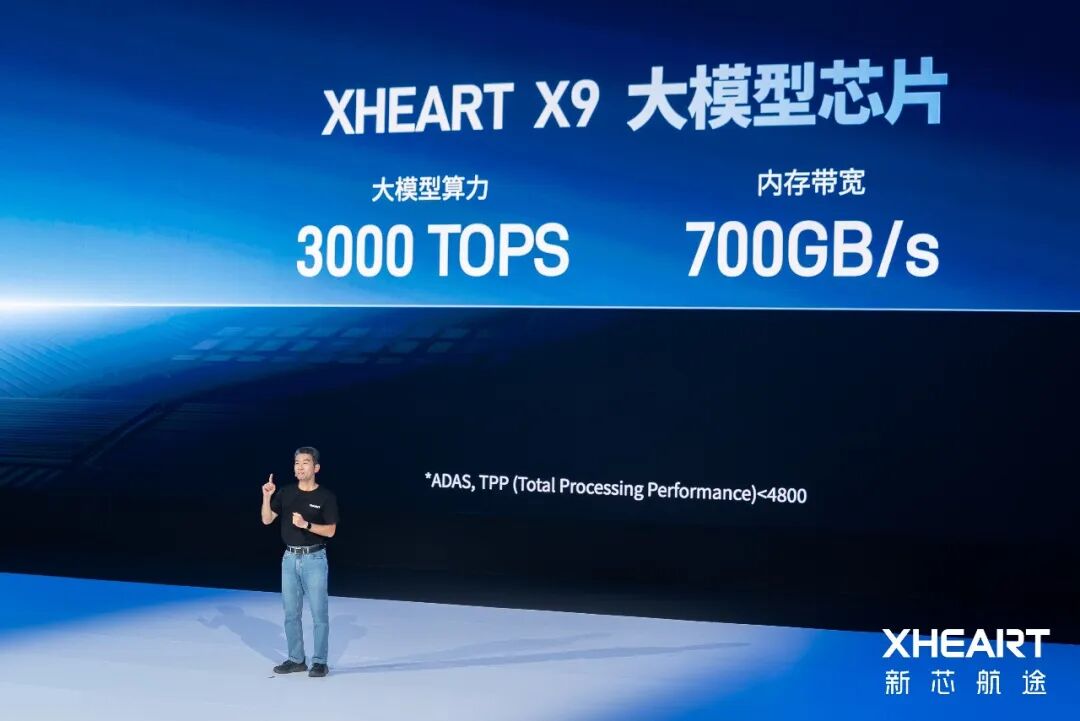
However, the current mainstream high-end autonomous driving chips were generally defined and developed around 2021, and gradually deployed on vehicles around 2025. At the beginning of their definition, these chips mainly considered the demands of the "early-stage" modular algorithms of the autonomous driving industry and early end-to-end models, and are more adapted to small detection modules and traditional CNN algorithms.
Using such chips to adapt to today's and future end-to-end autonomous driving models is a kind of "post-adaptation" or "patch-style adaptation". The mismatch of the native hardware architecture often brings a series of problems for car enterprises to deploy in-vehicle models.
A common problem is that some traditional NPU biased towards CNN operators have high nominal computing power, but when running Transformer-based end-to-end models, the effective computing power drops sharply.

Moreover, even if the chip and model are barely adapted, it is very likely to be accompanied by problems such as inference delay and forced "discount" of model capabilities.
XHEART noticed such industry pain points, so based on the idea of "large model defines chip", it created a chip natively adapted to large models.
According to XHEART's explanation, the so-called "large model defines chip" refers to deducing the chip architecture from the model demands in real applications, and reorganizing calculation, storage and data flow. This is fundamentally different from the traditional design method of autonomous driving chips that simply pile up computing power. It not only optimizes the deployment effect of end-to-end large models, but also reserves enough space for future model evolution.
The design idea of "large model defines chip" reflects the deep understanding of the relationship between models and chips by Li Zonglin, a veteran chip industry practitioner with decades of experience. In an interview with the media, Li Zonglin explained to 36Kr how XHEART enables large models to define chips:
"AI inference calculation is a continuous layer-by-layer calculation. Therefore, the core problem that chips need to consider is calculation and data transmission, and we need to find a way to take both into account."
The process of model inference is a process of constantly comparing new frames with the features of historical frames. This means that during model inference, historical information will be continuously added and read repeatedly. That is why Li Zonglin emphasizes the two things of calculation and data transmission.
To achieve excellent calculation and data transmission, the chip not only needs high computing power, but also higher calculation accuracy, larger cache and memory, and higher bandwidth.
Li Zonglin briefly explained to 36Kr the methods for the enterprise to meet these demands: "For key operators, we will optimize the operators most frequently used by large models as much as possible. This optimization is not only to implement the operators in hardware, but also to make the data transmission paths matched with the operators very short."
Li Zonglin pointed out that "this is very critical", "because during AI inference operation, we must avoid reading external DDR at a very high frequency". The most intuitive benefit of no need to read external DDR at high frequency for model operation is that the inference delay is shortened, which can further improve the safety of autonomous driving in emergency situations.
XHEART's dedicated efforts have finally been transformed into excellent chip performance and model deployment performance.
According to the caliber of XHEART's press conference, the X7 Ultra can deliver 700 TOPS of large model computing power. This performance is evaluated based on real mass-produced intelligent driving large models, on the premise that the similarity between the output of the quantized model and the trained FP32 floating-point model reaches more than 99.99%.
Actual test data shows that the NPU calculation utilization rate of X7 Ultra can reach 98.7%; under the condition of equivalent model performance, the memory bandwidth consumption is 80% lower than that of industry flagship products, and the energy efficiency is increased by 100%.
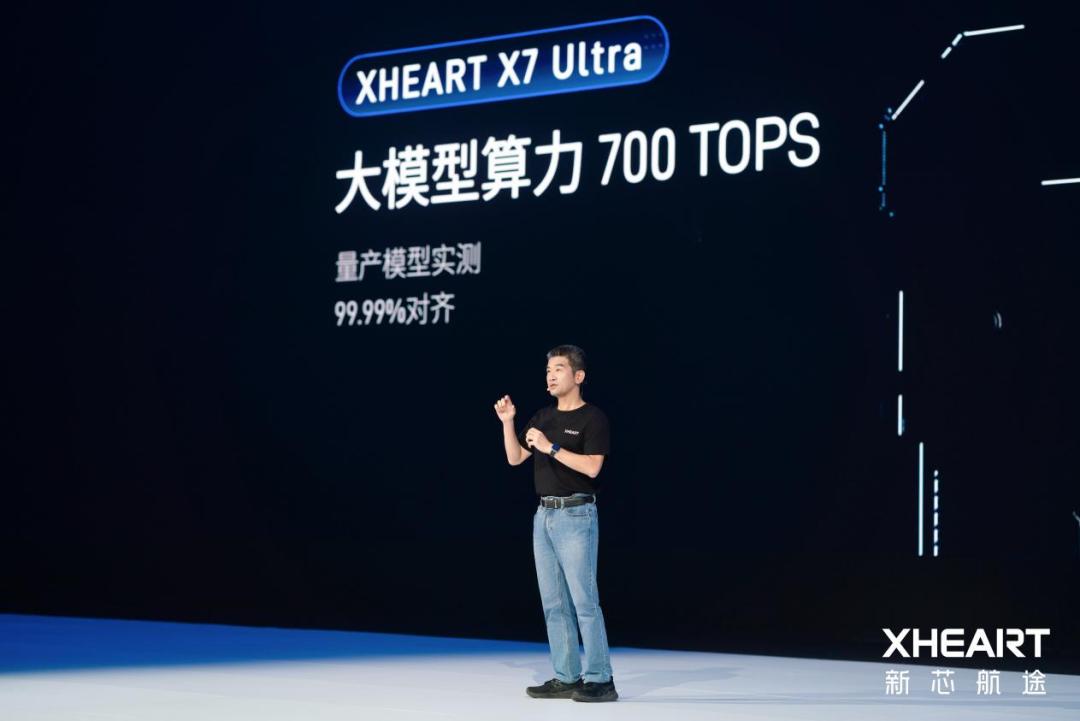
700 TOPS reflects the actual inference performance of X7 Ultra running mass-produced intelligent driving large models under strict accuracy constraints; the 98.7% NPU calculation utilization rate indicates that the computing power rarely idles while waiting for data transmission, which means that the peak computing power of the chip is improved and the model inference delay is more controllable; the 80% reduction in memory bandwidth consumption compared with competing products also helps to reduce model inference delay.
In simple terms, the model compressed and deployed on the vehicle based on the X7 Ultra has almost no performance discount compared with the cloud version. Such a deployment effect is relatively rare.
And the market will certainly not fail such an excellent product.
The "large model defines chip" concept helps XHEART stand out from fierce competition
Admittedly, many earlier-established chip companies have formed deep ties with some large OEMs, and self-developed chips of some car enterprises have also been mass-produced and deployed on vehicles. Some people therefore judge that the market entry window for autonomous driving chip companies is closing.
This judgment has a certain degree of rationality.
From the data perspective, according to statistics from the GGAI, in the first half of this year, leading players including NVIDIA occupied nearly 80% of the market share in the high-level autonomous driving chip market.
From the designated order situation of leading car enterprises, car enterprises with annual sales volume of more than 2 million units all year round such as BYD, Geely and Chery, mostly designate Qualcomm and NVIDIA as their chip suppliers for their vehicle models.
The industry competition is so fierce, but Li Zonglin said that XHEART has "very good opportunities".
This statement is by no means groundless.
His confidence comes on the one hand from XHEART's past customer expansion speed.
In the third quarter of 2025, 36Kr exclusively reported that XHEART's first chip was successfully lit up. In April 2026, XHEART X7 was first mass-produced and deployed on SAIC Volkswagen ID.ERA9X. It was less than a year after the chip was lit up.
After that, the X7 series won many more customers. According to XHEART's official disclosure, as of October, the X7 series has been deployed in more than 10 vehicle models, with cumulative shipments exceeding 200,000 units, and there are still 40 other vehicle models with designated orders pending delivery. The L3/L4 computing platform based on dual X7 has also obtained designated orders for multiple vehicle model projects.
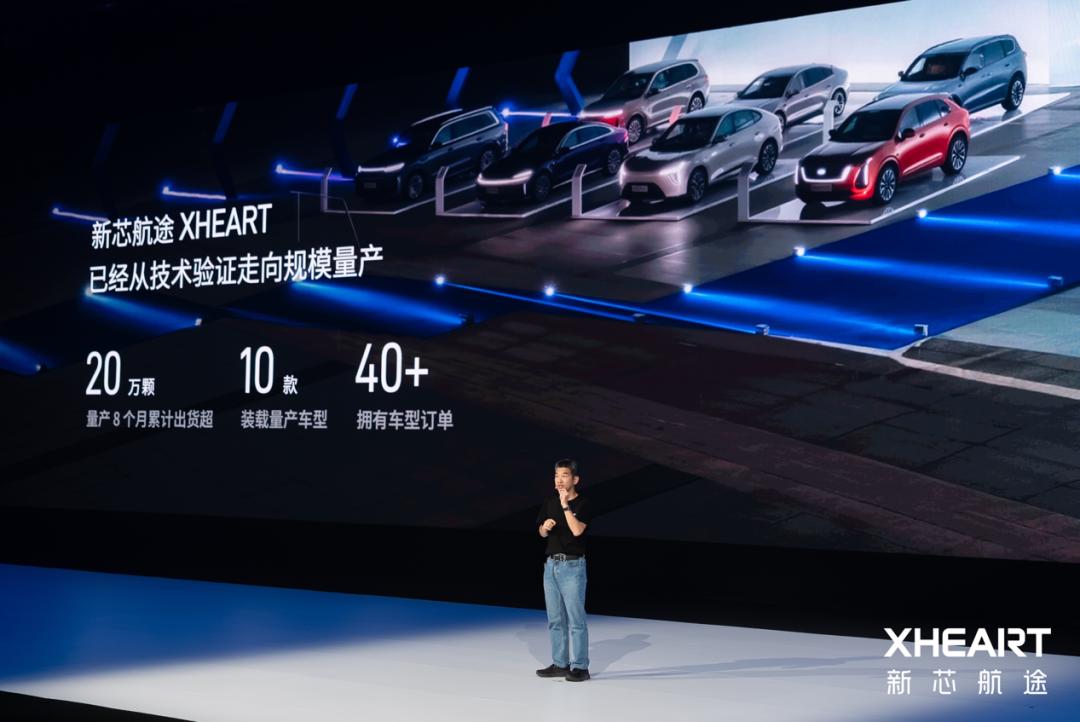
Under the heavy siege of first-movers, XHEART is breaking a path through its outstanding product strength.
In addition, Li Zonglin's confidence in XHEART also comes from his clear prediction of the future industry competition pattern.
Li Zonglin once proposed to 36Kr that the future competition of autonomous driving chips will focus on "the operation effect of the model on the chip". There are multiple indicators to evaluate the operation effect, among which "the most important thing that car enterprises care about is the response speed, because it is related to safety", followed by "whether the operation is stable", and whether there is enough space for continuous model upgrading.
The whole process of defining, designing, taping out and mass-producing a vehicle-mounted intelligent driving AI chip usually takes 3-4 years. However, model iteration may only take one year or even a few months. Facing this mismatch of iteration speed, car enterprises usually need to reserve space for model evolution in the next 2-3 years when selecting chip suppliers.
XHEART defines chips from the demands of large models, and brings model evolution and vehicle application requirements into product design at an earlier stage. In Li Zonglin's words, the result of this approach is that "as long as the future model iteration is still based on end-to-end and is the deduction or change of Transformer-based models, our chips can handle it very well".
Another focus of future competition mentioned by Li Zonglin is "reliability and mass production delivery capability", which is "a relatively big test for chip companies".
In Li Zonglin's view, XHEART has sufficient technical confidence to meet these tests.
He said that one of XHEART's killer features is that it has anchored the technical route of "large model defines chip", and through the software-hardware co-optimization of architecture and tool chain, XHEART can achieve excellent model operation efficiency and experience.
Why XHEART can realize software-hardware co-optimization at an earlier stage
It is undeniable that one of XHEART's core competitiveness comes from model-defined chips and software-hardware co-optimization.
However, deep collaboration with algorithms can generate a more reasonable chip architecture, which has long been a consensus in the chip industry. The self-developed chips equipped on vehicles such as XPeng and Li Auto are also defined through software-hardware co-optimization.
But before XHEART, few domestic chip manufacturers could achieve software-hardware co-optimization.
It should be noted that the reason why car enterprises can design chips through software-hardware co-optimization is that before developing self-developed chips, car enterprises already have a relatively mature autonomous driving algorithm team, and both the algorithm team and hardware team belong to the same enterprise, so they can naturally achieve better collaboration at the organizational level.
Many autonomous driving chip suppliers do not have such conditions.
That is why some leading domestic chip suppliers have adopted the traditional chip design method for the several generations of chips they mass-produced before. When such chips are supplied to car enterprises, the car enterprises' algorithms need to make unnecessary compromises to adapt to the chips. Their chips built based on the software-hardware co-optimization idea will not be released until about next year.

Then why can XHEART, a latecomer, implement software-hardware co-optimization at an earlier stage?
This is attributed to XHEART's construction of its own ecosystem.