Meta intends to raise nearly 100 billion U.S. dollars, and Oracle has submitted its "final offer".
Facing the "bottomless pit" of AI, the two tech giants have adopted different response strategies.
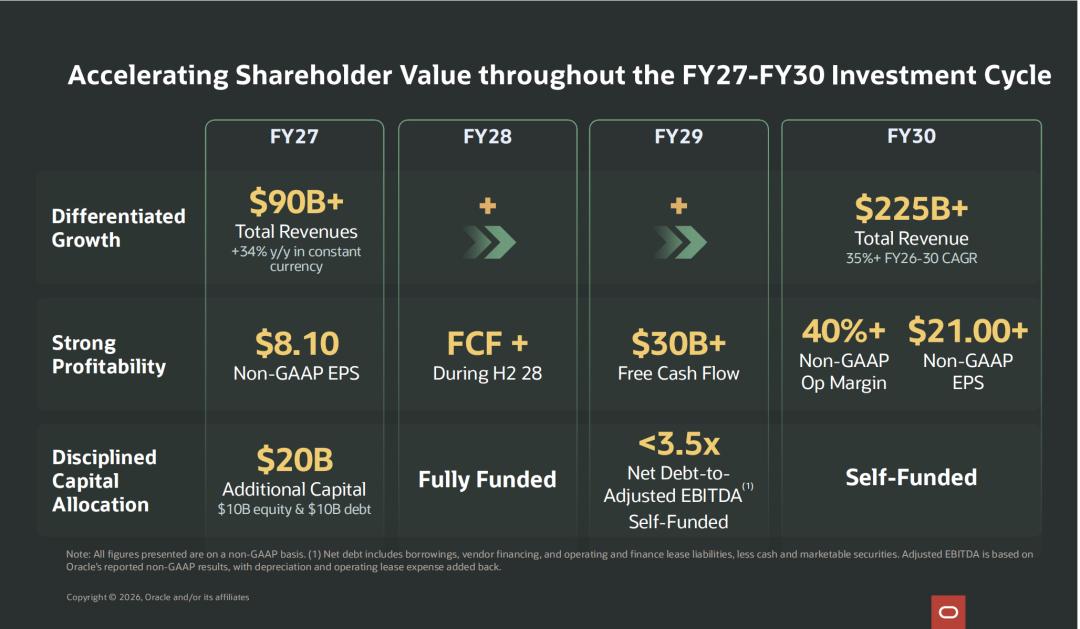
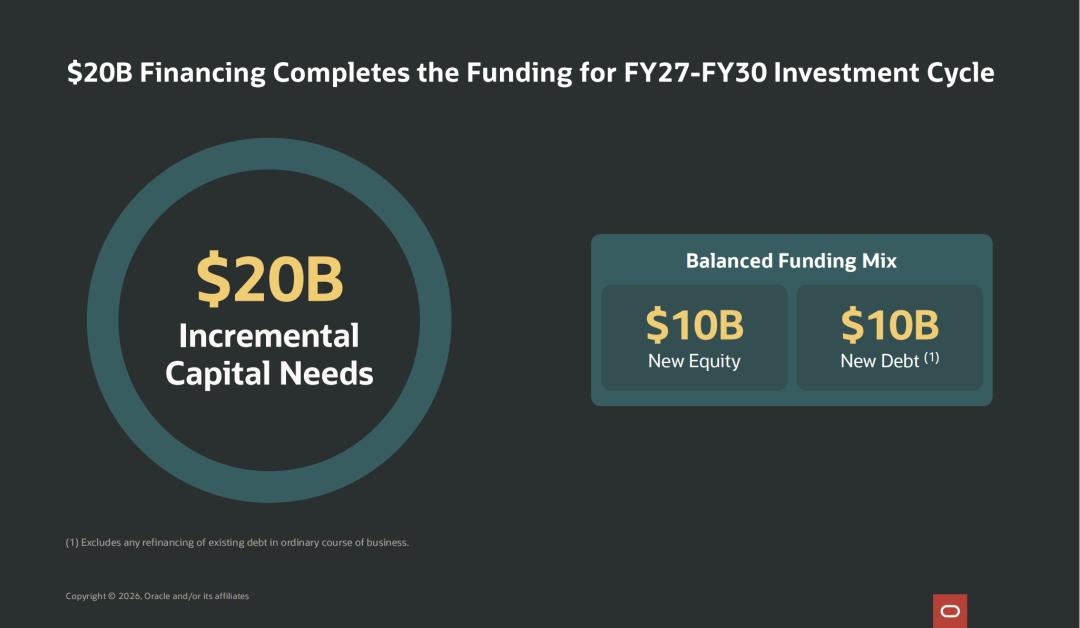
On October 28, at the Investor Day event held in Las Vegas, Hilary Maxson, Chief Financial Officer of Oracle, announced that the additional capital market financing required for this round of investment cycle up to FY2030 will be capped at 20 billion U.S. dollars.
This figure originally only corresponded to the remaining fundraising plan for FY2027, and she now refers to it as "the final tranche of funding needed to complete the rest of this cycle". Meanwhile, the announcement released by Oracle on the same day also set a timetable for free cash flow to turn positive in the second half of FY2028.
Oracle's stock price closed up 10.73% that day. According to a report by Cailian Press, institutional analyst Anurag Rana believes that this spending plan and outlook is expected to ease market concerns that capital expenditure will remain at a high level for more than the next two years. However, in the following two trading days, the stock price fell by 3.45% and 6.37% respectively, and by the close of October 30, it had nearly returned to the level before the Investor Day.
On October 26, two days before Oracle's Investor Day, Meta launched a new round of financing.
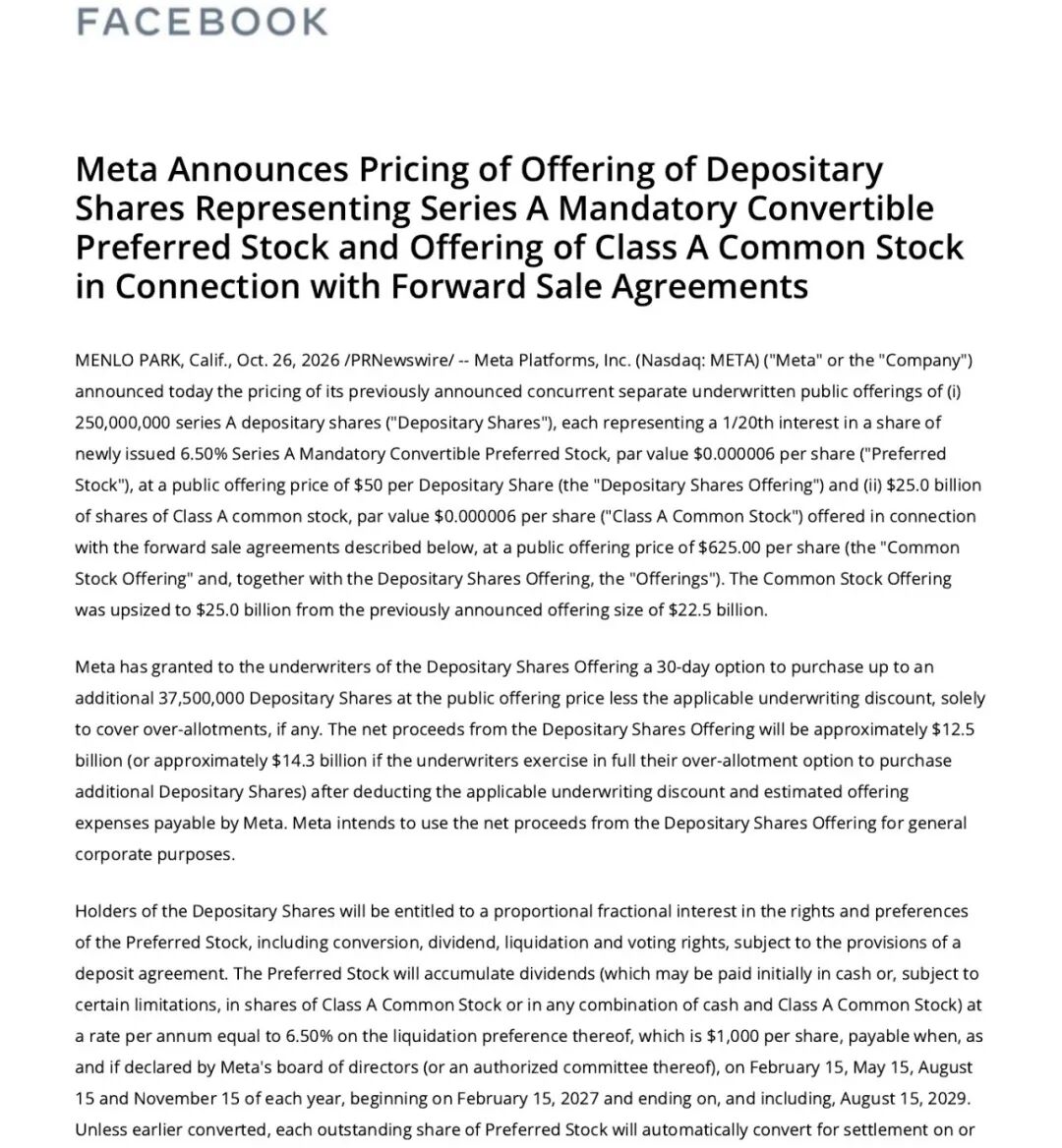
According to Meta's issuance announcement and the subsequent published pricing results, the scale of this equity financing was expanded from 35 billion U.S. dollars to 37.5 billion U.S. dollars; together with the proposed maximum 60 billion U.S. dollar stock sale plan, the total maximum amount reaches 97.5 billion U.S. dollars, excluding over-allotment. The proceeds will be used to support continuous investment in AI infrastructure and personal superintelligence.
On October 21, Meta released its Q3 financial report with 26% revenue growth. While Mark Zuckerberg stated that "our investments are paying off", Meta raised the lower limit of its full-year capital expenditure expectation.
On October 22, the day after the financial report was released, Meta's stock price fell by about 7%, and the Nasdaq Composite Index also fell by about 2.6% that day. According to Reuters, investors are worried about the payback period of AI investment, and also concerned that the voting-free Class C share arrangement announced by Meta the day before will open the door for additional issuance in the future, diluting the rights and interests of existing shareholders.
He Fan Finance previously discussed the situation of giants increasing investment while seeking revenue recovery, and tracked their attempts to reduce computing power costs through self-developed chips, diversified procurement and other measures.
Several months have passed, and expenditures are still on the rise.
Amazon maintained its full-year cash capital expenditure plan of about 220 billion U.S. dollars in this Q3 financial report, and Alphabet also maintained its plan of 195 billion to 205 billion U.S. dollars. Both companies predicted at their respective earnings calls that capital expenditure in 2027 will increase significantly.
The bill for this current year is still not the end of the expansion.
Capital has begun to pay more attention to the length of the waiting period. On October 22, when talking about the return of AI investment, Matthew Maley, chief market strategist at Miller Tabak, told Reuters: "It is becoming increasingly clear to people that this will take a much longer time."
Meta is also issuing new shares
Meta's financial report almost simultaneously presents reasons for optimism and anxiety.
On local time October 21, Meta announced its third-quarter performance for the period ending September 30, 2026. During the reporting period, the company's revenue reached 64.601 billion U.S. dollars, a year-on-year increase of 26%; among which, advertising revenue was 63.061 billion U.S. dollars, a year-on-year increase of 26%, with ad impressions and average price increasing by 10% and 14% respectively.
AI has already helped this "traditional" business improve its performance.
At the subsequent earnings call, Susan Li, Chief Financial Officer of Meta, introduced that a series of recommendation improvements for Instagram Reels in the third quarter increased viewing duration by more than 4%. Among them, the new model sorts a group of videos at the same time instead of evaluating them one by one, and the system also incorporates richer viewing duration signals.
But another batch of AI investments will have to wait much longer for returns.
Meta's newly launched personal AI agent Muse can assist with shopping and connect to users' email, calendar and other services. Mark Zuckerberg introduced at the earnings call that one and a half months after launch, more than 10 million people in the United States and Canada have completed the setup.
During the Q&A session, Mark Mahaney, an analyst at Evercore ISI, asked questions related to commercialization. His question was quite straightforward: Meta used to scale up the user base and usage of new products first before considering monetization, but Muse's operating cost may be much higher, can the old rhythm still be followed this time?
In response to this question, Zuckerberg predicted that this time it will "carry out commercialization earlier than the usual practice". He explained that both the cost of Muse and the scale of business opportunities are very large, and the company needs to increase revenue and improve computing efficiency at the same time, so as to continue to expand computing power and bring the product to more users.
Susan Li also acknowledged at the same time that the investment in the superintelligence laboratory "will take longer to generate returns than the core business".
Muse is not an exception. In terms of Meta's cash expenditure, this change has already taken place structurally.
The financial report shows that in the third quarter, operating activities brought in 32.786 billion U.S. dollars in cash, capital expenditure reached 34.906 billion U.S. dollars, and free cash flow was negative 2.12 billion U.S. dollars. Meta also raised the lower limit of the full-year capital expenditure expectation from 130 billion U.S. dollars to 135 billion U.S. dollars, while keeping the upper limit at 145 billion U.S. dollars. (The capital expenditure here includes the principal of financial leases)
Meta has also reduced the return of cash to shareholders.
According to Meta's 10-Q report for the third quarter, in the first three quarters of 2025, about 26.2 billion U.S. dollars in cash was spent on repurchasing Class A common shares; in contrast, this expenditure was zero in the same period this year. The same document shows that from November last year to May this year, Meta issued bonds twice for a total of 55 billion U.S. dollars.
By retaining the money for repurchases and borrowing money from bonds, Meta still has not finished fundraising.
According to the pricing announcement, the 37.5 billion U.S. dollars issuance includes 12.5 billion U.S. dollars of mandatory convertible preferred shares and a 25 billion U.S. dollars common share forward sale arrangement. Meta later disclosed that the issuance of depositary shares corresponding to the former was completed on October 29, and the relevant preferred shares will be converted into common shares in the future; the latter will not pay Meta at the initial stage, and the proceeds are expected to be received at the settlement on or before November 19, 2027.
Another stock sale plan with a maximum amount of 60 billion U.S. dollars is proposed to use voting-free Class C shares, which is expected to be launched as early as the first quarter of 2027 after the Class C shares start trading, and then sold to the market gradually.
Companies that sell computing power equipment have also put forward their contribution plans.
Meta initially disclosed that NVIDIA, AMD and Broadcom intend to subscribe for a maximum total of 5 billion U.S. dollars of common shares. On October 27, NVIDIA and AMD respectively announced that they will invest 3 billion U.S. dollars and 1 billion U.S. dollars in this equity issuance.
However, the cash gap of 2.1 billion U.S. dollars in a single quarter cannot explain the nearly trillion-dollar fundraising scale.
Meta's Q3 financial report shows that at the end of September, the company still held about 82.5 billion U.S. dollars in cash, cash equivalents and marketable securities, and the total free cash flow in the first three quarters was still positive at 11 billion U.S. dollars.
Holding cash on hand and being able to continue to borrow, why does Meta still add equity financing?
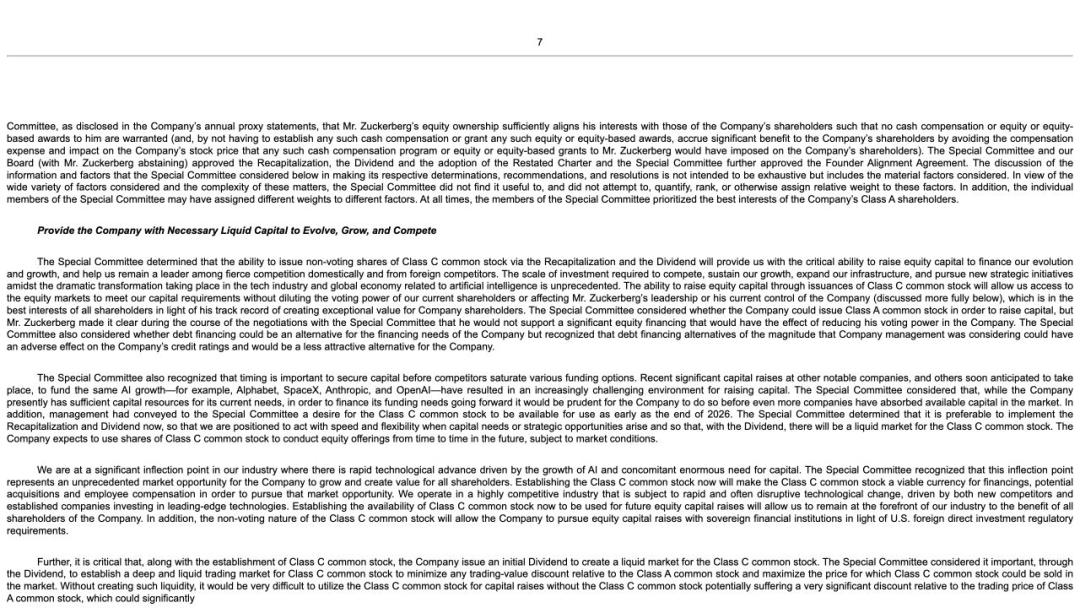
The preliminary information statement on capital restructuring submitted by Meta to the U.S. Securities and Exchange Commission on October 21 gives a more direct explanation: the special committee believes that the existing capital is sufficient to meet current needs, but more funds may be needed in the future. If a large amount of debt is raised at the scale considered by the management, the credit rating may be damaged. The document also named Alphabet, SpaceX, Anthropic and OpenAI, proposing to act before more competitors absorb market funds.
The issuance announcement on October 26 still lists operating cash flow, investment-grade debt, strategic cooperation and equity capital together as funding sources. Meta defines this equity financing as a supplement to existing channels.
Zuckerberg also set a condition. The preliminary information statement on capital restructuring on October 21 also disclosed that he does not support large-scale equity financing that would significantly dilute his own voting rights. The voting-free Class C shares thus have their purpose: new shareholders can contribute funds, but do not get voting rights as a result, and the existing control structure is preserved.
However, additional issuance will still dilute the economic rights and interests of original shareholders.
Meta has prepared more financing channels for the next round of investment. Oracle also needs to continue to raise money, but this time it tried to answer: How much more money does it need to take from the capital market to complete this round of expansion?
Oracle begins to set an upper limit for financing
This answer did not exist 48 days ago.
On September 10, at Oracle's FY2027 Q1 earnings call, Deutsche Bank analyst Brad Zelnick kept asking: peers are still increasing investment, why can Oracle reduce capital expenditure after the peak in FY2027 to FY2028? Will there be a higher peak? When will free cash flow turn positive?
Maxson's answer at that time was: "We have not given a specific time, and we do not plan to give one today." She also explained that the project will generate cash after it matures, but the overall free cash flow of the company still depends on how much funds continue to be invested to support growth.
The fact that one data center starts generating revenue cannot determine how much the next batch of data centers will cost. What Zelnick kept asking was exactly whether there is an end point between these two things.
On October 28, Oracle put the time and amount on the table together.
According to the Investor Day announcement released by the company that day, Oracle expects capital expenditure to peak in FY2027 to FY2028 and decline in FY2029; free cash flow is expected to turn positive in the second half of FY2028, that is, between December 2027 and May 2028, and start to rely on its own cash flow to support growth from FY2029.
Prior to this, the additional capital market financing required for this round of investment cycle up to FY2030 is capped at 20 billion U.S. dollars, with equity and new debt expected to account for about half each. This does not include refinancing of old debts, nor the 20 billion U.S. dollar stock financing completed in the first quarter of FY2027.
Then, what arrangements does Oracle rely on for this financing commitment to reduce upfront capital contribution?
In the CFO presentation materials that day, Maxson used the same 1GW project to compare three capital contribution methods.
If Oracle pays for the equipment by itself, the capital payment in the first two years is about 37 billion U.S. dollars. If the supplier provides five-year financing for 70% of hardware purchases, the payment in the first two years drops to about 18 billion U.S. dollars. At the same time, the annualized revenue after the project reaches full production is still about 16 billion U.S. dollars. In other words, the supplier advances part of the equipment payment first, and Oracle will repay the principal and interest later.
Another way is to let customers provide most of the hardware. According to the same model, Oracle only needs to pay about 6 billion U.S. dollars in the first two years, but the annualized revenue after reaching full production will also drop to about 11 billion U.S. dollars. Customers buy the equipment themselves, so Oracle advances less money and also charges less corresponding revenue.
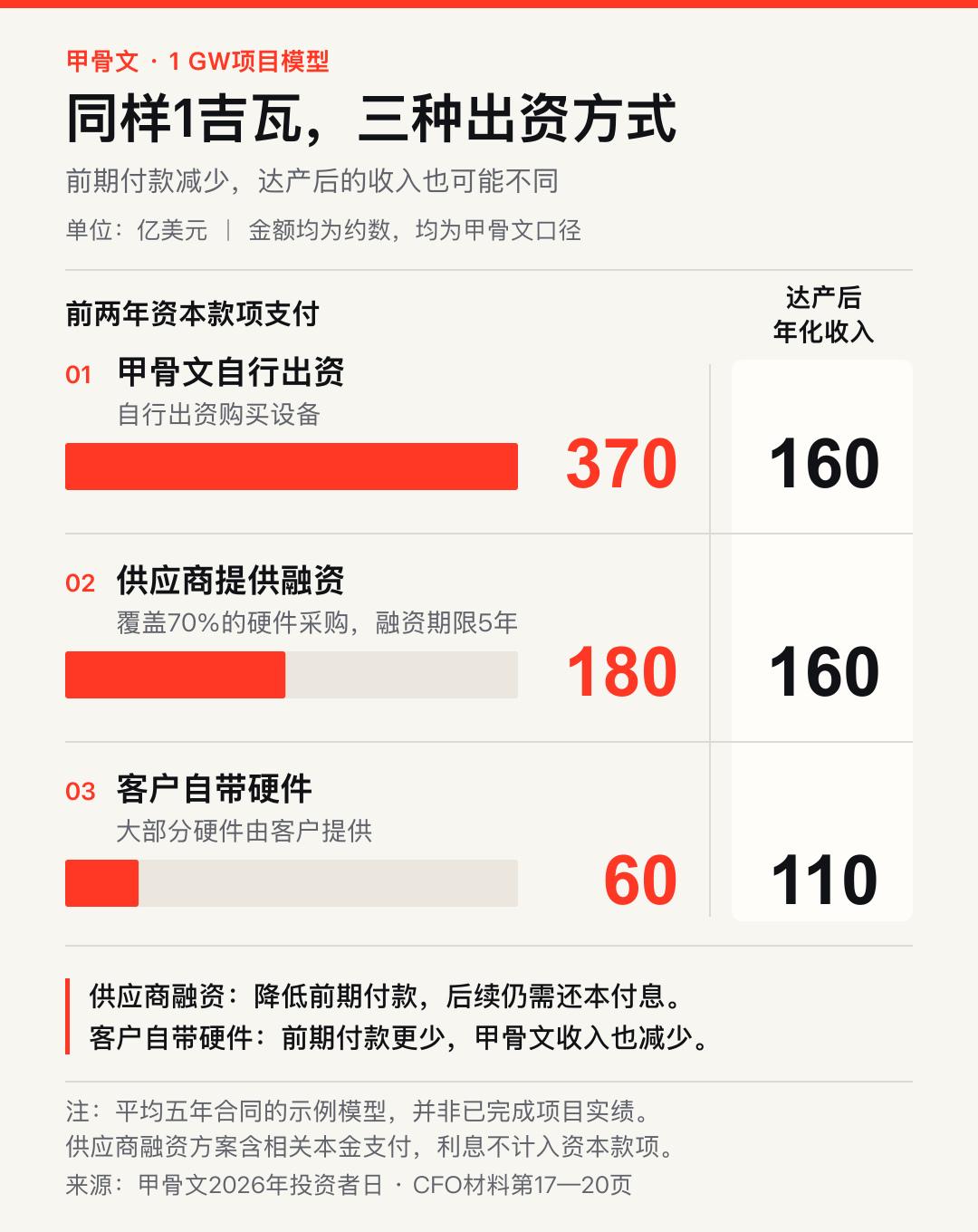
Plus customer prepayments, Oracle does not have to advance all the funds required before the project starts charging.
In fact, these cooperation methods have long existed.
Oracle disclosed in its FY2026 performance announcement released on June 10 that the total of customer prepayments and customer-provided hardware in large AI contracts reached 75 billion U.S. dollars. (This figure includes the value of hardware, not all 75 billion U.S. dollars in cash has been received.) At that time, the company still announced a stock and bond financing arrangement of about 40 billion U.S. dollars for FY2027.
This time, Oracle promises that the 20 billion U.S. dollars that originally only corresponded to the remaining fundraising needs for FY2027 will cover the additional capital market financing needs of this round up to FY2030. According to Oracle's forecast, customers and suppliers share the upfront funds, the commissioned projects gradually recover payments, and the construction peak will pass later, which together support this upper limit.
But this also brings a condition: the contribution arrangements of partners must keep up.
During the Q&A session on Investor Day, Jackson Ader, an analyst at KeyBanc, asked Maxson: If the combination of supplier financing, customer-owned hardware and prepayments changes, will the company still need to go out for financing? In order to maintain this combination, will it be necessary to reject certain customers?