Has Baijiu finally reached its inflection point?
In the past few years, the Baijiu sector has been declining in a far from dignified manner. The market topic of "The golden era of Baijiu is over, when will it hit the bottom?" has long been the focus of prolonged discussions.
Since October, the Baijiu sector seems to have ushered in some warming signs.
On October 30, the entire Baijiu sector skyrocketed, with the CSI Baijiu Index surging by more than 5%. Huangtai Liquor Industry, Gujing Gongjiu and Yingjia Gongjiu all hit the 10% daily limit, Luzhou Laojiao also hit the daily limit again after nine months, and Kweichow Moutai rose by more than 2%, hitting a new high in nearly half a year.
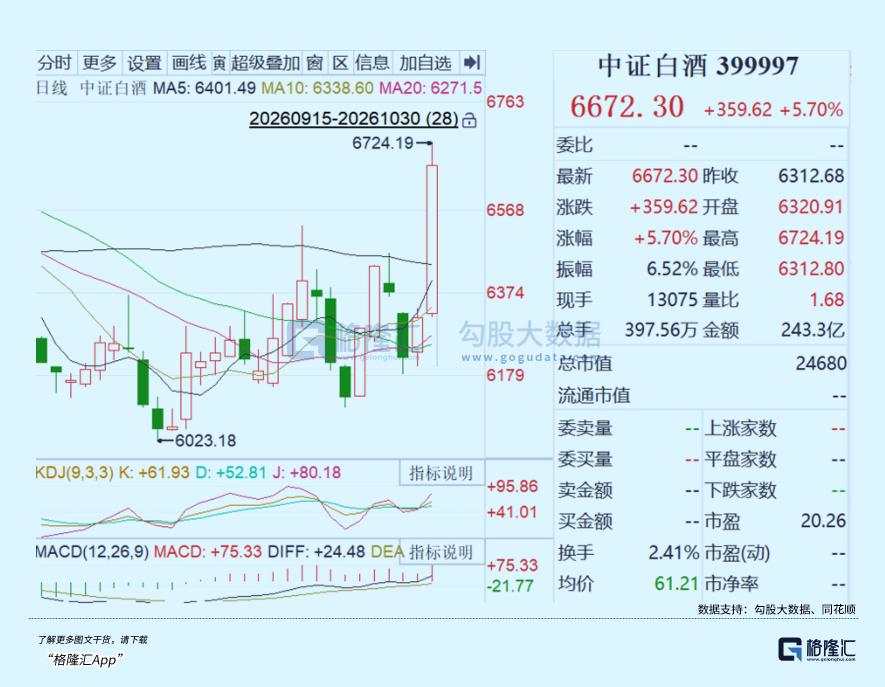
On the 29th, the so-called worst third quarterly reports of the Baijiu industry in recent years were all released collectively.
The figures on the performance statements are not impressive, but the stock prices have collectively hit the daily limit. What does such a divergence mean?
After nearly five years of continuous adjustment, has the Baijiu sector finally reached the inflection point?
01
In the past week, Baijiu enterprises have successively released their third quarterly reports.
If we only look at the year-on-year data, the performance of most liquor enterprises is indeed bleak.
Luzhou Laojiao recorded revenue of 14.668 billion yuan and net profit attributable to shareholders of 5.671 billion yuan in the first three quarters, with year-on-year declines of 36.58% and 47.31% respectively, and the year-on-year decline in the third quarter further expanded.
The year-on-year decline in net profit of Gujing Gongjiu in Q3 even reached 68%, and it is no exaggeration to say that this third quarterly report is the worst in recent years.
But positive signals have also emerged.
The net profit attributable to shareholders of Luzhou Laojiao in Q3 was 1.332 billion yuan, up 111.12% month-on-month from 631 million yuan in Q2, and the month-on-month increase in revenue also reached 71.45%.
Shanxi Fenjiu and Shede Liquor also completed the direction switch on the month-on-month dimension. Shede Liquor achieved a net profit of 49.55 million yuan in Q3, turning from loss to profit month-on-month, with a year-on-year increase of 72.44%, and the gross profit margin increased by 4.7 percentage points year-on-year.
The performance of Yingjia Gongjiu even showed a rare double growth: revenue in Q3 was 1.413 billion yuan, up 4.25% year-on-year; net profit attributable to shareholders was 414 million yuan, up 8.58% year-on-year.
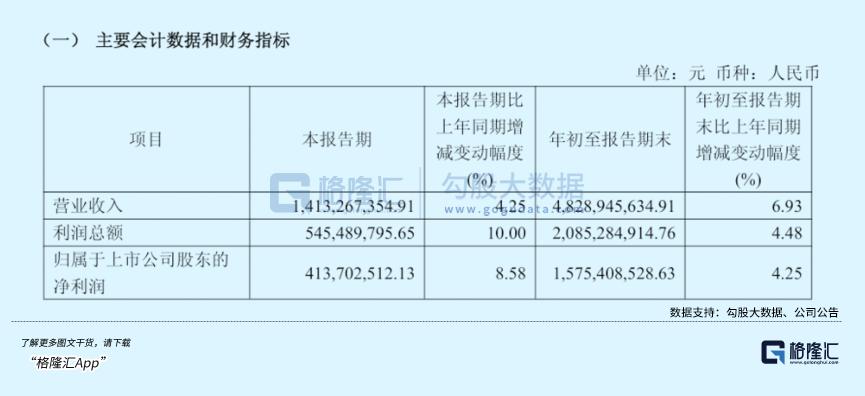
Moreover, at the end of the third quarter, the balance of contract liabilities of Yingjia Gongjiu was 454 million yuan, an increase of 30 million yuan from the end of the second quarter. Cash received from sales was 1.56 billion yuan, and net operating cash flow was 516 million yuan, up 9.3% year-on-year.
The month-on-month rebound of contract liabilities means that distributors are still willing to make payments to liquor factories in the off-season, and the simultaneously improved cash flow also indicates that these returned payments are not accumulated through credit sales and channel overstocking.
Against the backdrop of the overall weak willingness of payment collection in the industry, regional leading enterprises, supported by the rigid demand of their local market base, can complete the positive cycle of channel cash flow faster.
In contrast, pan-nationalized brands are still bearing the cost of active clearance, with relatively poor performance.
Wuliangye's operating cash flow in Q3 of 2.2 billion yuan turned positive year-on-year, but contract liabilities decreased by 1.5 billion yuan month-on-month, sales collection was 7.21 billion yuan, and receivables financing decreased sharply by 6.5 billion yuan month-on-month.
Behind such figures is that liquor enterprises are actively tightening the pace of payment collection, no longer blindly overstocking the channels, but letting the channels digest inventory first. Part of the decline in single-quarter performance is the cost of this active choice.
But on the other hand, the decline in single-quarter performance may have won breathing space for the channels.
The poor data of the third quarterly report partly reflects that the real demand for Baijiu is still weak, and on the other hand, it also shows that liquor enterprises are actively reducing pressure on channels, squeezing out the "moisture" brought by previous overstocking from financial reports.
After consecutive quarters of demand contraction and channel destocking, the month-on-month positive return of some liquor enterprises' performance may not mean that the inflection point has arrived.
Under the low base in the fourth quarter, some liquor enterprises are expected to turn positive, but the trend is still bottoming out rather than reversing.
But overall, it still shows that the industry's risks have been fully released, and the bottom characteristics of the Baijiu cycle have become increasingly obvious.
However, recovery is destined not to happen overnight.
Regional leading enterprises have more resilient demand and shorter channel clearance paths, because the consumption scenarios in their base markets are more focused on public banquets and daily drinking.
Pan-nationalized brands have accumulated longer distribution chains and heavier inventory burdens in the past few years, so the clearance process naturally takes more time.
In terms of price bands, the structure of "strong at both ends and weak in the middle" is also taking shape further.
Feitian Moutai has achieved double-digit year-on-year growth in sales in many regions, making it one of the very few ultra-high-end large single products that still maintain positive growth.
In the low price band, products under 100 yuan for mass consumption such as Bofen and Yingjia Dong 6 have achieved steady or even slight growth in sales, driven by demand for self-drinking and family gatherings.
Compared with the previous industry recovery rhythm, which was mostly led and defined by leading liquor enterprises such as Moutai, Wuliangye and Luzhou Laojiao, this round of recovery rhythm is obviously very different from the past.
But the worst time may have passed.
02
After the prosperity peaked in 2021, the Baijiu industry did not escape the previous cycle path.
The entire industry has gone through the stages of weakening demand, falling batch prices, accumulating channel inventory, and financial statement clearance in sequence, but this time the journey has taken longer than ever.
By the third quarter of 2026, this chain has advanced to the final stage, but it has not been completed yet.
And if you want to truly move towards recovery, you also need to go through this whole process.
In addition to the partial warming of the third quarterly report, during the just-concluded Mid-Autumn Festival and National Day holidays in 2026, channel data showed that the overall sales of the Baijiu industry fell by about 10% year-on-year. Although it still declined year-on-year, the decline in the same period of 2025 was about 20%, and that in the same period of 2024 was about 30%.
The narrowing of the decline for two consecutive years indicates that the downward slope of the demand side is slowing down.
In terms of batch prices, the batch price of bulk bottles of Feitian Moutai stabilized at around 1710 yuan after the double holidays, the batch price of whole cases was around 1725 yuan, the batch price of Wuliangye Pu Wu remained at around 780 yuan, and the batch price of high-alcohol Guojiao 1573 was about 830 yuan.
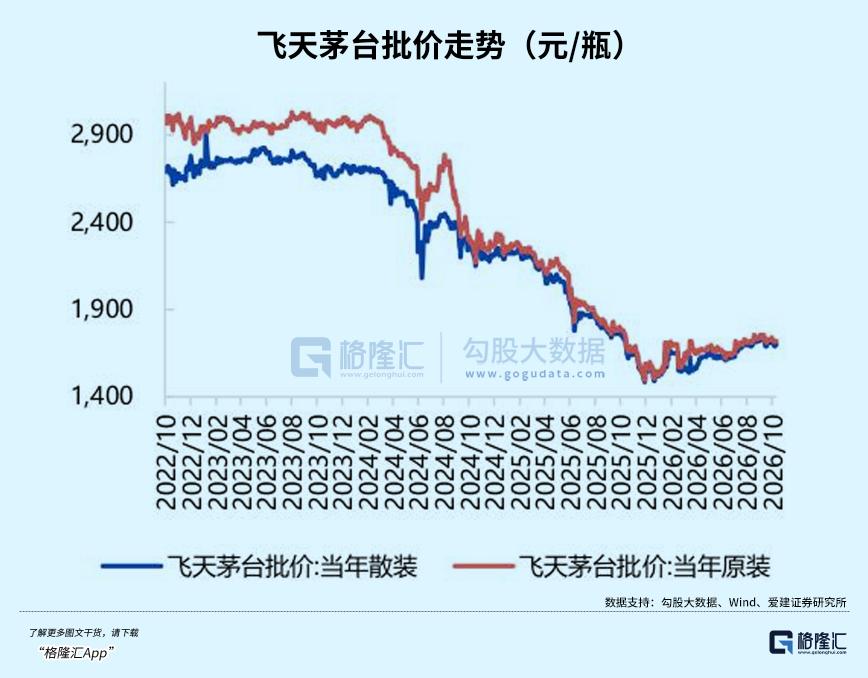
In the context of the continuous decline in batch prices in the past two years, the confirmation of the price bottom is a quite important change.
What is more critical is inventory. From the overall perspective of the industry, after nearly two years of active destocking, channel inventory has dropped to a historically low level.
Moutai distributors are basically in a state of low inventory or even no inventory, and Wuliangye distributors' inventory has dropped to a level of about 10%-15% year-on-year.
Inventory levels in most regions have fallen back to a reasonable range, distributors' goods dumping behavior has decreased significantly, and the industry inventory cycle is shifting from active destocking to the early stage of passive destocking.
However, the fact that inventory has fallen back to a reasonable range does not mean that demand is rising. There is still a key variable in between: whether distributors will choose to restock or continue to shrink their balance sheets after inventory normalization.
The contract liability data in the third quarterly report provides a rough perspective.
The contract liabilities of regional leading enterprises such as Yingjia Gongjiu and Gujing Gongjiu have rebounded month-on-month. The contract liabilities of Jinhui Liquor reached 820 million yuan, a sharp year-on-year increase of 30.3%, showing that the local terminal payment collection and channel stocking willingness are indeed recovering , which means that the local demand may have hit the bottom.
However, at present, the absolute level of finished liquor inventory in the whole industry is still not low, and the recovery of channel confidence is far from enough to support large-scale payment for goods.
The fourth quarter and the peak Spring Festival season in 2027 will be the key nodes to test the shift of the inventory cycle.
In this sense, the price bottom and inventory bottom may have been initially confirmed, but the demand bottom still needs time to verify.
It is in this gap where the fundamental bottom is gradually becoming clear but the recovery has not been confirmed, that valuation and dividends begin to take on the pricing of Baijiu enterprises, determining whether it is possible to take positions in advance in the bottom area .
After the recent rise, the rolling P/E ratio of the CSI Baijiu Index has risen to about 22 times, but it is lower than the historical median of 28.82 times, at the 23.96% quantile of the past ten years.
In the past ten years, Baijiu was cheaper than now in less than a quarter of trading days.
From the perspective of P/B ratio, it is at an extremely low quantile of about 5% in the past ten years.
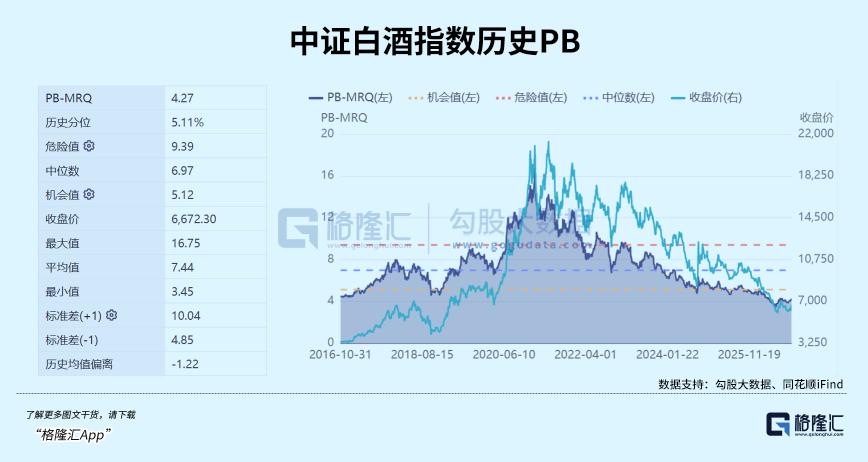
At the same time, the proportion of institutional positions in the Baijiu sector has also dropped to a historically low level, and the chip structure has been cleared before the fundamentals.
The dividend yield has continued to rise.
The dividend yield of the CSI Baijiu Index reached 4.45%, that of Luzhou Laojiao exceeded 7%, that of Wuliangye exceeded 6%, and that of Shanxi Fenjiu exceeded 5%.
Now, the 10-year Treasury yield is hovering around 1.6%, the spread between the dividend yield of the Baijiu sector and the 10-year Treasury bond has reached the highest range in history, and the dividend payout ratio of leading liquor enterprises is still increasing.
In a low-interest-rate environment, leading consumer goods enterprises with positive operating cash flow, no substantial weakening of brand barriers, and clear willingness to pay dividends, even if the revenue growth rate cannot return to double digits, dividends and share repurchases themselves provide shareholder returns, providing bottom support for stock prices.
Low valuation and high dividend do not constitute a reason to buy, but at least they mean safety.
03 Conclusion
The inventory cycle will not complete the clearance in a smooth curve, and the stock price will not rise in a straight line.
The Baijiu industry will not return to the era when growth could be achieved by overstocking channels.
But a valuation of 20 times, a dividend yield of more than 4%, and accumulated inventory clearance mean that the most painful stage of this industry is most likely passing.
The rest is left to time and market differentiation. (End of full text)
Gelonghui Statement: The views in the article are all from the original author and do not represent the views and positions of Gelonghui. Special reminder: Investment decisions need to be based on independent thinking. The content of this article is for reference only, and does not serve as any practical operation suggestion. Trading risks are borne by the investors themselves.
This article is from the WeChat Official Account "Gelonghui APP" (ID: hkguruclub), author: Yuan He, published by 36Kr with authorization.