Hackathons are becoming the "second autumn recruitment season" for young people | On-site Notes
"Workplace Bonus" (ID: ZhiChangHongLi)
Interview & Writing: Fang Tingyu Cover image: Still from *Dead Poets Society*
Art Editor: Fang Tingyu Text Editor: Chen Tong
The "Calculations" of Hackathon Participants ·01
Non-participants Are Also Seeking Opportunities ·02
How Should Enterprises Run Hackathons Themselves? · 03
After It Becomes a Business ·04
What Can a Hackathon Leave Behind? ·05
Inside a five-star resort hotel in Qixia, Nanjing, Liu Jingkang, Chairman of Insta360, stood at the center of the lobby stage, tossed a panoramic camera into the air, and took a group photo with a group of young people. This was the final scene of Insta360's first hackathon.
Minutes earlier, the presentation behind Liu Jingkang still read "A Story That Started in Qixia, Nanjing". This post-90s founder listed on the Sci-Tech Innovation Board told the participants on site about the early days of the team when they "started working with almost nothing but the clothes on their backs".
11 years ago, the story here belonged to Liu Jingkang. From September 21 to 24, 2026, the Insta360 Bold Maker Intelligent Imaging Challenge was held at Club Med Ark of Light Hotel in Nanjing, and the protagonists on the stage became the group of young people beside him.
Liu Jingkang said: "When a student starts a business, they have nothing at all from the beginning. If the business fails, it seems they still have nothing." But from another perspective, the capabilities and skills accumulated through starting a business will give them a huge competitive advantage when they go to work elsewhere.
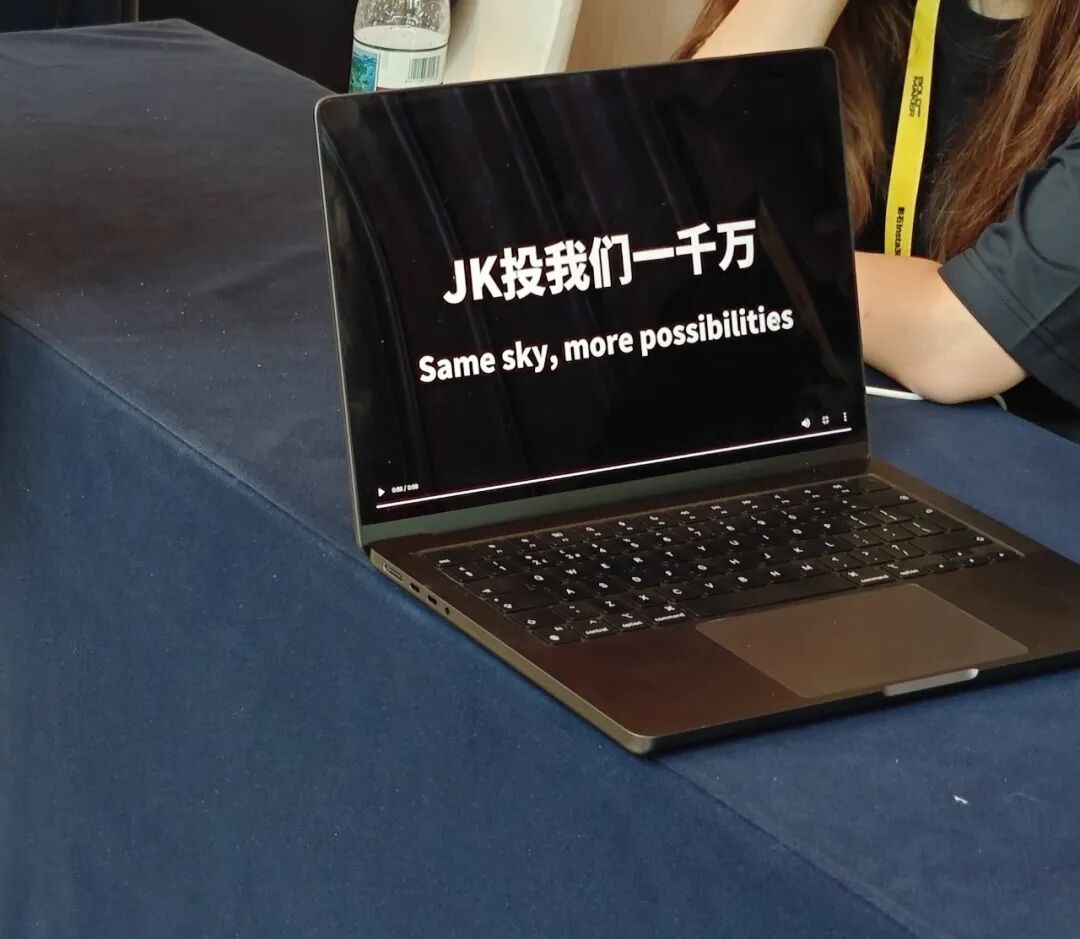
● Participants at the preliminary contest booth held up a sign that says "JK, invest 10 million in us"
The judges of this competition included senior executives from partner enterprises such as Alibaba Cloud, Qunhe Technology, and Droid Robotics, as well as scholars from Nanjing universities and local government representatives. Liu Jingkang graduated from the School of Software of Nanjing University, and many of his entrepreneurial partners met during their university years. He recalled: "Xianlin, Qixia District provided us with a very good office space, which is about 100 square meters in the Zidong Pioneer Park."
A staff member from a hackathon community ecological partner was surprised by Liu Jingkang's presence: "From my observation, Lei Jun did not show up when Xiaomi held a hackathon, and the top leader of Xiaohongshu also did not attend its competition... Liu Jingkang set a very high bar for this event."
A total of more than 220 makers participated in this competition, with a reward pool of 500,000 RMB, including 300,000 RMB in cash and hardware equipment worth 200,000 RMB. Winning participants can also become members of the local entrepreneurial "Black Card" and get support including office space, entrepreneurial grants and investment docking. The competition also provided five-star hotel accommodation, swimming pool access, buffet and free drinks.
Xiao He has participated in many hackathons. He said: "Before I came to the Insta360 hackathon, I always thought the AdventureX hackathon in Hangzhou was the best." In his opinion, the reasonable accommodation and meal arrangement and scale setting of this event provided practical convenience for team development.
The "Calculations" of Hackathon Participants
Compared with traditional hackathons dominated by tech geeks, the profile of participants in this competition is slightly different. Few of them are self-employed OPC (One Person Company) practitioners or cross-disciplinary brand operators. Most of the participants come from universities in and around Nanjing, with academic backgrounds ranging from undergraduate to doctoral, and majors covering science and engineering, liberal arts and art.
For current students, enriching resumes and seeking job opportunities are their main demands. One participant mentioned that a friend of his in the same year successfully got a job at ByteDance after participating in a hackathon held by ByteDance on campus. In their view, the demo completed in the hackathon is usually more mature than course assignments, and more suitable to be written into the resume.
A team of undergraduate computer science students from Wuhan University dedicated their first hackathon experience to Insta360. They had previously participated in another competition of Insta360's university-enterprise cooperation, which gave them the opportunity to participate. "Before coming, we thought it was a regular college student competition." When they arrived at the scene, they found it was a hackathon.
The team chose the "AI + Public Welfare" track. They initially planned to use panoramic cameras to help visually impaired people identify the environment, with functions including road sign recognition, voice broadcast and auxiliary judgment. After interviewing 3 visually impaired people and practitioners in related fields respectively, they took into account the information delay and complexity, and narrowed the scenario to a specific demand: helping visually impaired people identify the freshness of ingredients when buying groceries.
Insta360 invited interviewees from the public welfare field in advance, and required each team to interview at least 3 people. The conversations helped many teams calibrate their development direction.
A PhD student from Nanjing University of Science and Technology, who majored in image processing, also participated in the competition for the first time. He wanted to see how big the gap between academic research and practical application is. He originally thought that technology should occupy a high priority in products. After communicating with participants of different majors, he found that compared with the familiar academic problems, competition projects need to pay more attention to product pain points close to daily life.
Xiao He, a postgraduate student majoring in computer science, is an experienced participant. He has participated in two sessions of AdventureX and won many awards, and plans to try OPC entrepreneurship after graduation. To reduce differences of opinion, he usually forms a two-person team with an old partner.
"Winning an award is the goal, but we will not compete with a utilitarian mindset." Every time Xiao He conceives the product from scratch after arriving at the scene, and does not bring old projects into new competitions. His motivation to keep participating comes from the fun of the development process and the dopamine brought by "creating things".
On the last day of the competition, the demo of Xiao He and his team once again stepped onto the final stage.
"Technology is not the first, creativity is the first." Xiao He reviewed that in the first two competitions, he looked for breakthroughs from the technical level, and thought that the engineering implementation logic was very good. Although he won awards, he did not get the highest award. In the third competition, he focused his demands on daily desktop cleaning, and achieved satisfactory results.
Even for regular participants like Xiao He, there are very few projects that continue to be incubated after the competition. It is not easy to complete a complete product that can be incubated for a long time within 48 to 72 hours.
At the preliminary contest site, a participant from Shenzhen College of Innovation and Entrepreneurship had a heated discussion with the developer of another project next to the booth of that project — this is a demo that can realize "dance motion capture and error correction".
Both of them are dance lovers, and the debate focused on the interaction method: whether real-time error correction is suitable for dance learning. The former advocates that the system monitors the user's status in real time and gives feedback in time; the latter, based on his own dance learning experience, does not agree with frequent interruptions.
When talking about commercialization, the participant from Shenzhen College of Innovation and Entrepreneurship believes that if there is no external wearable device as the receiving end, it is difficult for such projects to form barriers. He then added: "However, competition projects do not need to consider making money. As long as they meet the needs and have good technical performance, they can get very high scores."
In the afternoon of the same day, this demo "Pocket Stage" that grew out of Insta360's product line won the second prize in the "AI + Imaging Product Development" track.
Non-participants Are Also Seeking Opportunities
To enter a hackathon, you do not necessarily need a demo, teammates or participant status.
Xiao Zhang, who is from Taiwan Province of China and studies at Nanjing University, is a soon-to-graduate medical student majoring in surgery. After missing the registration time, she chose to participate in this hackathon as a volunteer. "Coming to the hackathon is not just to make a demo, but more to find like-minded partners."
The organizer set up an "Extrovert Development Zone" in the on-site bar, and Xiao Zhang often appeared there. She talked from AI pharmaceutical to FDE (Forward Deployed Engineer), and made better use of the venue set by the organizer than the participants.
For her, the hackathon is also a platform to expand her social circle. In daily life, there are not many people around her who deeply apply AI to their work processes. As graduation approaches, the hackathon has shown her more career possibilities.
The screening threshold for volunteers in this event is relatively low, and the main criterion is whether they can participate in the whole process. Volunteers get a subsidy of 100 to 200 RMB per day, with meals included, but accommodation is not necessarily guaranteed. Among more than 40 volunteers, more than 10 came from other cities, one of whom traveled all the way from Karamay, nearly 4000 kilometers away.
A Qiao is also a volunteer from out of town. He just left his job not long ago. He used to work as a salesperson in the traditional medical device industry and is trying to switch to R&D. He believes that there is still a gap between traditional medical device companies and cutting-edge AI technology, so he decided to come out with his ideas to seek opportunities. Recommended by his former boss, he participated in this hackathon on his way home.
After arriving, A Qiao found the staff of companies such as Droid Robotics immediately, and verified his entrepreneurial idea of "Physical AI + Medical Machinery" from the technical level.
"I graduated from a non-top-tier university, and there is no suitable social circle around me, but many of the volunteers are students from Nanjing University." He said that the hackathon provided him with a channel to understand technological progress and contact peers.
In A Qiao's view, it does not make much sense to come here to visit the demos made by participants in a short time — but the value of "people" is far more important than the projects.
How Should Enterprises Run Hackathons Themselves?
Insta360 is a "veteran" in the hackathon field, but it was not an organizer at the beginning.
In June 2025, Liu Jingkang returned to his alma mater Nanjing University to participate in an event. Chen Rongxian, the founder of Nanke Song Hackathon, hoped to get a chance to introduce the competition to him in person. Since he could not get a spot in the normal process, he waited for Liu Jingkang at the door of the restroom. He finished explaining his idea during the dozens of meters walk from the restroom to the venue, and when the event ended, he walked through the crowd and stuffed a stack of paper materials into Liu Jingkang's hands.
Later, Insta360 sponsored a batch of products for Nanke Song Hackathon, and Liu Jingkang even recorded a promotional video.
Insta360 also sponsored AdventureX. In the sponsor list of this leading domestic hackathon, hardware enterprises are not uncommon. Bambu Lab brought several 3D printers to the competition site for participants to make prototypes, Rokid and Even Realities sent smart glasses, and Seenix provided the right to use dual-screen portable monitors.
For these hardware companies, the hackathon is a low-cost, high-concentration trial scenario — the young people who come to participate in the hackathon are exactly the group of users that hardware and tool products most want to reach.
Sponsorship only brings exposure, and running the competition by yourself allows you to set the rules. The organizer decides how to set the tracks, what the judges look at, and what equipment the participants use for development. The theme of Insta360's competition is almost designed closely around its own product system. The demos made by participants and the problems they encountered are all first-hand product data.
The "AI + Imaging Product Development" track revolves around the product itself. Participants develop based on Insta360's full range of cameras and open SDK. The topics involve automatic framing, subject tracking shooting and image quality enhancement, all of which are related to Insta360's product iteration direction.
The "AI + Imaging Content Creation" track focuses on usage scenarios. Participants shoot with Insta360 devices, and then combine AI tools to complete the narrative, and they can participate without writing code.
The "AI + Public Welfare" track tries to expand the application boundary, use imaging technology to respond to issues such as visual impairment, hearing impairment and aging, and give real demands to the participants.
The 4-day and 3-night continuous development is also a "job interview" close to actual work. In addition to developing demos, Insta360 also formulated a complete schedule, arranging product testing, user research and competitive product analysis into the agenda item by item, which is very similar to the product release process inside an enterprise.
Local governments also participated in project screening and undertaking. The competition was co-hosted by Insta360, Qixia Industrial Development Group and Xianlin Science City Group. On the award night, the Nanjing Qixia Intelligent Imaging OPC Creation Base was unveiled at the same time, and the first batch of high-quality projects were directly signed to settle in. Previously, Nanjing University, Insta360 and Qixia District had jointly built an algorithm innovation center, and Qixia District also opened 11 real application scenarios to Insta360.
Holding a national competition in Qixia gives Insta360 a feeling of returning home. Qi Lu, head of Insta360 Research Institute, said, "After the company has grown to a certain scale, we hope to give back the innovative spirit we absorbed in the early days to our hometown."
At present, there are not many hardware technology companies that run competitions on their own and make the events serialized and branded. The RoboMaster competition previously held by DJI is not a hackathon in the strict sense. It remains to be seen whether Insta360 will form a series of events in the future, and whether other companies such as Bambu Lab will choose to follow up.
Compared with technology companies, traditional enterprises, state-owned enterprises and local governments often have a mismatch when running competitions. A staff member of the hackathon community said that in the past, many similar competitions were difficult to truly land in the business and recruitment ends.
Such competitions mostly set competition topics around industrial issues, hoping to get implementable industry solutions. However, developers often have no