Just now, the China-specific Apple Intelligence was officially unveiled, but the fully-powered Siri AI still has to wait.
Just now, Apple officially announced that it will launch Apple Intelligence for users in Chinese Mainland!
It is reported that the first batch of functions will be opened for testing starting from November 4 with the iOS 27.3 Developer Beta.
The line "Ready for Apple Intelligence" that has been displayed on Apple's official website for more than two years has finally reached its moment of fulfillment today.
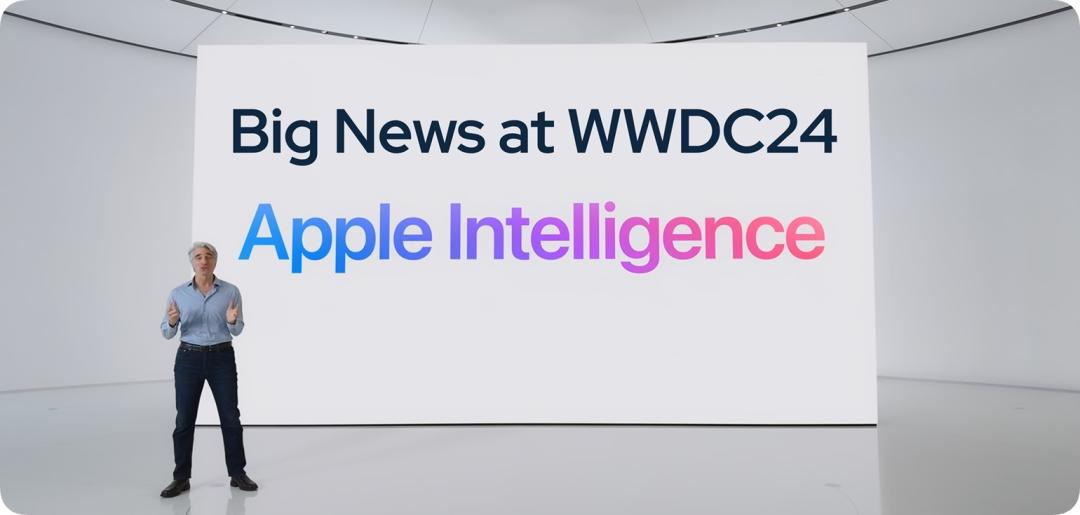
This also means that Apple Intelligence, which made its debut at WWDC 2024 and has been eagerly awaited by domestic users for more than two years, has finally taken a real step towards official launch.
As early as October 15, when Apple's Executive Chairman Tim Cook visited the "Blue Box" in Shanghai, he confirmed to ifanr that Apple had obtained approval to provide the first batch of core Apple Intelligence functions to users in China.
For the subsequent launch arrangement, Apple confirmed that the first batch of China-region Apple Intelligence functions will be officially released in December this year with iOS 27.3 for Chinese users - which is basically consistent with the previous exclusive disclosure by Mark Gurman, a reporter from Bloomberg.
iPhone gets priority for this round of updates
According to the officially released information, the first batch of functions opened for the Chinese mainland market covers the following contents:
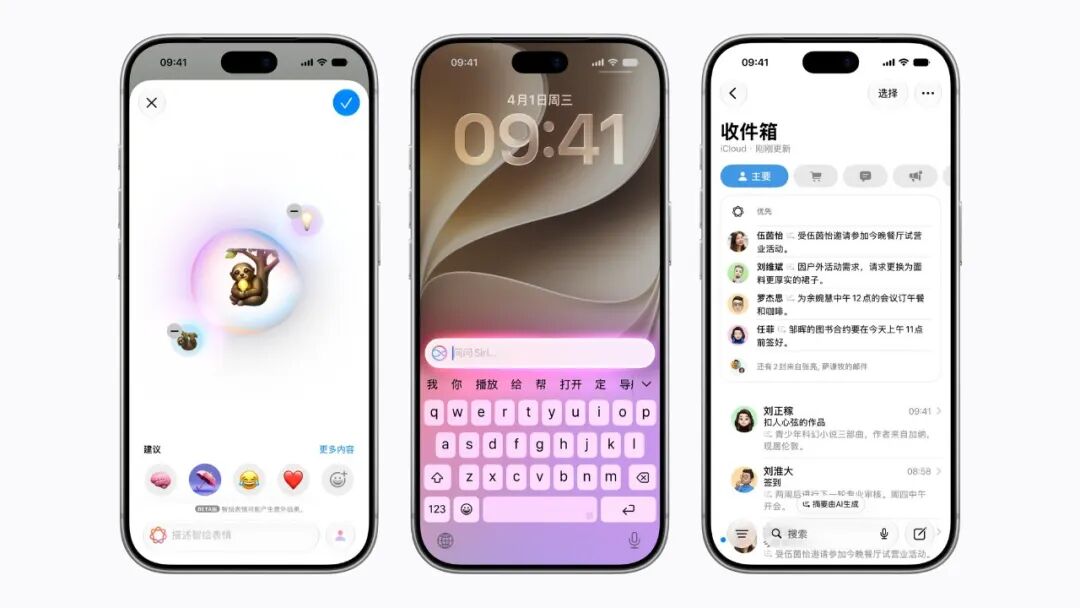
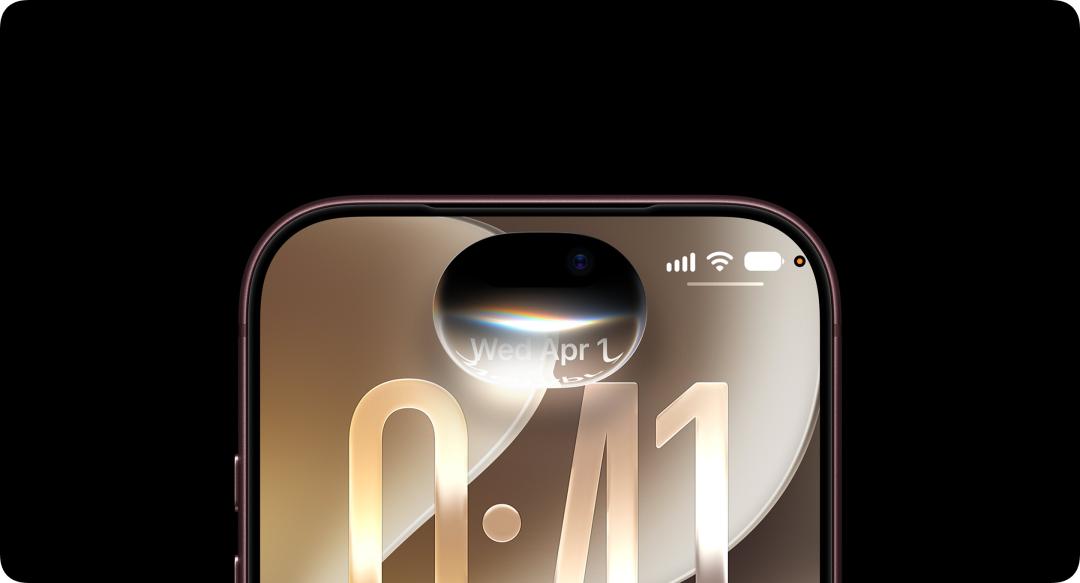
New Siri appearance and interaction: When you wake up Siri, a highly recognizable surrounding marquee light effect will light up at the edge of the screen; it supports switching between voice and text input at any time;
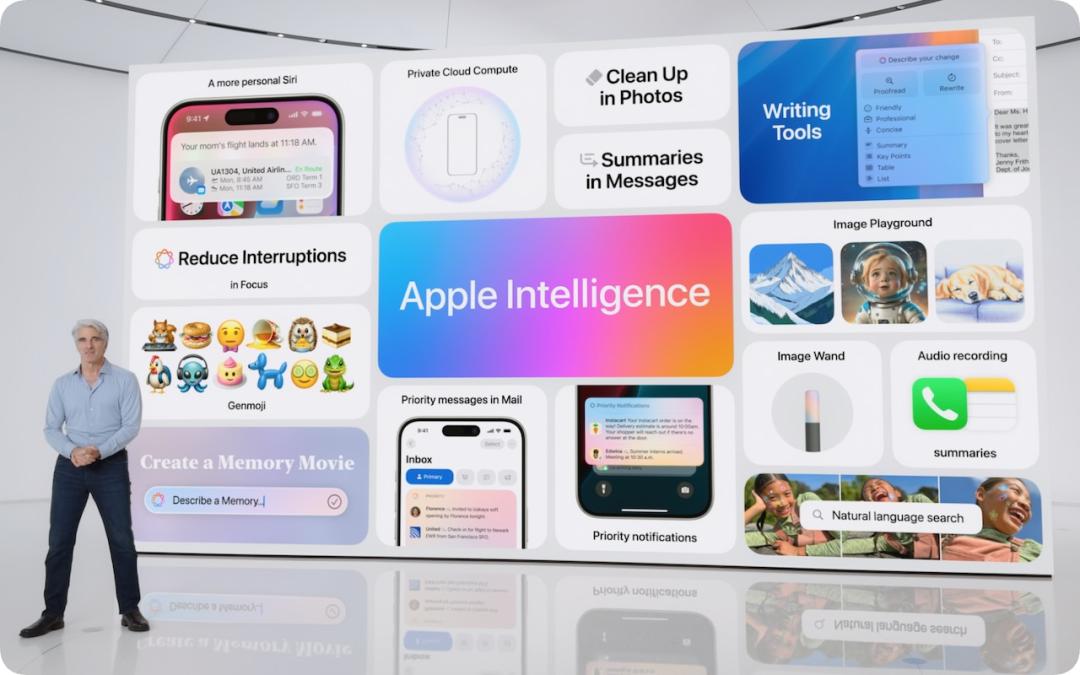
Writing Tools: It supports direct rewriting, proofreading and summarization of text in Notes, Mail and third-party apps, and supports generating content directly according to natural language requirements through the "Create" function;
Photo Erase and Natural Language Search: The photo album supports searching photos and video clips directly with descriptions in daily natural language; at the same time, the "Erase" tool is also available, and the on-device model will automatically identify and erase passers-by or sundries in the background with one simple smear;
Intelligent Emoji Generation: It supports generating exclusive personalized emojis directly through text description in the keyboard;
Real-time Translation: It enables cross-language real-time translation during phone calls, FaceTime and when wearing AirPods, and you can also directly send translated messages to each other in the Messages app. In addition to iMessage, even if the other party uses an Android phone, iPhone users can still communicate across languages with the other party through SMS or RCS messages;
Visual Intelligence: Quickly identify objects, restaurants or landmarks in front of you through the camera, supporting one-tap text translation and object recognition search;
Notification Summary: The system can automatically extract and summarize long notifications or multiple stacked notifications.
After going through the function list, here comes the practical question that everyone cares most about: can my existing device support this update? If I use an overseas version of iPhone, or travel abroad with a China-region iPhone, which version of Apple Intelligence will I be able to use?
This first batch of China-region Apple Intelligence functions is currently confirmed to be available only on iPhone. For other platforms such as iPad and Mac, Apple says that relevant regulatory approval is still pending, and the specific launch time has not been announced.
The hardware threshold is consistent with the international version — only iPhone 15 Pro/Max, iPhone 16 and later models (including the newly launched iPhone Duo) can get this update, and earlier models limited by memory specifications unfortunately cannot support it.
As for the regional restrictions between the "China Mainland Version" and "Overseas Version", according to the rules learned by ifanr, the device will apply the China Mainland version of Apple Intelligence function set as long as any of the following conditions is met:
The device is purchased in Chinese Mainland (that is, the China-region model);
The user is currently located in Chinese Mainland, and the billing address of the logged-in Apple ID is in Chinese Mainland (commonly understood as using the so-called "China-region Apple ID" we usually refer to);
The user is currently located in Chinese Mainland, and the device is not logged in to any Apple ID.
In addition, for users who are applicable to the China Mainland version of Apple Intelligence, even if they take their mobile phones abroad later, this set of China Mainland version of functions will still be applicable, and will not automatically switch to the overseas version due to geographical location changes.
Apple focuses on on-device capabilities, Qwen acts as the "external helper"
Compared with this long-overdue official announcement, the biggest highlight of the China-region Apple Intelligence is also the localized technical solution specially rebuilt for the Chinese Mainland market.
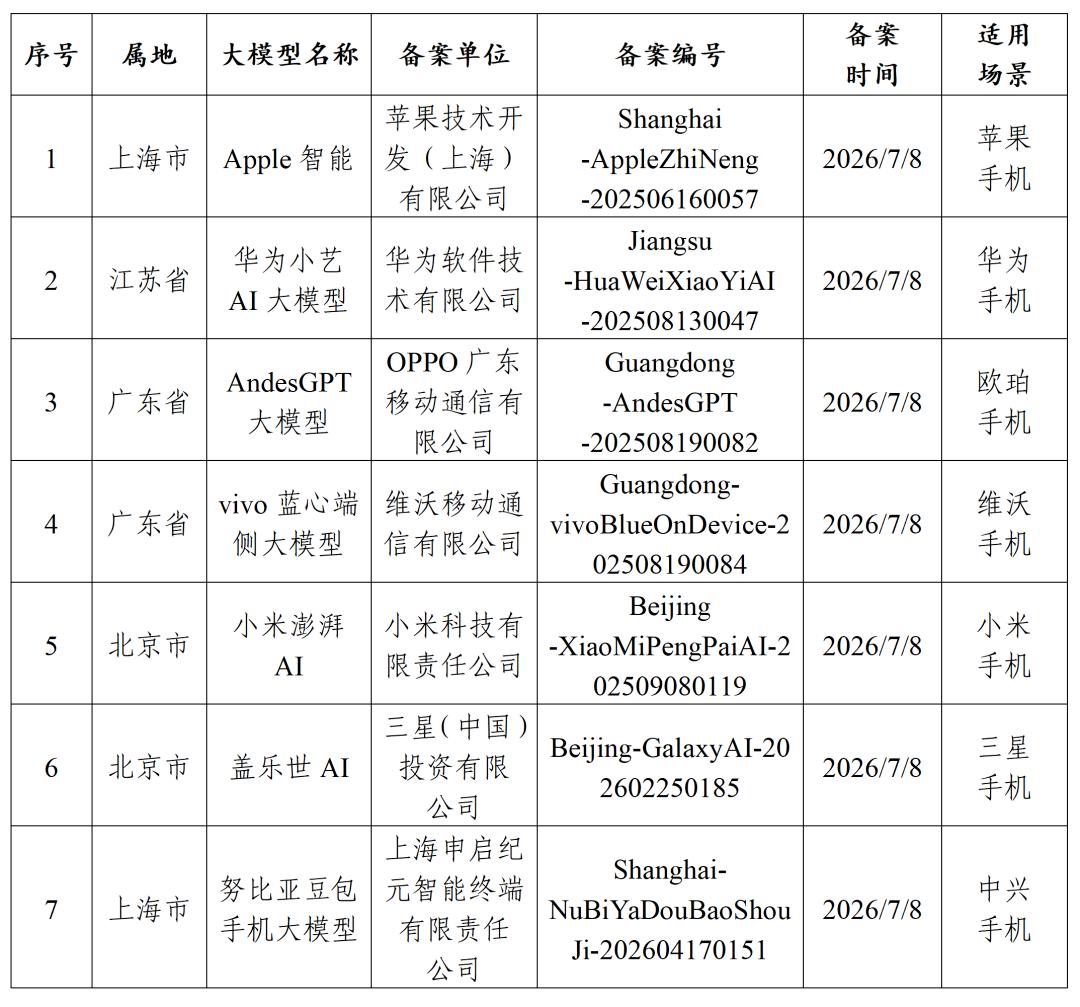
Previously, the filing information of the regulatory authority has actually revealed part of the answer: in July this year, Apple's "Apple Intelligence" appeared in the filing list of mobile on-device generative AI services announced by the Cyberspace Administration of China; at the end of September, the remarks column of the network access license of multiple China-region iPhones updated the filing numbers of three large models: Apple Intelligence, Alibaba Tongyi Qianwen and Tongyi Wanxiang.
With the official release of information today, the "two-layer model architecture" of China-region Apple Intelligence is finally completely clear — in short, it is "Apple's self-developed on-device model as the foundation + local large model providing cloud expansion".
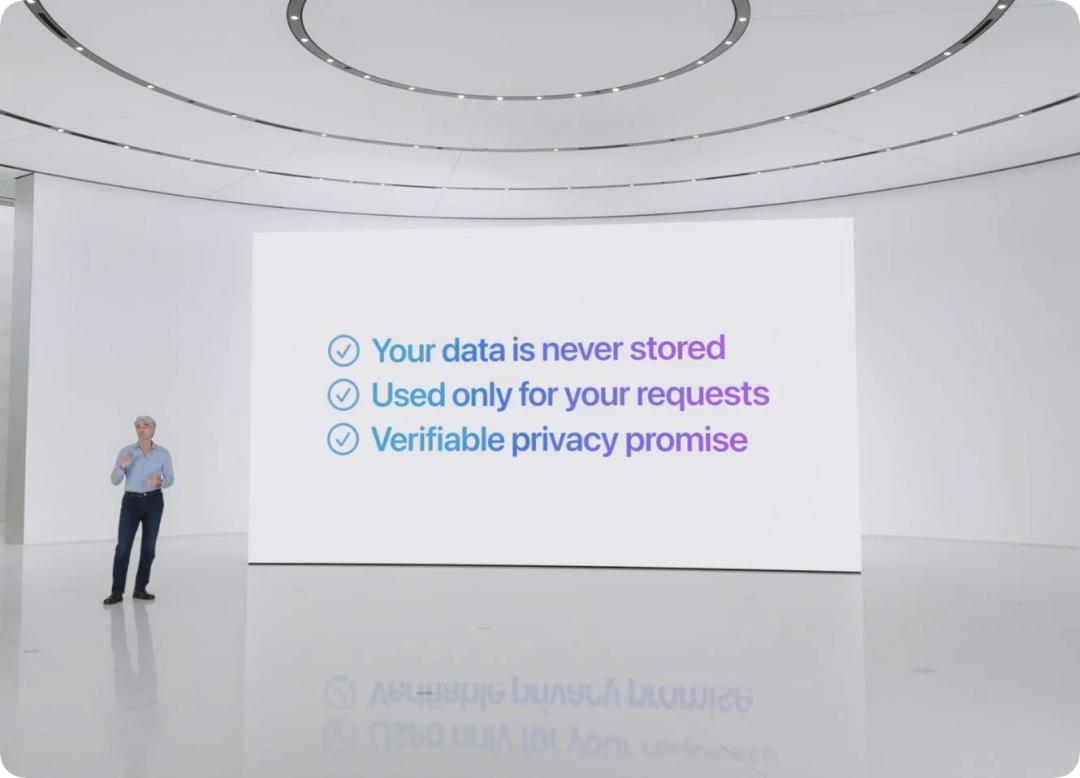
At the first layer (device side), Apple uses the self-developed Apple Foundation Models (AFM) specially customized for Chinese Mainland users. Many basic functions including photo erasing and real-time translation run completely locally on the iPhone. The official emphasizes that the personal data involved in these on-device functions will never be transmitted to Apple for storage, and Apple cannot access them.
At the second layer (cloud) that requires greater computing power, complex knowledge or deep generation capabilities, Alibaba's "Qwen" officially takes over, playing the role of ChatGPT in the overseas version of Apple Intelligence. ifanr learned from relevant channels that this cooperation is not bound to a single version of the Qwen model, but uses multiple different Qwen models, and will continue to be updated as the models iterate.
Specifically, Qwen's cloud expansion capabilities mainly cover the following scenarios:
Expanded Siri intelligent Q&A: Process complex questions transferred by Siri, and provide stronger knowledge Q&A and content generation capabilities;
Writing Tool "Qwen Create": Qwen will access Apple's system-level writing tools, users can not only generate text content through natural language instructions around any theme, but also generate images directly;
Visual Intelligence "Ask Qwen": Users can evoke Visual Intelligence through camera control, operation buttons or Control Center, select "Ask Qwen", identify objects and scenes in front of them, and further obtain relevant information and intelligent Q&A services.
In terms of privacy and invocation mechanism, this solution also continues the strict boundary when the overseas version accesses ChatGPT: users can independently choose whether to enable this expansion; when Siri judges that a question is more suitable for Qwen to handle, it can transfer the request to Qwen after obtaining the user's consent.
The interconnection of the account system is also very flexible. Users can either log in directly with their Qwen account (they can synchronously view the request history in the Qwen App after logging in), or use their Apple ID for one-click login, and turn on the "Hide My Email" function to protect personal privacy.
As for Baidu, which was widely rumored in the outside world before, it does appear in the cooperation list this time, but its role is very vertical — it mainly plays a role in the "image search (image recognition)" part of Visual Intelligence, while the banner of text understanding and generation is still carried by Qwen.
How far are we from the full-version Siri AI?
Although China-region Apple Intelligence has finally broken the ice, we still have to pour a basin of cold water first —
The version that will be opened for testing next week is far from the complete form of Apple Intelligence.
Compared with the evolution progress of the international version on iOS 26 and even iOS 27, the first batch of China-region functions still have obvious shortcomings. The most core missing part is the "Siri AI" that truly reconstructs the underlying interaction.
At WWDC26 this year, Apple demonstrated the complete form of the new generation of Siri AI. Compared with the traditional voice assistant that could only set an alarm clock and check the weather in the past, the new version of Siri can directly "see" the content on your phone screen (screen awareness), search for photos, emails and messages combined with your personal context, and even work across different apps for you.
This is also the next stage AI story that Apple really wants to tell: AI is no longer just passively answering your questions, but can understand what you are doing and take the initiative to get things done for you.
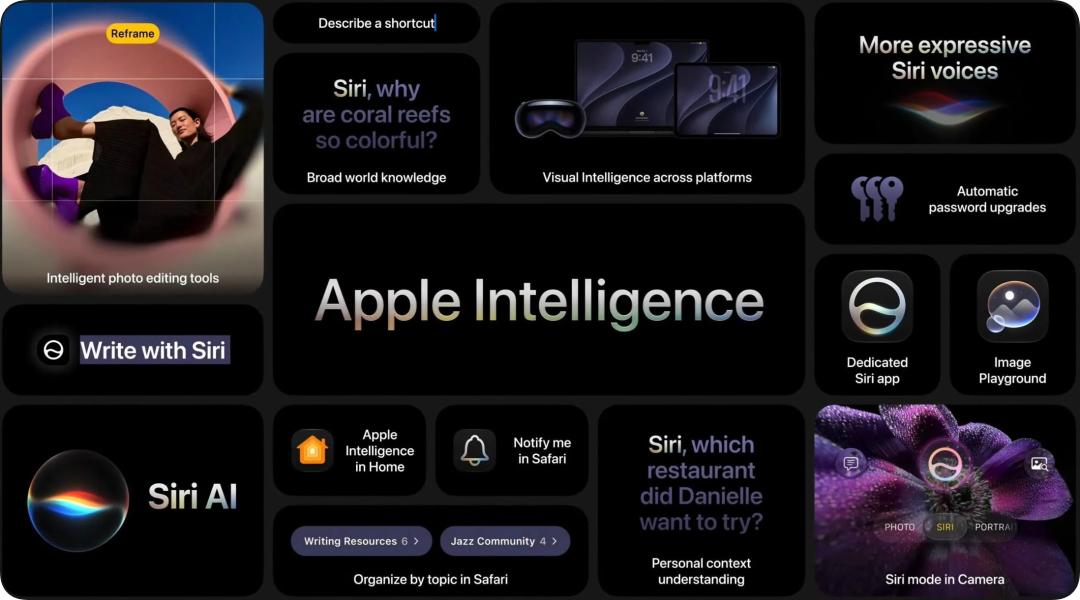
However, in the current iOS 27.3 China-region beta version, although Siri has a new marquee skin and is connected to Qwen as an "external brain", the core capabilities involving deep system invocation and personal context understanding have not been available to China-region users this time.
However, this does not mean that what China-region users get is just a plate of "leftover rice".
To be fair, although the "function framework" launched this time belongs to the old version of the previous two years, there is a generation gap from the underlying reconstructed, native AI-driven interaction form that Apple is pursuing now; but don't forget that the past two years have also been the two years when the underlying capabilities of large models have advanced by leaps and bounds. Whether it is Apple's self-developed on-device model or Qwen as the cloud external helper, its model intelligence, Chinese context understanding and generation level are far beyond what they were in 2024.
In other words, although the "shell" is still the first-generation function framework, the core inside is the mature model of 2026 — this cross-generation leap of underlying capabilities is expected to make the actual experience of the first batch of basic functions in the Chinese Mainland more solid than when the international version was first launched back then.
As for why Apple chose to launch such a combination of "old framework + new model" at this node, we can guess from the current launch rhythm:
Perhaps the China-region AI adopts a stable strategy of "passing approval in batches and gradually releasing". It first launches tools with stronger attributes such as rewriting, image editing, translation and compliant cloud Q&A, and then gradually unlocks AI assistants involving deep system permissions in the future.
Then, what exactly will support the full-version China-region Siri AI? We have to mention the deeper cooperation between Apple and Qwen.
Previously, Alibaba introduced to ifanr that in addition to directly accessing Qwen's existing cloud capabilities as it is now (to solve the problem of "whether the function exists"), the two sides are also deeply training and optimizing an exclusive large language model around Chinese users' language habits and local service ecosystem, and integrating it into Apple's AFM system.
As this jointly trained base is polished to maturity and completes the compliance process, the new Siri with screen awareness and cross-application execution capabilities is expected to be fully supplemented in subsequent versions.
This also gives the China-region Apple Intelligence, which arrived more than two years late, a more worthy of expectation possibility —
On the one hand, it accesses mature domestic large models to supplement the immediate functions; on the other hand, it jointly trains an exclusive base for the Chinese market to pave the way for the next generation of Siri AI and deeper system-level intelligence.
For domestic users, it is a pity to wait for two years, but if Apple can really combine the strengths of local large models with its own software and hardware ecosystem, this long wait may also bring some different experiences. As for whether it can finally move from "catching up with the international version" to a really handy and easy-to-use localized intelligence, it has to be answered by subsequent version updates and real device experience.
ifanr will also bring you the first real device hands-on test as soon as possible after the iOS 27.3 Developer Beta is pushed next week. After waiting for more than two years, we will see next week whether this hot Apple AI is really easy to use.