Having splurged a whopping 92 million US dollars, how do these two venture capital moguls navigate the US AI policy landscape?
In January this year, Silicon Valley venture capital firm Andreessen Horowitz (referred to as a16z) announced the completion of a $15 billion new fundraise. After this massive fundraising round, the 17-year-old institution's assets under management exceeded $90 billion, nearly doubling compared to 2024. For the firm's co-founders Marc Andreessen and Ben Horowitz, this also served as an opportunity for the two to publicly convey their grand ambition to reshape the United States and even the whole world.
"As a leader in the U.S. venture capital industry, part of the fate of the development of new technologies in the United States rests on our shoulders," Horowitz wrote in the blog post announcing the fundraising. "Our mission is to ensure that the United States wins the global technology competition in the next 100 years. The starting point for all of this is to seize the key technical architectures of the future — artificial intelligence and cryptocurrency."
This statement may sound a little boastful, but it is understandable. After all, it remains to be seen whether the United States can win in the next century, but his firm has already been one of the best-performing technology investment institutions over the past year and even the past decade.
01
a16z made its first investment in OpenAI in April 2023, when the latter was valued at $29 billion; by March this year, the AI giant was valued at $852 billion, and it is expected to go public next year with a valuation of over $1 trillion.
SpaceX is also an enterprise that a16z first participated in investing in 2023. It went public in June this year at a valuation of $1.8 trillion, delivering a 13x return on investment; two months after its listing, SpaceX acquired Cursor for $60 billion — this AI programming startup is also a portfolio company of a16z, and a16z obtained a 150x return on investment through this transaction. In addition, a16z is also a major investor in software startup Databricks. Databricks completed its latest round of financing in August this year with a valuation of $190 billion, while when a16z first invested in it, the company's valuation was only $47 million.
According to statistics from market research institution PitchBook, as of August this year, a16z completed another $5 billion fundraising, and its cumulative fundraising amount accounts for nearly 20% of the total U.S. venture capital fund fundraising as of 2026. As of March this year, a16z's assets under management exceeded $106 billion, making it the well-deserved largest venture capital institution in the United States (see chart).
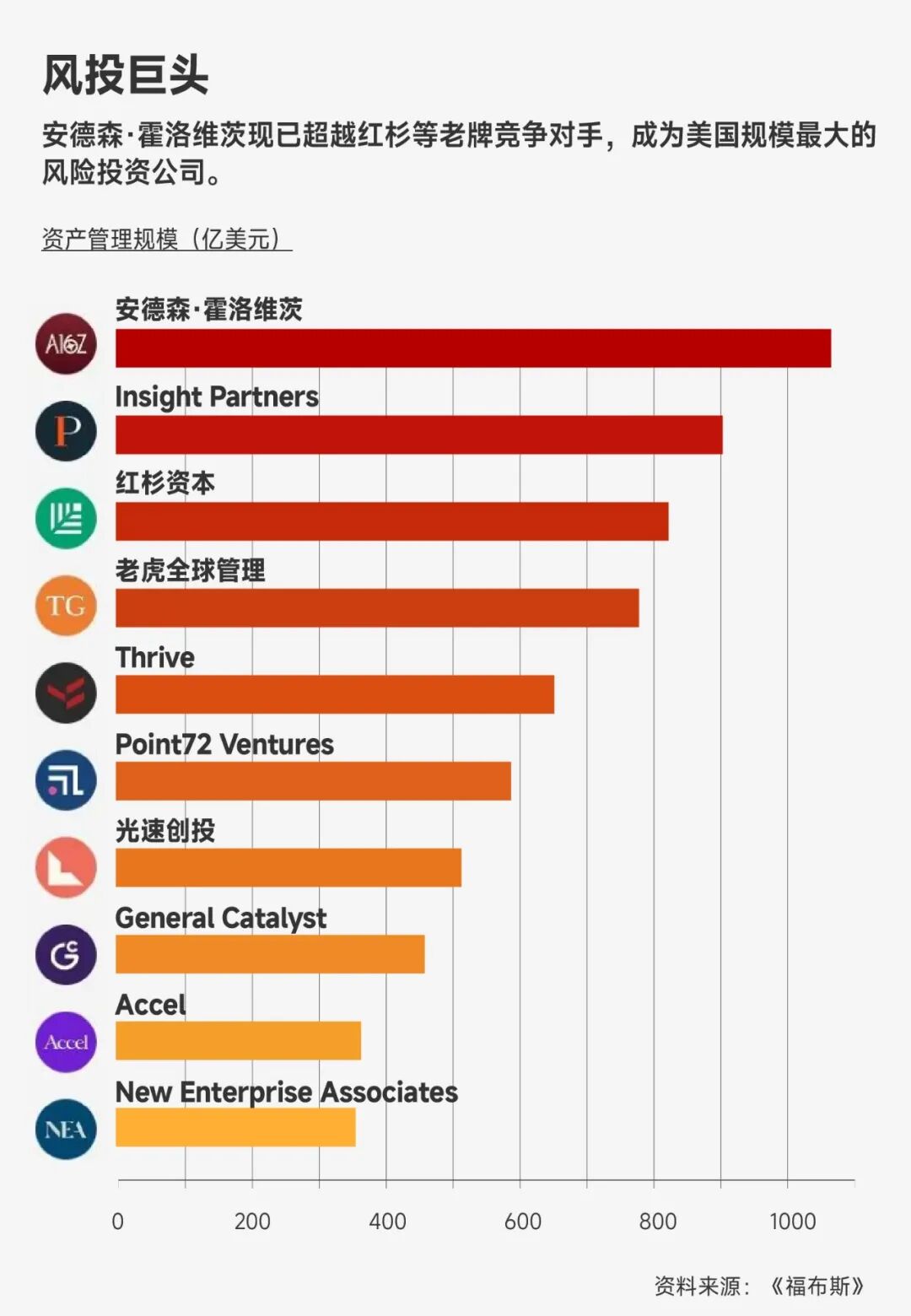
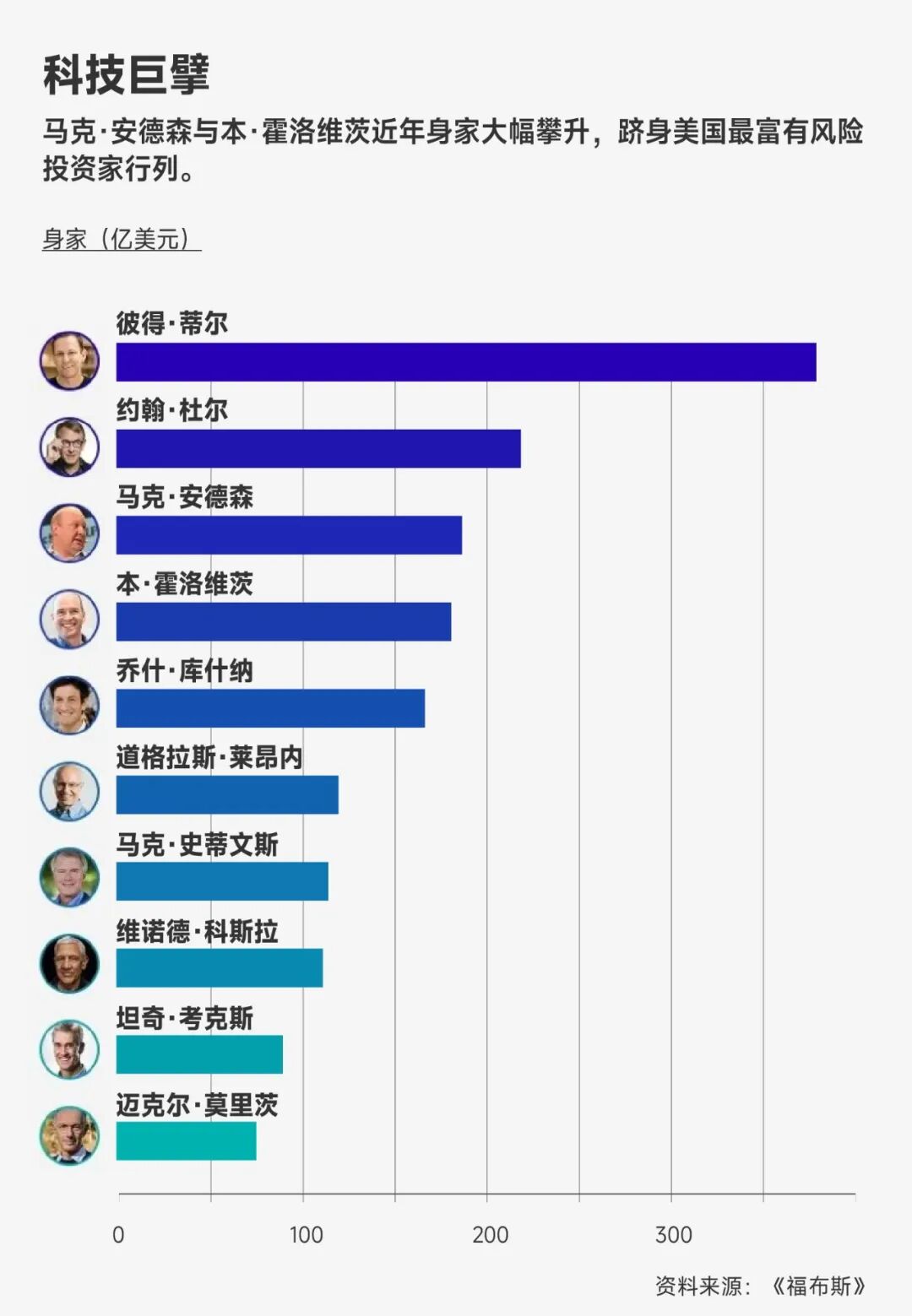
Forbes estimates that thanks to large-scale fundraising, a wave of successful investment exits, and the skyrocketing valuation of AI enterprises, Andreessen's current net worth has reached $18.6 billion, and Horowitz's is $18.1 billion. The two are among the richest venture capitalists in the United States, second only to Peter Thiel and legendary venture capitalist John Doerr. Peter Thiel has a net worth of $37.8 billion, about half of which comes from his shares in Palantir, which he co-founded and serves as chairman; John Doerr has a net worth of $21.8 billion, with a far longer investment career than the two. A spokesperson for a16z declined to comment, but Andreessen and Horowitz often speak publicly through the firm's multiple blogs, podcasts and programs.
The two have been selected to the Forbes Midas List of the world's top venture capitalists for a total of 27 times.
In the newly released 2026 Strebulaev-Jackson Top 50 AI Venture Capital Firms list, a16z ranks first. The list is jointly compiled by Ilya Strebulaev, a professor at Stanford University who has long been engaged in industry research, and Blake Jackson, a professor at The Ohio State University. "Andreessen Horowitz has always been at the forefront of the industry, investing in cutting-edge fields such as artificial intelligence and national defense early on, and continuously providing support to portfolio companies, which has allowed them to achieve extremely rapid growth," said Strebulaev. "Nowadays, enterprises stay private for longer, grow faster, and have greater demand for capital. The traditional venture capital model can no longer meet this demand. a16z's huge size gives it an advantage — the single-round financing amount in the AI field is generally very high, and many venture capital institutions are simply unable to take on such investments."
Nowadays, the two are increasingly using this strength to influence government policies. The two have long been Democrats, and they donated only a total of $2.5 million between 2009 and 2022; but since then, their total donations have reached $177 million, of which $92 million was contributed in this election cycle, most of which went to the Republican Party. This shift began with an article published by the two in 2023, in which they clearly announced for the first time that they would publicly support political candidates.
"We do not take sides with any political party, but only state our positions on a single issue: if a candidate supports an optimistic future empowered by technology, we will support him; if he wants to stifle the development of key technologies, we will oppose him," Horowitz wrote in the article. "Every penny we donate will be used to support candidates with consistent ideas, and oppose those who intend to ruin the future of cutting-edge technology in the United States."
02
In the 1990s, the two co-founders of a16z met because of Netscape, a web browser startup. In 1994, Andreessen co-founded Netscape with another billionaire Jim Clark, and Horowitz served as a product manager at the company at that time. In 1998, Netscape was acquired by AOL for $4.2 billion; later, the two joined hands to found data center software company Opsware, and sold it to Hewlett-Packard for $1.6 billion in 2007.
Two years later, the two opened an office on the famous Sand Hill Road in Menlo Park, California, and founded Andreessen Horowitz. Andreessen's father-in-law was the late Silicon Valley legendary real estate tycoon John Arrillaga, who played a key role in the development of this area into the core hub of the global venture capital industry.
From the very beginning of its establishment, the two were determined to build an institution completely different from traditional established venture capital firms.
The fundraising presentation materials for the first fund stated that the fund would look for a new generation of "ambitious" entrepreneurs — who, like the legendary Apple CEO Steve Jobs, would use technology to "make a dent in the universe".
Andreessen said this model originated from his own entrepreneurial experience. In an interview with Forbes in 2012, he said: "We have been entrepreneurs throughout our careers, and we know exactly what entrepreneurs really need. Our approach is based on practical experience, not on paper. What we want to build is exactly the kind of venture capital firm that we most hoped to encounter when we were starting our own business back then."
This model was unusual in Silicon Valley at that time. Strebulaev commented: "They created the so-called 'founder-friendly' model. Most venture capital firms are very small, with only a few partners, carefully select investment targets, and have a small number of employees. But a16z took a different path: they proposed that 'they want to help startups succeed', and for this purpose recruited a large number of personnel to provide startups with all-round support including marketing, business development, legal affairs and other services."
Less than three years after the establishment of its first fund, a16z reaped several of the firm's most impressive high-return investments. In 2011, Microsoft acquired Skype for $8.5 billion, and a16z's $50 million investment in Skype achieved a four-fold return after only two years of holding. The $250,000 bet on Instagram delivered even more astonishing returns. After Mark Zuckerberg acquired the app for $1 billion, Andreessen said the investment had achieved "unimaginable returns".
Startup founders are willing to turn to them because the two dare to place large bets, even when others think the valuation is too high or the relevant market has not yet taken shape. Brian Chesky, co-founder of Airbnb, said in an interview with Forbes in 2012: "They have the most aggressive style and the most optimistic outlook on the industry. They will not wait for the market to mature before making a move, but have their own judgments and beliefs."
Over the years, they have invested in many enterprises that have shaped the modern Internet landscape, including investing in Airbnb and Twitter in 2011, GitHub in 2012, Instacart in 2014, Plaid in 2018, Substack in 2019, and Roblox in 2020. The two began to lay out the cryptocurrency field as early as 2013, investing in crypto fintech company Ripple Labs and cryptocurrency exchange Coinbase, several years before cryptocurrency technology entered the public view.
By 2019, the 10th anniversary of the firm's founding, a16z had generated more than $10 billion in profits for its investors. This track record made the firm famous. Andreessen said in an interview with Forbes in 2019: "What is the number one differentiating advantage in any industry? It is to be number one." In the same year, the firm registered as an investment advisor while continuing to operate as a venture capital institution, allowing it to place larger bets in the cryptocurrency and public stock markets.
03
Another key to a16z's success lies in its strong lineup of partners, whose expertise covers multiple industries such as healthcare and fintech.
"Their talent pool is extremely deep," Strebulaev added. The 2026 Strebulaev-Jackson Top 100 AI Venture Capitalists list shows that a16z has 11 partners on the list, more than any other venture capital institution (Horowitz himself ranks third, and Andreessen ranks 22nd).
This model also allows them to continuously attract the best entrepreneurs. "What their investment team brings is far more than just capital, but also a real partnership," said Daniel Nadler, co-founder and CEO of medical AI enterprise OpenEvidence, who is also a billionaire. a16z first invested in OpenEvidence in March this year and participated in another round of financing in September, when the company was valued at $15 billion. "We can not only collaborate with their growth fund team, but also cooperate in depth with their biomedical team, which is extremely valuable. They know not only how to sell to enterprise customers, but also how to make products accepted by individual users, which is crucial for products like ours that take doctors as core customers."
a16z's limited partners have also reaped rich returns along the way. According to a presentation material obtained by tech journalist Eric Newcomer last year, between 2011 and August 2025, a16z distributed a total of $25.4 billion in net proceeds to its limited partners; if reinvested capital and the portion returned to partners are included, the total amount can reach $37 billion.
The wealth accumulation of these two venture capital tycoons and the development of the firm are highly dependent on friendly technology policies. It is not surprising that they regard the Biden administration's skeptical attitude towards large technology companies as a personal threat, and thus begin to get more involved in politics. This trend fully accelerated during Biden's re-election campaign in 2024. The two increasingly felt that they were at odds with the Biden administration, believing that the Biden team was extremely unwilling to communicate with them on core political issues such as AI and cryptocurrency. "We can't get in touch with this administration at all, we can't even get a word in, which makes me very annoyed," Horowitz later admitted in a podcast program.
04
In contrast, Donald Trump is very willing to meet with these wealthy and influential tech investors.
In July 2024, Andreessen and Horowitz had a three-hour dinner with Trump at Trump National Golf Club Bedminster in New Jersey. Ten days later, the two talked about the presidential election on their own podcast program, and publicly announced their decision to support Trump.
"A lot of my friends will probably be very angry if they hear me say good things about President Trump. Everyone will get very emotional, and it's hard to have an open and honest conversation," said Horowitz, who had never supported a Republican presidential candidate before. "But the future of our industry, the future of technology, and even the future of the United States are really at a critical juncture. We believe that Donald Trump is the right choice."
In the end, the two invested a total of $85 million in the 2024 general election. Of this amount, $67 million went to Fairshake, a political action committee that supports the cryptocurrency industry. Andreessen donated more than $5 million to Trump and his campaign committees, and Horowitz donated $2.5 million. Later, after Biden dropped out of the race and Kamala Harris took over as the Democratic candidate, Horowitz also donated $2.5 million to a super political action committee supporting Harris. Horowitz had previously hosted an annual CEO barbecue at his home, and invited Harris to attend.
After Trump won the election, the long-time partners each donated $3 million to the presidential inauguration fund, and have firmly supported Trump ever since. During the transition of power, Andreessen frequently visited Trump's Mar-a-Lago estate in Florida, assisting the president in formulating technology industry policies and reviewing core personnel candidates (two other partners of a16z joined the government to take up positions); Horowitz attended the signing ceremony of Trump's crypto-friendly GENIUS Act in July 2025. The two also accompanied the president on multiple state visits, including the meeting with Saudi leaders last year, and the meeting with King Charles III of the United Kingdom in April this year.
05
Horowitz's article announcing the new fundraise in January this year reveals ambitions far beyond just making money.
This article reads more like a political manifesto, urging the U.S. government to embrace AI and cryptocurrency to "defend and advance U.S. interests". He also issued a clear warning: "If we cannot push the national policy in the right direction, the United States is very likely to lose its position as the global technology leader."
To achieve this goal, the two billionaires have invested a total of $92 million so far in the 2026 election cycle. This donation scale makes them the fifth largest donor in the United States, second only to major Democratic donor George Soros ($102 million), Renaissance Technologies founder Jeff Yass and his wife Janine ($110 million), packaging and logistics supplies tycoons Elizabeth Uihlein and Richard Uihlein ($150 million), and Elon Musk ($446 million).
In their public statements, the two billionaire founders spare no effort to emphasize that they have cooperated with both the Democratic and Republican parties on artificial intelligence regulation issues. But the biggest beneficiary of their large donations is Leading the Future, a pro-AI super political action committee. The committee was launched by the two together with OpenAI president and fellow billionaire Greg Brockman in August 2025.
The super political action committee states on its official website that its goal is to "identify, support and empower candidates who support the development of artificial intelligence". Andreessen and Horowitz have contributed $50 million to it, and most of the remaining funds come from Brockman. Relying on a series of political action committees under its banner, Leading the Future has invested $39 million in elections so far, of which about $28 million is used to support Republican candidates and oppose Democratic candidates. Andreessen and Horowitz also donated a total of $12 million to Trump's "Make America Great Again" super political action committee, $5 million to other Republicans, while their donations to Democrats are only slightly more than $500,000. The two also donated $24 million to pro-cryptocurrency political action committees.
The vast majority of their funds go to candidates who oppose strict AI regulation. Their most important recipient, Trump, once called people's concerns about AI a "hoax"; senior Republican leaders in Congress also oppose widespread moratorium or suspension of artificial intelligence research and development. Leading the Future is consistent with this position: the candidates it supports advocate the establishment of a unified national regulatory framework instead of scattered rules set by each state