Losing money on every pig it sells, Muyuan Foods Co., Ltd. suffered a staggering loss of 9.3 billion yuan in the first three quarters, so why is it still sticking it out?
On the evening of October 29, Muyuan Foods Co., Ltd. released its 2026 third-quarter report: its operating revenue in the first three quarters reached 92.00 billion yuan, down 17.52% year on year; the net profit attributable to shareholders of the parent company was -9.319 billion yuan, compared with 14.779 billion yuan in the same period of the previous year, down 163.05% year on year; the non-recurring profit and loss adjusted net profit attributable to shareholders of the parent company was -9.107 billion yuan.
Even Muyuan Foods is suffering huge losses, other leading pig breeding enterprises are facing even tighter operating conditions. Wens Foodstuff Group Co., Ltd. recorded a net loss of 4.961 billion yuan attributable to shareholders of the parent company in the first three quarters of 2026, compared with a profit of 5.256 billion yuan in the same period of the previous year, and it lost 596 million yuan only in the third quarter. New Hope Liuhe Co., Ltd. has not released its third-quarter financial report, but its net loss attributable to shareholders of the parent company in the first half of the year has reached 1.702 billion yuan, compared with a profit of 755 million yuan in the same period of the previous year, turning from profit to loss year on year.
Looking at the 22 listed pig breeding enterprises: in the first half of 2026, the revenue of 15 enterprises declined year on year, the net profit of 20 enterprises decreased year on year, and 21 enterprises suffered losses. Among them, the three leading pig breeding enterprises, Muyuan Foods, Wens Foodstuff Group and New Hope Liuhe, posted a total loss of 12.146 billion yuan in the first half of the year.
Lose money for every pig sold
The performance decline of leading pig breeding enterprises did not start this year.
Taking Muyuan Foods as an example, its net profit attributable to shareholders of the parent company in 2025 was 15.487 billion yuan, and that in the first three quarters of 2025 was 14.779 billion yuan. Calculated based on these two disclosed figures, its net profit in the fourth quarter of 2025 was only about 700 million yuan, while that in the third quarter of 2025 was still 4.249 billion yuan. This means that since the fourth quarter of 2025, the profit buffer of leading pig breeding enterprises has been almost exhausted.
Entering 2026, pig prices have continued to run below the cost line. According to the monitoring data of Soyoung Info, on March 23, 2026, the national average trading price of lean-type live pigs once dropped to 9.71 yuan per kilogram, hitting a record low; the lowest single-day price in the first quarter touched 9.41 yuan per kilogram, a low point in the past 15 years. By late October, the national average price of lean-type live pigs still hovered in the range of 9.08-9.88 yuan per kilogram, and the expected rebound before the traditional pickled meat peak season did not materialize.
However, the average full cost of the industry is 12-13 yuan per kilogram. Citing data from analysts at Soyoung Info, China Business Journal pointed out that the break-even line of most breeding enterprises is 11.6-12.0 yuan per kilogram, and that of leading enterprises is around 11.5 yuan per kilogram; Zhu Zengyong, a researcher at the Institute of Animal Science of Chinese Academy of Agricultural Sciences, also confirmed that the average full cost of the industry is about 12-13 yuan per kilogram. Even Muyuan Foods, widely recognized as an "expert in cost control", only had a full cost of "slightly lower than 11.5 yuan per kilogram" in September, with a cash cost of about 10.3 yuan per kilogram.
This means that at the pig price of 9-10 yuan, for every kilogram of pork sold by Muyuan Foods, a loss of more than 1 yuan will be recorded on the book; for enterprises whose cost is still above 12 yuan, the loss per kilogram is close to 2 yuan. Converted according to the slaughter weight of standard pigs, the rigid loss per head is between 200 and 400 yuan, and small and medium-sized farms and households with higher costs suffer deeper losses.
The strategy of "making up for low prices by increasing sales volume" is almost completely ineffective in this price range. Muyuan Foods sold 6.423 million commercial pigs in September, up 15.24% year on year, but its sales revenue decreased by 6.01% instead, which means that the 15% increase in sales volume was completely swallowed up by the nearly 20% price drop. Below the cost line, selling one more pig means recording one more loss, and the slaughter volume has changed from a "growth engine" to a "loss amplifier".
Why are pig prices kept at the bottom?
Pig prices are determined by supply and demand, but the nature of both supply and demand sides in this round is different from any previous pig cycle.
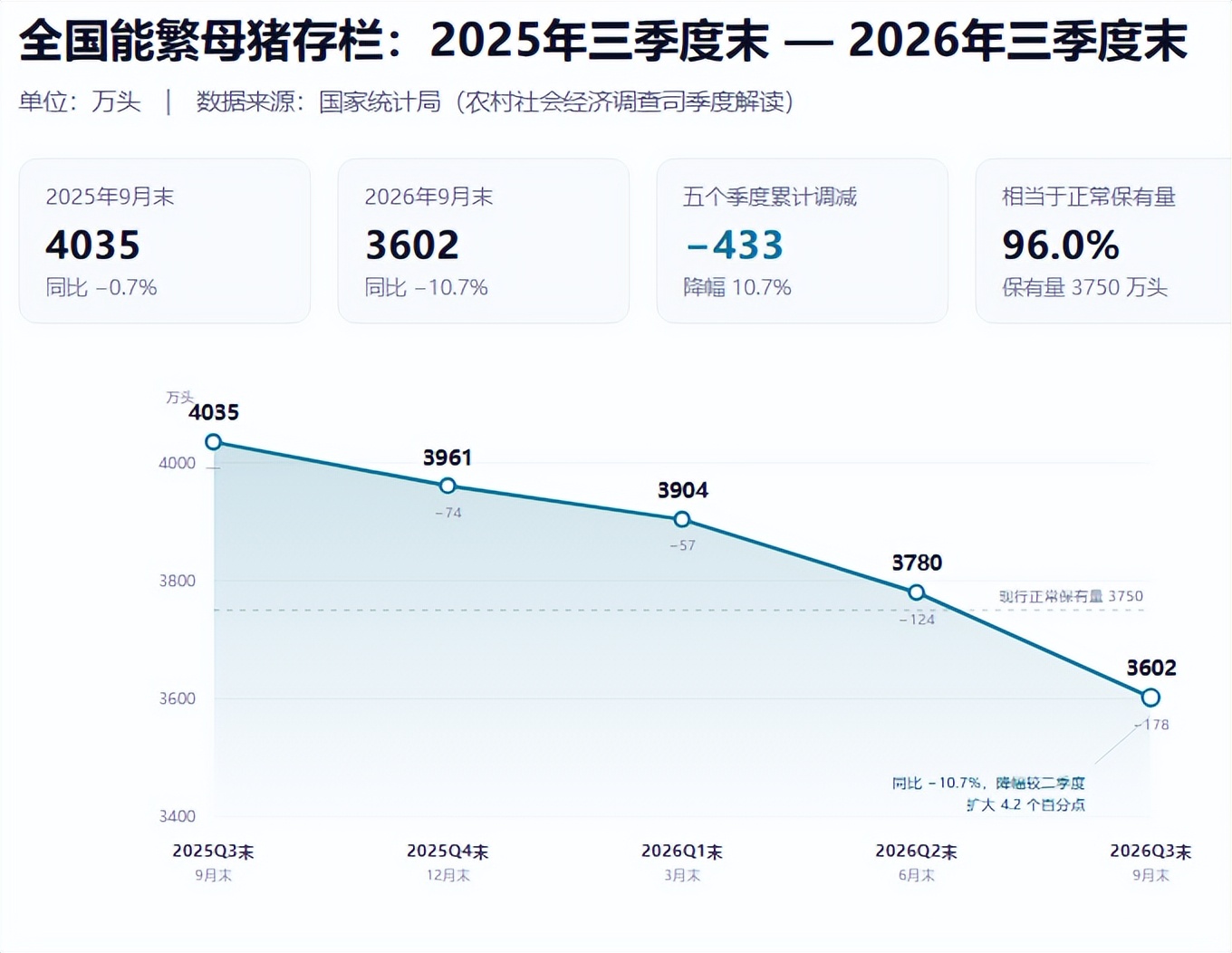
First look at the supply side. At the end of the third quarter of 2026, the national inventory of breeding sows was 36.02 million head, a year-on-year decrease of 4.33 million head, with a decline of 10.7%, equivalent to 96.0% of the normal reserve of 37.5 million head. This is the first time since the establishment of the production capacity regulation mechanism that this figure has substantially fallen below the "red line". According to traditional experience, the 10.7% de-capacity rate is enough to push up prices, but this time it did not happen.
The reason lies in the offset effect of efficiency on the number of heads. According to the survey of Soyoung Info, the current average PSY (piglets weaned per sow per year) of the industry has risen from 18-20 head in the past to about 28, and some high-efficiency farms have reached 30. Each sow "gives birth to more piglets and the piglets have higher survival rate", so the reduction effect caused by the decline in the number of sows is largely offset by the increase in per unit yield. At the same time, the average slaughter weight remains high: in October, the average trading weight of live pigs of sample enterprises was about 125 kg, still higher than the same period of the previous year. The large pigs that were previously delayed for slaughter and the secondary fattening pig sources are continuously released, and the actual meat supply under the same number of heads has increased instead of decreasing.
Then look at the demand side. About 45% of pork consumption relies on the catering channel, and 55% comes from household purchases. The two channels weakened simultaneously in 2026.
On the household side, national statistical data shows that the per capita pork consumption of residents' households has dropped from 30.5 kg in 2023 to 26.6 kg in 2025, with a cumulative decline of 12.8%, and pork consumption has entered a medium and long-term downward channel after peaking. The substitution effect of poultry meat and beef continues to appear: in 2025, the per capita poultry meat consumption of residents' households reached 13.2 kg, and its share continued to rise. On the enterprise side, the growth rate of catering revenue is close to zero, group meal procurement is conservative, the operating rate of slaughtering enterprises once was only about 32% (monitoring data from Soyoung Info and Mysteel), the frozen product inventory rate is higher year on year, and the negative feedback between fresh sales and frozen products further suppresses pig prices.
Pork consumption has broken away from the periodic fluctuation of "people will eat more when the price falls". What restricts consumption is not the price, but slow variables such as population structure, dietary substitution and income expectation. When the supply side offsets de-capacity with efficiency and the demand side is trending downward, the price has found a not-short "new equilibrium" below the cost line.
Why is this trough exceptionally long?
This downward cycle started in December 2022, and has exceeded 45 months by October 2026, more than twice the traditional "downward period of about two years". The de-capacity has been called for more than a year, but the effect has not been transmitted to the price. The reason is that the subjects and logic of market clearing have changed.
In 2024, the large-scale breeding rate of live pigs has exceeded 70%, and group enterprises have replaced individual farmers as the absolute main body of supply. In the era of individual pig farming, market clearing mainly depends on the profit statement: after losing money for several months, farmers will cull sows, clear the farms and leave the market, so the supply shrinks rapidly. In the era of group pig farming, market clearing depends on the balance sheet: pig breeding farms and fattening farms are heavy assets. Closing the farm means asset impairment, and banks will re-examine the credit line, while the management's assessment is anchored to the slaughter volume and market share. The rapid market clearing of individual farmers who "cull sows after losing money for several months" has been replaced by the slow market clearing of group enterprises who "do not reduce production as long as the cash flow does not break", so the de-capacity process is naturally prolonged.
The cash flow reserves of group enterprises have also postponed the market bottom. On the one hand, pig breeding enterprises have accumulated a certain cash buffer from early profits; on the other hand, the downward trend of corn and soybean meal prices has continued to reduce the full cost of leading enterprises. At the same pig price of 9 yuan, the loss is smaller than that in previous rounds. The pig-grain ratio is currently in the first-level early warning range of excessive decline of 4.4-4.7:1. In the past, this range meant "reserve purchase is coming and price rebound is coming", but now it is more like a normal position that can be maintained for a long time.
At the same time, listed pig breeding enterprises can supplement cash flow through equity and bond financing instruments, and banks and local governments have not systematically withdrawn loans under the logic of "risk prevention". Taking Muyuan Foods as an example, its monetary funds at the end of September were 22.888 billion yuan, and the asset-liability ratio was 55.89%, which is still in a controllable range.
The deeper problem is the prisoner's dilemma. Wens Foodstuff Group once analyzed that some market entities have fluke psychology, hoping that other entities will clear the market first and they can increase production against the trend. When every enterprise believes that pig prices will eventually rise, reducing production now means giving up market share and cash flow to competitors.
As a result, every enterprise "rationally" does not reduce production, and the whole industry is stuck in an equilibrium where no one is willing to take the first move. Many enterprises are still storing frozen meat at low positions, delaying slaughter to increase weight, and carrying out secondary fattening, turning "losing money now" into "betting on the future". These behaviors do not eliminate supply, but only move the supply from today to tomorrow. The frozen meat in the cold storage and the large pigs in the pens will become new selling pressure every time the price rebounds.
No longer passively "wait until pig prices rise back"
Wens Foodstuff Group judges that pig prices are expected to usher in a consolidation inflection point around the Spring Festival, which is a relatively optimistic estimate in the industry. But Wens Foodstuff Group also said another sentence: if there is still widespread no profit next year, large-scale production capacity clearing will occur, and pig prices may enter a stage of rapid rise. The key is that "large-scale production capacity clearing" is the prerequisite for pig price rise, and pig breeding enterprises must first be able to "survive until that day".
In this case, leading enterprises have been making various preparations.
First, exchange cash flow for time. Muyuan Foods' monetary funds at the end of September were 22.888 billion yuan, significantly higher than that at the beginning of the year. Although its operating cash flow dropped sharply year on year, it remained positive; Wens Foodstuff Group relies on the profit of its chicken breeding sector to hedge the loss of pig breeding, and the sum of its monetary funds and loans lent out in the first half of the year was 6.529 billion yuan. Leading enterprises are using the endurance of their balance sheets to survive until the day when the supply is truly cleared.
Second, extend business from pig breeding to slaughtering to expand profit sources. In the first three quarters, Muyuan Foods slaughtered 25.83 million pigs, up 34.8% year on year; in the first half of the year, it slaughtered 17.234 million pigs, with a capacity utilization rate of over 100%, and it made profits every month. The profit volume of the slaughtering sector is not enough to fill the huge loss of the breeding end, but its strategic significance is: to anchor part of the income on meat processing and channel value, instead of being completely exposed to the unilateral fluctuation of live pig spot prices.
Third, take the initiative to reduce production. Muyuan Foods has adjusted its inventory of breeding sows from the peak of 3.62 million head to 2.97 million head at the end of September, with a reduction of about 650,000 head; it has suspended the construction of 124 pig farms under construction, involving a planned production capacity of about 12 million head. The slaughter volume of Wens Foodstuff Group in the first three quarters decreased by 4.18% year on year, and the single-month slaughter volume in September decreased by 10.13% year on year, making it the only enterprise among the top three leading enterprises that has substantially reduced slaughter volume.
From the perspective of financial data, active production reduction will directly reduce the slaughter volume and increase the unit fixed cost in the current period, and the short-term report will only look worse. But the signal it conveys is clear: when leading enterprises start to reduce their own supply in exchange for the industry's supply contraction, the countdown to the bottom of the pig cycle really begins.
For leading pig breeding enterprises, the meaning of getting through this trough has changed. It is no longer the passive waiting of "waiting until pig prices rise back", but orderly contraction, reserve and structural adjustment. The losses exposed in the third-quarter reports of leading enterprises such as Muyuan Foods and Wens Foodstuff Group, as well as the active production reduction accompanied by losses, may be an indispensable part of this long round of market clearing.