Amazon's Q3 financial report: AI makes the money and AI spends it, and the company "consumed" the equivalent of three Baidus in just one quarter.
On October 29, Amazon released its Q3 financial report, posting total revenue of around 201.9 billion US dollars, up 12% year on year, and operating profit of about 28.1 billion US dollars, marking a 61% increase; the growth rate of its AWS cloud business even surged to 39.3%.
However, over the 12 months ending at the end of September, Amazon recorded a net free cash flow outflow of roughly 42.4 billion US dollars. This means the cash generated from the company's operations can no longer cover its current equipment and infrastructure expenditures.
The faster the cloud business grows, the heftier the infrastructure bill gets
AWS remains Amazon's most powerful growth engine. Its Q3 revenue reached around 46 billion US dollars, up 39.3% year on year, the fastest growth rate in nearly five years, and it has accelerated for six consecutive quarters. AWS contributes roughly 23% of the group's total revenue, but accounts for around 63% of its operating profit.
Andy Jassy, CEO of Amazon, stated on the earnings call that AWS's backlog of signed orders not yet recognized as revenue has hit 578 billion US dollars; he also projected that AWS's revenue growth rate will exceed 40% in both 2027 and 2028 — of course, these are only forward-looking judgments from the management based on existing orders, not already secured performance.
But computing power does not materialize out of thin air in financial reports. In Q3, Amazon's capital expenditure was around 77.3 billion US dollars, nearly 2.2 times that of the same period last year. Roughly calculated against Amazon's market cap at close on October 29, 77.3 billion US dollars is approximately equal to three times the market value of Baidu. The company's planned full-year cash capital expenditure for 2026 is around 220 billion US dollars — Jassy noted that the 2027 investment will see a "significant increase".
In addition, the total capital Amazon plans to invest this year has exceeded AWS's current annualized revenue of roughly 184 billion US dollars.
Profits are still being generated, yet a gap has emerged in free cash flow
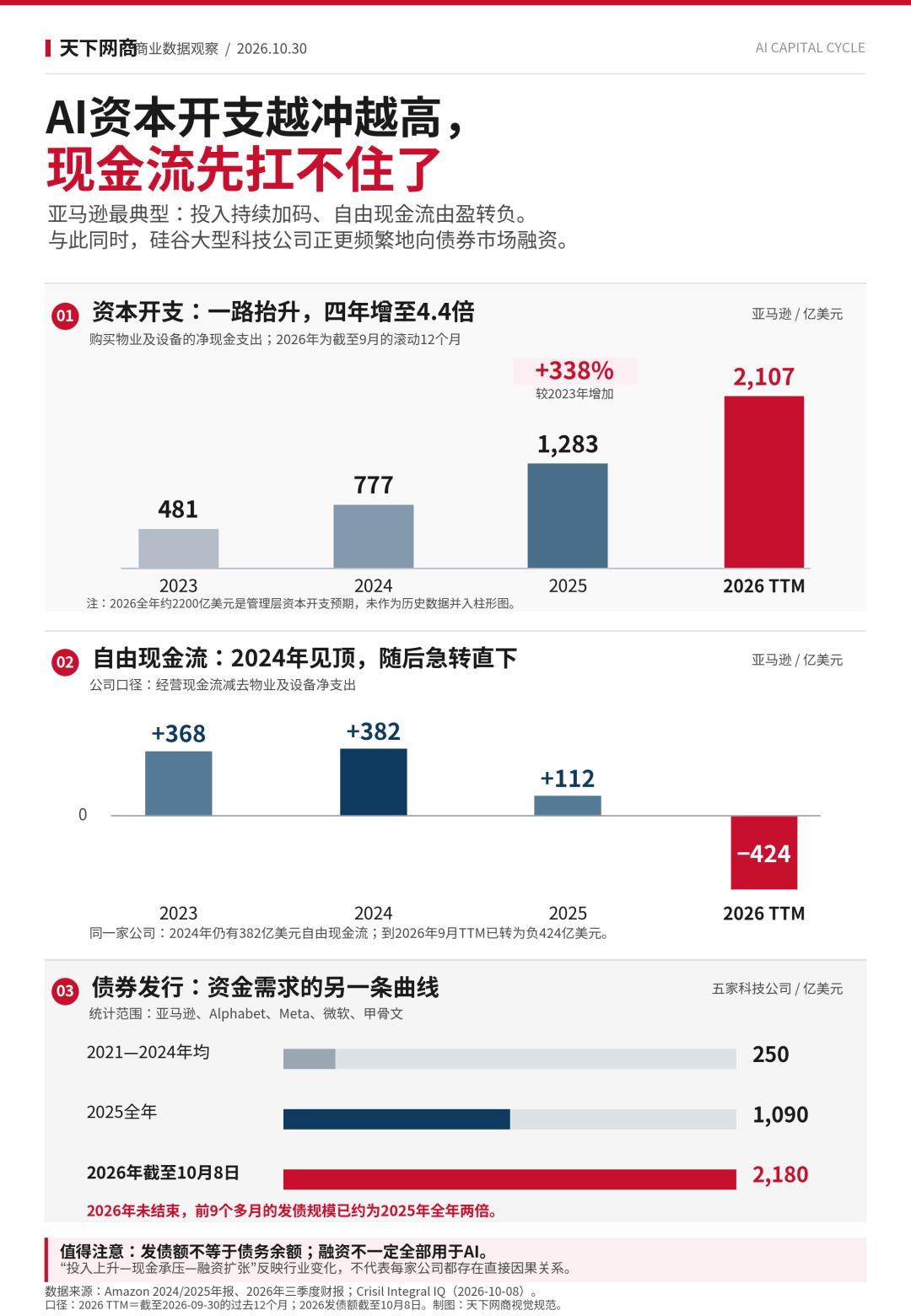
If we only look at operating cash flow, Amazon still maintains strong performance: it generated roughly 168.3 billion US dollars in revenue over the past 12 months, up 29% year on year. The problem is that net cash expenditure for property and equipment purchases reached around 210.7 billion US dollars in the same period. Calculated in the way Amazon discloses, subtracting the two figures results in a net free cash flow outflow of roughly 42.4 billion US dollars — while there was still a net inflow of around 14.8 billion US dollars in the same period a year earlier.
Looking back at the trajectory over the past few years, the change is even more striking. Amazon's net capital expenditure was around 48.1 billion US dollars in 2023, roughly 77.7 billion US dollars in 2024, and hit 128.3 billion US dollars in 2025; the rolling 12-month figure ending at the end of September 2026 has reached around 210.7 billion US dollars, about 4.4 times that of 2023.
Free cash flow, meanwhile, has dropped from a high of 36.8 billion US dollars net inflow in 2023 and 38.2 billion US dollars in 2024, to 11.2 billion US dollars in 2025 — and further to a negative 42.4 billion US dollars over the latest rolling 12-month period.
It did not decline year by year starting from 2023, but took a sharp downturn after 2024.
In the past, profit generation and expansion could often go hand in hand. Now, cash is still flowing in steadily, but the bills for data centers and servers are due first. Server depreciation can be counted into costs over multiple years, but construction expenditures have to be paid immediately.
From self-funding to tapping into the bond market
Amazon is not the only company facing this cash flow timing mismatch. Alphabet (Google's parent company) recorded roughly 51.4 billion US dollars in capital expenditure in Q3, with a net free cash flow outflow of around 9.1 billion US dollars. Meta also posted a net free cash flow outflow of roughly 2.1 billion US dollars in Q3.
Financing activities send out another signal. According to statistics from Crisil Integral IQ covering Amazon, Alphabet, Meta, Microsoft and Oracle, the five companies issued an average of around 25 billion US dollars in bonds per year from 2021 to 2024; the figure rose to roughly 109 billion US dollars in 2025; as of October 8, 2026, the cumulative issuance volume this year has reached around 218 billion US dollars. Before the year even ends, the issuance scale has already doubled that of last year.
The change at Amazon is particularly concrete: the US dollar, euro, Swiss franc and Canadian dollar bonds issued in the first half of 2026 totaled around 66.9 billion US dollars when converted to US dollars as of the disclosure date. Later, the company disclosed that it had issued an additional 25 billion US dollars in US dollar bonds after the end of June — the company that once could mainly rely on its own cash flow for expansion now chooses to open its financing toolbox much more frequently.
The advantage of long-term bonds is that they can spread expenditures across multiple years, but the cost is the interest and repayment obligations that will last for decades in the future.
Equity financing has also started to make an appearance. Meta priced its offering of roughly 25 billion US dollars in common stock and 12.5 billion US dollars in mandatory convertible preferred stock on October 27, for a total of around 37.5 billion US dollars. However, the common stock is subject to a forward sale arrangement, and Meta expects to receive the corresponding funds only when the settlement takes place in the future. Meta still held roughly 82 billion US dollars in cash, cash equivalents and marketable securities at that time. It is not that the company has run out of cash, but that it is actively expanding its financing channels to reserve space for heavier AI investments.
Taking on debt does not equal a financial crisis, and a surge in financing does not mean that big tech firms will be unable to pay their debts immediately. But when bonds, preferred stocks, long-term leases and cooperative construction are increasingly used to support computing power investment, risks will extend from today's capital expenditure to future interest payments, maturing refinancing and cash recovery speed.
After the financial report was released, AWS posted its fastest growth rate in nearly five years, but this did not bring a reward in share price — Amazon closed down 4.25% that day. The market sees two facts that hold true at the same time: the cloud business is indeed growing faster, but the company has to keep spending far more money in the next few years.
The retail business leaves a small buffer for the company. Amazon stated that in terms of advertising revenue, the figure grew by around 12% in Q3 after excluding exchange rate impacts, and the company expects the growth rate in Q4 to return to a relatively high range of over 10 percentage points. These businesses can still generate huge cash flow, but they are increasingly unable to keep up with the appetite of AI capital expenditure — as for the long-term financing risk, the real answer does not lie at the moment when bonds are issued, but after the data centers are put into use, whether customers can keep paying continuously.
For Silicon Valley, this may not be a story of "cannot afford to borrow", but a story of "increasingly needing to borrow money from the future in advance". Amazon has already proven that there is sufficient demand for AI; what has not been proven yet is how fast this demand can turn the concrete poured and chips installed today back into free cash flow, and whether all of this is ultimately cost-effective.
This article is from WeChat Official Account "Tianxia Wangshang" (ID: txws_txws), written by Tianxia Wangshang, and published with authorization from 36Kr.