Even credit cards cannot escape being tied to insurance sales promotion.
Recently, the credit card industry has once again become the key target of financial regulatory penalties.
Since October 23, a number of joint-stock banks' credit card centers, including China Merchants Bank, SPD Bank, and Industrial Bank, have successively received fines of varying amounts.
In the past few years, under the dual pressure of industry cycle adjustment and tightening supervision, it is not uncommon for credit card centers to receive fines of millions or even tens of millions of yuan due to core risk control problems such as credit granting, collection, and capital flow.
But this time, it is precisely some penalties for basic process problems with small amounts that are more worthy of in-depth analysis.
In the same batch of penalties, both credit card centers were fined for compliance defects in the insurance agency sales business, with problems directly pointing to basic process issues such as failure to open an independent account for receiving insurance commissions and incomplete content of customer notification letters. Before that, complaints about insurance policies from credit card centers on social media have also been increasing day by day.
It should be noted that insurance agency sales is not a new thing in the credit card industry — almost 20 years ago, credit cards and insurance had already begun to cooperate. These leading credit card institutions have been deeply engaged in this field for many years and are even seasoned practitioners, so how could they step into the pit?
The root of the problem still comes from the survival anxiety of the entire industry. After several years of adjustment, the industry is still struggling under the dual pressure of "rising risks" and "shrinking scale". Institutions can no longer rely on "issuing more cards" and "launching more installment plans" to make profits, but need to "sell more services" to fill the gap, which is also the widely concerned path of retail integration and comprehensive operation in recent years.
In this process, the exposure of compliance problems is only the superficial phenomenon, and what is more important is the transformation of business models and operation ideas — The essence of comprehensive operation should be to make it easier for customers in need to obtain appropriate protection, rather than making it easier for institutions to use information asymmetry to complete sales transactions.
Behind these several inconspicuous small fines lies the in-depth transformation that the entire credit card industry is undergoing.
Why do credit card institutions need to sell insurance?
Looking back now, it is almost inevitable that credit cards and insurance come together. Because selling insurance through credit cards used to be a "good business" with low cost and high return.
In the golden age of the credit card industry's rapid expansion, the number of issued cards and customers grew at a high speed, and each card center held a huge number of real-name customers, high-frequency service touchpoints, and mature outbound call and payment systems.
Taking insurance as a product for secondary monetization of existing customers is almost one of the lowest-cost sources of non-interest income — there is no need to acquire new customers, and the sales network can be directly reused to complete conversion through telephone outbound calls, earning high agency commissions.
Another non-negligible industry background is that many early sales teams of credit card centers were poached from insurance companies.
The latter already had a relatively mature sales system and communication logic, with methodologies ranging from offline cold visits to the construction of telemarketing platforms, which was exactly the capability most needed by the credit card industry in the expansion period at that time — reach more users and achieve larger scale in a shorter time.
For insurance companies, the credit card channel provides a scaled, reachable group of precise customers, eliminating the customer acquisition cost of building trust from scratch.
In particular, credit card customer groups generally have stable payment capacity, and transaction scenarios such as travel and consumption are highly compatible with products such as accident insurance, flight delay insurance, and repayment protection insurance, with conversion efficiency far higher than that of unfamiliar channels.
However, the "fast-consumption" telemarketing model has carried "hidden risks" since its birth.
Insurance products, especially long-term and complex health insurance and savings-type products, inherently require sufficient information disclosure, demand assessment and health notification, while the conversion logic of short-time telephone sales naturally tends to exaggerate protection, weaken restrictions and simplify decision-making.
For example, packaged paid insurance as "card rights upgrade", using "a few yuan per month" to weaken the long-term payment obligation, and gloss over exemption clauses and surrender losses.
Public penalty information in 2022 once showed that the credit card centers of Hua Xia Bank, China Guangfa Bank and Industrial Bank were each fined 100,000 yuan for sales misleading behaviors such as exaggerating insurance liabilities in the insurance sales outbound call agency business.
Such penalties are not isolated cases. From the perspective of regulatory penalties and insurance consumption complaints, insurance sales misleading has always been a high-incidence problem, and common controversial points include identity confusion, exaggeration of insurance liabilities, automatic renewal without consent, and tied sales.
For this reason, the "Measures for the Administration of Commercial Banks' Agency Insurance Business" issued in 2019 clarified requirements such as separate accounting, full commission entry and centralized management, and traceable sales, and strictly prohibited off-book accounting and operation to prevent institutions from ignoring costs for business scale.
As the supervision continues to tighten the constraints on sales behaviors, coupled with the pressure of surging complaints, the extensive telephone agency sales model has gradually faded away.
In 2021, the credit card center of Industrial Bank took the lead in announcing the suspension of telephone agency sales of insurance products; in 2023, Bank of China also announced the termination of the insurance agency sales business through the credit card telephone channel; in 2025, the credit card center of China Merchants Bank stopped selling some agency sales products with an insurance period of 1 year.
The short-term commissions exchanged by information asymmetry were eventually returned in the form of complaints, rectification and brand loss.
New routines, old problems
However, the ebb of the telemarketing boom does not mean that insurance sales are no longer important to the credit card business. After all, the transformation examination of the credit card industry is still ongoing.
Data from the operation of the central bank's payment system shows that the number of credit cards and integrated loan cards across the country has dropped from the historical peak of 807 million at the end of the third quarter of 2022 to 677 million in the second quarter of 2026, a cumulative decrease of about 130 million from the peak.
At the same time, multiple factors such as weakening credit demand, rising pressure on non-performing loan generation, and continuous narrowing of net interest margin have combined, and the traditional profit model of credit cards relying on interest and installment handling fees has continued to face pressure.
In the first half of 2026, the interest income of credit cards of listed joint-stock banks was under pressure, and tapping the value of existing customers to supplement diversified income has become a common proposition of the whole industry.
As a typical business that reuses customers and scenarios, insurance will naturally not be easily abandoned — it appears in different business scenarios in different ways and different forms.
In particular, as online becomes the main battlefield for credit cards to reach and serve customers, online self-operated scenarios such as credit card apps, official public accounts, transaction notifications, and bill pages can all become "positions" for sales.
Differentiated product packaging also makes the insurance application process more convenient and scenario embedding more natural, and can also rely on user consumption portraits to make more accurate product recommendations, which seems to be a more efficient operation method.
It is worth noting that although it seems to be "credit card + insurance", under different models, the identity of the cardholder (may be one or more of the policyholder, the insured or the beneficiary) and the responsibilities that the bank needs to assume (promotion, explanation, demand analysis, information transmission, after-sales service) are different.
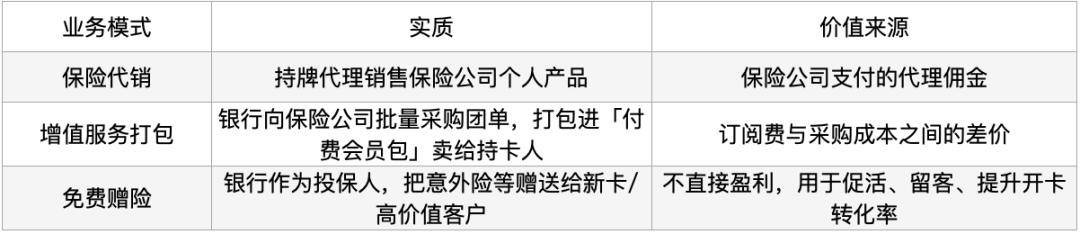
In the process of rapid model iteration, new and old risks are intertwined, exposing many common pain points.
First, the product boundary is blurred. Free insurance gift rights and paid agency sales products are mixed in the rights center, and users are likely to misjudge paid insurance as a card rights upgrade; page designs with default check and automatic renewal are more likely to take advantage of users' attention inertia to form insurance applications that are not of their own free will.
Second, information disclosure is weakened. Just like in the telemarketing era, online pages often fold key information such as exemption clauses, surrender losses, and payment cycles in long texts, and users may not fully understand the rights and responsibilities of the product after one-click insurance application, which has also become a high-incidence area for subsequent complaints.
Third, basic compliance is absent. Insurance agency sales should follow regulatory requirements such as independent accounts, separate accounting, and traceable sales, but the financial accounting and process control of some institutions have not kept up synchronously, and basic problems such as the mixing of commission accounts and self-operated funds, and incomplete notification elements still exist.
In fact, from the "Measures for the Administration of Insurance Sales Behaviors" in 2023 that clearly prohibits forced tied sales and default check, to the "Measures for the Administration of Commercial Banks' Agency Sales Business" in 2025 that requires agency sales business to be strictly separated from other businesses in terms of accounts, funds and accounting, and requires the name of the cooperating institution to be clearly marked on the prominent position of the first page of the publicity materials of agency sales products, and then to the "Measures for the Administration of Product Suitability of Financial Institutions" implemented in February 2026 that further standardizes the classification and grading of insurance products, policyholder demand assessment and suitability matching, relevant business requirements continue to tighten.
The emergence of this round of penalties is essentially because although the business has changed to new scenarios, the operation actions and ideas have not kept up with the new requirements.
Times have changed
From the big perspective of industry transformation, the relationship between credit cards and insurance has long gone beyond the scope of the traffic business of "selling products to earn commissions".
One iconic change is that the organizational form of credit cards is being reconstructed as a whole.
By the end of 2025, among the 17 banks that originally set up independent specialized credit card centers, 7 have completed the withdrawal and merger, 5 have started the adjustment, and the remaining institutions have generally weakened the independent assessment mechanism.
When the vertical credit profit center is gradually integrated into the large retail system, the positioning of credit cards has also changed from a single credit product to the most frequent entry point for banks to reach retail customers.
This round of adjustment is also directly reflected in personnel changes. Public information shows that as of October 2026, 4 leading institutions including Bank of Communications, China Guangfa Bank, China Merchants Bank, and Industrial Bank have completed the replacement of the "top leader" of their credit card centers this year, and the new general managers generally have composite experience in branches, retail or wealth management lines.
The most typical example is Li Mingdong, the new general manager of the credit card center of China Merchants Bank. Before taking office, he served as the general manager of the Wealth Platform Department and the general manager of the Retail Customer Department of China Merchants Bank Head Office. His succession is also interpreted by the market as a signal that China Merchants Bank is connecting the wealth management and credit card scenarios and deepening the large retail collaboration.
Behind the organizational withdrawal, merger and executive reshuffle is the transformation of operation ideas — the role and value of insurance agency sales urgently need to be re-evaluated.
In the past, it was an additional commission supplement for credit card centers, with assessment indicators focusing on conversion rate and first-year premium; now, it is an integral part of the customer's comprehensive financial plan, and the measurement focuses on the improvement of the customer's full life cycle value.
What's more, the needs of credit card customer groups are three-dimensional: daily consumption requires payment and settlement, large expenditure requires credit support, wealth accumulation requires allocation services, and risk hedging requires protection plans.
From payment to credit, from wealth to insurance, everything must be carried out around people's needs.
Accident insurance in travel scenarios, return and exchange protection in consumption scenarios, and basic protection products in wealth allocation, these protection services deeply bound to card scenarios are essentially extensions of customer services.
From this perspective, the extensive model that used to rely on sales script induction and information asymmetry conversion is no longer feasible after all.
After all, the core of comprehensive operation has never been "selling more products to the same customer", but "matching more appropriate services for the same customer".
This article is from the WeChat official account "Xin Finance" (ID: Xinfinance), written by Paozhuan Yinyu De, and published with authorization from 36Kr.